

Select explosion-proof lighting by matching five things: the documented hazardous area, the exact equipment approval, the visual task, the operating environment, and the installation interfaces. Start with the project requirements, not a wattage or a product photograph. A model is a defensible choice only when its exact configuration and supporting documents meet those requirements together.
This guide turns that process into a per-area selection record. It is for engineers and technical buyers comparing candidate luminaires; it does not classify an area, approve an installation or replace the applicable rules and manufacturer instructions.
1. Establish what the project requires before choosing a light
Obtain the approved area-classification drawing and schedule, its revision, and the jurisdiction and acceptance route specified by the project. Identify the particular mounting location—not just the building or plant name—and whether the hazard involves gas/vapour, combustible dust, or another classified material.
The U.S. example illustrates why this comes first: OSHA 29 CFR 1910.307 evaluates locations by individual area and sets requirements for documentation and suitable equipment. A classification elsewhere in the same facility is not evidence for this mounting point.
Record the classification system, required equipment protection level or category where applicable, material group, temperature requirement and any owner restrictions. Do not translate “Zone 1” into a Class/Division purchase specification without a project-approved assessment. The Class I Division 1 versus Division 2 guide explains that framework boundary.
Keep the approval route explicit. The European Commission distinguishes the ATEX product Directive 2014/34/EU from the workplace Directive 1999/92/EC. IECEx is a separate certification scheme. Neither a broadly worded “ATEX/IECEx” brochure nor an approval accepted on a previous project settles the requirements for a new location.
If the classification or local acceptance requirement is missing, hold final selection. A supplier can discuss candidate forms, but should not fill this safety-critical gap by guessing from the process name.
2. Match hazardous-area requirements to the exact configuration
Ask for the full proposed ordering code and the documents covering that configuration. Compare the project requirements with the marking, certificate and schedule, instructions and any stated conditions of use. Check the model suffix, electrical version, optics, entries and emergency option where those choices affect scope.
| Project requirement | Evidence to compare | Reason to keep the candidate on hold |
|---|---|---|
| Required local approval/conformity route | Exact equipment documents accepted by the project | A different scheme is offered without an approved acceptance path |
| Gas or dust atmosphere and material group | Applicable marking and certificate scope | Gas evidence is offered for a dust requirement, or the required group is unresolved |
| Protection level/category or location suitability | Exact document scope under the specified framework | Only a generic “hazardous-area” claim is supplied |
| Temperature requirement and site ambient range | Applicable temperature marking, ambient limits and conditions for the proposed version | The site conditions fall outside documented limits, or the relation is unclear |
| Complete luminaire configuration | Model/variant identification across the offer and document set | Certificate, datasheet and offer refer to different versions |
Under OSHA’s approved-equipment route, suitability includes the relevant ignitable material and temperature restrictions, not merely the location class. “Explosionproof” also names one protection technique in that framework; it is not a universal name for every accepted Ex technique. Specify what the project accepts rather than forcing every candidate into one marketing label.
For an IECEx claim, verify the exact equipment in the scheme’s online certificate system, linked from the IECEx overview. Obtain the complete record and conditions, not just a brochure badge. An equipment certificate is one part of the selection evidence; it does not by itself establish a compliant installed system.
3. Turn the visual task into a lighting specification
After the hazardous-area requirements are established, define what people must see and from where. A walkway surface, a vertical gauge, an inspection point and a large open work area are different lighting tasks—even if their mounting points share the same classification.
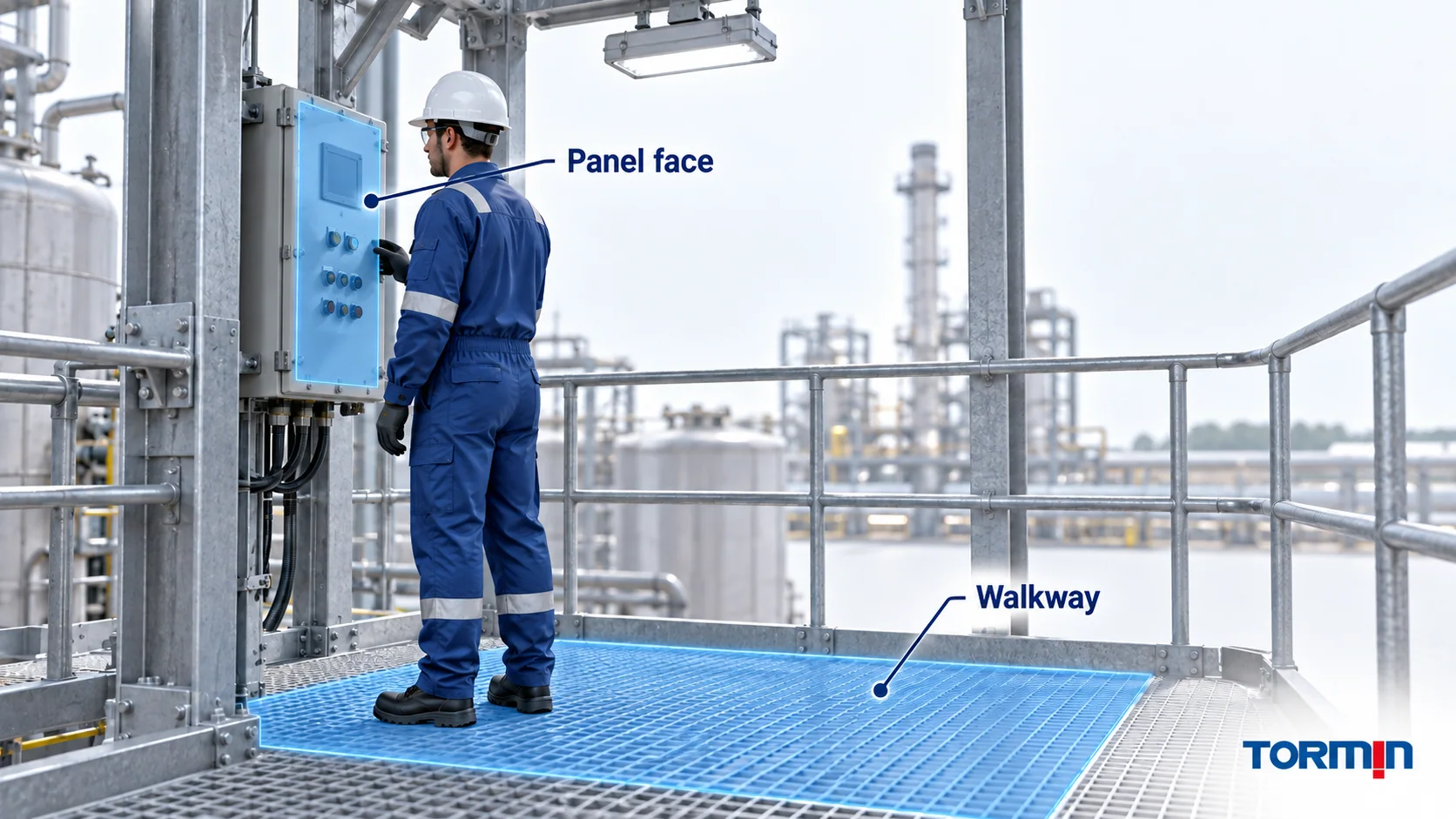
Choose a candidate lighting role before choosing watts. Linear, high/low-bay, floodlight and portable forms provide different starting points for distribution, aiming and access. The form is not proof of suitability: each candidate still needs the exact hazardous-area documents and a distribution appropriate to the task.
For the lighting review, define:
- the task plane, orientation and viewing direction;
- the applicable maintained-lighting criteria and their project authority;
- mounting positions, heights, aiming constraints and obstructions;
- glare, shadows, colour requirements and operating pattern;
- the calculation and acceptance method.
ISO/CIE 8995-1:2025 addresses the quantity and quality of lighting for indoor workplaces. It does not supply one target for every industrial task and does not cover emergency lighting. Use the requirements applicable to the actual location and function; specify emergency operation separately.
Ask for a calculation using the exact proposed optical configuration and photometric file. The IES Computer Committee identifies luminaire photometric data as input to lighting calculation software. The submission should also identify the geometry, task planes, reflectances and maintenance assumptions used. Watts, nominal lumens or a single beam-angle number cannot establish the result at a particular task plane.
For example, an educational selection review might consider a walkway and a nearby vertical control panel. A candidate that satisfies the walkway criterion is not automatically accepted for panel reading. Review both planes, obstructions and operator views; a revised position, different distribution or separate task light may need evaluation. This example sets no lux target or real-project layout.
4. Resolve the interfaces before accepting the configuration
Check the environment at the mounting point: ambient extremes, nearby heat, moisture, dust, cleaning chemicals, salt exposure, vibration, impact and the intended maintenance method. Compare those conditions with exact-model construction and documented limitations.
An IP rating concerns enclosure ingress protection under IEC 60529. It does not establish explosion protection or resistance to a particular chemical or corrosive exposure. Use separate evidence for these requirements; see the IP rating versus explosion-protection guide for the distinction.
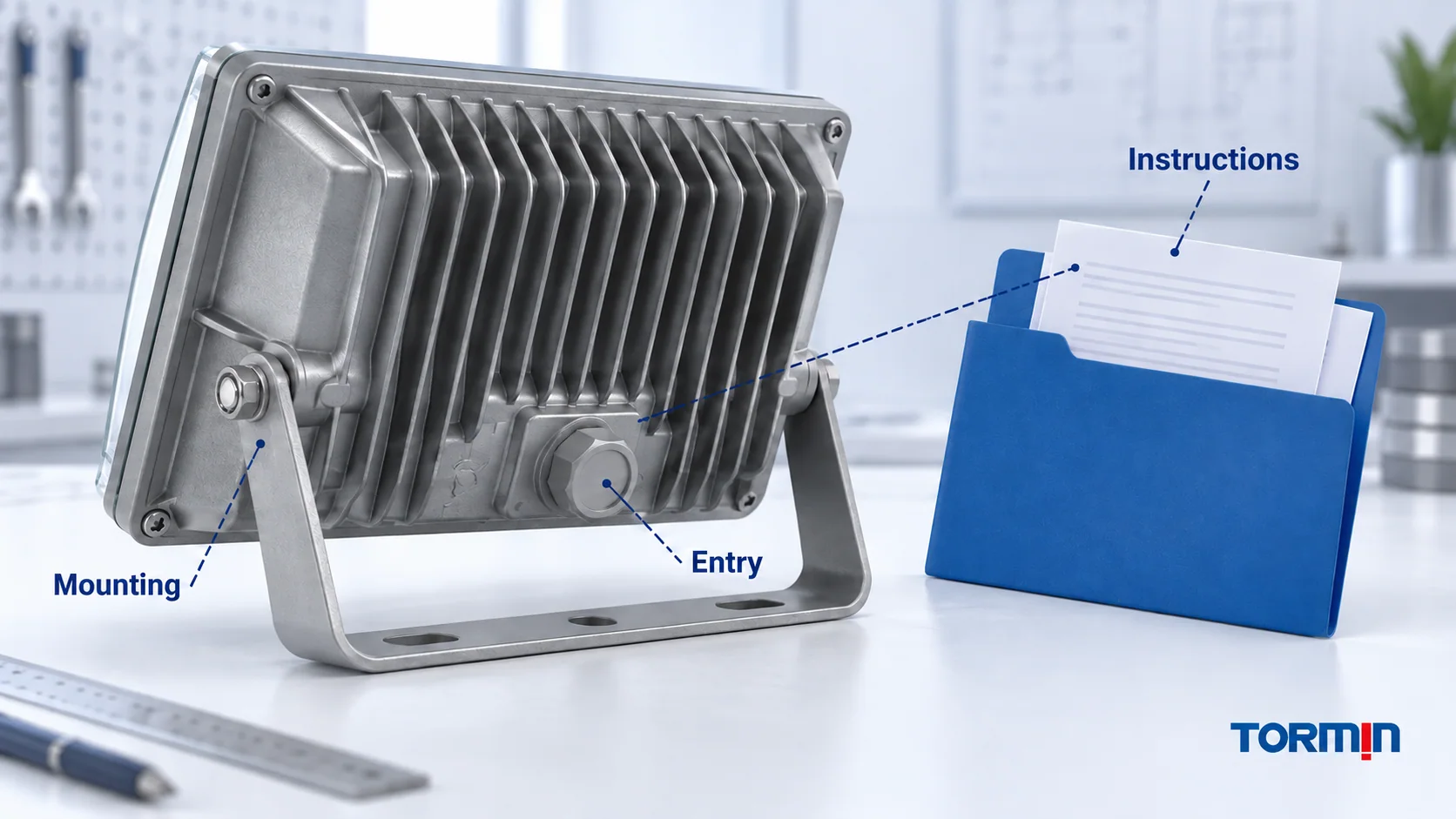
Then resolve the interfaces that can change the orderable version:
- Electrical and controls: confirmed supply, frequency, control interface, circuit arrangement and behaviour on loss/restoration of power.
- Mounting and access: bracket or support arrangement, dimensions and loads, allowable orientation, clearance and safe maintenance access.
- Cable entry and accessories: entry type, thread, cable system and the proposed glands, adapters and stopping plugs, reviewed against the equipment instructions and applicable installation rules.
- Emergency operation, where required: exact operating mode, output requirement, duration, ambient conditions and test arrangement for the emergency version.
Do not assume a dimming, mounting or emergency option in a family brochure applies to every certified version. Require the offered combination to remain traceable through its documents.
These are selection inputs, not connection instructions. IEC 60079-14:2024 covers electrical Ex equipment selection, installation and initial inspection, including documentation and personnel competency. Qualified project personnel must resolve the actual installation under the applicable rules and manufacturer instructions.
5. Create one selection record for each area or mounting group
Use a shared record to prevent a technically acceptable luminaire from being attached to the wrong location, optical version or accessory set. This is a proposal review worksheet, not a compliance certificate.
| Selection-record field | What the project team records |
|---|---|
| Location and controlling documents | Area ID, drawing/classification revision, jurisdiction and project specification |
| Hazardous-area requirement | Atmosphere, classification, required group/protection level/category and temperature requirement, as applicable |
| Lighting requirement | Task planes, criteria, geometry and accepted calculation basis |
| Operating/interface requirement | Environment, supply/controls, mounting, cable entries, maintenance and emergency function |
| Exact proposed configuration | Full ordering code, optics, driver, mounting, entries, accessories and emergency option |
| Supporting evidence | Document identifiers/revisions and the calculation tied to that configuration |
| Deviations and status | Each unresolved item, its responsible reviewer, and hold or release decision |
Do not treat a blank field as acceptance. If a requirement is unknown, state who will resolve it. If the supplier proposes an alternative, record the deviation and its review outcome rather than silently changing the original specification.
Keep the candidate on hold when the classification is missing, the approval route is unresolved, the exact configuration cannot be traced, a condition of use is unaddressed, or the lighting/interface evidence does not demonstrate the specified result. A competitive price does not close any of these gaps.
Release a configuration for ordering only after the authorized project review has accepted its evidence and resolved the deviations. Keep the exact code and document revisions in the purchase/submittal record. Installation and required inspection remain separate project activities after that procurement decision.
TORMIN’s explosion-proof lighting category is a starting point for candidate forms, not a substitute for this review. To request a comparable proposal, send the selection record and drawings through the TORMIN contact page, asking for exact configuration evidence and an explicit deviation list. If the underlying site inputs are still incomplete, use the industrial lighting enquiry checklist to assemble them first.