
Short answer
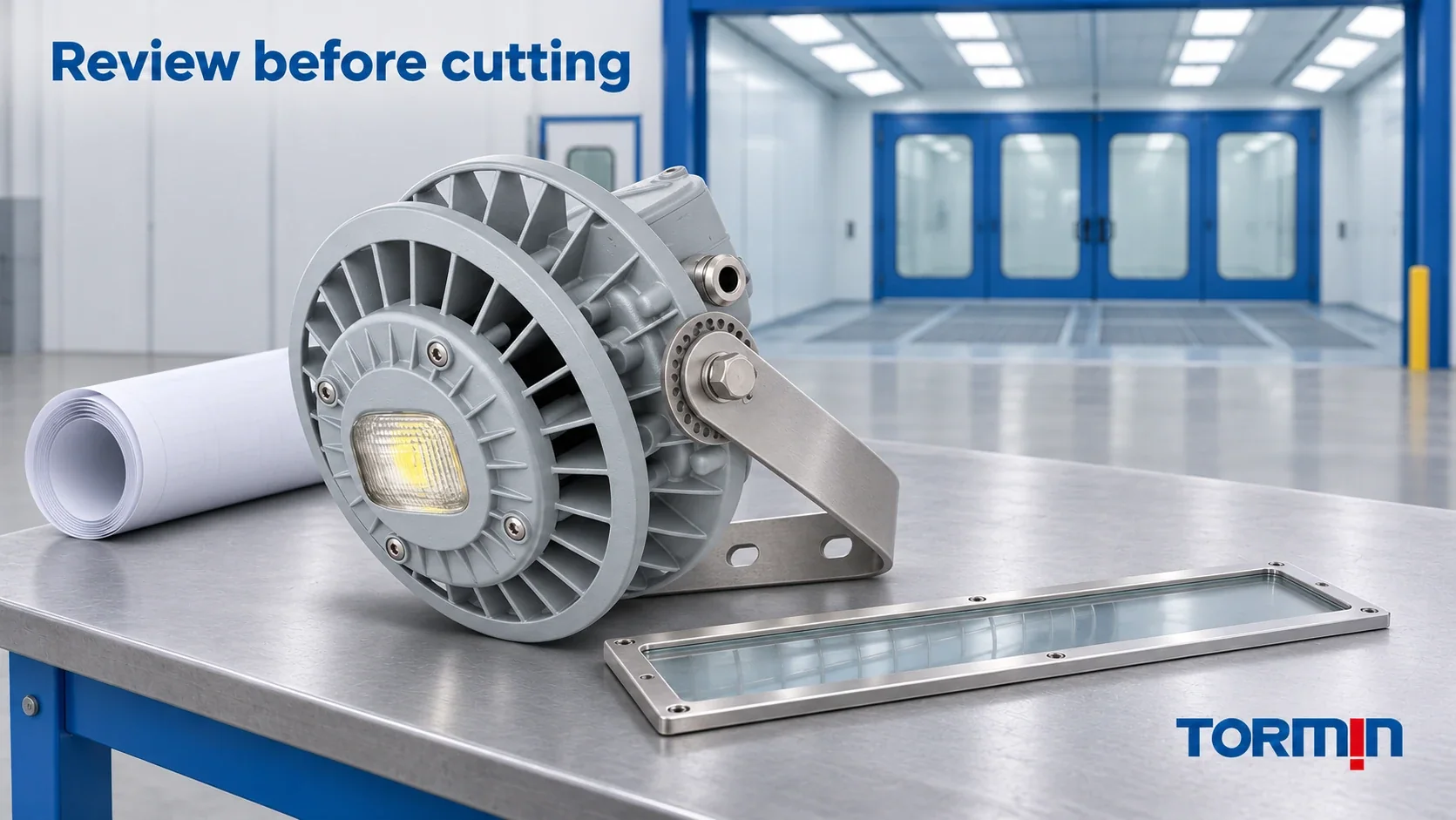
You can add spray booth ceiling lights, provided the proposed change passes three reviews: the light’s location, the mounting and equipment approval, and the consequences for the booth’s existing acceptance. A roof opening, a replacement panel or a new electrical route can affect more than the fixture. Resolve those interfaces before cutting the ceiling or ordering a retrofit kit.
Start by identifying which arrangement you actually propose. A light exposed to the spraying space, a light isolated behind a fixed panel, and a light above an entrance require different evidence. The following table is a retrofit decision aid, not permission to build an assembly from generic parts.
| Proposed arrangement | What must be established | What defeats the proposal |
|---|---|---|
| Light directly exposed on the inside of the ceiling | Equipment identified for the documented location, including applicable combustible-residue exposure; compliant wiring and accepted mounting. | An ordinary fixture or a modification unsupported by the complete equipment’s approval. |
| Fixed light outside the spraying space, shining through a sealed panel | The light’s own location, complete separating assembly, thermal and residue conditions, service access and acceptance of the roof modification. | Removing the barrier, leaving gaps, using an unsuitable panel or assuming the exterior position is automatically unclassified. |
| Light above an opening within the documented surrounding classified area | Equipment and wiring suitable for that location, together with the booth’s accepted modification details. | Treating the position as ordinary workshop space simply because it is outside the booth. |
These distinctions are supported by the illumination and residue provisions in NEC Article 516 and OSHA’s spray-finishing rules. The NEC examples here use the inspected NEC-based adopted text; the project’s adopted edition and applicable workplace rules must be established for the alteration.
Step 0: which layer is the ceiling in?
For the liquid-spray context addressed here, the documented spraying interior is treated as Class I, Division 1; nearby openings can create a surrounding Division 2 extent. The inspected NEC Article 516 examples include 3 ft around relevant booth openings, with construction and door-interlock qualifications; open spraying has its own provisions. OSHA separately includes a 20 ft electrical-equipment provision for surrounding areas without separating partitions, so those texts must not be collapsed into one universal boundary. Use the existing spray-booth specification guide for that background and the classification-input guide when the controlled location record is missing. For this retrofit, identify the new light’s actual position and the separating construction on the accepted drawing; brightness comes afterward.
The three ways to add a ceiling light
A light exposed inside the spraying space
An exposed fitting must have evidence for the location already identified on the project documents. Where paint deposits can readily accumulate, checking only a gas-area label is incomplete: the equipment must also be suitable for the residue conditions. A robust housing, enclosed lens or LED source does not establish that suitability.
For an existing booth, ask how the new fitting attaches without compromising the roof, how its wiring reaches it and how it will be serviced. A luminaire certificate covers a defined construction and use; it does not approve a field-made roof opening or an improvised support. Have the complete arrangement reviewed, including its effect on the booth assembly.
A special distinction matters here. A purpose-evaluated luminaire integrated into the booth ceiling can include its own separating glass and residue suitability. That is not the same construction as an exposed shop light. Identify the approved service arrangement and complete assembly rather than deciding from which side the metal housing appears to sit. Do not imitate a listed integral assembly by combining a generic light with a homemade window.
A fixed light behind a separating panel
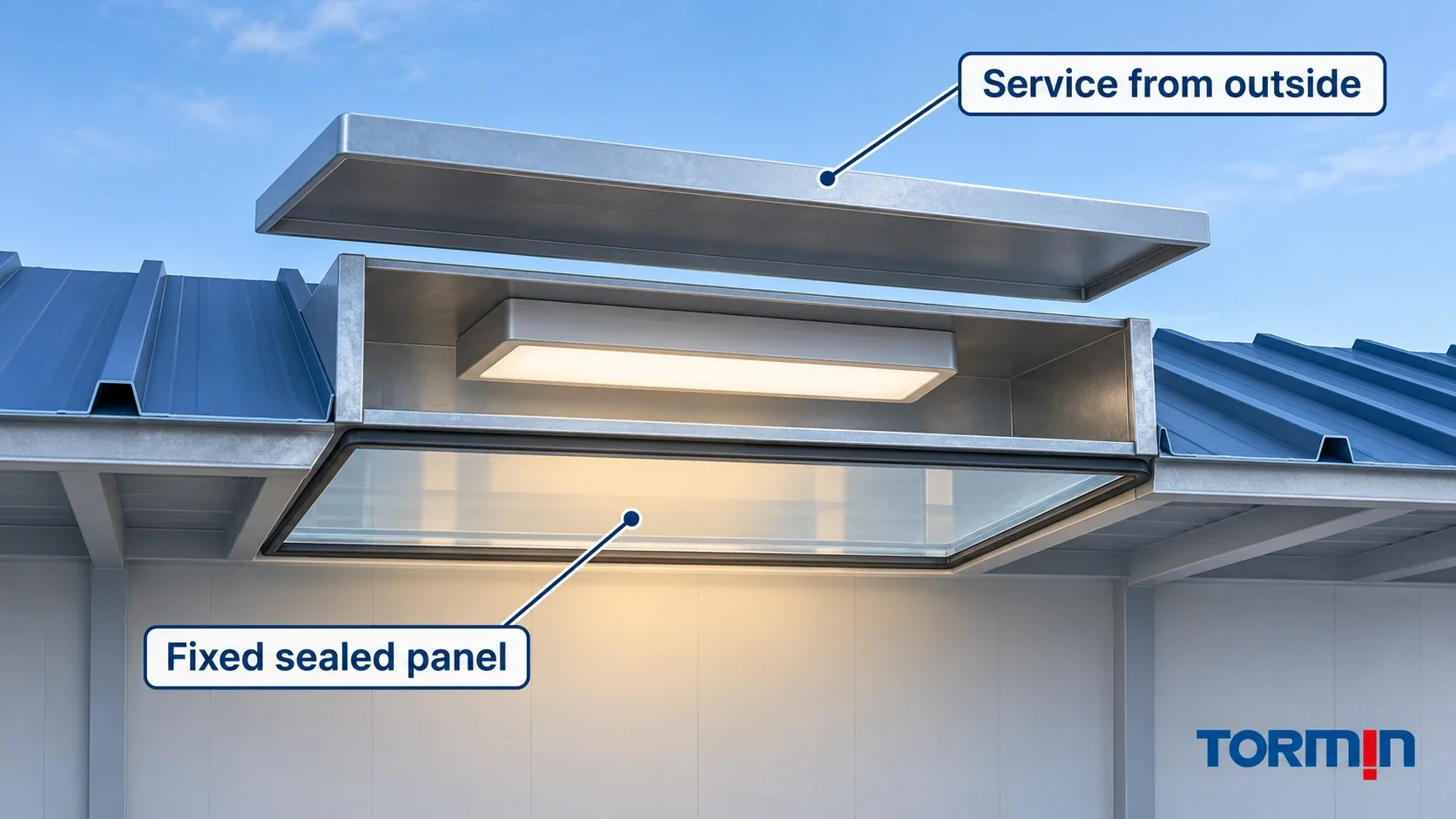
Through-panel lighting places the fixed source on the other side of an isolating transparent assembly. It can keep the luminaire out of the spraying atmosphere, provided the panel, frame, seals and attachment maintain the required separation. Its eligibility also depends on where the source itself is located: outside the spray space does not necessarily mean outside every classified extent.
The inspected Article 516 text distinguishes an exterior-service light outside classified space from a panel-separated light whose own position remains classified. It also distinguishes a listed integral assembly intended for service from inside. Select the documented arrangement first; do not change its service side merely because reaching the light from below would be convenient.
OSHA’s through-panel requirement calls for fixed lighting, effective isolation, appropriate noncombustible panel construction or protection against breakage, and an arrangement that does not dangerously heat normal residue deposits. Clear material is not interchangeable simply because it transmits light. The panel and its mounting need evidence for the proposed use.
Removing the original panel to fit a larger light changes that separation. Likewise, a cable slot left beside the frame is not a harmless finishing detail. If the approved barrier is removed or bypassed, reassess the proposed exposed construction; do not keep relying on the previous panel-separated acceptance. Obtain the accepted detail for the whole opening before work starts.
A light above the booth opening
Use the documented location requirement for the fitting above the entrance. An exterior mounting position does not excuse the retrofit team from checking the light, its electrical route and the applicable equipment conditions. Do not substitute a warehouse fixture merely because it can be bolted to the existing roof edge.
The support arrangement also needs attention. A new bracket can interfere with a door, access cover or maintenance route even when the fixture’s electrical evidence is acceptable. Show those relationships on the alteration drawing and have the responsible parties accept them. The result should be an identifiable installed configuration, not a collection of individually plausible components.
What the modification does to the booth you already own
A booth may have been certified as an assembly, accepted as a site installation, or both. Those are related but distinct records. Find out what was actually evaluated, which configuration the documents describe and whether later changes have already occurred. A label on one component does not prove that the current booth matches the original accepted assembly.
UL’s code-authority guidance on field modifications explains why a factory certification does not settle the acceptability of an altered product. The AHJ assesses the modification and whether further evaluation is needed. This does not mean every added light automatically voids every approval; it means the original evidence cannot silently be extended to new construction.
Before work, resolve three separate questions:
- Original manufacturer: do the booth instructions permit the proposed opening, light assembly, support and service method? Obtain the applicable drawing or change documentation, rather than a general assurance that another customer has done something similar.
- AHJ and applicable fire review: what submission, inspection or evaluation is required for the altered installation? Identify any certification-body involvement needed to establish the modified assembly’s acceptability.
- Insurer: what notification, documentation or conditions apply under the site’s coverage? Insurance acceptance is separate from code approval, and neither should be assumed from silence.
A useful submission shows the existing arrangement beside the proposed one. Identify the added opening, the retained barrier, the fixture configuration, the support and wiring route, and the access required for maintenance. Include the control interfaces that remain unchanged or need review. This lets each reviewer assess a concrete alteration rather than approve an ambiguous intention to “add LEDs.”
Use the nameplate and certificate guide to match the proposed equipment to its own documents. For a North American project, equipment approval must be appropriate to that jurisdiction; an unrelated certificate cannot be used to fill a gap in the booth’s acceptance. The new luminaire evidence and the altered-booth evidence answer different questions.
If the manufacturer is unavailable or original records cannot be found, raise that absence before cutting. The AHJ and an appropriate evaluation body can define what evidence is needed; do not promise that an after-the-fact field evaluation will always be possible. UL’s published spray-booth guidance notes that evaluations of modified assemblies can be difficult because ventilation, filters and other assembly characteristics matter.
Record the agreed scope before shutdown. It should identify who reviews the proposed work, what evidence the installer must retain and what checks are required before the booth returns to service. Photographs of the completed alteration can support the record, but they cannot replace missing construction or approval evidence.
Existing questionable lights should appear in that discussion. Adding acceptable equipment does not automatically exempt the old fittings, and this article cannot determine whether a particular installation has any lawful existing-use status. Ask the enforcement authority how the discovered conditions will be handled within the alteration. Do not describe undocumented equipment as “grandfathered” to avoid review.
Wiring and seals at the boundary
The wiring design follows the actual mounting arrangement and the applicable Article 516 and Article 501 requirements. Have the qualified electrical designer identify the entries, raceway or cable system, transitions and equipment instructions affected by the new light. A hole through a roof sheet is a mechanical penetration; it does not, by itself, describe the electrical sealing duty.
Article 501 has boundary-sealing and equipment-entry provisions with specific conditions and exceptions. Determine which apply to the actual conduit run; do not assume either that every penetration needs an identical seal or that an LED luminaire removes the requirement. Cable systems and integral factory arrangements also need their applicable evaluation. The conduit-seal decision guide covers those distinctions without turning this article into an installation recipe.
Keep the electrical seal and the booth’s panel or penetration seal separate in the review. They address different interfaces. Satisfying one does not prove the other is complete, nor does a visible bead around a frame establish an acceptable electrical transition. Retain the approved details and inspect both after installation.
Layout that survives overspray
Begin the layout with the workpiece and the existing booth construction. Note the surfaces the operator must see, the objects that can cast shadows and the ceiling areas that already serve air supply, filtration or access. A fitting that improves one viewing direction may obstruct an air path or make a filter inaccessible. Resolve that conflict with the booth designer rather than moving ventilation parts to make the lamp fit.
Preserve the spray and ventilation interlocks required for the accepted installation. A lighting alteration must not bypass those controls or change how their failure response works. The fire-code spray-finishing provisions explicitly connect spraying operation to ventilation; confirm the applicable adopted requirements and verify the affected control functions before return to service. This is a functional review, not a direction to modify the control circuit from a sketch.
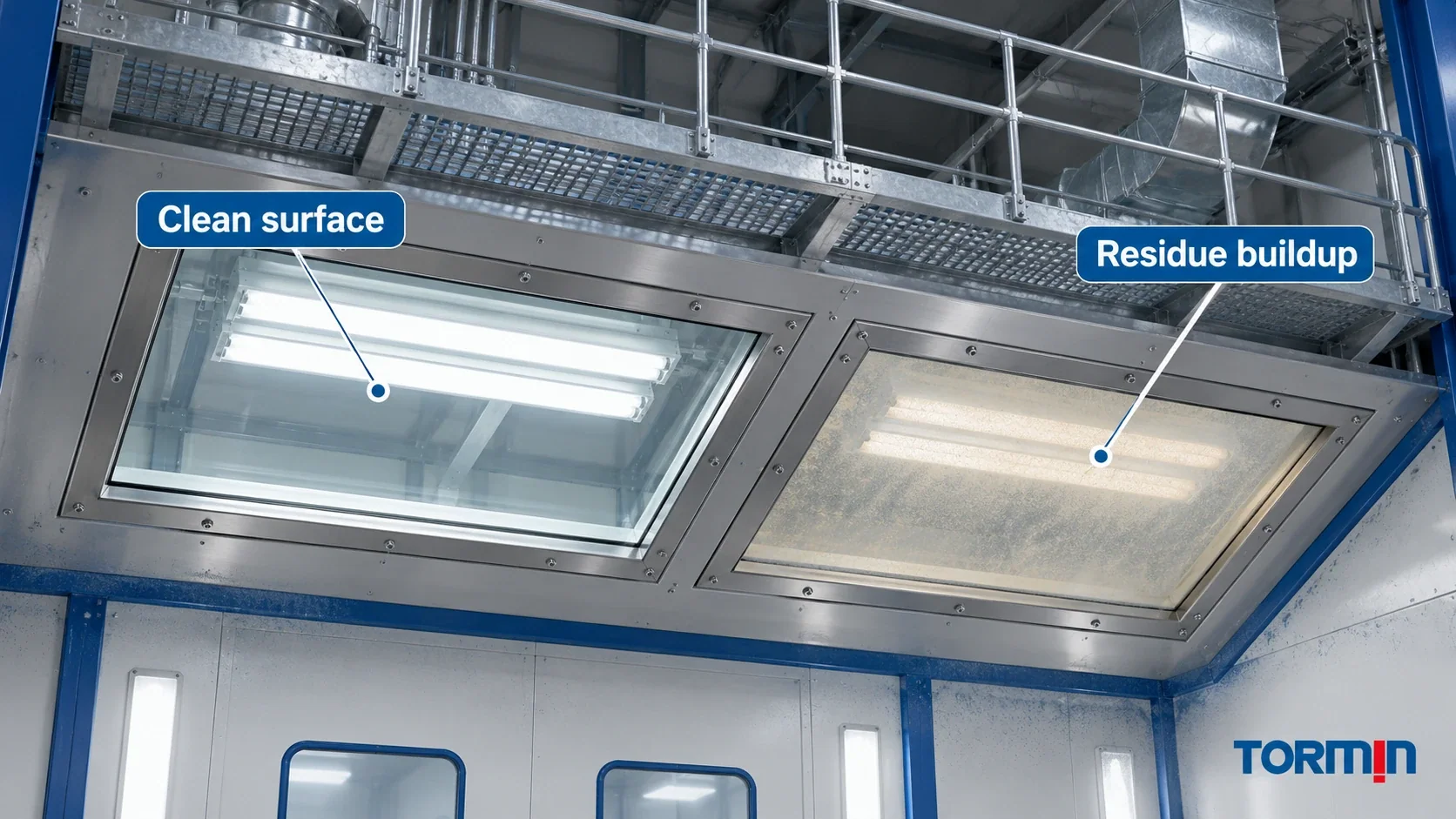
Consider the condition after overspray has deposited, not only the first clean view. A coating on the spray-side panel can obscure light, and residue near a heat source is also a safety concern. Avoid adding pockets and ledges that collect material or require awkward access. Prefer a documented assembly whose exposed surfaces can be maintained under the site’s safe-work arrangements.
Settle who cleans which surface, from which side, using what approved method. The panel’s material and protective surfaces must tolerate that method, and the barrier must be restored correctly after any authorized servicing. Do not scrape, solvent-clean or substitute a protective covering merely because it worked on a different booth. Follow the applicable instructions and maintenance procedure.
OSHA’s cleaning provisions support treating residue removal as an operating requirement. Plan inspection and corrective action around the actual accumulation, not an invented calendar interval. If a panel becomes obscured, investigate cleaning access and the deposition pattern before simply increasing lamp output. If it is damaged or its seal is compromised, the team must resolve the lost barrier condition before relying on the assembly again.
After the work, confirm that the installed arrangement matches the accepted change, the affected controls function, the required access remains available and the maintenance instructions reflect the alteration. Hand those records back to operations. The retrofit is complete when the booth can be used and maintained on an accepted basis, not when the lamps first turn on.
Mistakes
- Bolting ordinary shop or vapor-tight lights directly inside: a familiar housing is not an approval; use the general-purpose equipment guide to understand that evidence gap.
- Keeping an old housing and assuming an LED retrofit preserves its listing. The replacement must be supported for that exact assembly and use; similar dimensions or lower electrical input do not establish continued approval.
- Treating the booth’s original acceptance as permission for any addition. An alteration needs its own documented review, including the booth interfaces it changes.
- Designing only for a clean panel. A layout that cannot be maintained as residue accumulates has left a central operating condition unresolved.
FAQ
Can I just add standard LED shop lights to my spray booth ceiling?
Not as directly exposed fittings without the required location and residue suitability. An accepted fixed, panel-separated arrangement may provide another route, but its barrier, service method and the light’s own position must be evaluated. Do not start from a generic shop-light specification.
What is through-panel lighting in a spray booth?
A fixed source illuminates the spraying space through a separating transparent assembly. The panel, frame and seals must maintain isolation, with suitable thermal, residue and service conditions. Ordinary-location equipment is an option only where the source’s own location and the accepted complete arrangement permit it.
Does adding lights void my booth’s existing approval?
Neither automatic continuation nor automatic cancellation is a reliable answer. Establish the permitted alteration with the original manufacturer, AHJ and any necessary certification review, and address insurer conditions separately. Keep the resulting evidence with the booth’s records.
Do the new fixtures need conduit seals?
Where the applicable boundary or equipment-entry provisions require them, yes, subject to their conditions and exceptions. Have the actual route reviewed under Article 501; the wiring section above links the detailed seal decision guide. A roof opening alone does not settle the answer.
My booth is old and its lights were never rated — does the upgrade have to fix that too?
Bring the existing conditions to the reviewing authority. The retrofit does not create an exemption for undocumented lights, and the required correction scope depends on the applicable rules and acceptance decision. Use the alteration to resolve the evidence and remediation scope rather than declaring the old installation exempt yourself.
Sources
- California Electrical Code, 2022 edition, based on NEC 2020 — Article 516 lighting, separating-panel and residue provisions, with identified NFPA 33 extracts; Article 501 wiring and sealing conditions. This is a scoped adopted-code reference, not a statement of the edition applicable to every project.
- OSHA — Spray finishing using flammable and combustible materials — through-panel lighting, residue exposure, ventilation and maintenance requirements.
- NFPA — NFPA 33, Standard for Spray Application Using Flammable or Combustible Materials — standard identity and scope; detailed NFPA-derived provisions used here were checked in the inspected Article 516 text.
- UL Solutions Code Authorities — Code Authority FAQs — modification of listed equipment and the AHJ’s role in determining acceptance or further evaluation.
- UL Solutions, IAEI Question Corner — Does UL List (Certify) Paint Spray Booths? — assembly instructions and limitations of modified-booth evaluations; historical technical guidance, not a current service-availability guarantee.
- ICC — International Fire Code, Flammable Finishes — spray/ventilation interlock relationship; apply the locally adopted requirements.