
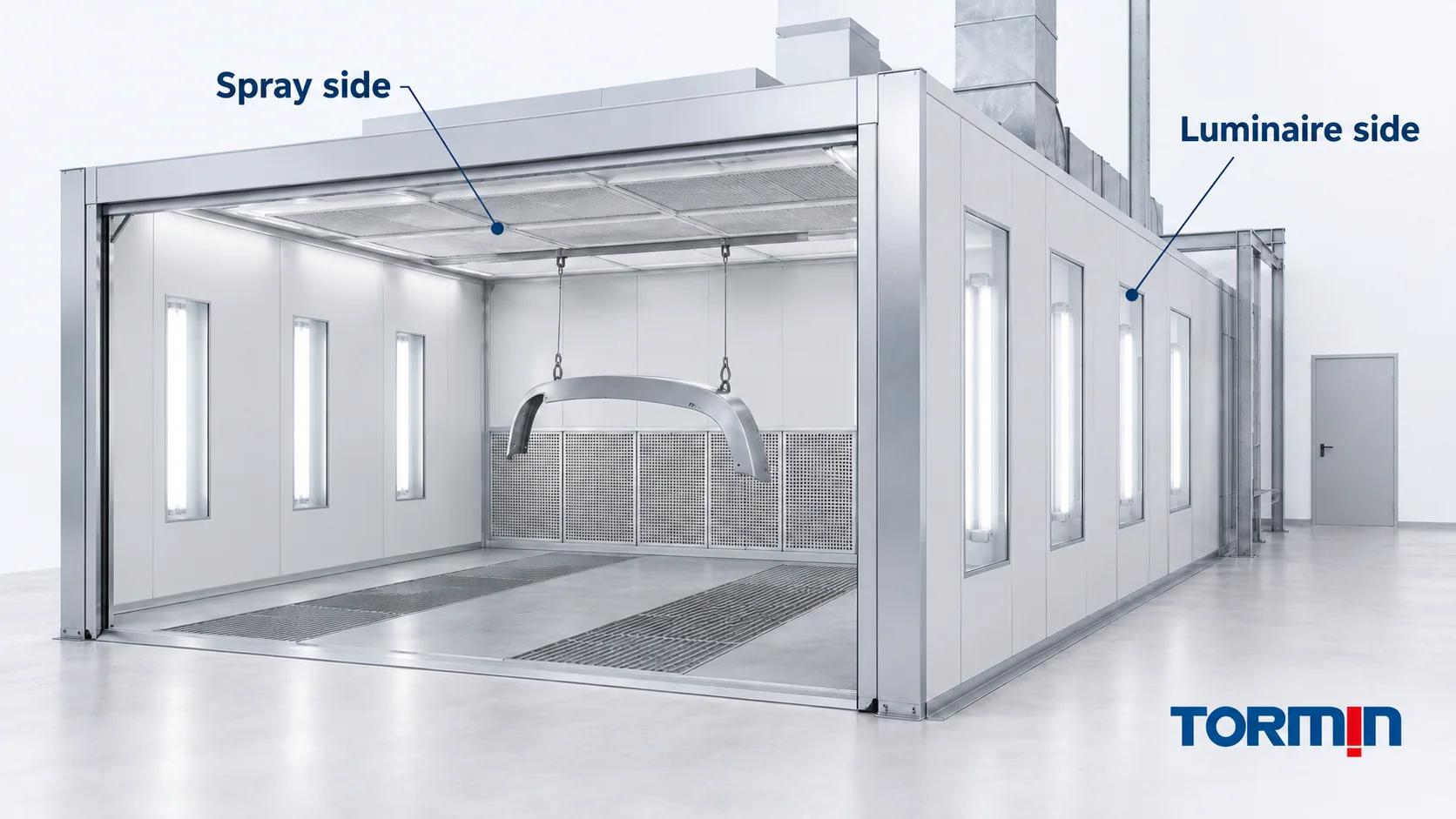
Explosion proof lighting for a paint booth starts with the documented process hazards and the actual location of the luminaire. A light exposed to the spraying area, a fixed light behind an isolating window, and a light near an open booth entrance are different arrangements to evaluate. LED technology, a waterproof housing or the words “paint booth light” do not settle that evaluation.
Specify paint booth lights against that documented arrangement, not a product label alone. Before comparing fixtures, identify the spraying side, the luminaire side, the separating construction and the workpiece surfaces that need illumination. Then ask for evidence tied to the proposed assembly and operating conditions.
This guide helps booth builders, engineers and technical buyers prepare that specification for a new installation or replacement. U.S. OSHA provisions below are scoped examples, not a classification for your booth or a substitute for the applicable project rules and qualified design review. The images show generic spatial relationships, not actual TORMIN installations or approved layouts.
Paint booth lighting requirements: the documents that govern them
For a North American project, distinguish the spray-process fire-safety requirements, the electrical installation code and the employer’s workplace obligations. They overlap, but one document does not replace the others. Establish the adopted editions, jurisdiction and applicable process before attaching a rating to a light.
NFPA 33, Standard for Spray Application Using Flammable or Combustible Materials, addresses covered spray applications. Its process safeguards extend beyond the luminaire. The publicly inspected NEC text identifies relevant provisions extracted from NFPA 33; those references explain the connection between spray-area construction, electrical classification and lighting arrangements. This article does not assume that the latest published edition is the one adopted at your site. NFPA 33 record
NEC Article 516 addresses the relevant electrical installations for spray application and related processes. The examples below use the NEC 2020-based 2022 California Electrical Code, whose Article 516 identifies NFPA 33-2018 and NFPA 34-2018 extracts. Read the project’s adopted text and obtain the responsible classifier’s and AHJ’s determination; do not apply this edition’s figures as a universal site drawing. Article 516 scope, PDF page 514
OSHA 29 CFR 1910.107 supplies workplace spray-finishing requirements, including through-panel lighting, residue exposure and portable lamps. 1910.94(c) also addresses spray-finishing ventilation. A ventilation review is part of the booth assessment; this article supplies no fan sizing, airflow value or permission to change a classification. OSHA ventilation provisions
Classification depends on the booth and the opening
For processes within the inspected Article 516 scope, 516.5(C) treats the interior of spray booths and rooms as Division 1 or the applicable Zone location, except where its specific provisions say otherwise. Gas/vapour and combustible-powder hazards require their respective Class or Zone treatment. The material and process determine that choice; the phrase “paint booth” alone is not a complete classification.
The following are scoped examples from 516.5, not instructions to draw a boundary around an unknown booth. The inside spraying area and the surrounding classified space must be distinguished. Equipment in the direct spray path and equipment at an opening are not interchangeable review cases.
| Arrangement in the inspected NEC edition | Classification point | Condition that must stay with the example |
|---|---|---|
| Interior of a covered spray booth or room | Division 1, or the applicable Zone classification, under 516.5(C) | Use the actual material hazard and retain the specific exceptions in 516.5(D). |
| Closed-top, open-face or open-front booth or room | Outside electrical equipment within 915 mm (3 ft) of an opening falls within the applicable Division 2/Zone scope. | Read 516.5(D)(2) and its figure; the extent starts at the opening edges, not an assumed room centre. |
| Enclosed booth or room | The general opening rule is 915 mm (3 ft), with the applicable surrounding Division 2/Zone classification. | 516.5(D)(4) includes an automated access-door exception where the specified interlock prevents spraying with the door open. It is not a manual-booth exemption. |
| Unenclosed spray process | The surrounding example extends 6100 mm (20 ft) horizontally and 3050 mm (10 ft) vertically. | Apply 516.5(D)(1), its spray-area figure and partition conditions; do not measure a generic sphere from a spray-gun tip. |
Open-top booths have another stated arrangement: 516.5(D)(3) includes the space 915 mm (3 ft) above the booth and around its other openings. That is one reason a single “all booths have a 3 ft boundary” sentence is inadequate. Exhaust paths, recirculation and other features can also change which specific provisions need review. NEC 516.5, PDF pages 515-516
A position outside a closed booth is therefore not automatically unclassified, while a position behind an effective isolating window is not automatically Division 1. Locate the actual light and its service opening on the applicable drawing. State the basis of any claimed exception and who verified it instead of letting the fixture supplier infer the boundary.
Keep OSHA and the installation-code review separate
The NEC opening-distance examples do not displace OSHA’s separate requirements. OSHA 1910.107(c)(6)-(7) separately addresses unpartitioned equipment and lamps within 20 feet of spraying areas. A supplier cannot use an NEC 3 ft example alone to dismiss another applicable obligation. Resolve the governing requirements together for the specific arrangement.
For equipment acceptance, 1910.107(a)(8) defines “approved” in terms of NRTL approval and listing. Request the relevant US evidence where those provisions apply. An ATEX or IECEx document alone does not establish that acceptance; the AEx and US-acceptance guide handles that separate document question. No product category linked here establishes a North American listing for its members.
Map the fixture location before specifying its rating
Map proposed paint booth lights on a drawing of the booth and surrounding space. Mark each proposed light, transparent panel, opening and service-access point. Obtain the applicable area-classification record rather than assigning a rating from a product photograph.
OSHA 1910.307 treats classification as a room-, section- or area-specific question. Equipment acceptance must account for the actual substance hazard, not only a familiar class designation. Temperature and operating conditions also matter.
Use the following table to organize the review. It is a specification worksheet, not a map of approved locations.
| Proposed arrangement | Record on the booth drawing | Question the proposal must resolve |
|---|---|---|
| Luminaire on the spraying side | Exact fixture position, process exposure and service access | What documented location and exposure requirements apply to this exact configuration? |
| Fixed luminaire illuminating through a panel | Spraying side, panel assembly, luminaire side and all relevant openings | What evidence establishes the separation and the requirement at the luminaire’s own location? |
| Luminaire near an entrance or other opening | Opening geometry, partitions and position relative to the spraying area | Does the project classification or applicable spray-finishing provision extend to this position? |
| Replacement in an existing lighting recess | Existing assembly identity, retained parts and proposed changes | Does the replacement preserve the reviewed assembly, or require a new assessment? |
For the broader classification question, use the Class I Division 1 versus Division 2 guide. Apply that documented requirement to the actual booth arrangement.
Use the classification document to select the relevant Article 516 arrangement before reviewing a quotation. If a claimed boundary depends on an opening, partition or automatic interlock, identify that feature on the drawing and confirm that the proposed lighting position respects it. The catalogue does not establish whether the actual door, recess or access space has those conditions.
Where the classification study is missing or does not reflect the present booth, use the Class, Division and Zone determination guide to organize the missing inputs and competent review. Do not assign a less demanding location merely because the light is outside the operator’s working envelope.
For each light, distinguish its normal operating position from the route used to service it. A luminaire that is isolated during normal use can still require a documented service arrangement. Record whether opening a panel exposes the spray side, whether the fixture is an integral part of the booth and which supplier is responsible for the interface. These questions connect the drawing to the three lighting arrangements below without prescribing a booth modification.
Check the spray-finishing provisions that affect lighting
For covered U.S. operations, OSHA 1910.107 distinguishes:
- Through-panel lighting: (b)(10) requires fixed lights, effective isolation, noncombustible panels constructed or protected so breakage is unlikely, and prevention of dangerous residue heating.
- Equipment in spraying areas: residue-exposed luminaires need specific approval for readily ignitable deposits and explosive vapors under (c)(5). For covered equipment without those deposits, (c)(6) specifies approved Class I, Group D explosion-proof equipment and Division 1 provisions.
- Nearby, unpartitioned locations: (c)(6)–(7) address equipment and lamps within 20 feet, including Division 2 requirements and enclosed, mechanically protected lamps.
- Portable lamps: (c)(8) prohibits their use in spraying areas during spraying. Cleaning/repair lamps must be of a type approved for hazardous Class I locations.
- Different processes: powder coating and drying/curing have separate provisions; do not reuse one liquid-spray specification for all operating modes.
The general-purpose lighting acceptance guide addresses ordinary fittings separately; neither an IP rating nor a similar housing establishes acceptance here.
These are not universal booth classification boundaries. A light behind glass is not automatically an ordinary-location light. Evaluate the separation and luminaire location under the project’s complete applicable requirements.
Review the window and fixture as an installed arrangement
When light reaches the workpiece through a panel, compare proposals for the complete arrangement—not just the LED module or enclosure.
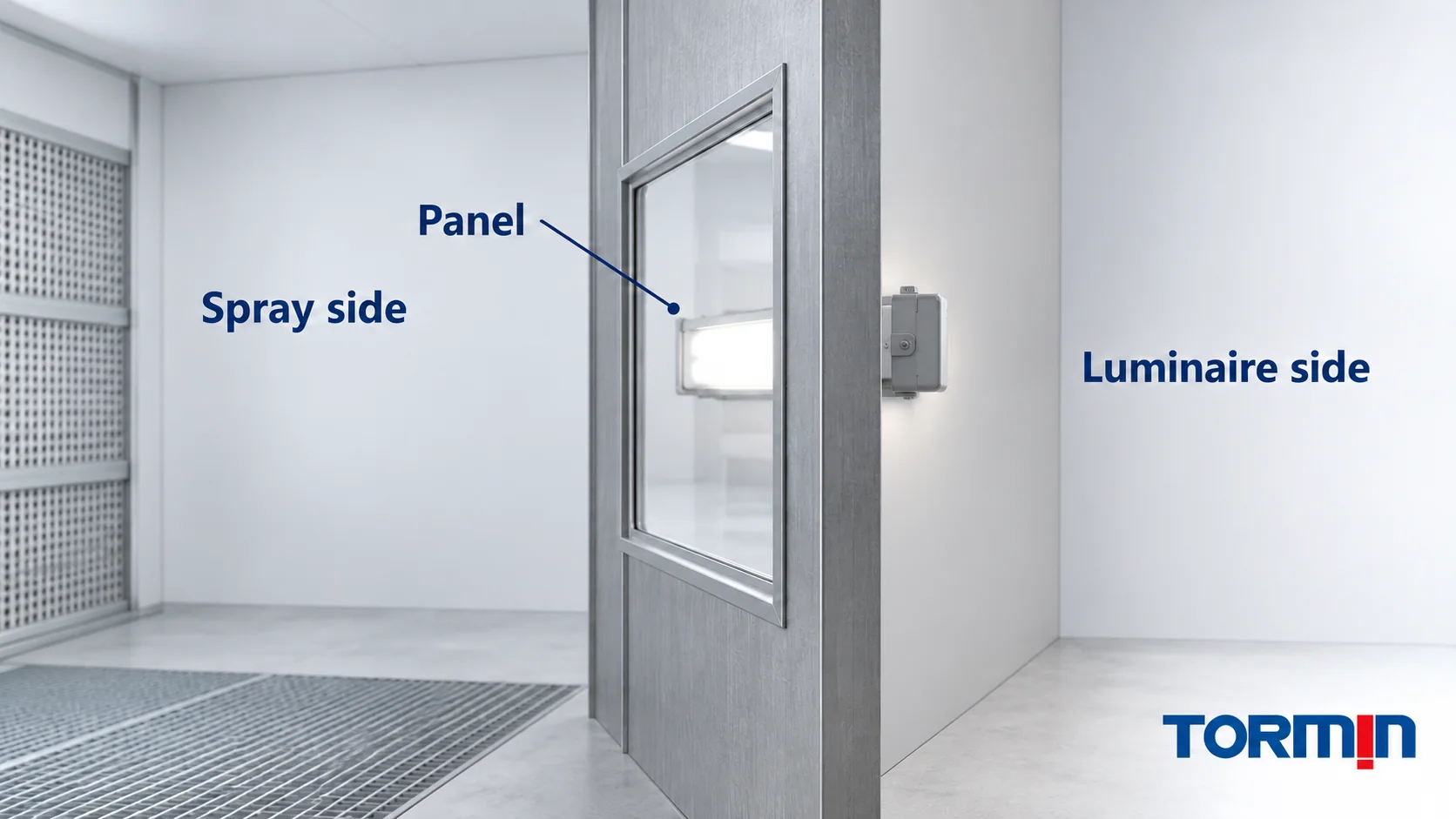
Ask the booth supplier and lighting supplier to identify:
- the panel, frame, seals and documented assembly configuration;
- the allowed luminaire position, orientation and surrounding space;
- which side provides access for maintenance and cleaning;
- the expected coatings, residues and cleaning-agent exposure on each side;
- the applicable instructions and any restrictions on substitutions.
Record unanswered interface questions separately from the fixture’s electrical rating. An enclosure may have documents for a particular hazardous location while the proposed booth recess or window arrangement remains unresolved.
For an exposed fixture, ask specifically what supports the intended spray-process and residue exposure. Do not accept a generic “explosion-proof” description as the complete application evidence.
Three through-panel arrangements need different evidence
NEC 516.6(C) distinguishes the location of the light, its separation from the spray area and its service side. The table follows the inspected edition; it does not authorize a site-built glass box or a substitution into a listed booth.
| Through-panel arrangement | Equipment basis in 516.6(C) | Service relationship |
|---|---|---|
| Outside every classified area, separated from the spray area by glass panels | The luminaire may be suitable for an unclassified location when the specified arrangement applies. | Serviced from outside the spray area. |
| Separated by glass, but the luminaire is within an applicable Division 2/Zone location | The luminaire must be suitable for that actual location. | Serviced from outside the spray area. |
| Integral wall/ceiling fixture with its own separating glass panel | The applicable Division 2/Zone listing and listing for accumulations of combustible residue are required. | The specified integral arrangement may be serviced from inside the spray area. |
These alternatives explain why “behind glass” is not an equipment rating. In the first arrangement, the documented separation and an actually unclassified luminaire position matter together. In the second, glass does not remove the classification where the light sits. In the third, being integral to the wall or ceiling is part of the evaluated arrangement; the residue-related listing cannot be replaced by a generic hazardous-location description. NEC 516.6(C), PDF pages 518-519
The separating panels also have construction, attachment, sealing and heating requirements in that text. Describe the actual assembly rather than asking whether any transparent sheet would work. The exposed panel can collect coating residue, and the service arrangement must remain consistent with the documented design. This is an interface to resolve before accepting an apparently like-for-like light.
For a panel-format enquiry, the panel and cleanroom lighting category identifies available product forms. It does not establish that a cleanroom panel is a spray-booth assembly, has the required residue listing or is approved for a US classified location. Match any candidate to the complete arrangement before treating it as a replacement.
Keep detailed marking and certificate decoding in the nameplate and certificate guide. For this application, the important deliverable is a documented connection between the exact fixture, the exact arrangement and the location requirement.
Specify visibility at the workpiece, not only floor illumination
A paint-booth lighting proposal should describe what the operator must see. Spray application, surface-defect inspection and colour evaluation may involve different workpiece faces and viewing directions. Write those tasks into the brief instead of specifying only total watts or room brightness.
The CIE summary of ISO/CIE 8995-1:2025 explains that workplace lighting quality includes light delivery, glare and colour characteristics, alongside illuminance. Select the applicable task criteria; the publication’s scope is not a single paint-booth target.
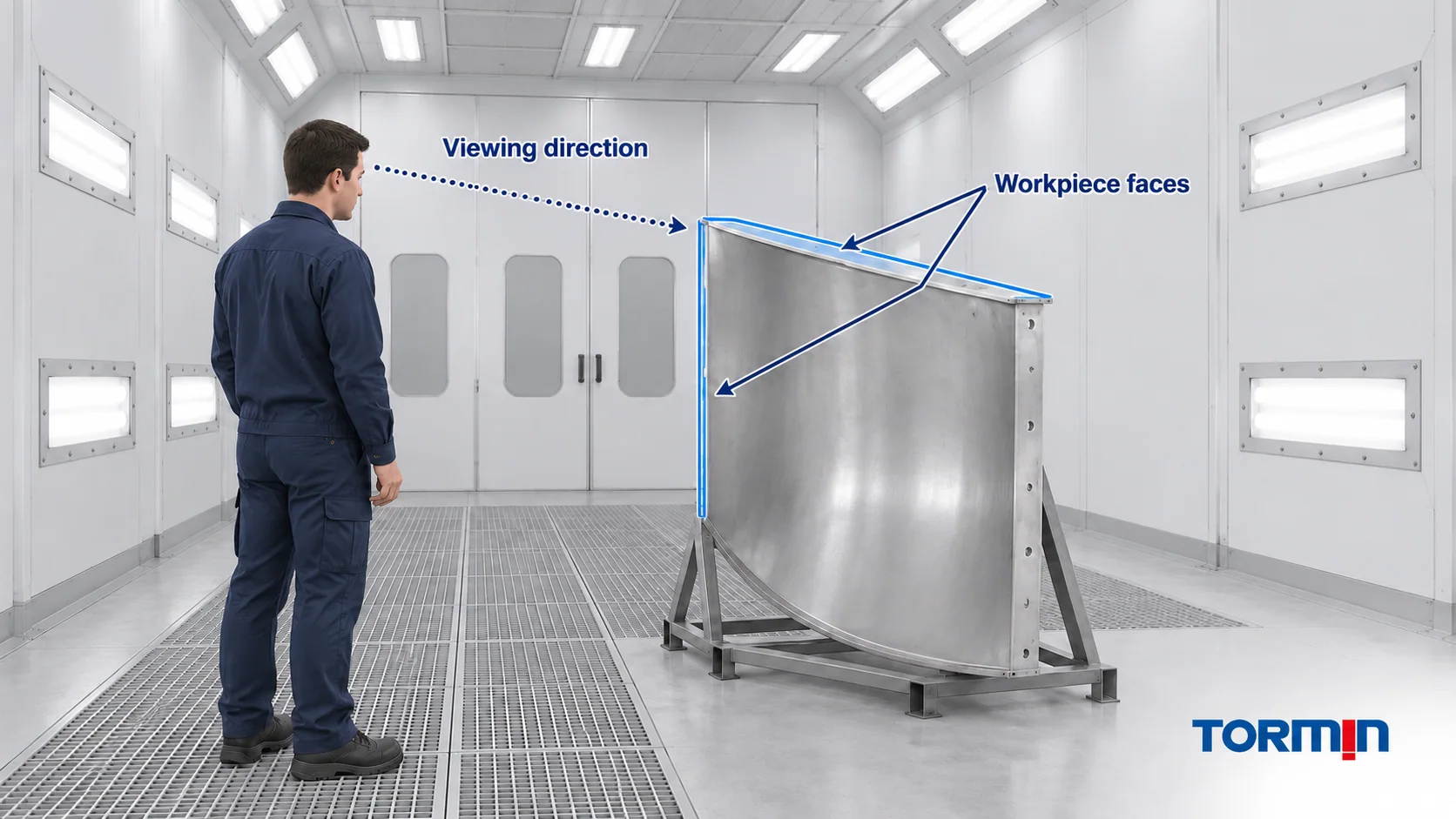
Give the lighting reviewer the actual workpiece envelope, operator positions, obstructions and proposed mounting locations. Ask the proposal to address:
- the vertical and inclined surfaces used for application or inspection;
- views where the workpiece, operator or equipment may interrupt the light;
- glare or reflections from the operator’s relevant viewing directions;
- the installed panel and the stated cleaning/maintenance assumptions;
- the project’s measurement and acceptance method.
Request the photometric file for the exact optical version being proposed. IES explains that these files describe light distribution and support simulation together with the modeled space and surface properties.
For a window-lit proposal, ask how the assessment represents the installed panel. A calculation for a bare fixture does not, by itself, establish the result at the workpiece through that assembly. Keep any unverified panel or maintenance assumption visible for review. Do not turn a quoted lumen output, beam angle or high CRI claim into a guarantee of finish inspection or colour matching.
Separate a fixture replacement from a booth-lighting redesign
Replacing a light with an LED version can involve more than matching its length and electrical input. First identify what stays and what changes.
For a retained booth recess, record the existing fixture and assembly identity. Ask the responsible equipment reviewer to assess proposed changes to the fixture, driver location, optical components, panel, frame, sealing arrangement, mounting or access method against the relevant documents.
Compare both proposals on the same drawing and task criteria. For example, one proposal might retain a reviewed through-panel arrangement while another places a different fixture on the spraying side. They are not like-for-like offers merely because their nominal lumen outputs match. This is a proposal-review example, not an approved design for either arrangement.
Obtain the applicable installation and replacement instructions. Do not improvise changes to a window, enclosure, cable entry or control interface to make a new product fit. The project’s qualified personnel and the relevant equipment suppliers must resolve those interfaces.
The general explosion-proof lighting selection guide covers the broader equipment-selection process. Use it alongside the booth-specific arrangement review, rather than assuming the old installation proves the replacement is suitable.
Prepare one arrangement record for each lighting position
Use this record to make supplier offers comparable. Attach the drawing and refer to the exact proposed assembly. Where several positions genuinely share the same requirements, identify the group explicitly.
| Record field | Information to supply or obtain |
|---|---|
| Process and operating modes | Coating/cleaning materials, spray process and any separate drying, curing or inspection mode |
| Location requirement | Jurisdiction, classification document/revision and the requirement at the actual luminaire position |
| Booth boundary | Spray side, luminaire side, isolating panel, openings and service-access location |
| Exact assembly | Luminaire ordering code, optical/electrical options, panel/frame arrangement and document references |
| Exposure and access | Residue, cleaning contact, temperatures and the documented maintenance method |
| Visual task | Workpiece faces, operator views, applicable criteria and assessment/measurement method |
| New or replacement scope | Parts retained, parts changed and the required compatibility review |
| Unresolved items | Missing information, deviations and the person responsible for each decision |
Missing classification, unresolved separation, unclear assembly compatibility or unsupported workpiece-lighting performance means the proposal still needs review. Completing this worksheet does not approve the installation.
To explore candidate forms, start with TORMIN’s explosion-proof lighting range. Send the arrangement record and booth drawing through the TORMIN project-enquiry channel and request documents for the exact proposed configuration, with deviations identified. Product-family names are a starting point for the enquiry—not proof that a particular luminaire is accepted for your paint booth.
FAQ
What lighting is required in a paint booth?
Specify the complete arrangement against the actual spray process, classification and applicable requirements. NFPA 33, NEC Article 516 and OSHA 1910.107 address different parts of that assessment. A fixture in the spray area and a fixture behind an isolating panel can need different evidence; no single product label answers every arrangement.
Is a paint booth a Class I, Division 1 location?
For covered flammable-vapour processes, the inspected NEC treats booth interiors as Division 1 or the applicable Zone location, subject to its specific provisions. Combustible-powder hazards require their own classification. Surrounding opening rules depend on the booth design and conditions; do not classify every position inside or near every booth from its name alone.
Can lights sit outside the booth behind glass?
Yes, where the actual arrangement satisfies the applicable separation, panel, location and service requirements. NEC 516.6(C) distinguishes unclassified external positions, classified external positions and integral fixtures. Ordinary glass alone does not establish the required arrangement or equipment acceptance.
Can I use portable lights inside a spray booth?
For operations covered by OSHA 1910.107(c)(8), portable electric lamps are prohibited in spraying areas during spraying. Lamps used for cleaning or repair must be approved for hazardous Class I locations. Do not treat a different code’s limited allowance as removing the applicable OSHA restriction.
What documents should I check before specifying paint booth lights?
Check the adopted NFPA 33 and NEC Article 516 requirements, OSHA 1910.107 and relevant ventilation provisions, the current classification drawing and the booth/fixture instructions. Then reconcile the exact light, panel assembly, service side and certification evidence with the requirement at each position.
Sources
- OSHA 29 CFR 1910.107 — Spray finishing using flammable and combustible materials: scoped U.S. spray-finishing provisions, including lighting arrangements and portable lamps.
- OSHA 29 CFR 1910.307 — Hazardous (classified) locations: location-specific classification and suitable equipment.
- CIE — ISO/CIE 8995-1:2025 public summary: workplace-lighting quantity and quality; no numerical paint-booth criterion is inferred here.
-
IES — Learn About IES Files: light-distribution data and simulation inputs.
-
NFPA – NFPA 33, Standard for Spray Application Using Flammable or Combustible Materials: standard identity; the specific NFPA 33-2018 extracts used here were read in the adopted NEC text below, not assumed from an unread later edition.
- California Building Standards Commission – 2022 California Electrical Code, NEC 2020-based text: Article 516 scope, PDF514; conditional classification and figures, PDF515-517; lighting arrangements and panels, PDF518-519. Check the project’s adopted edition and amendments.
- OSHA 29 CFR 1910.94(c) – Spray finishing ventilation: applicable ventilation context; no airflow design or numerical lighting criterion inferred.