
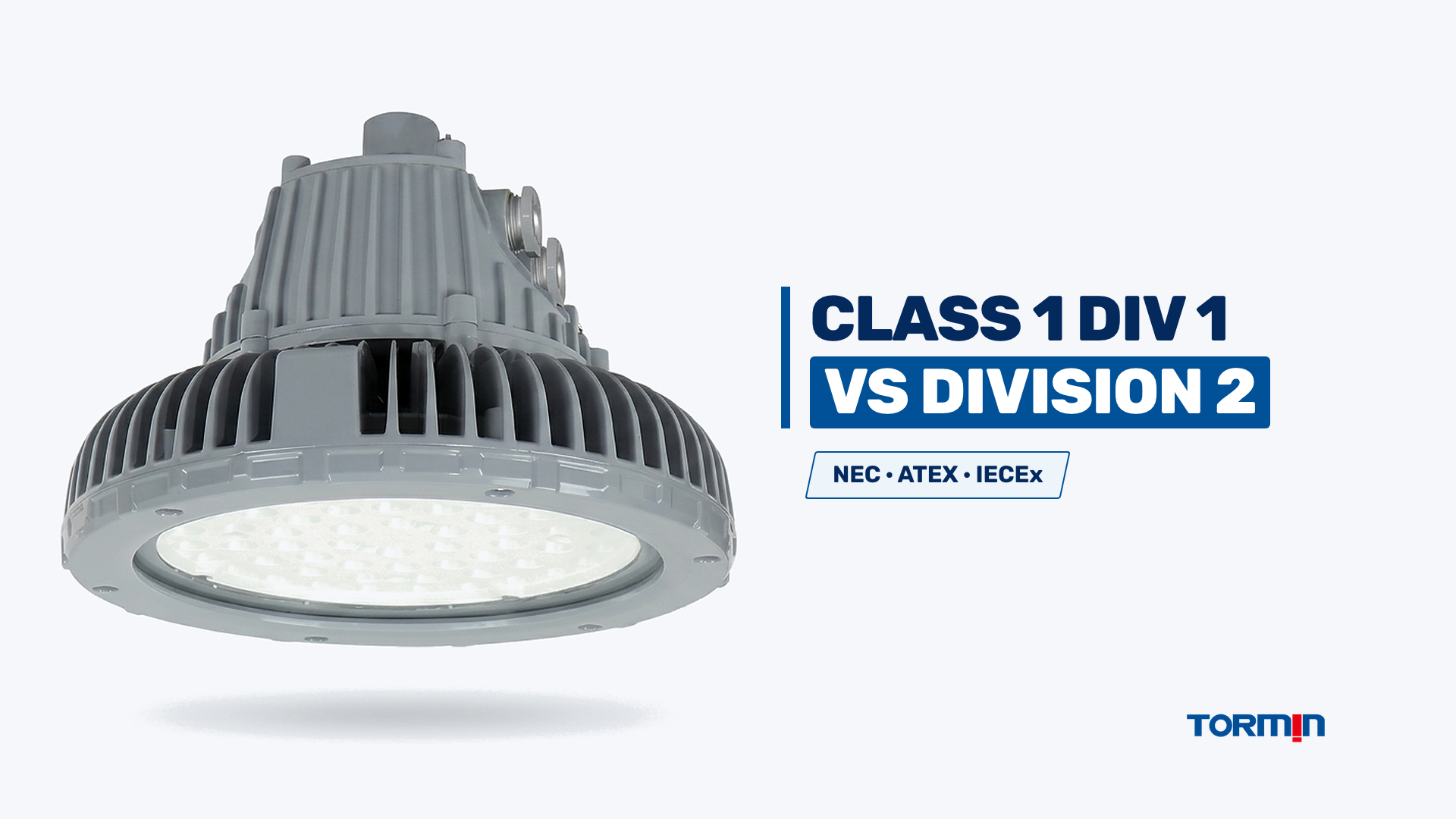
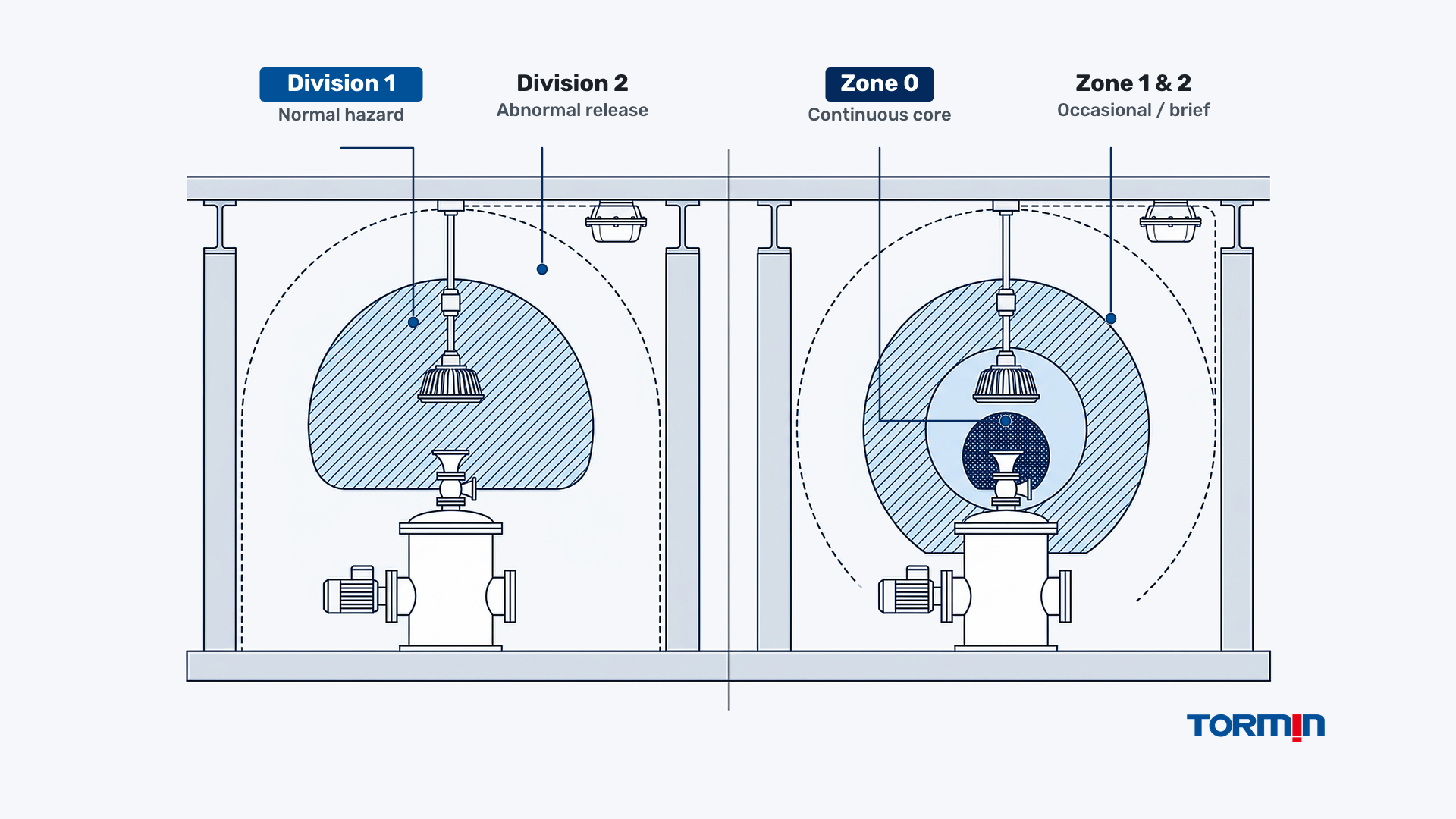
The boundary between Class I, Division 1 and Class I, Division 2 is set by how often and how long an ignitable gas or vapor atmosphere can exist—during normal operating conditions in Division 1 versus only under abnormal release, equipment breakdown, or ventilation failure in Division 2—and every luminaire, wiring, and sealing rule follows that boundary. Whether a buyer is specifying class 1 division 2 lighting for a process bay or comparing it against class 1 division 1 containment, the division rating governs the required protection technique before optical layout even begins. Even within a class 1 division 2 boundary, however, the division label alone is never a complete purchase specification.
Zone 0, Zone 1 and Zone 2 describe frequency and duration differently. They are useful comparison points, but Division 1 is not automatically Zone 1, and Division 2 is not a certificate-level synonym for Zone 2. A luminaire is acceptable only when its complete marking, approval or certificate, conditions of use, installation method and local acceptance all fit the project.
Selection rule: treat a Division-to-Zone table as orientation, not as a conversion certificate. Start with the project’s hazardous-area classification, adopted code and authority having jurisdiction (AHJ), then verify the exact luminaire variant and its documents.
What do Class I, Division 1 and Division 2 mean?
In the North American Class/Division framework, Class I identifies locations where flammable gases or vapors are, or may be, present in the air in quantities capable of producing an explosive or ignitable mixture. Class II concerns combustible dust, while Class III concerns easily ignitable fibers or flyings; those hazards require separate analysis.
For Class I locations, the distinction between the two divisions is about the conditions under which the hazard may exist:
- Division 1: ignitable gas or vapor concentrations may exist under normal operating conditions; may exist frequently because of repair, maintenance or leakage; or may be released while equipment failure simultaneously creates an ignition source.
- Division 2: volatile liquids or gases are normally confined and would escape only through accidental rupture, breakdown or abnormal operation; ventilation failure could create ignitable concentrations; or the location is adjacent to a Division 1 area and vapors could communicate with it unless suitable safeguards are used.
These are condensed planning descriptions, not substitutes for the adopted code. The public definitions appear in OSHA 29 CFR 1910.399, while equipment and installation obligations for hazardous locations appear in OSHA 29 CFR 1910.307. The electrical design must use the NEC edition adopted for the project and the AHJ’s requirements, not simply the newest edition listed by NFPA. NFPA identifies the NEC as NFPA 70.
What this changes for lighting
A request for a “Class 1 Division 2 light” is not a complete specification. At minimum, a buyer still needs the material group, temperature requirement, ambient range, environmental exposure, supply, mounting and required listing or approval. “Class I, Division 2” describes only part of the installation condition.
A luminaire suitable for one Class I location may still be unsuitable for another because the gas group, maximum surface temperature, ambient conditions, approval scope or installation restrictions differ.
Class 1 Division 2 Lighting Requirements
Meeting class 1 division 2 lighting requirements starts by separating abnormal-release protection from the normal-operation containment required in class 1 division 1, because the NEC assigns different luminaire qualification routes, raceway rules, and sealing obligations to each division.
In a Class I, Division 1 location, ignitable gas or vapor concentrations may exist during normal operations, frequent maintenance, or simultaneous equipment failure. Fixed and portable luminaires must be identified for Class I, Division 1—following the explosionproof protection route—and protected against physical damage. Wiring and entries follow Class I methods, including conduit seals at required enclosure and boundary points; see whether explosion-proof light fixtures need conduit seals.
In a Class I, Division 2 location, flammable gases or volatile liquids are normally confined and escape only under abnormal rupture, breakdown, or ventilation loss. Fixed lighting in Class I, Division 2 therefore follows one of two code paths: either the luminaire is identified for Class I, Division 2 (or carries a Class I, Division 1 identification covering the same gas group and temperature requirement), or it falls within the conditional exceptions of NEC 501.130(B) where non-explosionproof enclosed and gasketed or general-purpose fixed luminaires are permitted only if their operating surface temperatures stay within the code limit under normal conditions. For when that exception holds or fails, see general-purpose lighting in Division 2 and Zone 2.
| Requirement area | Class I, Division 1 lighting | Class I, Division 2 lighting |
|---|---|---|
| Operating hazard basis | Ignitable gas or vapor in normal operation, frequent maintenance/leakage, or simultaneous fault | Flammable gas or liquid normally confined; present only during abnormal release or ventilation loss |
| Luminaire qualification route | Identified for Class I, Division 1 (explosionproof protection route matching group and temperature code) | Identified for Class I, Division 2 (or Division 1), or compliant with conditional NEC 501.130(B) allowances |
| Wiring and conduit sealing | Full Class I, Division 1 raceway/cable methods plus required enclosure and boundary conduit seals | Class I, Division 2 wiring methods, with conduit seals at qualifying enclosures and Division boundaries |
| Cross-division directionality | Permitted in Class I, Division 2 when gas group, temperature class, and ambient rating match | Never acceptable in a Class I, Division 1 location |
What do Zone 0, Zone 1 and Zone 2 mean?
The gas and vapor Zone framework—reflected in OSHA’s Class I Zone provisions, Europe’s Directive 1999/92/EC, and IEC 60079-10-1—classifies locations by how often and how long an explosive gas atmosphere occurs: Zone 0 covers continuous, long-period, or frequent presence; Zone 1 covers occasional occurrence in normal operation; and Zone 2 covers atmospheres unlikely in normal operation and present only briefly (while Zones 20, 21, and 22 apply strictly to combustible dust, never gas). Read our dedicated guide to Zone 0, 1 and 2 in full.
Class I Division 1 vs Division 2 and Zone cross-reference
The following table compares the hazard logic only. It does not establish that equipment approved under one system is certified under another.
| Classification | Operating hazard condition | Nearest Zone / Division orientation | Compliance boundary (what this does not prove) |
|---|---|---|---|
| Class I, Division 1 | Ignitable gas/vapor concentrations may occur in normal operation, occur frequently during maintenance or leakage, or coincide with equipment failure | Depending on the source, release grade, ventilation and persistence, the classified space may involve Zone 0 or Zone 1 conditions | It does not prove Division 1 = Zone 1, nor that Division-approved equipment has ATEX or IECEx conformity |
| Class I, Division 2 | Gas/vapor is normally confined; hazard is associated with abnormal release, ventilation failure or communication from an adjacent Division 1 area | Often closest in operating concept to Zone 2 | It does not prove that every Division 2 boundary matches a Zone 2 boundary or that the same luminaire marking is acceptable |
| Zone 0 | Explosive gas atmosphere is continuous, long-lasting or frequent | No single universal Division label | It does not permit selection of ordinary Division 1 equipment without a marking and approval that covers the application |
| Zone 1 | Explosive gas atmosphere is likely occasionally in normal operation | Part of the risk space commonly associated with Division 1 | It does not convert an ATEX or IECEx document into a North American listing |
| Zone 2 | Explosive gas atmosphere is unlikely in normal operation and, if present, persists briefly | Broadly comparable to the abnormal-condition logic of Division 2 | It does not make all Zone 2 and Division 2 products interchangeable |
Why is there no exact one-row conversion? The two systems classify hazardous space using different structures and design practices. The final boundary can change with the release source, ventilation, material properties, process conditions and the rules adopted in the jurisdiction. OSHA also requires each room, section or area to be considered individually and requires hazardous-area documentation to be available to those who design, install, inspect, maintain or operate the equipment.
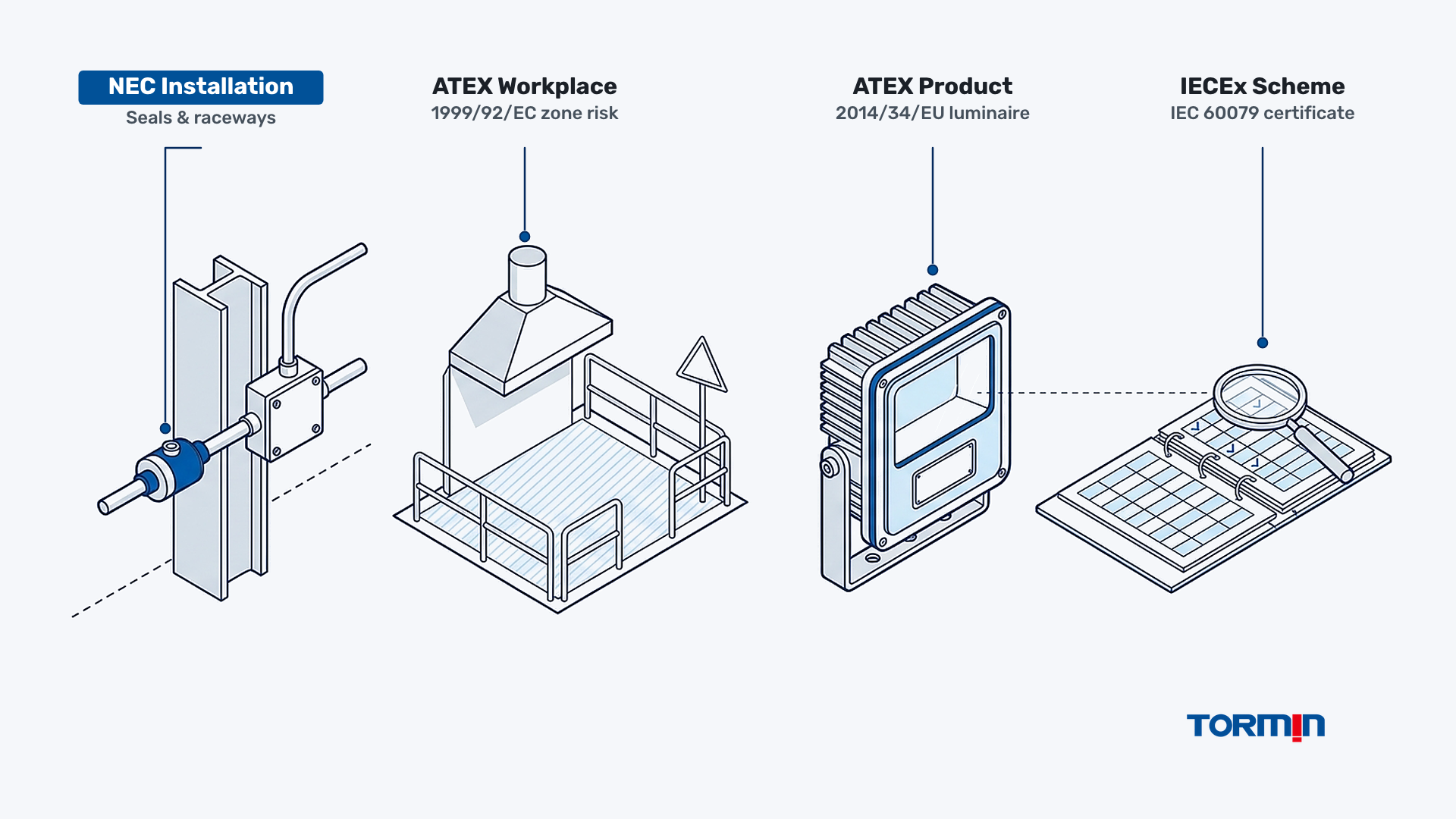
NEC, ATEX and IECEx do different jobs
NEC, ATEX and IECEx are often grouped in one procurement sentence, but they are not three interchangeable labels.
| Framework | What it is | What it controls for a lighting project | Evidence to request |
|---|---|---|---|
| NEC / North American installation framework | An electrical installation code adopted and enforced by jurisdictions; OSHA rules also establish workplace obligations | Area-classification method, acceptable equipment and wiring methods, installation and inspection under the adopted rules | Adopted code edition, area-classification drawing/schedule, listing or approval details, luminaire marking and installation instructions |
| ATEX workplace framework | EU minimum workplace requirements under Directive 1999/92/EC | Employer risk assessment, hazardous-place classification and organizational/technical protection measures | Explosion-protection document, Zone drawing, material and process data, required equipment category |
| ATEX product framework | EU equipment requirements under Directive 2014/34/EU | Conformity of equipment and protective systems placed on the EU market, including applicable marking and documentation | EU declaration of conformity, notified-body documents where applicable, instructions, exact equipment marking and special conditions |
| IEC standards | International technical standards in the IEC 60079 family | Area classification, protection concepts, equipment construction/testing, selection and installation, depending on the adopted standards | Exact standards and editions named by the project, equipment marking, certificate scope, installation instructions and conditions of use |
| IECEx | An international conformity-assessment system using IEC standards | Independent certification of specified equipment, service facilities or personnel within an IECEx scheme | Online IECEx certificate record, current status, exact model/variant, certificate schedule and any conditions of certification |
The ATEX workplace directive links Zones to equipment categories unless the risk assessment provides otherwise: Category 1 equipment in Zone 0/20, Category 1 or 2 in Zone 1/21, and Category 1, 2 or 3 in Zone 2/22. The equipment categories and protection objectives come from the separate ATEX product Directive 2014/34/EU. That legal relationship is not the same as saying an ATEX-marked luminaire is automatically accepted on an NEC project.
Similarly, IECEx is not a zoning law. The IECEx Certified Equipment Scheme provides a route for equipment certification to IEC standards. The certificate belongs to a defined scope, and the IECEx certificate FAQ explains how certificates are issued and verified through the system. Project acceptance still depends on local legislation, the specified scheme and the exact certificate status and schedule.
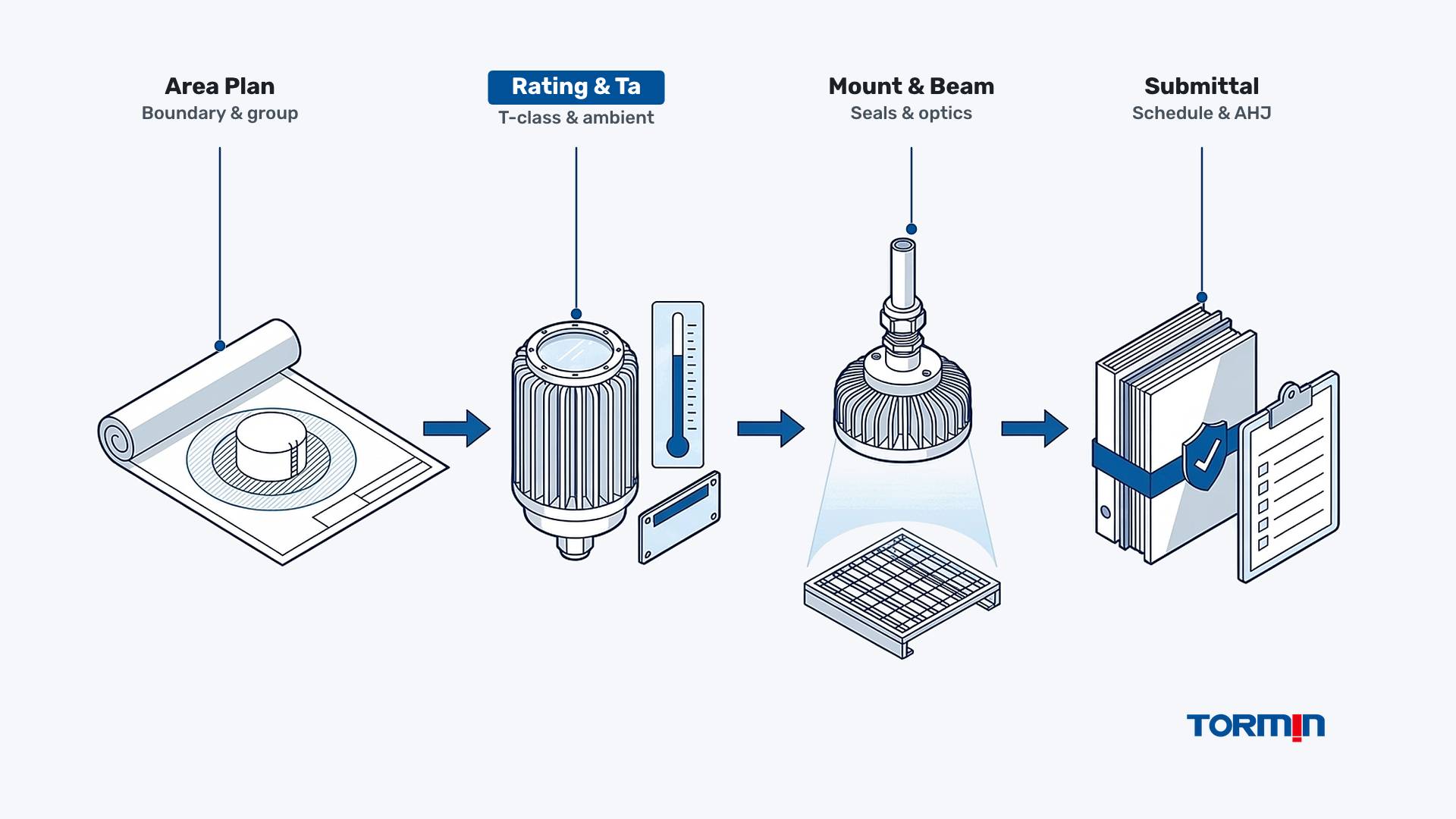
How to specify Class I Division 1 or Division 2 lighting
Use the classification as the start of a controlled selection workflow, not as the complete product description.
1. Establish the governing jurisdiction and adopted documents
Record the country, state or province, site owner specification, adopted electrical code and required conformity scheme. A project may cite more than one standard for contractual reasons, but that does not make their approvals interchangeable.
Where the project uses the NEC Class/Division system, confirm the adopted edition and local amendments. Where it uses Zones, identify whether the legal basis is an NEC Zone installation, EU ATEX requirements, another national implementation of IEC standards, or a project specification.
2. Obtain the hazardous-area classification package
Do not classify the area from a luminaire catalog. Request the signed or controlled area-classification drawing and schedule from the responsible engineering organization. It should locate the boundary and state the classification system, gas/vapor or dust hazard, group and relevant temperature requirement.
Area classification depends on process and site information. Equipment suppliers can help compare a defined requirement with product documents, but they should not replace the project’s qualified classifier or AHJ.
3. Identify the hazardous material group
“Class I” alone does not identify the material group. In North American Division work, the marking may include Groups A, B, C or D. Zone/IEC equipment uses gas subdivisions such as IIA, IIB or IIC. These group structures are related to material ignition behavior, but they should be read within their own approval framework rather than converted from memory.
Provide the actual gas or vapor and the classification group’s project designation. If the certificate covers only a narrower group or the marking does not match the project, stop the selection.
4. Check temperature class and ambient conditions together
The equipment’s maximum surface temperature or temperature class must remain appropriate for the hazardous material under the rated conditions. Do not compare a T-code with the material’s autoignition temperature and ignore the certified ambient range, supply variation, dust layers or mounting restrictions.
Use the exact nameplate, certificate schedule and instructions for the proposed variant. If a suffix, wattage, driver, battery, mounting arrangement or ambient option changes the certified scope, the general product-family page is not enough.
5. Verify the protection concept and complete marking
For Zone equipment, the marking communicates more than the Zone number. Depending on the scheme, relevant fields can include:
- equipment group and category for ATEX;
- gas or dust atmosphere identifier;
- type of protection;
- gas or dust group;
- temperature class or maximum surface temperature;
- Equipment Protection Level (EPL);
- ambient range when it differs from the normal marking convention;
- certificate number and an
Xsuffix where special conditions apply.
For North American equipment, relevant fields can include Class, Division or Zone, material group, temperature code, environmental type/rating information and the mark of the approving organization; see our field guide on how to read an explosion-proof lighting nameplate and certificate to cross-check these fields line by line. The required format depends on the approval and adopted rules.
This is why a photograph labeled “explosion-proof light” or a datasheet carrying only IP66 cannot establish hazardous-location suitability. An ingress-protection rating addresses enclosure protection against solids and water; it does not replace an Ex approval.
6. Confirm ordinary lighting and environmental requirements
Once the hazardous-location requirements are fixed, complete the luminaire specification:
- input voltage, frequency and control interface;
- emergency function, if required;
- ambient temperature and expected thermal exposure;
- corrosion, chemical, vibration and mechanical-impact conditions;
- ingress and enclosure requirements;
- mounting method, cable entries, glands and accessories;
- maintained illuminance, uniformity, glare constraints and emergency-lighting criteria;
- photometric file and lighting-layout assumptions;
- maintenance access and inspection strategy.
Hazardous-area compliance does not prove that the luminaire will deliver the required lighting performance, and photometric performance does not prove hazardous-area suitability. Both must be checked.
7. Close the document loop before approval
For the exact proposed model and ordered configuration, request:
- product datasheet and complete ordering code;
- nameplate or marking drawing;
- current certificate or listing record;
- certificate schedule, annex or descriptive documents identifying the variant;
- special conditions of use and limitations;
- installation, operation and maintenance instructions;
- declaration of conformity where the applicable framework requires it;
- photometric file and dimensional/mounting drawings;
- confirmation of required accessories, entries and glands;
- AHJ, owner or engineer approval record where required.
IEC 60079-14:2024 addresses electrical-system design, equipment selection and installation, and initial inspection within the IEC framework. Use the edition adopted by the project; an IEC catalog page or IECEx certificate does not by itself establish the applicable local installation rules.
What should a Class 1 Division 2 lighting RFQ include?
A usable class 1 division 2 lighting RFQ lets the manufacturer compare one defined operating envelope with one exact luminaire configuration. Include the following fields:
| RFQ field | What to provide | Why it matters |
|---|---|---|
| Jurisdiction | Country, state/province, site owner and AHJ | Determines the applicable legal and code framework |
| Classification | Exact Class/Division or Zone notation from the project schedule | Prevents informal conversion by the supplier |
| Hazardous material | Gas/vapor name and specified group | Confirms group compatibility within the required scheme |
| Temperature basis | Required temperature code/class or maximum surface temperature, plus process basis | Supports a controlled temperature check |
| Ambient | Minimum and maximum ambient at the mounting location | Certificate and driver limits may depend on ambient |
| Approval scheme | Required listing, ATEX conformity, IECEx certification or other national approval | Prevents submission of the wrong document set |
| Electrical | Voltage, frequency, phase, controls and emergency duration/function | Defines the orderable electrical variant |
| Mechanical | Mounting, entries, glands, cable type, corrosion/vibration exposure and enclosure needs | Affects installation and sometimes certified scope |
| Lighting duty | Mounting height, target plane, illuminance, uniformity, optics and layout file format | Allows photometric evaluation |
| Documents | Certificate, schedule/annex, declaration, instructions, marking drawing and photometry | Creates a reviewable submittal rather than a verbal claim |
If the project uses both North American and international approval schemes, list each as an independent requirement. Ask the supplier to identify which exact marking and document satisfies each requirement; do not accept “equivalent” as the entire response.
Common mistakes when comparing hazardous-area lights
Treating Division 1 as a synonym for Zone 1
Division 1 can encompass conditions that the Zone framework separates into Zone 0 and Zone 1. The actual classified extent depends on the engineering assessment. A shortcut can understate the hazard or demand irrelevant documentation.
Assuming a higher-hazard approval crosses every boundary
Within one adopted system, equipment intended for a more demanding location may sometimes be permitted in a less demanding location when all other class, group, temperature and installation conditions are met. That principle does not turn a North American approval into ATEX conformity or an IECEx certificate into a US listing.
Checking only the certificate front page
The schedule or annex may identify the exact models, construction options, ambient range and special conditions. A similar family name or catalog photograph is not evidence that the quoted ordering code is covered.
Using IP rating as proof of explosion protection
Water and dust ingress performance is important in industrial lighting, but it answers a different question. Confirm both the environmental enclosure requirements and the hazardous-area approval.
Ignoring the installation system
Cable entries, glands, seals, conduit practices, mounting and maintenance can be part of compliance. Selecting a marked luminaire does not approve an incompatible installation around it.
Letting procurement choose the classification
Procurement should preserve and transmit the engineering classification, not infer it from an old purchase order or a product label. When project documents conflict, return the question to the responsible engineer and AHJ.
FAQ
What is the difference between Class 1 Division 1 and Division 2 lighting?
The difference follows how often an ignitable gas or vapor atmosphere can occur. Class I, Division 1 lighting serves locations where flammable gas or vapor concentrations may exist during normal operation, frequent maintenance, or simultaneous equipment failure, requiring luminaires identified for Division 1 (the explosionproof route) with full Class I wiring and conduit seals. Class I, Division 2 lighting serves locations where flammable gases or volatile liquids are normally confined and escape only under abnormal conditions, permitting luminaires identified for Class I, Division 2 (or qualifying under NEC 501.130(B)) along with Division 2 wiring rules.
What are the lighting requirements for a Class 1 Division 2 area?
Luminaires in a Class I, Division 2 location must either be identified for Class I, Division 2 (or carry a Class I, Division 1 approval covering the project’s gas group, temperature code, and ambient range) or meet the specific conditional allowances of NEC 501.130(B) for fixed lighting whose operating surface temperature stays within the code limit under normal conditions. In addition, the fixture’s gas group (Groups A, B, C, or D), temperature code, ambient rating, cable entries, and boundary seals must match the adopted code and classification schedule.
Can a Division 2 light be used in a Division 1 area?
No. Hazardous-location ratings cannot be upgraded into a more severe division. A luminaire approved only for Class I, Division 2 is designed for abnormal-release conditions and is never acceptable inside a Class I, Division 1 location where ignitable gas or vapor concentrations can exist during normal operation.
How do Division 1 and 2 map to Zone 1 and Zone 2?
There is no automatic certificate-level conversion: Class I, Division 1 can span conditions that the Zone system separates into Zone 0 and Zone 1, while Class I, Division 2 is broadly comparable in abnormal-release logic to Zone 2 without making boundaries or product approvals interchangeable. Refer to the Division-to-Zone cross-reference table earlier in this guide for orientation, and always match the exact scheme required by the project.
Who decides whether my area is Division 1 or Division 2?
The area classification is determined and documented by the responsible engineering organization or qualified classifier on controlled area-classification drawings and schedules, subject to the adopted electrical code and the authority having jurisdiction (AHJ)—never by a luminaire manufacturer, distributor, or procurement team guessing from a catalog.
A safer way to compare TORMIN hazardous-area lighting
Start with the controlled classification schedule, not a product thumbnail. Then compare the exact requirement with the complete documents for the proposed variant.
Use the hazardous-area lighting range to identify candidate forms, then compare the exact offered model with the project’s required approval route. A Zone-based product listing does not establish Class I, Division 1 or Class I, Division 2 acceptance. For an existing installation, record the retained mounting and electrical interfaces using the retrofit survey checklist.
For a document-led review, contact TORMIN with the classification, hazardous material/group, temperature requirement, ambient range, mounting, electrical supply, photometric target, quantity and required approval scheme. Ask for the current certificate and full schedule or annex for the exact offered model before it enters the project submittal.
Official references
- OSHA 29 CFR 1910.307 — Hazardous (classified) locations
- OSHA 29 CFR 1910.399 — Definitions applicable to Subpart S
- NFPA 70 — National Electrical Code
- Directive 1999/92/EC — worker protection in explosive atmospheres
- Directive 2014/34/EU — equipment for potentially explosive atmospheres
- IEC 60079-10-1 — classification of gas areas
- IEC 60079-14:2024 — electrical-system design, equipment selection and installation
- IECEx Certified Equipment Scheme
This guide supports specification and document review. It does not classify a site, approve a product, replace the adopted code or replace review by the responsible engineer and AHJ.