
Industrial Lighting Specifications Explained
Read a luminaire datasheet with confidence. Use this quick reference to distinguish power, light output, color and enclosure protection—and identify the documents you need before comparing two products.
On this page
Energy and payback calculations now have a dedicated calculator.
Find beam diameter and footprint in the beam coverage calculator.
Lighting specifications at a glance
Start with the parameter you need to check. Each value answers a different question; no single rating establishes whether a luminaire is suitable for your project.
Swipe horizontally to view all columns.
| Parameter | What it tells you | What to check before comparing |
|---|---|---|
| Input power · W | Electrical power drawn by the luminaire. | Total input power, including the driver, at the stated supply and operating setting. |
| Luminous flux · lm | Visible-light output, weighted for human vision. | Output from the complete luminaire, for the exact optic and configuration. |
| Luminous efficacy · lm/W | Light output per unit of electrical power. | Luminaire lumens divided by total input watts under matching conditions. |
| Illuminance · lx | Light arriving at a surface; 1 lx = 1 lm/m². | The task plane, layout and whether the result is initial or maintained. |
| CCT · K | The color appearance of nominally white light. | The specified kelvin value and tolerance; CCT does not state light output. |
| CRI · Ra | Color fidelity relative to a reference light source. | The reported metric and the color requirements of the actual task. |
| IK code · IK00–IK11 | Enclosure protection against specified mechanical impacts. | The tested enclosure, configuration and referenced standard edition. |
Definitions: CIE photometric vocabulary, DOE LED Basics and IEC 62262 Amendment 1. Use the sections below to interpret their limits.
Power, light output and efficacy
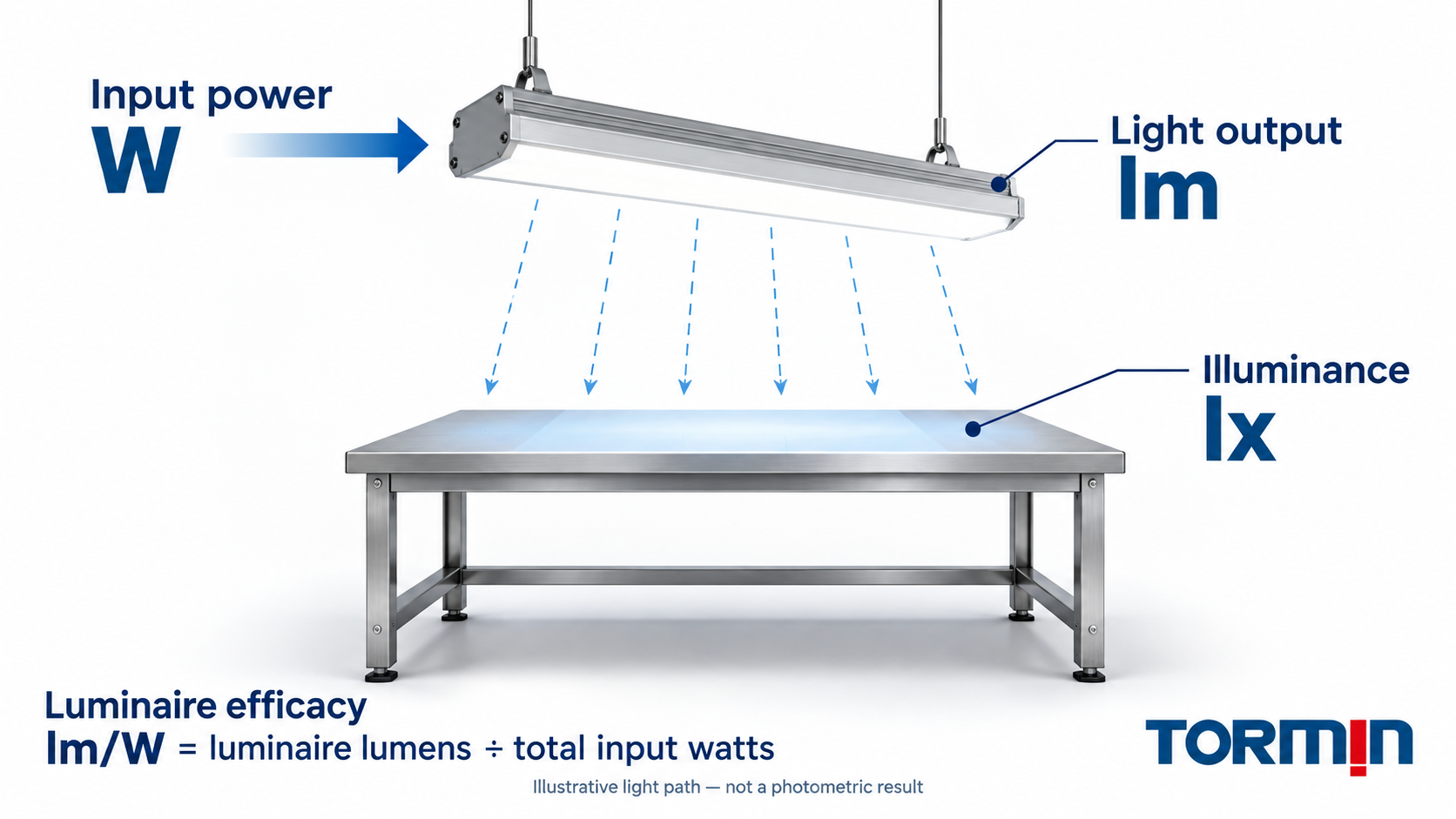
Watts describe electrical input. Lumens describe light output. To compare energy performance, divide the complete luminaire’s light output by its total electrical input:
Confirm the measurement boundary. A value for an LED package is not the same as a value for the assembled luminaire, which includes its driver and optical system. CIE’s efficacy definition explicitly requires clarity about auxiliary power; DOE distinguishes source efficacy from luminaire efficacy.
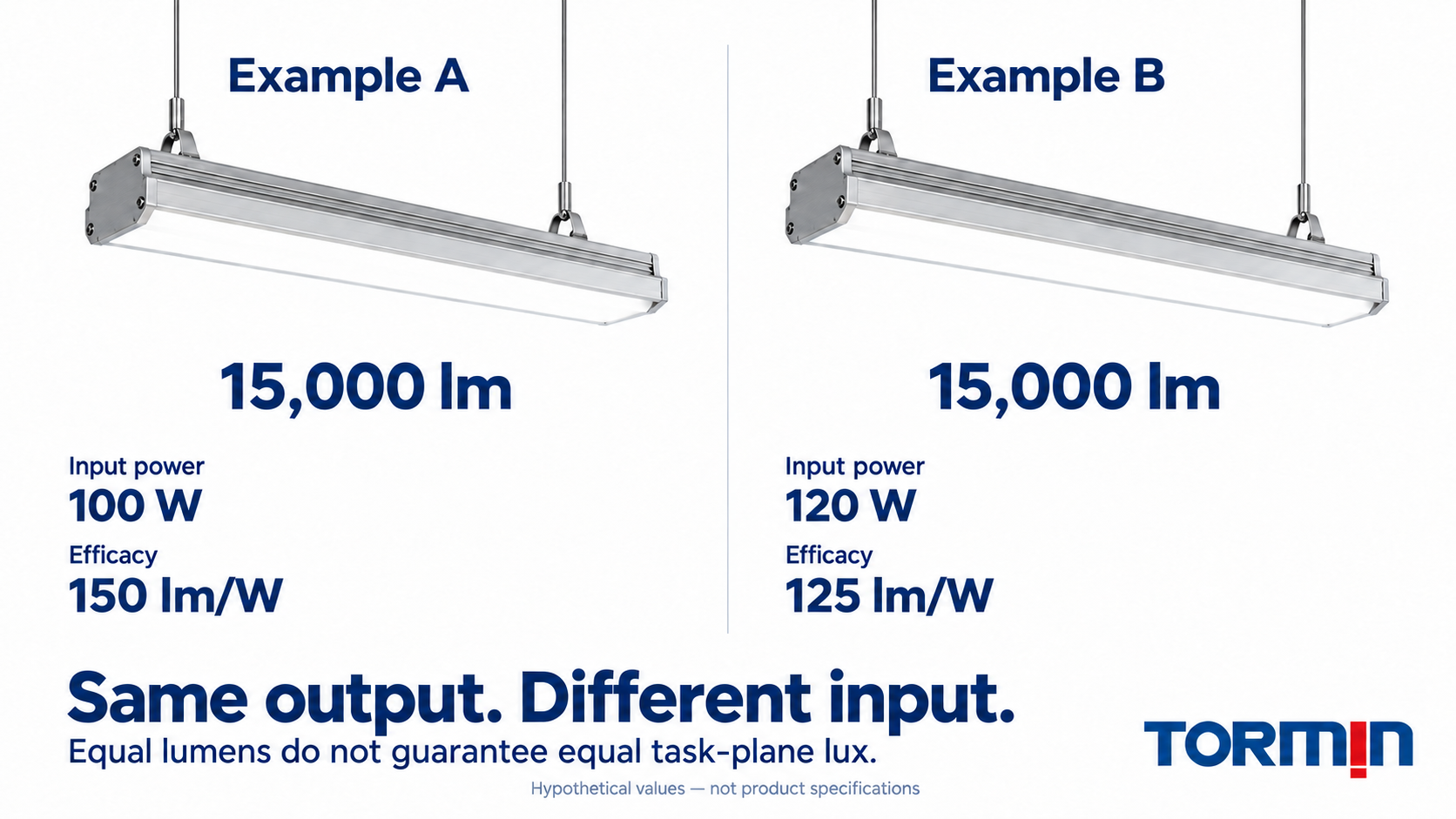
Worked comparison: the same lumens, different watts
The following figures are hypothetical teaching values, not TORMIN product specifications.
Swipe horizontally to view all columns.
| Comparison point | Example A | Example B |
|---|---|---|
| Complete-luminaire output | 15,000 lm | 15,000 lm |
| Total input power | 100 W | 120 W |
| Calculated efficacy | 150 lm/W | 125 lm/W |
| Difference in input power | 20 W lower than B | Reference case |
Example A uses less power for the stated output. This does not establish that it delivers the same illuminance, uniformity or visual comfort in a real installation. Before treating the products as alternatives, compare their distribution, mounting arrangement, color specification and operating conditions.
When reviewing a quotation, ask: “Are these lumens and watts for this exact luminaire configuration, measured under the same conditions?”
Illuminance: check the surface that matters
Illuminance describes light incident on a surface and is expressed in lux. CIE defines 1 lx as 1 lm/m². A luminaire’s lumen rating alone cannot tell you the lux at a workbench, floor or vertical inspection surface.
Lux ↔ foot-candle converter
Enter either value to convert the same illuminance between units. This does not estimate a luminaire’s light output or the number of luminaires needed.
Enable JavaScript for interactive conversion. To convert manually: foot-candles = lux × 0.09290304; lux = foot-candles ÷ 0.09290304.
1 fc ≈ 10.76391 lx. Conversion uses the international foot (0.3048 m); converted values are rounded to six significant digits. NIST unit conversion reference.
For a project comparison, request a lighting calculation using the proposed model’s IES or LDT photometric file. Record:
- Task and assessment plane: where people need to see, including the plane’s height and orientation.
- Geometry: mounting height, spacing, aiming and obstructions.
- Calculation assumptions: surface reflectances and the maintenance assumptions used.
- Acceptance criteria: required maintained illuminance, uniformity and applicable glare criteria for the project.
Do not divide the total catalogue lumens by floor area and present the result as a verified lighting design. That shortcut does not establish how much light reaches each assessment point. Keep product output and installation performance as separate lines in your comparison.
CCT and CRI: two different color questions
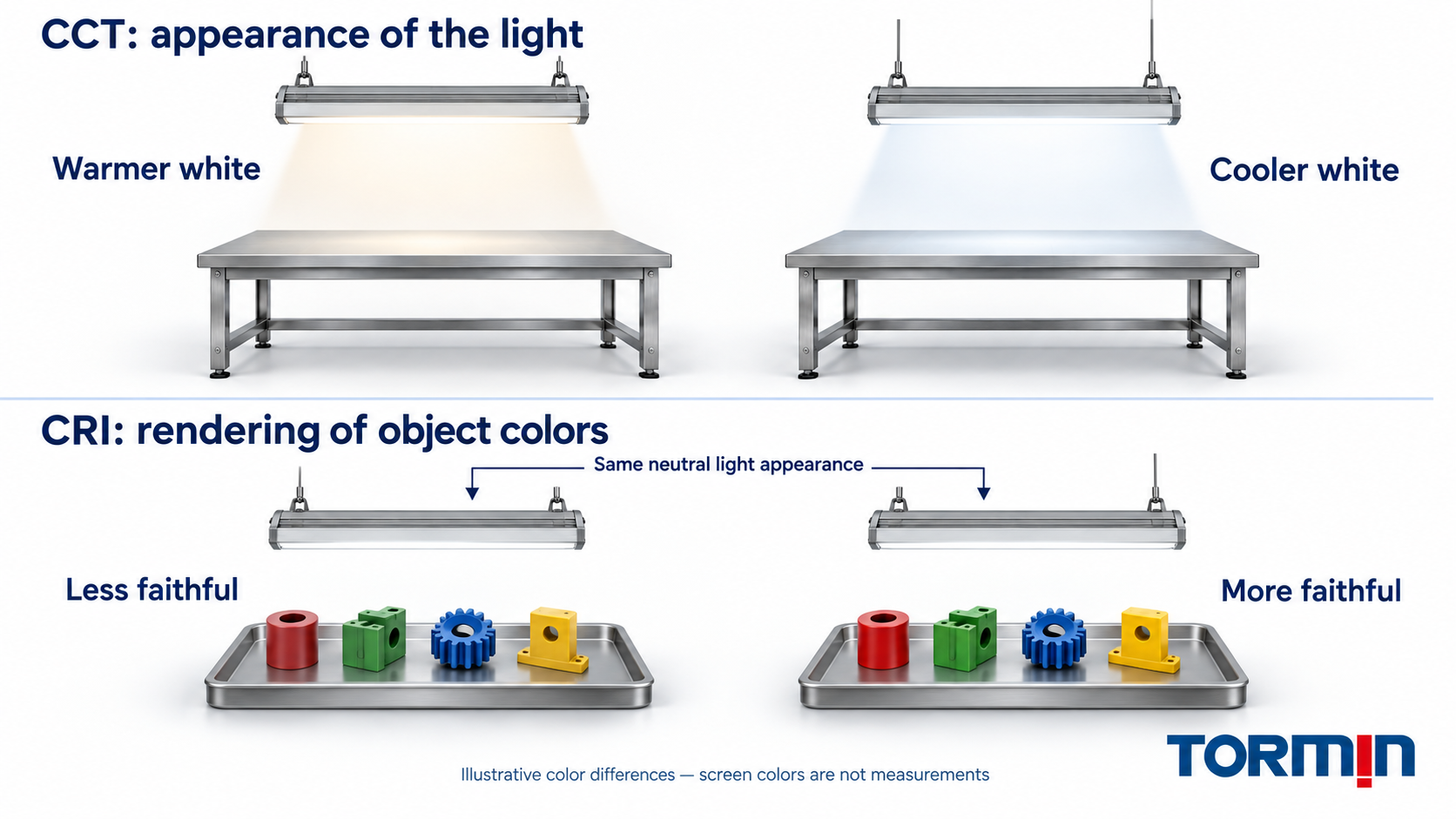
CCT: what does the light look like?
Correlated color temperature, in kelvin, relates a light source’s chromaticity to that of a reference thermal radiator. In practical white-light comparisons, lower values usually look warmer and higher values cooler. It is not the operating temperature of the fixture. CIE: correlated color temperature.
Specify the numeric CCT rather than relying only on labels such as “warm white” or “cool white.” For a replacement within an existing installation, check the required consistency with neighboring luminaires. A CCT value alone does not establish lumen output, efficacy or color fidelity.
CRI: how faithfully are object colors rendered?
CRI is commonly reported as Ra. It summarizes color fidelity using a defined set of test colors; it is not a percentage of colors reproduced correctly. The general index uses eight samples, so a single Ra value does not describe every color response. CIE: CRI test samples.
For sorting colored components, inspecting coatings or judging surface appearance, identify the actual visual task before specifying a minimum value. Where color decisions are critical, ask for the relevant color data and review representative materials under the proposed lighting.
In its 2025 position statement, CIE recommends transitioning to the general color fidelity index Rf, with Ra and Rf reported together during the transition. They are distinct metrics: retain the metric named in the project specification rather than silently substituting one for the other. CIE PS 002:2025.
Swipe horizontally to view all columns.
| Your question | Start with | Do not infer |
|---|---|---|
| Will the light look warmer or cooler? | CCT in K | Brightness or color fidelity. |
| Can this support our color-inspection task? | Specified color metric, supporting data and task review | Suitability from CCT alone. |
| Does the cooler option produce more light? | Exact luminaire output and input data | A fixed percentage advantage from “cool white.” |
IK ratings: mechanical impact protection
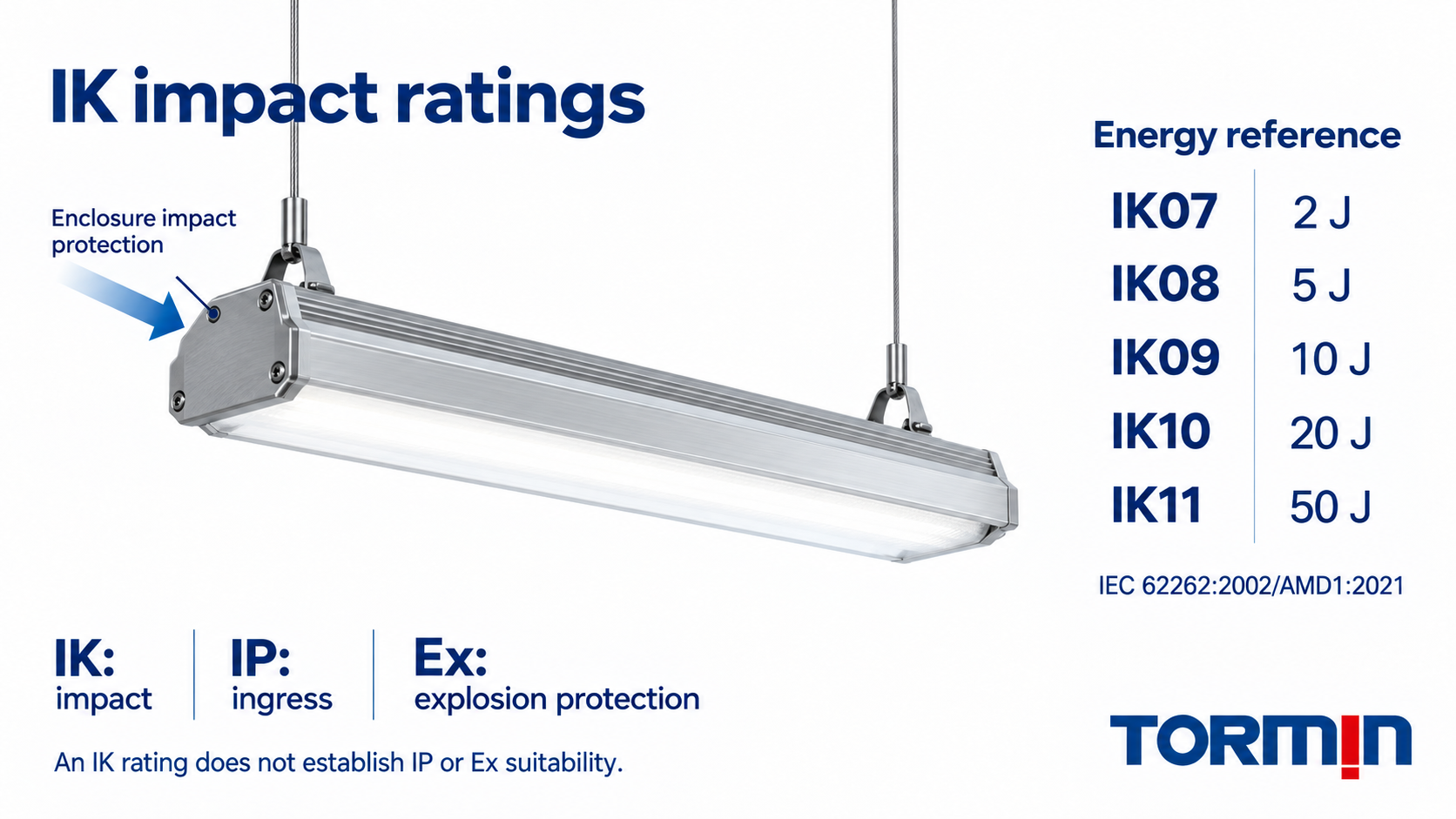
The IK code classifies enclosure protection against external mechanical impacts under specified test conditions. The energy values below follow the amended table in IEC 62262:2002/AMD1:2021. IEC publication record; amendment preview, Table 1.
| IK code | Impact energy |
|---|---|
| IK00 | No protection classified under this document |
| IK01 | 0.14 J |
| IK02 | 0.20 J |
| IK03 | 0.35 J |
| IK04 | 0.50 J |
| IK05 | 0.70 J |
| IK06 | 1 J |
| IK07 | 2 J |
| IK08 | 5 J |
| IK09 | 10 J |
| IK10 | 20 J |
| IK11 | 50 J |
Use this as an energy lookup, not a field drop-test procedure or a promise of resistance to every collision. Confirm which parts and configuration the rating covers, including the lens or guard where applicable. An unreported IK rating is not automatically IK00.
Keep IK, IP and explosion protection separate
- IK: mechanical-impact classification under IEC 62262.
- IP: enclosure protection under IEC 60529, addressing access to hazardous parts and ingress of solid objects and water.
- Explosion protection: suitability established through the applicable hazardous-area framework and exact equipment documentation.
An IK or IP rating does not establish hazardous-area approval. See IEC 60529 for the IP framework and TORMIN’s nameplate and certificate guide for the separate document check.
Before you compare or replace a luminaire
Build a comparison around the exact ordering code. Put each quoted value beside its evidence, and leave unconfirmed fields open for clarification.
Swipe horizontally to view all columns.
| Ask for | What to match |
|---|---|
| Current datasheet and full ordering code | Wattage option, supply, optic, CCT, color metric and accessories. |
| Photometric report and IES/LDT file | The proposed configuration and the data used in the layout calculation. |
| Operating limits | Ambient temperature, supply conditions and any stated restrictions. |
| Enclosure documentation | The claimed IP/IK ratings, test basis and covered configuration. |
| Dimensions and installation instructions | Mounting, clearances, weight, cable entry and service access. |
| Hazardous-area documents, where required | Exact model scope, marking, certificate conditions and site requirements. |
Treat matching watts, a similar shape or one higher rating as a starting point for review—not proof of interchangeability. For hazardous areas, follow the separate explosion-proof lighting selection guide.
Need the documentation for a TORMIN model? Contact TORMIN with the full model reference, destination market and project requirements. For delivery, warranty and order questions, use the existing FAQ.
Sources
- CIE — International Lighting Vocabulary, CIE S 017:2020: terminology reference; specific entries linked below.
- US Department of Energy — LED Basics: source versus luminaire efficacy and color-quality distinctions.
- CIE — Luminous efficacy of a light source, 17-21-089: ratio, units and auxiliary-power boundary.
- CIE — Illuminance, 17-21-060: incident flux per area and lux.
- CIE — Correlated color temperature, 17-23-068: CCT definition and kelvin unit.
- CIE — Spectral radiance factors of CRI test samples: eight samples used in the general index, from CIE 13.3:1995.
- CIE — Position Statement on Colour Quality Metrics, 2nd edition, 2025: parallel reporting of Ra and Rf during the recommended transition.
- IEC — IEC 62262:2002/AMD1:2021, with Table 1 in the SIST-hosted IEC amendment preview: IK classification and amended impact-energy values. This is a preview, not a review of the complete consolidated standard.
- IEC — IEC 60529:1989+AMD1:1999+AMD2:2013: official publication record for the IP enclosure-protection framework.