
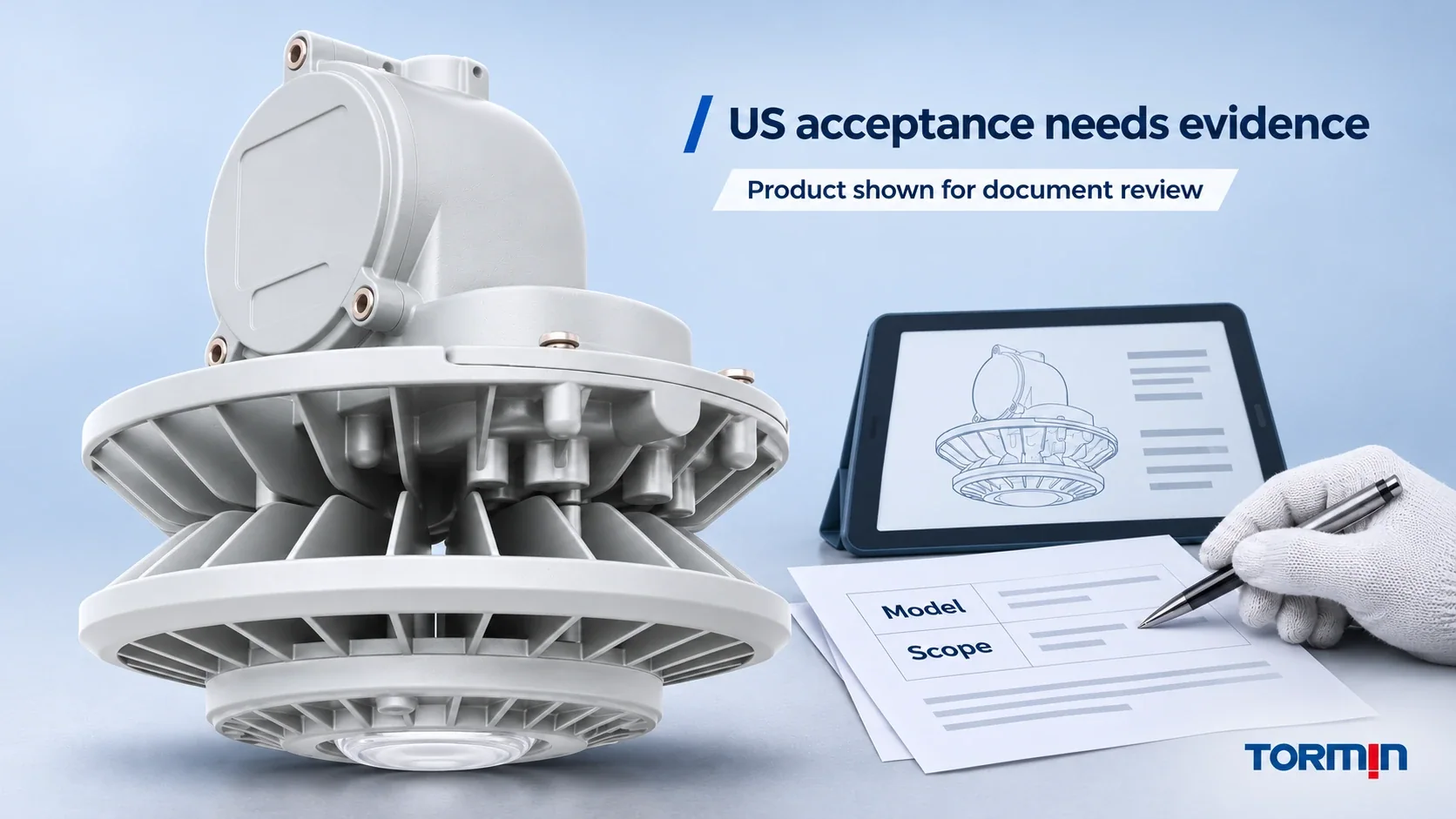
ATEX or IECEx certification alone does not establish acceptance for a US hazardous location. For routine lighting procurement, verify the applicable US certification by an OSHA-recognized Nationally Recognized Testing Laboratory (NRTL), the exact model and its permitted installation scope. An AEx marking identifies the US Zone protection designation; it does not replace the certification body’s mark or the project review.
This article assumes the area classification is already established. Use the Class, Division and Zone determination guide when that input is missing. The task here is to judge the equipment submission, not classify the plant. OSHA explicitly distinguishes ATEX certification from the US certification mark required under its NRTL program. OSHA NRTL FAQ
| Evidence supplied | US procurement decision |
|---|---|
| ATEX and/or IECEx documents only; no demonstrated US acceptance basis | Do not release the fixture for the classified location on those documents alone. |
| Applicable US certification and marking, verified for the exact model and permitted location | Proceed with the project review, including classification, temperature, ambient conditions and installation instructions. Certification is not approval of the complete installation. |
Why ATEX and IECEx stop at the US border
The word “certified” leaves an important question unanswered: certified under which system, for which destination? A technically credible foreign certificate can still be the wrong evidence for a US purchase order.
ATEX Directive 2014/34/EU governs products within its scope placed on the EU market. It defines essential health and safety requirements and conformity-assessment procedures. IECEx is a separate international certification scheme. Neither document becomes a US workplace approval simply because its technical references look familiar. European Commission ATEX overview
For Ex electrical equipment, there is substantial common technical ground in IEC-based standards and their national or regional adoptions. That does not make every edition, national difference, manufacturing assessment or approval decision identical. Shared test methods help explain why evidence may be reused; they do not establish recognition of the finished product under every country’s rules.
The distinction is between the engineering evidence and the authority of the resulting approval. A test report can describe what was tested. A certification scheme determines what assessment, production controls and marking authorization support its certificate. The destination’s requirements determine what evidence is acceptable there. A buyer needs all three questions answered for the offered configuration.
The separate ATEX-versus-IECEx document guide covers those two systems in more detail. This article follows the next decision: what additional US evidence must the supplier demonstrate? IECEx itself explains that national processing can remain necessary even in member countries. Membership is not automatic permission to install every IECEx-certified product. IECEx equipment-scheme FAQ
Canada runs its own approval framework; a US-only certification must not be assumed to cover Canada.
The US gate: OSHA “approved” and the NRTL mark
OSHA’s electrical rules and the locally applicable installation code perform related but different jobs. An inspector’s installation review does not erase the employer’s workplace obligations, and a product certificate does not approve the installed lighting system.
29 CFR 1910.303(a) requires equipment covered by the electrical subpart to be approved as defined in 1910.399. Section 1910.303 also requires listed or labeled equipment to be installed and used according to the instructions included with that listing or labeling. The evidence must therefore follow the actual equipment into the installation, rather than end at the purchasing desk. OSHA 1910.303
For ordinary procurement of manufactured hazardous-location luminaires, request the applicable US NRTL certification. The legal definitions also contain limited alternative provisions; this article does not turn those into a supplier-declared exemption or a purchasing workaround. ATEX and IECEx alone do not demonstrate that an alternative provision applies. OSHA 1910.399, Acceptable and Approved
Look for the registered certification mark associated with the US evaluation, then verify its scope. A laboratory’s name on an ATEX certificate is not enough, even if the same organization also operates an NRTL business. The organization may act under different schemes; establish which role applies to this particular document and model.
OSHA recognition is scope-specific. Check the body and relevant recognized standards, not merely whether the organization’s logo is familiar. UL, CSA, FM and Intertek appear in OSHA’s current NRTL list, but their names are not interchangeable promises that every document they issue is a US hazardous-location certification. OSHA recognized laboratory list
A visible US electrical-safety mark also needs the right scope. Evidence for ordinary-location safety is not, by itself, evidence for the proposed hazardous location. The reviewer must connect the certification record to the location characteristics and actual luminaire, rather than treating any US mark anywhere on the assembly as sufficient. Likewise, approval of a component does not establish approval of the complete fixture. If the documentation identifies only a driver or another part, ask which record covers the finished equipment being purchased. This is a scope check, not a request for more logos.
For the same reason, a supplier’s phrase “internationally approved” needs a concrete answer: which US certification record covers the complete offered light? A CE declaration or an IECEx certificate can remain useful in the document package while that US question is still unanswered.
The two US routes and the AEx marking
The following map concerns equipment and documentation routes, not a new area-classification exercise. The NEC references use the publicly inspected NEC 2020-based 2022 California Electrical Code; verify the edition and amendments adopted for the project.
| US route | NEC framework | Marking to investigate | Site document to reconcile |
|---|---|---|---|
| Class/Division | Article 500 and applicable equipment articles | Applicable Class/Division, material and temperature identification, subject to the actual marking rules | Controlled Division classification and equipment requirements |
| Gas Zone | Article 505 | US Zone marking, including AEx for equipment following the Zone-equipment marking route, plus applicable certification identification | Controlled gas-Zone classification and project requirements |
| Dust or ignitible-flyings Zone | Article 506 | Applicable US Zone/AEx dust marking and certification scope | Project-adopted dust classification and separately established regulatory acceptance basis |
For a gas-Zone example, OSHA supplies this exact string:
Class I, Zone 0, AEx ia IIC T6
Read its parts as separate information:
- Class I: the gas/vapour classification context.
- Zone 0: the location classification in this example.
- AEx: the symbol for equipment built to American specifications.
- ia: the protection designation in the example, intrinsic safety.
- IIC: the gas group. Use the NEC-versus-IEC gas-group guide for the letter-system issue; this article does not reproduce its comparison.
- T6: the temperature classification, a separate requirement from gas group.
This is OSHA’s explanatory example, not the marking of a real fixture offered here. It illustrates a protection method; it does not recommend an intrinsically safe design for every lighting application. The example also contains no certification-body mark, so the string alone cannot complete the buyer’s certification check. OSHA 1910.307(g)(5), Figure S-1
The difference between Ex and AEx is therefore more than typography, but it is not a certificate conversion mechanism. A supplier cannot create a US acceptance basis by inserting an A into an existing IEC marking, reproducing the OSHA example on a label or attaching a foreign certificate beside it. The marking must follow the actual evaluated equipment and authorized documentation. When the label and the record disagree, keep the discrepancy open for the issuing body to resolve; do not choose whichever version appears to fit the drawing.
Do not use that historical regulatory illustration as a complete current nameplate template. The inspected NEC 505.9(C)(2) includes an equipment protection level (EPL) among the marking fields, with specific exceptions. Read the actual listing and adopted rules rather than adding or omitting fields by imitation. NEC 505.9, PDF page 480
There is also a dust boundary: NEC Article 506 contains Zone 20, 21 and 22 provisions, but federal OSHA 1910.307(a)(4) expressly retains the Division system for Class II and III locations. Do not infer complete federal OSHA adoption of dust Zones from their appearance in the NEC. A dust-Zone proposal needs its regulatory basis resolved for the project.
The conversion trap: similar hazards do not create an approval
A classification comparison helps an engineer understand another document. It does not, by itself, extend a certificate’s scope. Similar occurrence categories or gas-group coverage cannot supply missing US certification.
However, the opposite blanket statement is also wrong: “Zone equipment can never be used in a Division location unless it has both markings.” The inspected NEC contains express conditional permissions. Section 501.5 permits equipment listed and marked under 505.9(C)(2) for Zones 0, 1 or 2 in Class I, Division 2 for the same gas and a suitable temperature class. In this inspected edition, the additional Division 1 permission concerns Zone 0 equipment. NEC 501.5, PDF pages 451-452
In the other direction, 505.20 includes permissions for certain Division-identified equipment in Zone locations under stated conditions. These are code provisions to apply, not a general conversion based on matching words. They concern the required US identification and conditions; they do not make an ordinary ATEX Zone label sufficient. NEC 505.20, PDF page 489
OSHA’s separate Zone-marking provisions still require review; a NEC cross-use permission alone does not decide the employer’s OSHA compliance. OSHA 1910.307(g)(5)
For a submittal, ask the reviewer to identify the applicable equipment route, model scope and conditions. A product carrying verified approvals for both frameworks can simplify that review, but dual markings are not the only possible code-permitted arrangement. Conversely, two printed marking strings still need genuine supporting certification.
Keep the adjacent problem separate as well. The general-purpose lighting acceptance article addresses ordinary equipment left in a classified location. This article addresses equipment carrying foreign Ex evidence. Both need a defensible acceptance basis, but neither answer can be obtained merely from the other’s label category.
What your ATEX/IECEx paperwork is still worth
Do not discard the foreign documents. ExTRs, relevant test records, drawings and manufacturing information can support assessment for another jurisdiction. IECEx describes the use of its testing within national certification processes; it does not remove the destination’s national requirements. IECEx equipment-scheme overview
ATEX type-examination material may also help the reviewing body understand the design and previous assessment. Whether a particular report can be relied on, whether more samples or tests are required, and which national differences remain are assessment questions. A shared standard number is not a promise of automatic conversion, a waived test or a shorter certification schedule.
A model can hold several separate approvals. The useful question is whether the precise offered configuration has each required approval, not whether its product family has appeared in several markets. Do not reject a submission merely because it includes ATEX; hold it when the required US basis is missing or cannot be matched to the order.
Ask the supplier for these five items
- The US certification reference. Request the file, control or certificate identifier used by the issuing body. Naming an NRTL without identifying the actual product record leaves the essential connection unproved. Keep the US identifier separate from ATEX and IECEx numbers.
- The issuing body’s listing or certification-database record. Obtain the direct record or a clear way to locate it. Confirm that the record actually concerns the claimed US approval and the manufacturer and equipment being offered. A certificate image copied into a brochure is not the same check.
- A legible photograph of the complete nameplate. Read both the certification mark and hazardous-location designation. The AEx letters should not be cropped away from the surrounding identification. A catalogue screenshot may describe a family rather than the delivered unit.
- Exact model and configuration coverage. Map the full ordering code to the record, schedule and instructions. Resolve relevant options and limitations before substitution. If the supplier proposes a US version, require its own ordering identity rather than assuming the export version changes approval when shipped.
- Applicable conditions and installation instructions. Ask for limitations affecting the proposed use. Where an ATEX/IECEx reference has an X suffix, read the actual special conditions; do not assume that suffix explains every condition in a US record. Use the nameplate and certificate guide for the broader reading task.
The practical output is a reconciled submission: the ordered unit, its marked identity, the controlled certification evidence and the proposed service conditions agree. A discrepancy needs resolution by the manufacturer, issuing body and responsible reviewer, not a purchasing note saying the models are “equivalent.”
For ATEX selection in Zone-system markets, use the ATEX lighting range. That destination is not a recommendation for US classified locations.
If the fixture is already on site with ATEX only
Treat shipment and installation acceptance as different milestones. Having paid for a fixture, received it or matched its mechanical dimensions does not establish the missing US basis. Do not install it in the classified location while assuming that documentation can be resolved afterward.
There are three appropriate routes to investigate:
Use a US-certified version, if available. Ask whether the manufacturer offers a version meeting the actual US project requirements. Confirm its exact model, certification and installation scope before accepting a replacement. A similarly named version must not inherit approval through resemblance.
Discuss an appropriate professional field assessment before committing to it. Engage the relevant certification/evaluation body and the AHJ early. Confirm hazardous-location competence, the proposed scheme, the standards and the resulting documentation or label, together with its acceptance basis. A visit called a “field evaluation” is not automatically a new NRTL listing.
UL’s published scheme comparison distinguishes a site-specific field-evaluation label from its limited-production certification mark and from ATEX/IECEx unit verification. That distinction is useful when specifying the outcome; it is not a promise that a particular imported luminaire will pass or that every label satisfies every applicable requirement. UL field-based hazardous-location services
Keep the fixture out of the US classified location. If no acceptable basis can be established, do not release it for that application. Any proposed alternative use requires its own ordinary electrical and project checks; this article does not prescribe relocation distances or a site modification.
Consult the AHJ and the employer’s responsible compliance team before ordering replacements or assessment work. Resolve the applicable route first. Local acceptance of an installation and the employer’s OSHA duties must both be addressed; neither should be assumed to substitute for the other.
For model-specific document requests, TORMIN’s certification document library is available. Request the complete applicable certificate list from the manufacturer; this document link does not establish US certification for a TORMIN product.
FAQ
Is IECEx accepted in the USA?
An IECEx certificate alone does not establish US hazardous-location acceptance. Its assessment material can support the applicable national certification process, subject to review and any additional requirements. For routine procurement, verify the actual US certification and model scope.
What does AEx mean on a nameplate?
AEx identifies equipment built to American specifications within the US Zone marking system. It is not itself the certification body’s mark. Read the six-part example above, then verify the actual product’s certification and complete marking.
Can I use a Zone 1 ATEX light in a Class I, Division 1 area?
Not on the ATEX marking alone. Demonstrate the applicable US acceptance basis and permitted equipment scope. Code cross-use provisions and verified dual approvals require their own checks; a Zone 1 label is not automatic Division 1 permission.
Does a CE mark or ATEX certificate satisfy OSHA?
Neither alone demonstrates the applicable US approval. The normal procurement check is the relevant NRTL certification; OSHA also contains limited, location-specific provisions, including “safe for the location,” which are engineering determinations, not a catalogue-based purchasing exemption. OSHA 1910.307
We already bought ATEX-only fixtures — what are our options?
Investigate a suitable US-certified version if available, an appropriate professional field-assessment route agreed with the relevant authorities, or keeping the equipment out of the classified location. None guarantees approval; establish the intended outcome before committing to installation.
Sources
- OSHA – NRTL Program Frequently Asked Questions – certification marks, scope of recognition and distinction from CE/ATEX; checked November 10, 2026.
- European Commission – Equipment for potentially explosive atmospheres (ATEX) – Directive 2014/34/EU product scope and conformity-assessment role.
- IECEx – Certified Equipment Scheme FAQs – national processing, scheme evidence and controlled certificate records.
- OSHA – 29 CFR 1910.303 – approval and installation/use obligations.
- OSHA – 29 CFR 1910.399 – Acceptable and Approved definitions, including limited provisions beyond routine NRTL certification.
- OSHA – Current List of NRTLs – recognized bodies; verify the relevant recognition scope.
- California Building Standards Commission – 2022 California Electrical Code, NEC 2020-based adopted text – 501.5, PDF451-452; 505.9, PDF479-482; 505.20, PDF489; 506.9, PDF493-495. Not asserted to be the project’s adopted edition.
- OSHA – 29 CFR 1910.307 – hazardous-location provisions, Class II/III classification boundary and official Figure S-1 AEx example.
- IECEx – Certified Equipment Scheme Overview – scheme assessment and national-difference context; no automatic US authorization claimed.
- UL Solutions – Field-based Services for Hazardous Locations – documented distinctions between its field-evaluation, limited-production certification and ATEX/IECEx unit-verification routes; no product acceptance inferred.