
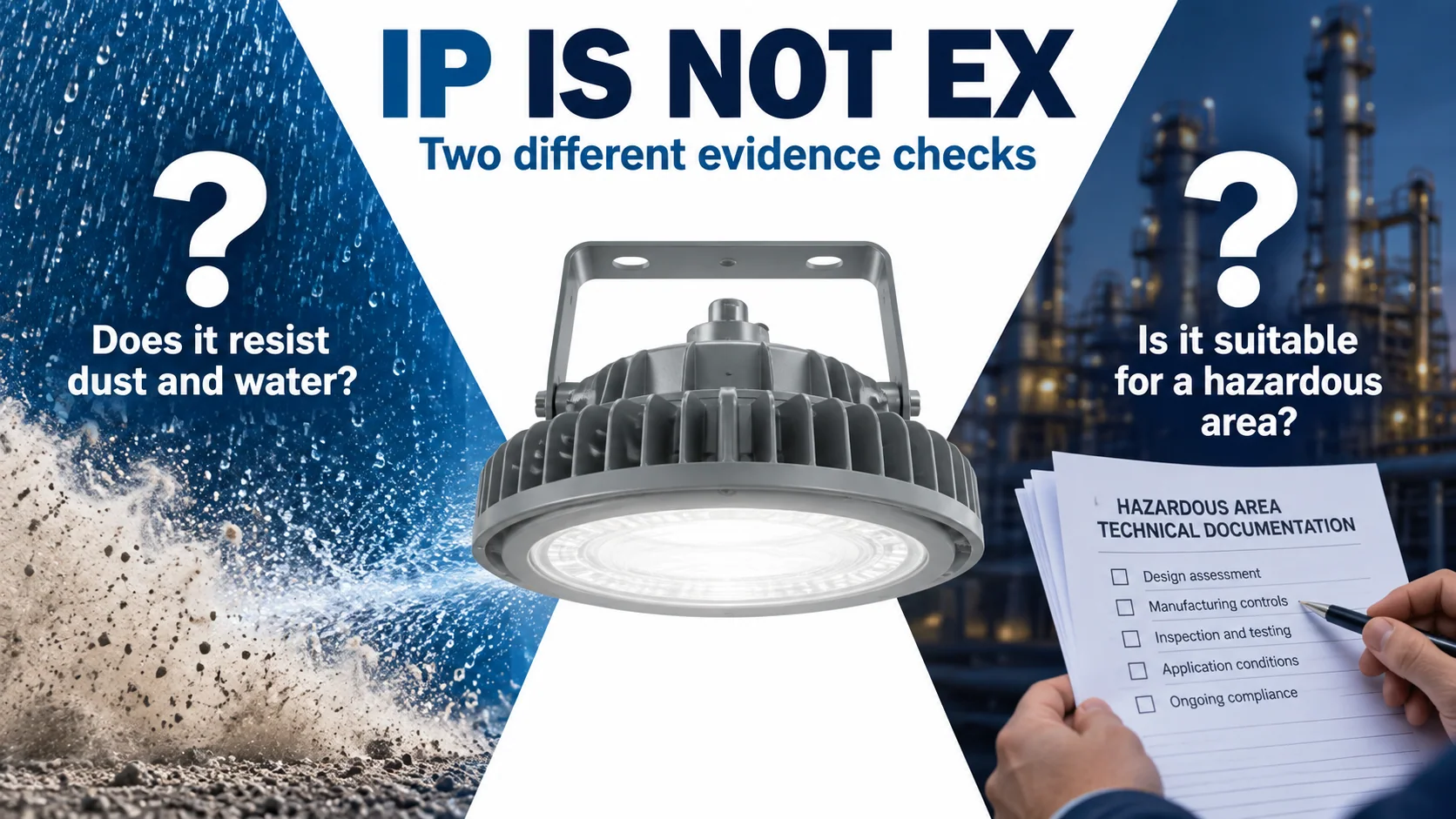
No. An IP rating does not establish that a light is suitable for an explosive atmosphere. An IP code classifies protection provided by an enclosure against access and the ingress of solid objects and water under IEC 60529. Hazardous-area suitability requires the equipment approval or conformity specified for the location, the complete marking, exact model and variant scope, and an installation that follows the applicable rules. A project may require both kinds of evidence, but one cannot stand in for the other.
“Explosion-proof” is also used loosely in marketing. Under North American rules it can name a particular protection approach, while other Ex protection techniques may be accepted for particular locations. Ask for the project’s required scheme and the exact equipment documents instead of treating the phrase as a universal certificate.
Two questions, two evidence sets
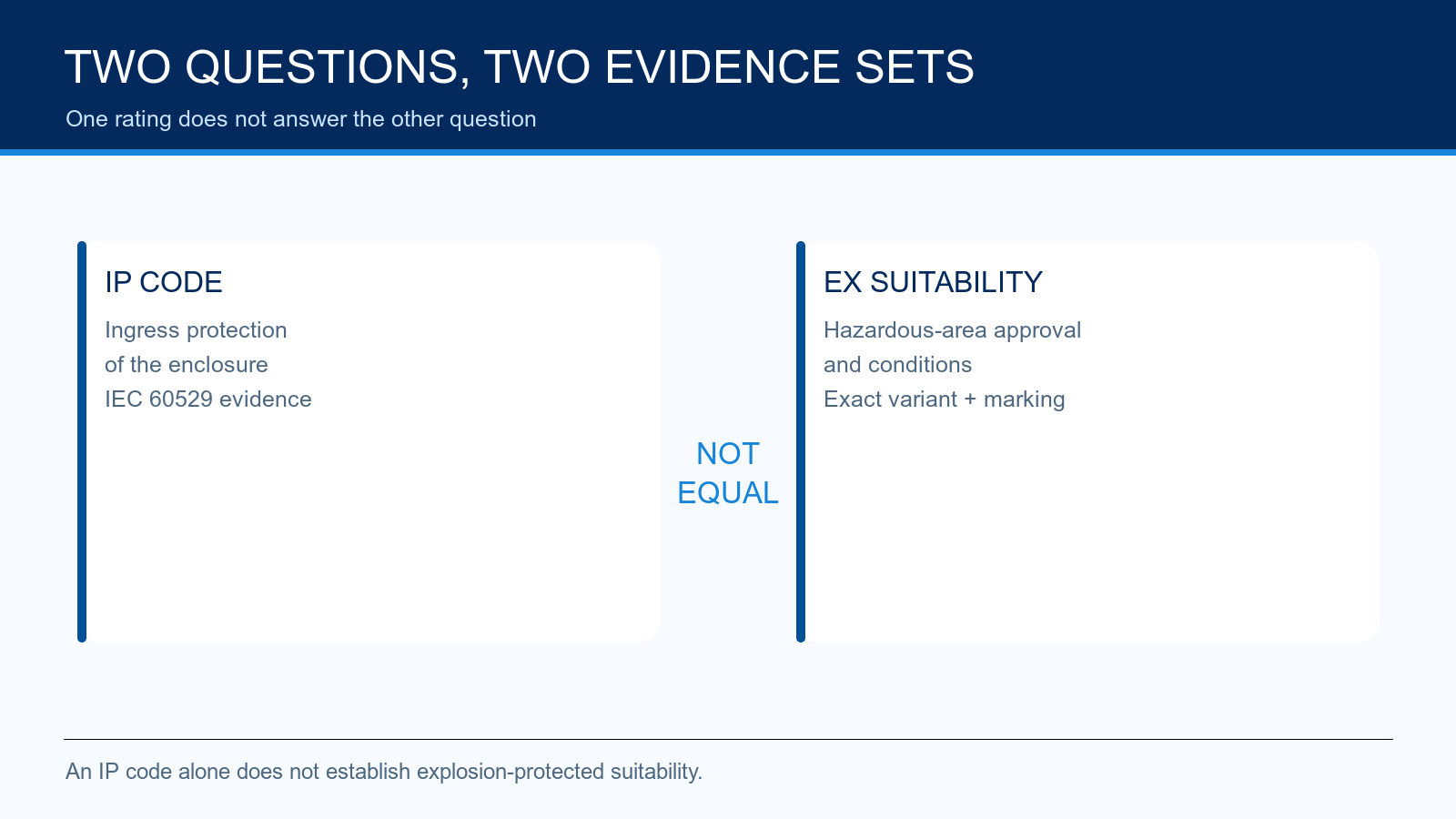
| Question | Evidence to inspect | What it does not establish |
|---|---|---|
| How does the enclosure resist ingress? | IP code and the exact product’s enclosure/test information under IEC 60529 | Gas or dust explosion-protection approval; chemical or corrosion life |
| Is the electrical equipment acceptable in this hazardous location? | Complete Ex or hazardous-location marking, current certificate/listing and schedule, exact model identification, conditions of use, and applicable installation documents | That every variant, accessory, gland or installation is automatically covered |
The first question is about enclosure protection. The second is about ignition risk in a defined atmosphere and under a defined conformity framework. Enclosure integrity can be part of an Ex protection concept, especially for certain dust applications, but that relationship must come from the applicable equipment standard and certification. You cannot derive it from the IP digits alone.
The distinction is practical: an IP-rated industrial high bay might be designed to withstand dust or rain but lack any hazardous-area approval. Conversely, an Ex-certified luminaire still needs to meet the project’s water, dust, washdown and other environmental requirements at its actual mounting location.
What an IP code tells you
IEC 60529 defines the IP Code for degrees of protection provided by electrical-equipment enclosures. The first characteristic numeral relates to access to hazardous parts and ingress of solid foreign objects; the second relates to water ingress. Additional letters may appear where relevant. The product’s test and rating must be checked for the exact construction, including fitted entries and accessories.
An IP code does not describe whether a driver, cable connection or hot surface can ignite a particular gas or dust atmosphere. It also does not, by itself, prove resistance to corrosion, process chemicals, UV, vibration, impact, immersion beyond its stated test, or repeated cleaning conditions. Those properties need their own project requirements and product evidence.
Why “IP66 means explosion-proof” fails
Even if a luminaire has an IP66 marking, that code only addresses its claimed enclosure protection under the relevant IP test conditions. It says nothing by itself about the required gas group, dust group, temperature class, equipment protection level, protection technique, approved ambient range or hazardous-location approval. The same enclosure style could contain different drivers, optics, entries or operating temperatures.
The reverse shortcut also fails: a hazardous-area marking is not a complete environmental specification. A certified product can still be the wrong choice for salt spray, aggressive cleaning, low temperature, a high-vibration structure or a particular ingress requirement. These are separate checks against the same proposed ordering code.
What hazardous-area evidence must answer
The project first needs an approved area-classification drawing or schedule and a governing jurisdiction. That document identifies whether the issue is gas/vapor, combustible dust or another hazard, along with the required classification and material/temperature conditions. The electrical designer then determines the applicable equipment and installation rules.
For U.S. workplaces, OSHA 29 CFR 1910.307 requires each room, section or area to be considered individually and requires hazardous-location equipment to be intrinsically safe, approved for, or otherwise demonstrated safe for that location under its specified conditions. The rule also addresses documentation and equipment marking. An IP code is not one of these approval routes.
For IEC-based projects, IEC 60079-0:2026 sets general requirements for Ex-equipment construction, testing and marking; the applicable protection-standard parts and the project’s adopted installation rules add other requirements. IEC 60079-14:2024 covers Ex electrical-system design, equipment selection, installation and initial inspection, including documentation and competency. Naming these standards does not prove that a particular TORMIN model has been tested or certified to them.
The IECEx Certified Equipment Scheme provides an online certificate system for equipment within the scheme. The IECEx guidance for certificate users describes checking a certificate record and its updates. An IECEx certificate is evidence for the models and conditions it identifies; local acceptance and installation requirements still need separate review.
Read the exact variant, not a family claim
Request the full ordering code, not only a series name or product photograph. Compare it with the certificate, listing, schedule or annex and the manufacturer’s installation instructions. Check at least:
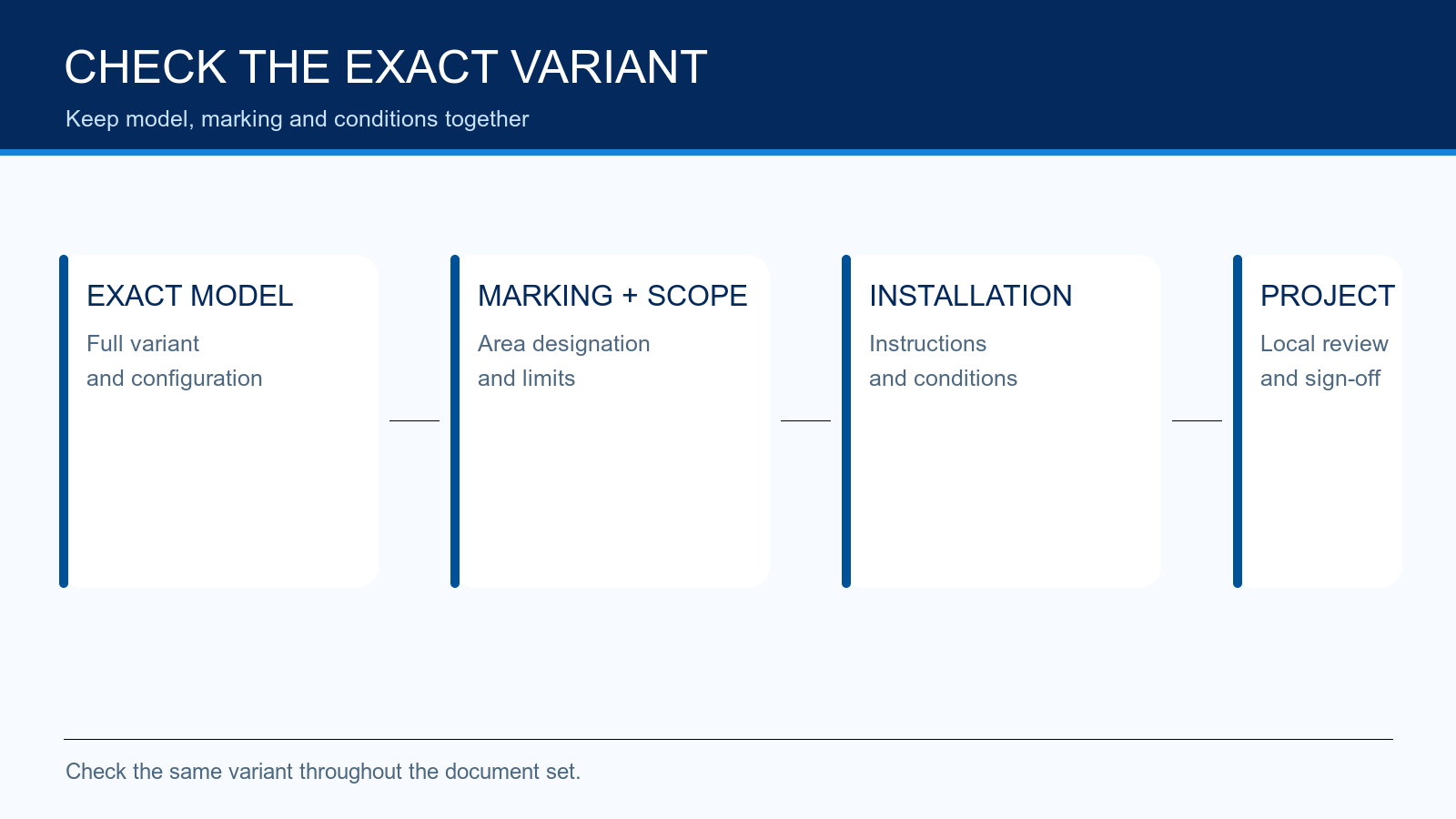
- the required jurisdiction and approval scheme;
- the Class/Division or Zone and gas/dust scope stated by the project;
- equipment group, gas or dust group, temperature class or maximum surface temperature;
- equipment protection level or category when applicable;
- certified ambient range and any special conditions of use;
- optics, driver, emergency/battery, mounting, entries and accessories included in the offered variant;
- the separately required IP, corrosion, temperature and mechanical evidence.
If the exact code is absent from the document scope, the correct response is to request clarification from the certificate holder or responsible engineer. A certificate logo placed on a brochure does not extend certification to every visually similar configuration.
| Supplier statement | Appropriate next question |
|---|---|
| “This light is IP66, so it is explosion-proof.” | Which hazardous-area approval, complete marking and exact certificate/listing cover this model and variant? |
| “This series has IECEx.” | Which ordering code is on the current certificate and schedule, and what conditions apply? |
| “The model is Ex-certified, so it is suitable offshore.” | What exact material, coating, entry, fastener and environmental evidence covers the mounting exposure? |
| “The catalogue says Zone 1/2.” | Which project classification, gas group, temperature requirement, ambient range and local acceptance route does the quoted unit satisfy? |
The Class I Division 1 versus Division 2 guide explains why Division and Zone labels cannot be treated as direct certificate conversions. This article’s narrower decision is whether an IP marking can replace hazardous-area evidence; it cannot.
A clean document request for buyers
Attach the controlled classification drawing and the environmental specification to your RFQ. Ask each supplier to return a separate response for hazardous-area suitability and enclosure/environmental suitability, both tied to the same full ordering code. Require the certificate or listing record, schedule or annex, marking drawing, current datasheet, instructions and any special conditions. Record deviations rather than accepting a general “equivalent” statement.
The TORMIN standards and certifications page can help locate available first-party information, and the hazardous-area lighting category shows candidate product types. Neither page alone proves that a particular unit is acceptable for a project. Send the classification and document requirements through the TORMIN contact page for exact-model review.