
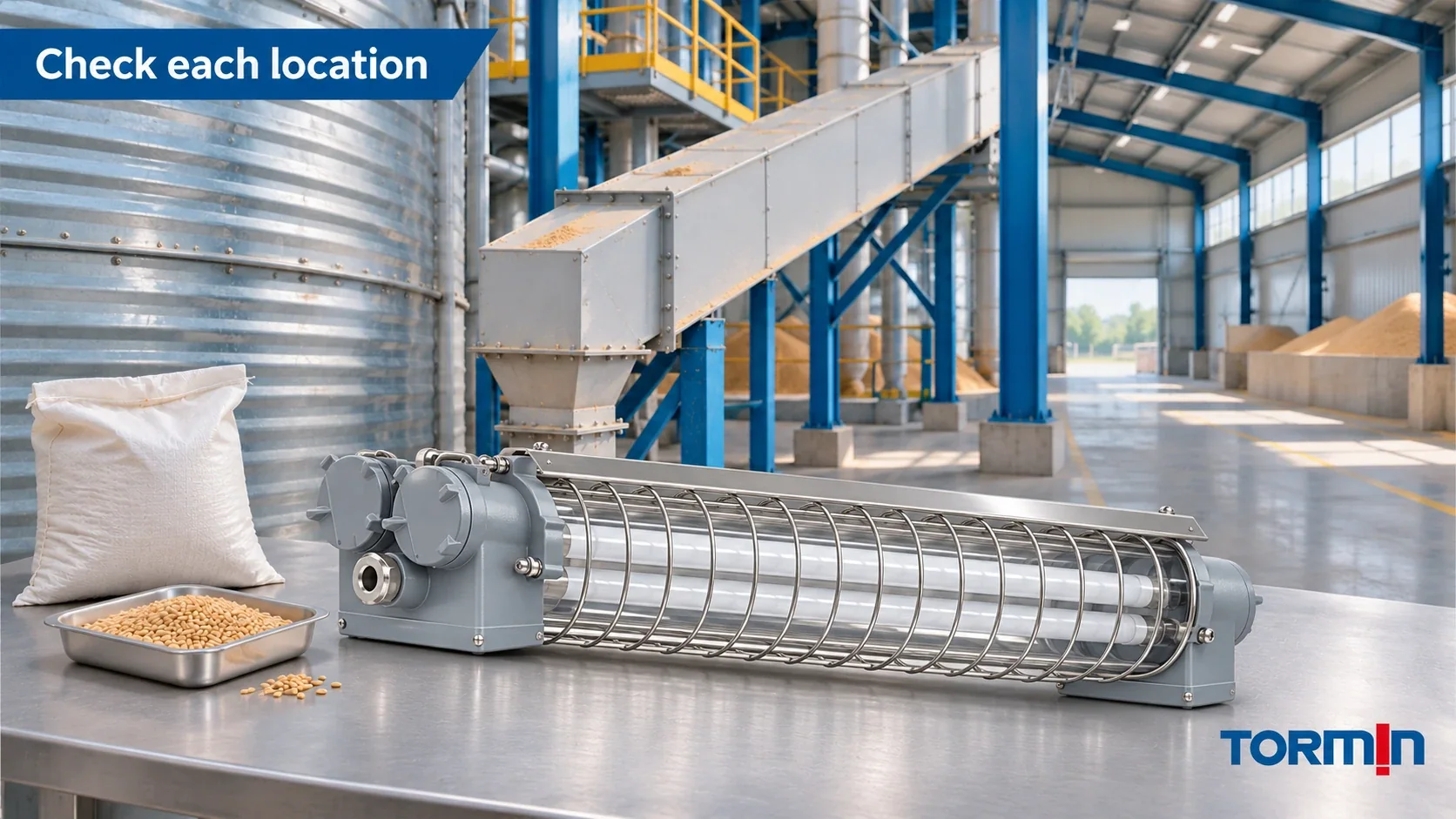
Short answer
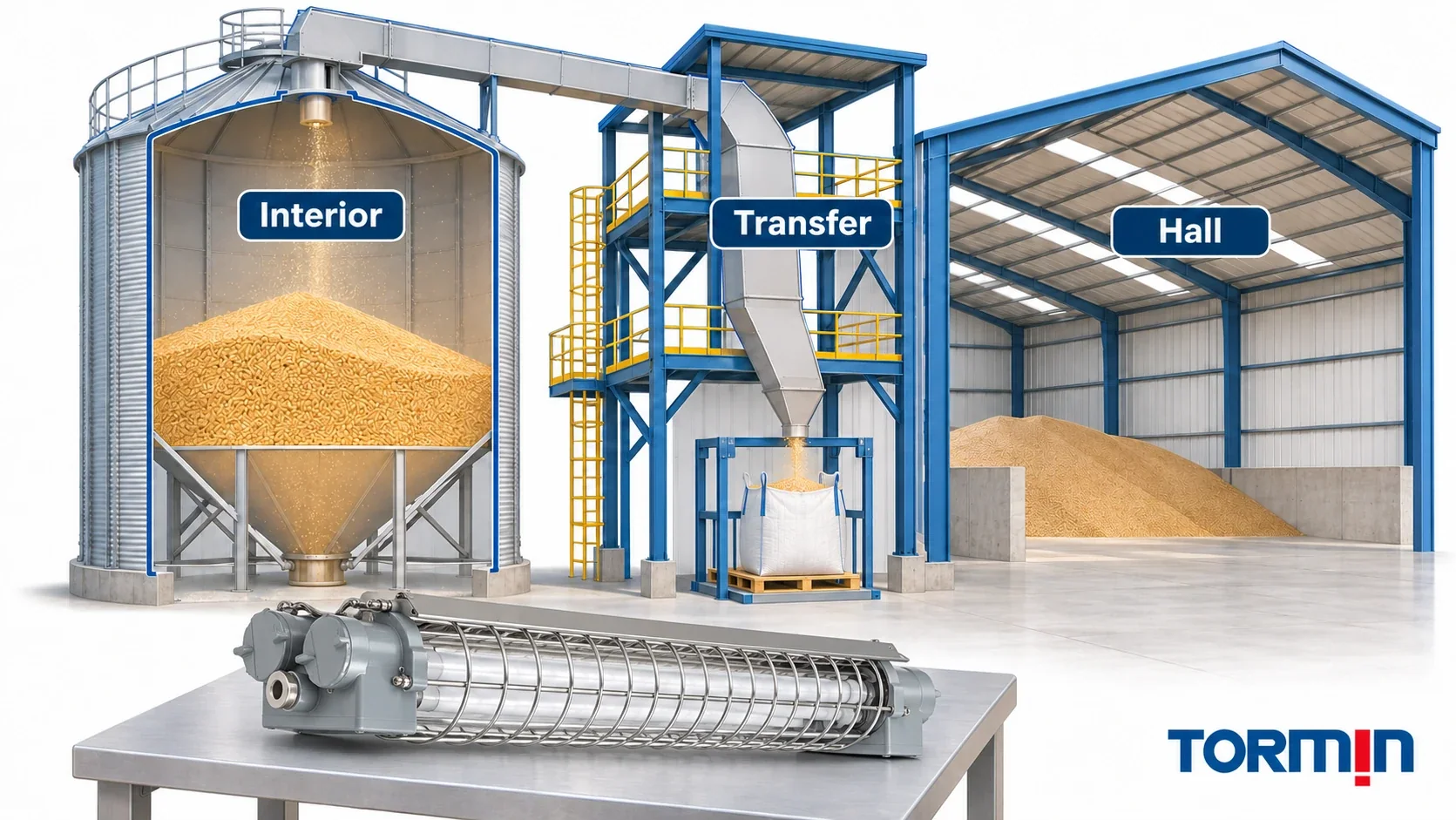
Explosion proof grain silo lighting starts with the exact mounting location. A grain facility can contain three different dust-exposure scenarios: process interiors, the surroundings of release points, and halls with controlled deposits. They do not automatically become three classified areas. The classification study determines each location’s requirement; the dust’s cloud and layer ignition properties then determine the permissible equipment surface temperature. Buying by wattage or giving the whole plant one rating misses both decisions.
Use the following table to organize a site review. Its IEC and NEC descriptions are independent possibilities, not equivalent approvals or a classification drawing. The position of the light relative to containment matters as much as the name of the building.
| Location | Zone / Division | Fixture considerations |
|---|---|---|
| Inside silos, bins or dust-handling equipment | Potential Zone 20 where explosive clouds are continuous, frequent or long-lasting. A separate NEC assessment may identify Class II, Division 1. | For Zone 20, verify EPL Da and an applicable protection method; Db is insufficient. Assess burial, deposits and the exact temperature conditions. |
| Transfer, bagging and elevator-head surroundings | Potential Zone 21 where explosive clouds occur occasionally in normal operation. A separate NEC assessment may identify Class II, Division 1. | For the enclosure-protection route, check Ex tb / Db or suitable higher protection, dust group and maximum surface temperature. |
| Processing halls and storage areas with controlled deposits | Potential Zone 22 only where explosive clouds are unlikely in normal operation and brief if they occur. An independent NEC assessment may identify Class II, Division 2; other outcomes are possible. | Check the applicable dust protection, temperature and housekeeping basis. Dust layers alone do not assign the classification. |
These scenarios follow the dust-cloud and layer distinction in IEC 60079-10-2. NEC Class II decisions use their own criteria under Article 500, followed by Article 502 equipment requirements.
One facility, three different answers
Inside containment
A luminaire inside a vessel can experience a different atmosphere from one mounted outside its wall. Filling, discharge and dust collection may produce persistent or recurring clouds inside containment. Where an explosive dust atmosphere is continuous, frequent or long-lasting, Zone 20 is the relevant IEC scenario. The study must establish whether those conditions actually exist at the equipment position.
Do not extend that conclusion automatically to a roof platform or inspection walkway. Conversely, a clean-looking walkway does not establish that an interior fitting can use the same specification. Record which side of the process boundary contains the light and whether dust can surround or bury it. Internal lighting also raises access and maintenance questions that an external wall fitting may avoid.
Around transfer points
Bag filling, transfer chutes and elevator-head surroundings deserve individual attention because release and containment change with the operation. Occasional explosive clouds during normal operation can support a Zone 21 assessment. An enclosed transfer with effective containment may produce a different extent from an open release. The equipment name alone does not establish either result.
For a lighting schedule, identify the release point, the lamp position and the operating states considered. A light above a bagging station and another beyond the assessed release extent need not receive the same requirement. Do not draw a standard-radius zone around every chute without a qualified assessment. Under NEC, apply Class II occurrence and accumulation criteria separately rather than translating the Zone number.
In halls and storage areas
An otherwise controlled hall may have settled deposits without a cloud during normal operation. A possible Zone 22 conclusion depends on an explosive cloud being unlikely normally and persisting only briefly if it occurs. Assess resuspension from layers, loss of containment and the effectiveness of housekeeping. Some positions may require a different classification or be unclassified.
Cleaning records are therefore part of the evidence behind the drawing. Persistent deposits on overhead ledges can become release sources even when the floor looks clean. A deterioration in containment or housekeeping requires review of the assumptions; sweeping the floor does not formally reclassify the building.
Use the general dust-environment guide for the wider framework. If the location basis is missing, the classification-input guide explains what to assemble for the competent classifier. Lighting selection follows that study.
Grain dust in the two marking systems
Typical nonconductive grain dust is IEC Group IIIB. Under NEC Class II, grain and flour dusts fall within Group G. Verify the material actually handled: a feed blend’s additives and physical properties should be represented by its documentation, rather than assumed from the word “grain” on a process description.
The dust-group and surface-temperature guide explains those markings. For IEC dust selection, use the maximum surface temperature stated in °C rather than the gas T-class ladder. Group coverage and temperature suitability remain separate checks. The Group G examples are supported by NEC 500.6(B)(3), which points to NFPA 499 for classification guidance; they do not convert an IEC approval into a North American approval.
The number that actually selects the fixture
Obtain representative dust test data or the supporting dust hazard analysis (DHA) records. Grain type, moisture and particle characteristics can change the relevant properties. There is no single ignition temperature that this article can assign to every grain silo or feed mill. A report for another material or process condition is not a substitute for the dust being assessed.
Keep the sample identity with the result: which material stream it represents, where it was collected and the conditions recorded by the testing organization. A whole-grain delivery description may not describe the fine fraction collected at an extraction point. Where a feed line changes ingredients, ask the DHA owner whether the existing data remain representative. Procurement should receive the approved values and their scope, rather than searching for a convenient number after choosing a light.
For the IEC cloud and thin-layer screening method, the permissible maximum surface temperature is the smaller of:
- Two-thirds of the dust-cloud minimum ignition temperature, calculated using its numerical value in °C.
- The minimum ignition temperature of a 5 mm dust layer minus 75 K.
In compact form: Tmax ≤ min[(2/3 × cloud MIT), (5 mm layer MIT − 75 K)]. A temperature difference of 75 K is also a difference of 75°C. Do not convert the cloud input to kelvin before multiplying it. These rules are stated in IEC 60079-14:2013, 5.6.3.2 and 5.6.3.3; the project’s adopted edition and the equipment’s particular conditions must also be checked.
Reusing the established teaching example
The following inputs are the hypothetical values already used in TORMIN’s dust article, not measured grain-dust data: cloud ignition temperature 300°C and 5 mm layer ignition temperature 280°C.
The cloud calculation gives 2/3 × 300°C = 200°C. The layer calculation gives 280°C − 75 K = 205°C. The smaller result is 200°C, so the cloud side controls this example. It is an upper screening limit under the stated assumptions, not a recommended operating temperature or a model approval.
A candidate’s applicable maximum surface temperature must not exceed that ceiling. Choosing below it leaves margin, but no temperature comparison compensates for the wrong EPL, an uncovered ambient range or unsuitable installation conditions. Enter the actual dust data in the dust surface-temperature checker, then retain the calculation with the fixture schedule.
When the thin-layer basis stops being enough
Deposits insulate the equipment and can become easier to ignite as their thickness increases. Where layers can exceed the 5 mm basis, the allowable temperature needs further reduction or specific verification. Do not invent a reduction by subtracting an arbitrary number from the first result. Dust surrounding the sides and underside, full burial, and Zone 20 applications need additional attention to the relevant tests and certificate conditions.
This IEC calculation is not a NEC acceptance calculation. NEC 500.8(D)(2) has separate Class II temperature provisions, including an additional limit for organic dusts that can dehydrate or carbonize. Apply those provisions for a NEC project rather than importing the example’s ceiling.
What the fixture has to survive here
The required protection level
For an IEC enclosure-protection route, Ex ta corresponds to EPL Da, Ex tb to Db, and Ex tc to Dc. Zone 20 requires Da; Zone 21 normally requires Db or suitable higher protection; Zone 22 permits Dc or suitable higher protection. These are selection relationships, not permission to put any fixture carrying a familiar suffix anywhere in the facility.
A tb/Db light selected for a transfer-point location does not become a Zone 20 candidate when moved inside a vessel. Da equipment must meet its own construction, fault and thermal requirements. Ex ta also has electrical constraints that can restrict practical fixture choices. Confirm that a suitable complete luminaire actually exists for the internal application; do not infer it from an external lighting range. Other protection methods require their own applicable evidence.
Dust exclusion and an exterior that can be cleaned
For IIIB equipment, IEC 60079-31:2022 Table 1 requires IP6X for ta and tb, while tc has an IP5X minimum. A grain project can deliberately specify IP6X as a stricter dust-exclusion preference, but it is inaccurate to call that the universal minimum for every IIIB Ex tc fitting. An IP rating alone never establishes Ex protection. IEC 60079-31 addresses both dust exclusion and ignition protection.
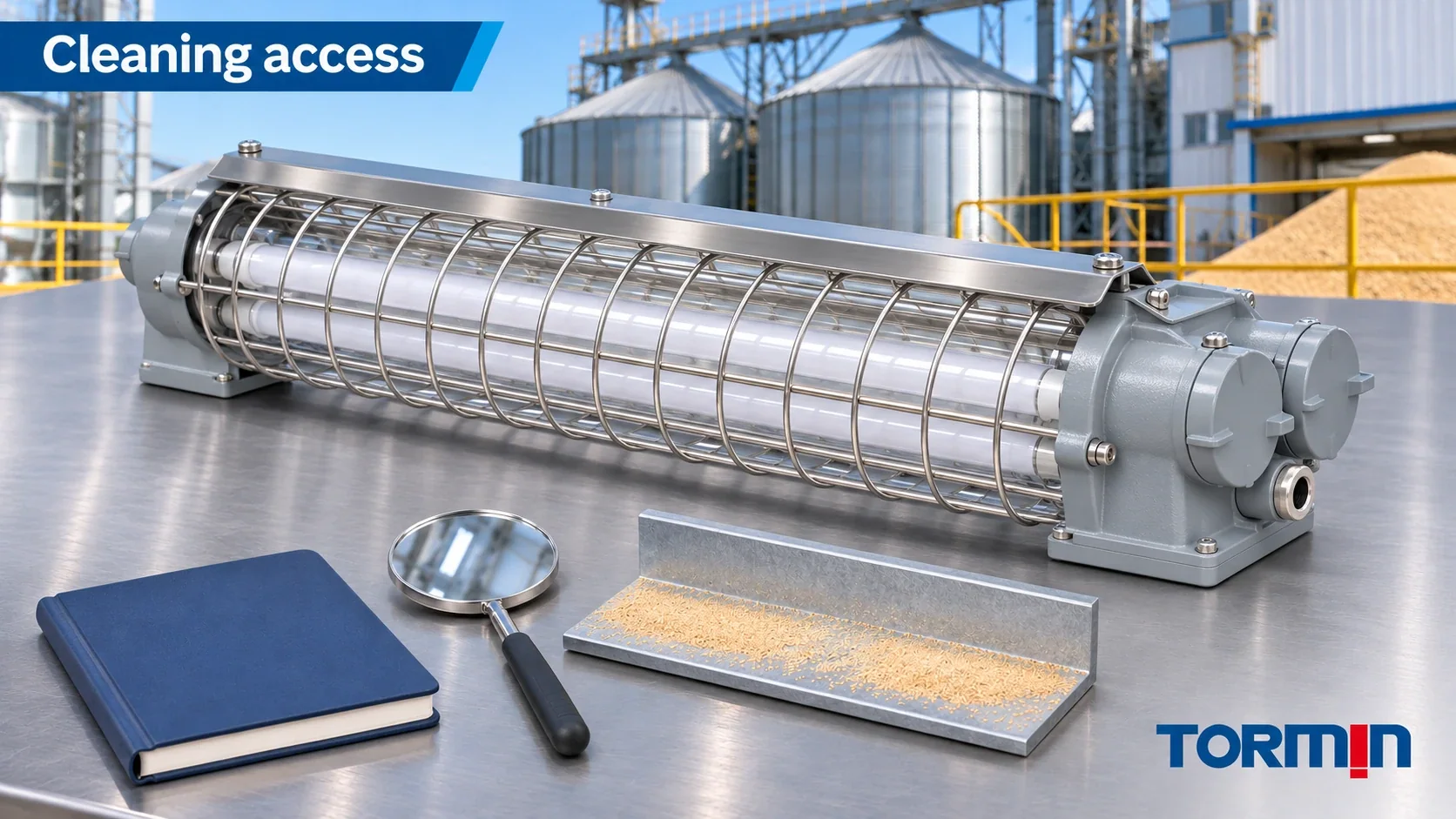
Inspect the actual installed orientation. Upward-facing flat areas and exposed cooling fins can retain deposits; inaccessible recesses complicate cleaning. Prefer smoother, accessible external shapes where the complete certified design permits. A high-output fitting with difficult-to-reach dust pockets can create a maintenance burden that its wattage comparison hides. Do not modify certified fins, covers or entries to improve cleanability.
In a NEC location, Article 502 distinguishes the requirements. Division 1 luminaires must be identified for the location. For fixed Division 2 lighting, 502.130(B)(2) permits dusttight enclosures or equipment otherwise identified for the location, with the applicable marking and temperature requirements. It does not impose one universal dust-ignitionproof construction on every fixed Division 2 light. This distinction is visible in the NEC-based adopted code text; use the edition adopted for the project.
The documents must describe the supplied configuration
Match the exact luminaire configuration to its dust marking, permitted ambient range, installation instructions and certificate schedule. Check any dust-layer conditions and cleaning requirements. A gas-only marking cannot prove dust suitability, and a general product-family statement cannot establish the variant’s maximum surface temperature.
The nameplate and certificate guide provides the document-reading step. Add the proposed mounting orientation and means of reaching the exterior to the review, so maintenance staff can actually preserve the conditions the specification assumes. No model is recommended here without that location-specific evidence.
For each light position, retain a schedule row connecting the drawing reference to the material data, temperature calculation, selected configuration and cleaning provision. Record whether access requires a planned stoppage or other site controls. This lets a replacement review recover the original reasoning: an apparently similar housing does not show whether its temperature or maintenance conditions match. It also makes a later process change visible to both the electrical and operations teams.
Housekeeping is part of the lighting specification
A surface-temperature calculation assumes a deposit condition. If the cleaning program cannot maintain it, the calculation and selected equipment conditions need review. Cleaning access is therefore a design input: the responsible team needs to know which surfaces accumulate dust, who checks them and how they can be reached under the site’s safe-work arrangements.
OSHA 29 CFR 1910.272, paragraph (j)(1), requires a written housekeeping program addressing the frequency and methods used to reduce fugitive grain-dust accumulations. Its application includes feed mills as well as grain elevators. A lighting specification should align with that program instead of assuming the maintenance team will discover an inaccessible fitting later.
The additional priority-area provision in (j)(2) is specifically for grain elevators. It calls for immediate removal when fugitive grain-dust accumulations exceed 1/8 in., approximately 3.2 mm, in those areas, or a demonstrated and assured equivalent-protection housekeeping program. This is not a blanket permission to allow that depth on every light, and it must not be presented as an identical statutory threshold for every feed mill.
Legacy NFPA 61:2020, 8.4.2.1, also addresses written housekeeping and a 1/8 in. accumulation criterion, but includes affected-area and documented risk-assessment conditions. Its basis differs from OSHA’s designated priority areas. NFPA has consolidated NFPA 61 into NFPA 660:2025; establish the edition applicable to the facility rather than treating the old number as the only current reference.
The housekeeping action criterion and the 5 mm thermal test basis serve different purposes. Neither allows the operator to wait for a lamp to become heavily coated. When deposits exceed the assumed condition, control the situation through the site’s procedures, restore housekeeping and have the affected selection basis reviewed. Cleaning alone cannot authorize continued use of equipment with an unsuitable rating.
Join this review to the lighting inspection program: record recurring deposits, damaged covers, compromised entries and access problems. Repeated buildup should prompt investigation of containment and maintenance arrangements, rather than an endless cycle of cleaning an unsuitable location.
Mistakes
- Buying the highest specification for every position. Standardization can simplify spares, but it can also add avoidable cost where the documented requirement is lower. Verify the complete configuration and access needs before deciding that one fitting is economical everywhere.
- Buying the lowest specification for the whole plant. A hall specification cannot cover a normally dusty transfer point or a process interior automatically. Check each scheduled position against its classification and equipment conditions before accepting a common fixture.
- Using gas-temperature shorthand or checking only the cloud. The layer calculation can control, and deposits affect heat loss. Retain both dust inputs and their test basis; a familiar gas marking or a low wattage does not establish the required dust temperature performance.
- Treating vaportight as a rating: the term does not establish explosion protection; check the actual marking and supporting documents.
Carry the location, dust data, calculated ceiling and housekeeping assumptions into the complete lighting-selection process. That gives the supplier a defined requirement and the site a basis it can maintain.
FAQ
Are grain silos a Zone 20, 21 or 22 area?
Different positions can have different requirements. An interior with persistent explosive clouds may be Zone 20; an occasional normal release may support Zone 21 nearby; a controlled hall may meet Zone 22 criteria. These are assessment scenarios, not automatic assignments. The drawing must identify the actual position and extent.
What dust group is grain dust?
Typical nonconductive grain dust is IEC IIIB; grain and flour dusts are NEC Class II Group G. Confirm the actual dust or feed blend from representative records. The group does not establish the permissible surface temperature or make the two approval systems interchangeable.
Why does the surface temperature marking matter more than wattage in a feed mill?
Wattage describes electrical input, while dust selection depends on the equipment’s applicable maximum surface temperature and the dust’s cloud and layer limits. Deposits also insulate the fitting. Two lights with similar wattage can have different thermal conditions and suitability.
Can one fixture type be used across the whole grain facility?
Possibly, if its exact configuration covers every required location, temperature and installation condition. A higher protection level can cover a lower requirement where applicable; the reverse does not work. Compare the resulting maintenance, access and purchasing costs with a location-specific schedule.
How much dust accumulation is too much?
Use the facility’s controlled program and thermal assumptions. OSHA’s grain-elevator priority-area rule addresses accumulations exceeding 1/8 in., with an equivalent-protection alternative; NFPA 61’s legacy criterion has additional conditions. Neither is a universal safe layer depth for a luminaire. Unexpected buildup requires action and review before relying on the original selection basis.
Sources
- IEC — IEC 60079-10-2:2026, Classification of areas: Explosive dust atmospheres — public scope distinguishes clouds, layers and housekeeping; public definition excerpts support the location scenarios.
- California Electrical Code, 2022 edition, based on NEC 2020 — 500.5(C), 500.6(B)(3), 500.8(D)(2) and 502.130; project-adopted editions govern.
- IEC — IEC 60079-14:2013 — 5.6.3 cloud/layer rules checked in publicly accessible standard text; 2024 edition record identifies the subsequent edition, whose full clauses were not accessed for this article.
- IEC — IEC 60079-31:2022, Equipment dust ignition protection by enclosure “t” — public preview 4.1 and Table 1 establish ta/tb/tc, EPLs and group-dependent ingress protection.
- OSHA — 29 CFR 1910.272, Grain handling facilities — application, written housekeeping and grain-elevator priority-area provisions.
- NFPA 61:2020 — Standard for the Prevention of Fires and Dust Explosions in Agricultural and Food Processing Facilities, public text — 8.4.2.1 housekeeping criterion and qualifications; NFPA 660:2025, Origin and Development documents the consolidation.
- NFPA — NFPA 499 recommended practice — scope pointer for dust classification referenced by NEC; no site boundary is derived here from its examples.