

Explosion-proof lighting inspection asks what the inspection can establish: visual covers visible defects; close adds access and tools; detailed adds internal examination and/or testing where necessary. These are IEC inspection grades.
An operating lamp does not establish intact explosion protection. See the introduction to IEC 60079-17:2023.
For an asset owner or inspection coordinator, the useful output is a record that connects the grade, actual coverage, observations and unresolved checks. A photograph of the front of a luminaire should not quietly become evidence about an unseen cable entry or internal connection.
Visual, close and detailed: what each grade adds
| Inspection grade | Reach of the inspection | Illustrative defect | Boundary of the result |
|---|---|---|---|
| Visual | Defects apparent to the eye, without access equipment or tools. | A visibly missing fastener. | Does not establish conditions that need closer access or internal examination. |
| Close | Includes visual; uses access equipment and tools. Normally no enclosure opening or de-energization. | A previously unnoticed loose bolt. | Does not establish internal termination condition. |
| Detailed | Includes close; adds opening and/or tools and test equipment as necessary. | A loose internal termination. | Covers completed work against applicable criteria. |
Close and detailed: IEC 60079-17 preview, clauses 3.1 and 3.3. Visual: UK MOD petroleum-installation guide, section 6.
Inspection depth is not work authorization. A close inspection normally staying closed does not authorize energized manipulation. Apply separate safe-work controls.
Current edition: IEC 60079-17:2023, edition 6. Use applicable adopted requirements and exact equipment instructions. Full inspection tables and mining are outside this comparison.

Apply the grade to the luminaire’s actual viewing limits
The UK MOD guide gives exterior examples involving enclosure and glass condition, fasteners, cable entries, cables, earthing and environmental deterioration. Its requirements concern MOD petroleum installations; its inspection cycles and defect codes should not be transferred to another site as universal rules. Use the examples as observation prompts, then assess the installed luminaire against its own inspection criteria. Source: MOD Pet 02, inspection schedules.
For a lighting inspection, the position of the observer matters. A front view may show the lens and face fasteners while a bracket, pipe or structural member hides the rear entry. A wide photograph records that view; it does not remove the obstruction.
Separate three things in the report:
- Observation: what the inspector actually saw, identified or established within the authorized scope.
- Assessment: how that finding compares with the applicable documented criterion.
- Limitation: what remains unseen, unchecked or unresolved, and what follow-up is needed.
For example, “rear cable entry not visible from this position” is a useful limitation. “Cable entries satisfactory” would claim more than that view supports. Likewise, an apparently present fastener and a verified fastening condition are different observations. Avoid turning a photograph into a check that the work order did not include.
Start with the correct asset identity. The nameplate and certificate guide explains that document-matching task separately. Use the matched documents to identify the inspection instructions and acceptance criteria.
Define the detailed scope before arranging internal access
An instruction such as “perform a detailed inspection” still leaves practical questions. Which installed variant is involved? What protection types apply? Which documents and special conditions govern it? What examination or tests are included, and who is authorized to perform them?
The IECEx OD 504, edition 5, Ex007/Ex008 competence framework connects inspection with dossier review, safe work, applicable requirements and reporting. It is a scheme document, not a universal credential rule.
Before commissioning work, ask for an explicit scope rather than a promise to “check everything.” Useful questions include:
- Which exact luminaire instructions and document revisions will the inspector use?
- Which locations or interfaces require access that is unavailable during the planned visit?
- Which unresolved findings would require another inspection activity or a separate repair decision?
- Who will review limitations and decide the next authorized action?
Keep electrical safety planning distinct from that scope. UK HSE HSG85 emphasizes competent work, secure isolation, all relevant supply sources, stored energy and proving dead. Where an installed lighting system includes backup supplies or stored energy, those sources belong in the authorized planning. Follow the site’s hazardous-area controls and exact equipment instructions before internal work. This article supplies no opening, isolation, testing or reassembly procedure.
Record what was inspected—and what was not
IECEx OD 504 covers documenting faults and unauthorized changes, reporting actions and re-energization status where applicable, and retaining inspection records in the verification dossier. See Ex007 and Ex008.
The following six-field format is an editorial aid for reviewing a report, not an official inspection form:
| Record field | What the reviewer should be able to identify |
|---|---|
| Asset and location | Luminaire identity and inspection location. |
| Planned and actual coverage | Intended grade, completed work and scope changes. |
| Assessment basis | Documents and revisions used for assessment. |
| Observation and evidence | Condition, date and photo or result reference. |
| Limitation and follow-up | Unchecked item, reason and required follow-up. |
| Action and closure | Recipient, action, applicable circuit state and closure evidence. |
Avoid a single “pass” box that conceals incomplete coverage. The record should let another competent reviewer distinguish a completed check from a check that could not be performed. Attach evidence to the specific finding instead of leaving the reader to infer which asset a photograph shows.
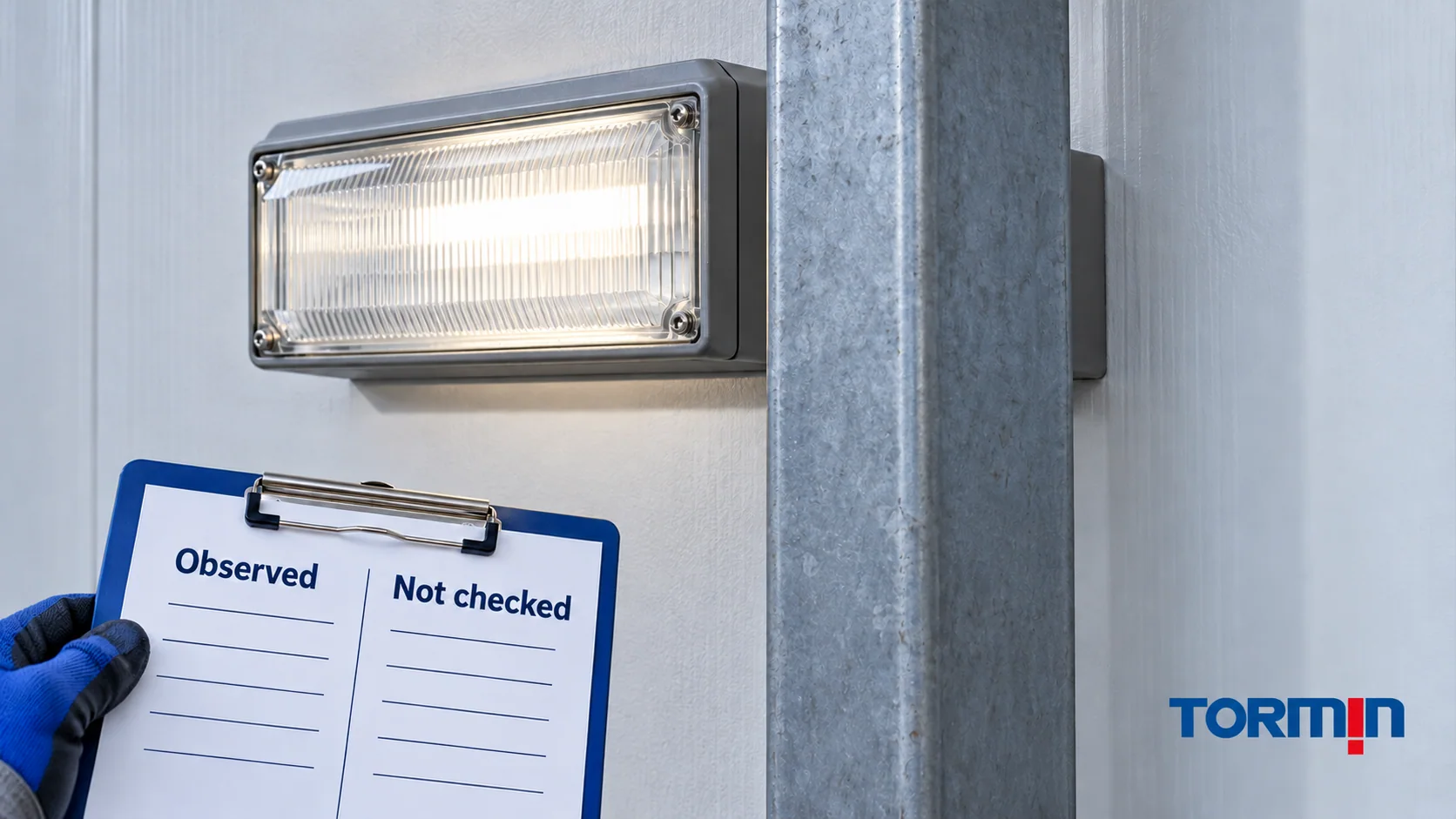
Example: an inaccessible rear entry
Consider an invented asset, L-017, observed from a walkway during a planned visual inspection. The front exterior is visible, but a structural member blocks the rear entry. The record identifies L-017, the viewing position and the photograph; it states that the rear entry was not examined. The coordinator assigns review of suitable access and the required inspection scope.
That entry is a record of a limitation and follow-up. It is not evidence that the unseen entry passed, that a closer inspection occurred, or that the luminaire is safe to continue operating. Any operating-state decision needs the authorized person’s assessment of the actual circumstances.
Route findings without turning inspection into repair
When a finding needs attention, preserve its identity and evidence so the next person knows what was observed. Ask the responsible person to define the next action and the evidence needed to close it. Replacing a vague report with a more specific report is useful; it does not itself correct the equipment.
Inspection and repair also have different scopes. IEC 60079-19:2025 addresses service-facility repair, overhaul and reclamation. Its catalogue scope excludes manufacturer repair of its own equipment. An inspection finding is therefore a reason to resolve the appropriate repair route, not an invitation to improvise a repair.
Do not attach a universal annual or three-year interval to the three grade names. When reviewing an inspection proposal, request the site’s programme, the basis for its interval and any unresolved findings from the previous visit. If salt exposure and access restrictions are the specific problem, the offshore lighting guide addresses that separate operating context.
Request the documents for the installed lighting
For replacement or product enquiries, begin with TORMIN’s hazardous-area lighting category. A category listing does not establish suitability for the installed asset or its inspection findings. The lighting selection guide covers pre-purchase checks.
Send the exact model or variant, available certificate reference, location information and the relevant finding through TORMIN’s contact page. Request the matching instructions and clarification of the documented maintenance or service route. Keep the inspection limitation visible in the enquiry—for example, “rear entry not examined”—so a product discussion does not become an unsupported clearance of the existing installation.
Sources
- IEC, IEC 60079-17:2023, edition 6. Electrical installations inspection and maintenance: edition and scope; authorized preview: introduction and accessed definitions.
- UK MOD DIO, TS2023-01, Pet 02 v2.1. Maintenance, inspection and testing at MOD petroleum installations, section 6 and inspection schedules; estate-specific guidance.
- IECEx, OD 504, edition 5.0, 2022. Specification for units of competence assessment outcomes, units Ex007 and Ex008.
- UK HSE, HSG85, third edition, 2013. Electricity at work: Safe working practices, competent work and safe isolation.
- IEC, IEC 60079-19:2025, edition 5. Official service-facility repair, overhaul and reclamation scope.