
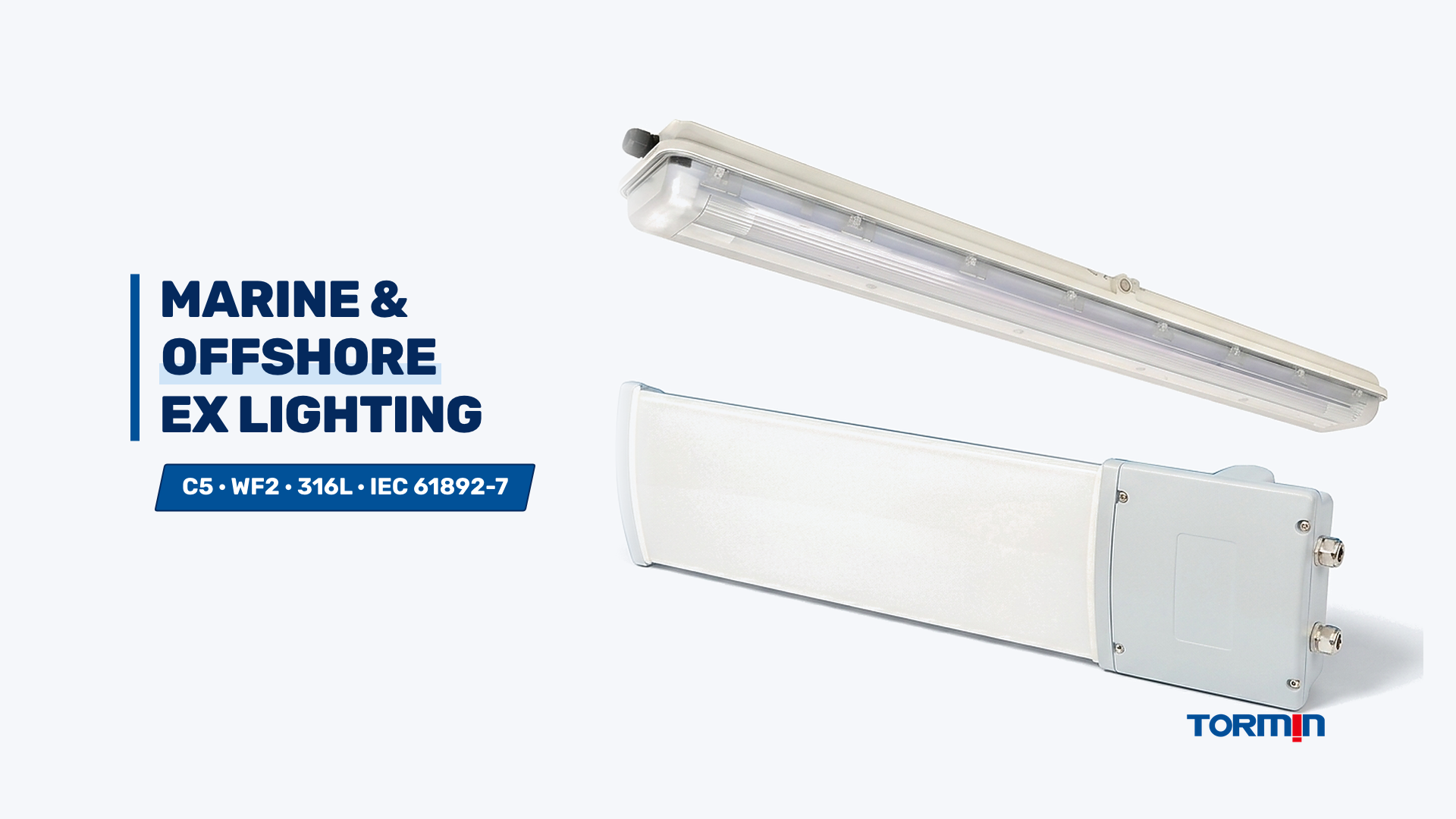
Specifying marine and offshore explosion-proof LED lighting requires passing three independent engineering gates rather than relying on a standard onshore datasheet. Every luminaire deployed on offshore platforms, FPSO decks, LNG jetties, or chemical tankers must simultaneously satisfy hazardous-area ignition protection (IEC 60079 and IEC 61892-7), marine anti-corrosion metallurgy (ISO 12944 C5/CX or WF2 with 316 stainless hardware), and vibration-resistant maintenance access.
Onshore luminaires that carry valid Zone 1 or Zone 2 certificates routinely fail within 18 to 36 months at sea when chloride salt spray pits 304 stainless fasteners, seizes aluminum-to-brass cable gland threads, or bridges heat-sink fins with conductive salt crust. Before issuing an enquiry for ATEX explosion-proof lighting or marine-ready explosion-proof LED linear lights, engineering teams should separate offshore exposure micro-zones, corrosion metallurgy, and certification layers using the framework below.
Offshore Exposure Micro-Zones and Environmental Demands on Marine Platforms
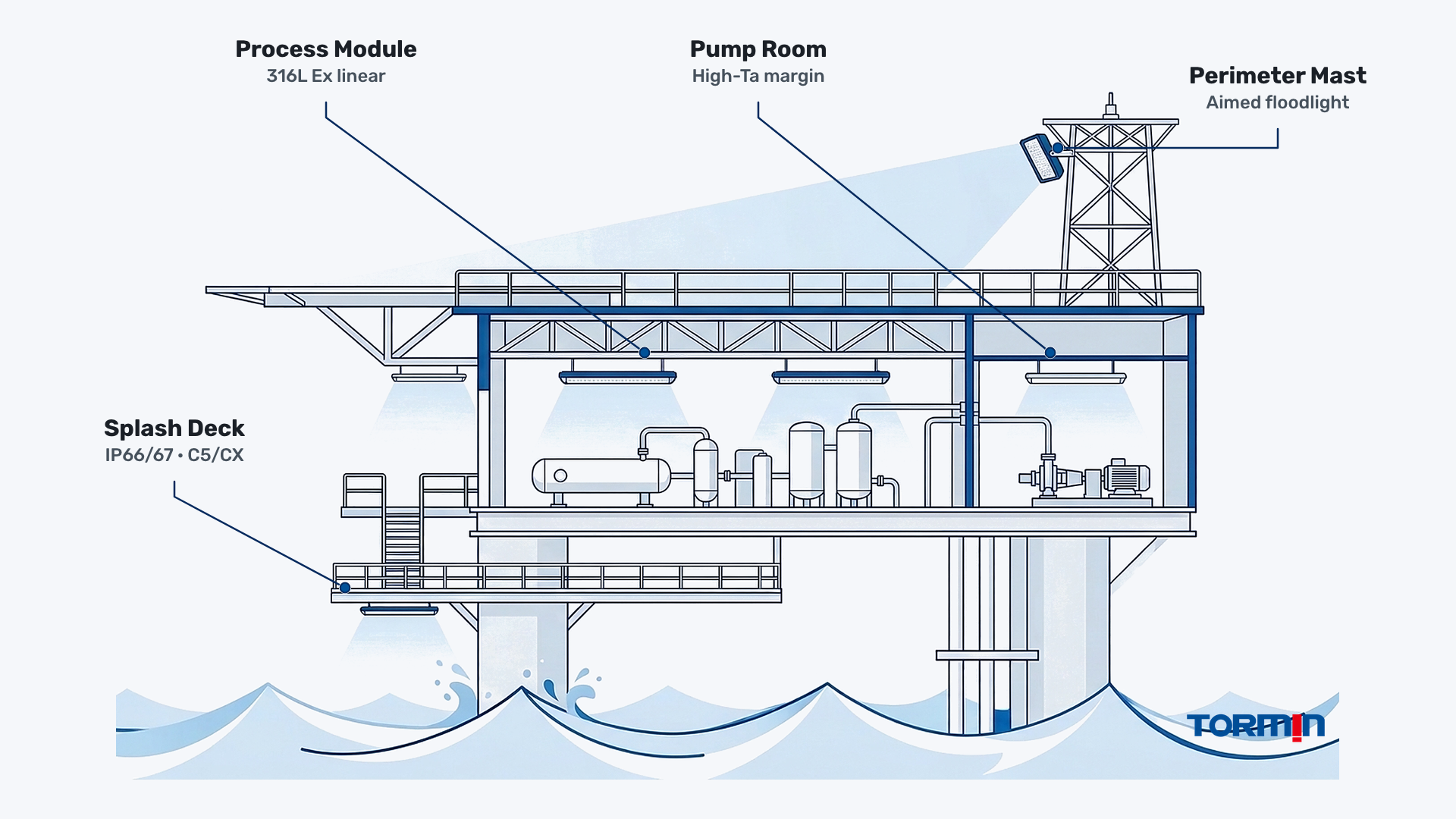
Offshore platforms, vessels, and coastal terminals are not a single uniform environment; exposure severity varies sharply between wave-swept exterior decks, sheltered process modules, and enclosed machinery spaces. Mapping each lighting circuit to its physical micro-zone prevents both under-specifying splash-zone enclosures and over-spending on protected interior compartments.
| Offshore / Marine Micro-Zone | Dominant Environmental Stress | Typical Area Classification | Minimum Enclosure & Hardware Baseline | Primary Luminaire Form Factor |
|---|---|---|---|---|
| Open Splash & Main Weather Deck | Direct salt spray, wind-driven rain, UV, green-water wash | Zone 1 or Zone 2 (verify site drawing) | IP66 / IP67, ISO 12944 C5 or CX / WF2, 316L fasteners | Low-profile marine explosion-proof LED linear or marine floodlight |
| Sheltered Process & Wellhead Module | Airborne salt mist, hydrocarbon mist, pipe-rack vibration | Zone 1 or Zone 2 (IIA / IIB / IIC) | IP66, C5 / WF2 finish, secondary safety-cable retention | Elongated diffused linear (e.g., BC5402A with 316 hardware option) |
| Derrick, Flare-Boom & Perimeter Mast | High wind load, heavy structural vibration, difficult rope access | Zone 1, Zone 2, or Non-Hazardous | IP66, high-vibration bracket, low wind-area modular body | Bracket-mounted explosion-proof LED floodlight |
| Enclosed Pump, Mud & Engine Room | Elevated ambient Ta (45 to 55 °C), oil vapor, washdown | Zone 1 / Zone 2 or Non-Hazardous | IP66, verified high-Ta T-class margin, easy gland access | Compact linear or anti-corrosive tube (e.g., BC5407) |
| Jetty Loading Arm & Tanker Manifold | Coastal salt fog, cargo vapor release, corrosive washdown | Zone 1 or Zone 2 | IP66 / IP67, WF2 / C5 coating, non-sparking entry hardware | Linear walkway fixtures plus perimeter floodlights |
Treat this micro-zone split as the structural input to your luminaire schedule; never copy an enclosed engine-room fixture code onto an exposed weather-deck walkway without verifying wind load, UV diffuser stability, and 316 stainless fastener availability. For multi-elevation layouts combining low pipe-rack walkways with open laydown decks, align fixture form factors using our explosion-proof high bay vs linear vs floodlight guide.
ISO 12944 C5 / CX vs. WF2 Anti-Corrosion Grades and Marine Metallurgy
Marine corrosion failures in hazardous-area luminaires rarely begin in the LED chips; they begin at coating pinholes, dissimilar-metal joints, and exposed fasteners where chloride ions accelerate pitting and crevice corrosion. Specifying both the atmospheric corrosivity grade (ISO 12944-2 C5/CX or WF2) and exact alloy of every wetted external component protects multi-year offshore service life.
| Material or Protection Layer | Standard Industrial / Onshore Spec | Marine & Offshore Recommended Spec | Failure Mode Prevented at Sea |
|---|---|---|---|
| Atmospheric Corrosivity Grade | ISO 12944 C3 / C4 or WF1 | ISO 12944 C5 (Marine) / CX (Offshore) or WF2 | Blistering, under-film filiform corrosion, coating chalking |
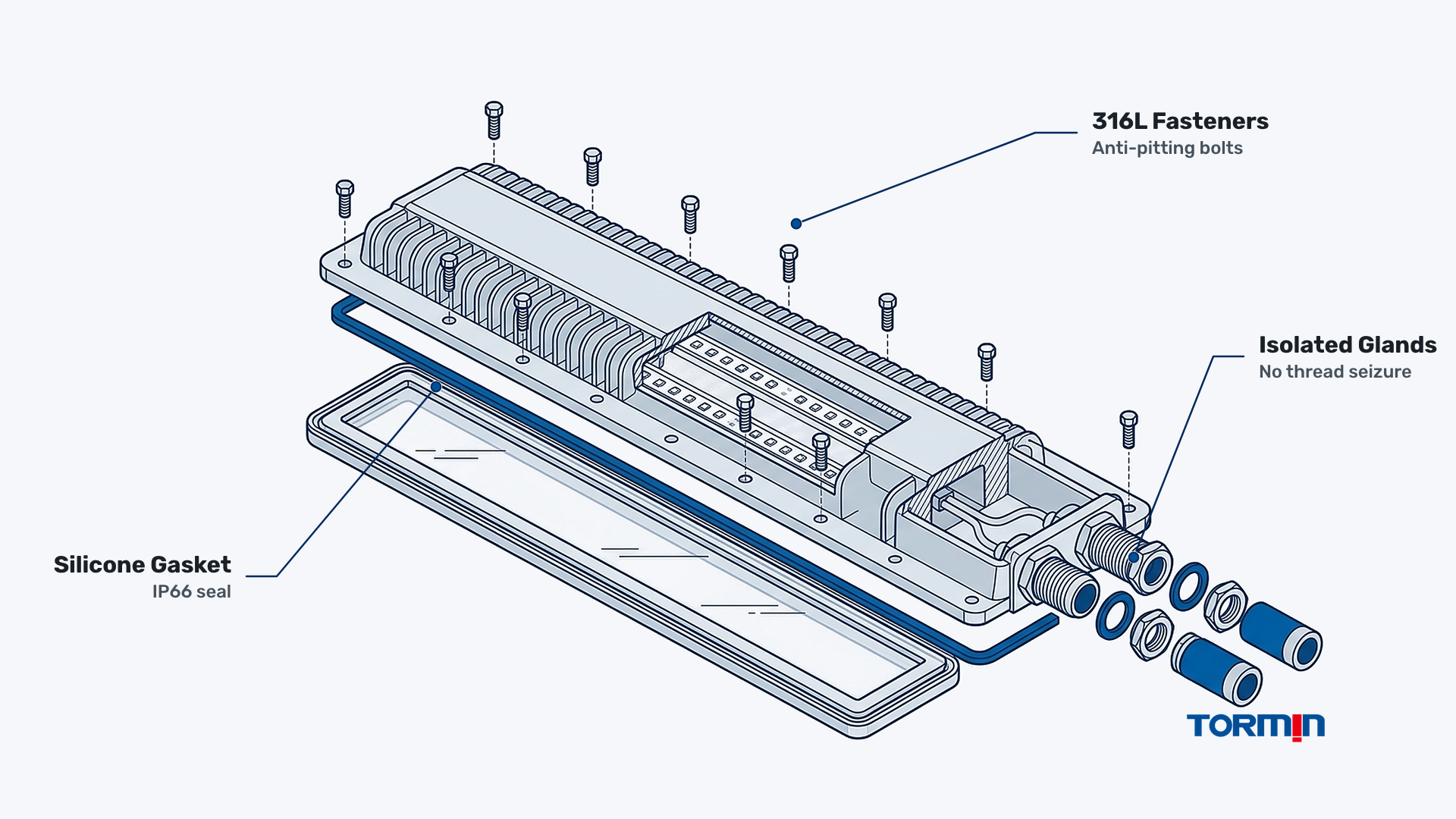
| Metal Housing Alloy | Standard die-cast aluminum (higher Cu) | Copper-free die-cast aluminum (< 0.1% Cu) or anodized aluminum | Rapid galvanic pitting of aluminum castings in salt spray |
| Non-Metallic Housing Option | Standard polycarbonate / ABS | UV-stabilized GRP (glass-reinforced polyester) with static-safe rating | Eliminates painted-metal flaking in chemical/salt splash zones |
| Exposed Fasteners & Brackets | Carbon steel or 304 stainless steel | 316 / 316L stainless steel (molybdenum-alloyed) | Chloride pitting, tea-staining, and seized cover bolts |
| Cable Gland & Entry Interface | Nickel-plated brass directly in aluminum | 316L gland or isolated nickel-plated brass with approved thread sealant | Galvanic seizure between brass/stainless and aluminum threads |
| Enclosure Gasket Material | Generic EPDM or foam strip | Molded silicone or fluorosilicone compression gasket | Compression-set water ingress after thermal and salt cycling |
Always confirm fastener alloy on the purchase order rather than assuming marine stainless steel is standard. For example, the TORMIN BC5402A explosion-proof linear luminaire (30 to 80 W, 3,300 to 8,400 lm, IP66) ships with an anodized aluminum housing and 304 stainless steel exposed fasteners by default, while 316 stainless steel fasteners are explicitly available by request for offshore projects. Where anti-corrosive linear or tube formats are preferred for corrosive chemical or coastal spaces, evaluate the BC5407 family (9 to 81 W by configuration, 90 to 264 VAC, IP66) and verify exact chemical and UV compatibility against site exposure data.
Separating ATEX/IECEx, IEC 61892-7, and Marine Classification Society Approvals
A frequent procurement error on offshore tenders is assuming that an ATEX or IECEx luminaire certificate automatically satisfies vessel flag-state or offshore classification society rules. Hazardous-area ignition certification, offshore electrical installation codes, and marine class type approval are three separate governance layers that must be verified individually against the project contract.
- Hazardous-Area Ignition Protection (IEC 60079 / ATEX / IECEx): Certifies that the exact luminaire model, gas or dust group (IIA, IIB, IIC), temperature class (T1 to T6), and ambient temperature range (Ta) will not ignite the classified atmosphere. For foundational zone definitions and nameplate verification steps, review our guides on Zone 0, Zone 1, and Zone 2 lighting and reading Ex nameplates and certificates.
- Offshore Electrical Installation Standard (IEC 61892-7): Governs the selection, installation, earthing, cable entry, and mechanical protection of electrical equipment in hazardous areas on mobile and fixed offshore units, including vibration, tilt/pitch stability, and emergency lighting segregation.
- Marine Classification Society Type Approval (DNV, ABS, Lloyd’s Register, BV): Required by specific vessel owners, flag states, or offshore operators for shipboard and classed-unit electrical equipment, covering marine environmental tests such as salt mist, vibration endurance, and electromagnetic compatibility (EMC) near bridge navigation gear.
Never assume a luminaire carries DNV, ABS, UL 844, or CSA marine listing unless that exact approval appears on a current, verifiable certificate for the ordered SKU. For TORMIN hazardous-area luminaires, verify model-specific ATEX, IECEx, CE EMC, CE LVD, and CNEX documentation directly in the TORMIN Standards and Certifications archive before finalizing project submittals.
Offshore Vibration, Secondary Retention, and Real-World Platform Context
Offshore process modules, compressor decks, and shipboard superstructures subject luminaires to continuous low-frequency vibration and intermittent storm wind gusts. Even when a housing passes IP66 ingress testing, loose mounting bolts, unsupported pendant stems, or unbraced cable glands can fatigue wiring terminations or create dropped-object hazards over active walkways.
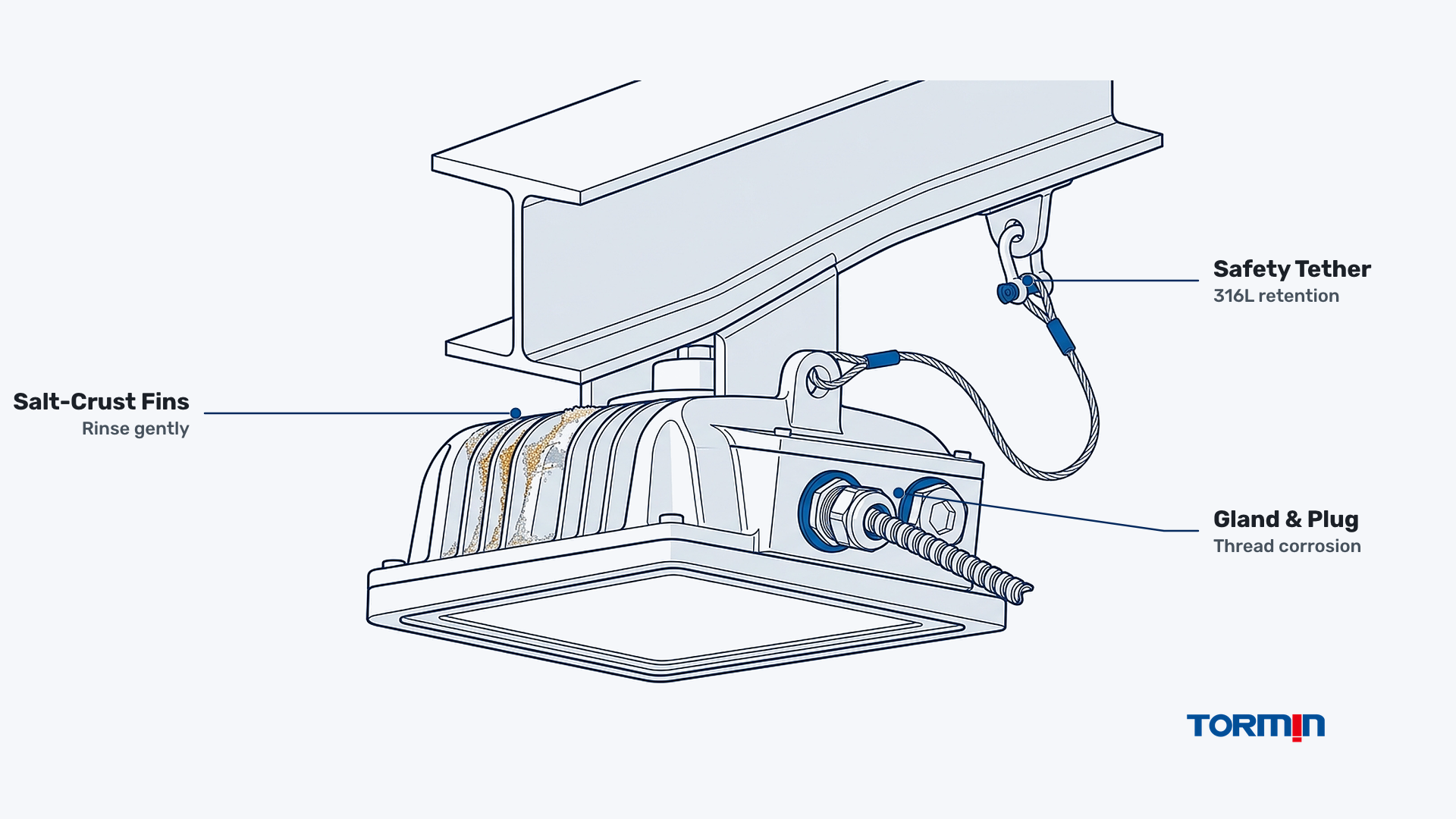
Specify locking hardware (316L spring washers or prevailing-torque locknuts) and independent stainless steel secondary safety retention cables on all elevated deck, pipe-rack, and mast fixtures. When reviewing real installation photography—such as the 2022 Malaysia offshore-platform linear lighting photo archive documenting a linear luminaire mounted on an exposed offshore structure—treat photo archives strictly as mechanical-context references rather than proof of an exact model code or class-society approval; final selection must always rest on controlled datasheets and certificate schedules. For broader port, jetty, and shipyard application context, also see our Ports & Marine lighting solutions page.
IEC 60079-17 Offshore Maintenance and Salt-Crust Inspection Protocol
Offshore lighting reliability depends as much on structured IEC 60079-17 inspection intervals as on initial luminaire metallurgy. In chloride-rich salt fog, minor installation defects—such as a pinched gasket, an unsealed spare entry, or salt buildup across cooling fins—escalate rapidly into thermal derating, moisture ingress, or loss of Ex integrity.
| Offshore Inspection Target | Visual / Close Check (IEC 60079-17) | Early Failure Indicator at Sea | Corrective Action Boundary |
|---|---|---|---|
| Heat-Sink Fins & Diffuser | Check for white salt crust, marine oil film, or bird fouling | Encrusted fins raising housing temperature near T-class limit | Low-pressure freshwater rinse only; avoid high-pressure jet directly on gasket seams |
| Cable Glands & Stopping Plugs | Verify thread engagement, locknuts, and IP sealing washers | White aluminum oxide powder or green corrosion at brass/aluminum joint | Replace corroded gland/plug with certified matched-thread part; use approved anti-seize only if permitted by manual |
| Cover Fasteners & Hinges | Verify all bolts present, tight, and free of severe pitting | Rust-streaked 304/carbon substitutes or seized bolt heads | Replace only with exact grade/material (316L) specified in manufacturer parts list |
| Silicone Gasket & Flamepath | Inspect during detailed shutdown (power isolated, gas-free) | Hardened, cracked, or permanently flattened gasket; pitted flamepath | Replace OEM gasket; never machine, sand, or paint flameproof joint faces |
| Bracket & Safety Wire | Check welds, U-bracket tilt locks, and secondary tether | Cracked bracket slots, loose trunnion bolts, frayed safety wire | Re-torque to specification and replace worn 316 stainless retention wire |
Schedule close inspections at tighter intervals on open splash decks than in enclosed machinery spaces, and pair every maintenance work order with the full site-level rules in our explosion-proof lighting installation guide and explosion-proof lighting inspection guide. Never perform unauthorized field drilling, substitute uncertified commercial glands, or swap an Ex luminaire housing component without verifying certificate compliance.
Offshore Marine Lighting Enquiry Checklist for EPC and Fleet Buyers
Sending an incomplete enquiry—such as requesting an IP66 marine light without naming the exposure micro-zone, fastener grade, or class-approval requirement—delays technical bid evaluation and invites non-compliant substitutes. Include the five verification blocks below when submitting an offshore or marine lighting request:
- Area Classification & Governance: Exact Zone (Zone 1, Zone 2, Zone 21, Zone 22), gas group (IIA, IIB, IIC), T-class, ambient Ta range (°C), and whether marine classification society type approval (DNV, ABS, LR, BV) is contractually required in addition to ATEX or IECEx.
- Exposure Micro-Zone & Corrosion Spec: Open splash deck vs. sheltered module vs. interior machinery space; required ISO 12944 C5/CX or WF2 corrosion level; mandatory 316/316L stainless steel fastener and bracket specification.
- Optical & Electrical Inputs: Mounting height (m), target maintained illuminance (lx), supply voltage (VAC or VDC) and frequency (Hz), emergency battery runtime requirements if applicable, and preferred cable entry thread (M20, M25, NPT) plus loop-in wiring preference.
- Mechanical & Retention Requirements: Ceiling, pendant, stanchion, wall, or pole-mast mounting; vibration/wind-load zone; secondary safety-wire attachment requirements.
- Documentation Package: Request model-specific datasheets, IES or LDT photometric files, and current certificate schedules for review before purchase order release.
To request matching datasheets, 316 stainless offshore configuration options, IES photometric files, or model-specific certificate PDFs across our ATEX explosion-proof lighting and explosion-proof LED linear ranges, send your project brief to [email protected] or via the TORMIN Contact page.
Sources
- IEC 60079-0:2017 — Explosive atmospheres: Equipment general requirements — supports hazardous-area gas/dust group, temperature class, and ambient Ta certification boundaries.
- IEC 60079-14:2024 — Explosive atmospheres: Electrical installations design, selection and erection — supports hazardous-area cable entry, earthing, and installation requirements.
- IEC 60079-17:2023 — Explosive atmospheres: Electrical installations inspection and maintenance — supports offshore visual, close, and detailed inspection boundaries.
- IEC 61892-7:2019 — Mobile and fixed offshore units: Electrical installations, Part 7: Hazardous areas — supports offshore platform electrical installation and hazardous-area governance.
- ISO 12944-2:2017 — Paints and varnishes: Corrosion protection of steel structures by protective paint systems, Part 2: Classification of environments — supports atmospheric corrosivity categories C5 (Marine) and CX (Offshore).
- IEC 60529 — Degrees of protection provided by enclosures (IP Code) — supports IP66 and IP67 ingress-protection boundaries.
- TORMIN Standards and Certifications Archive (first-party product documentation) — supports model-specific ATEX, IECEx, CE, and CNEX certificate verification.