
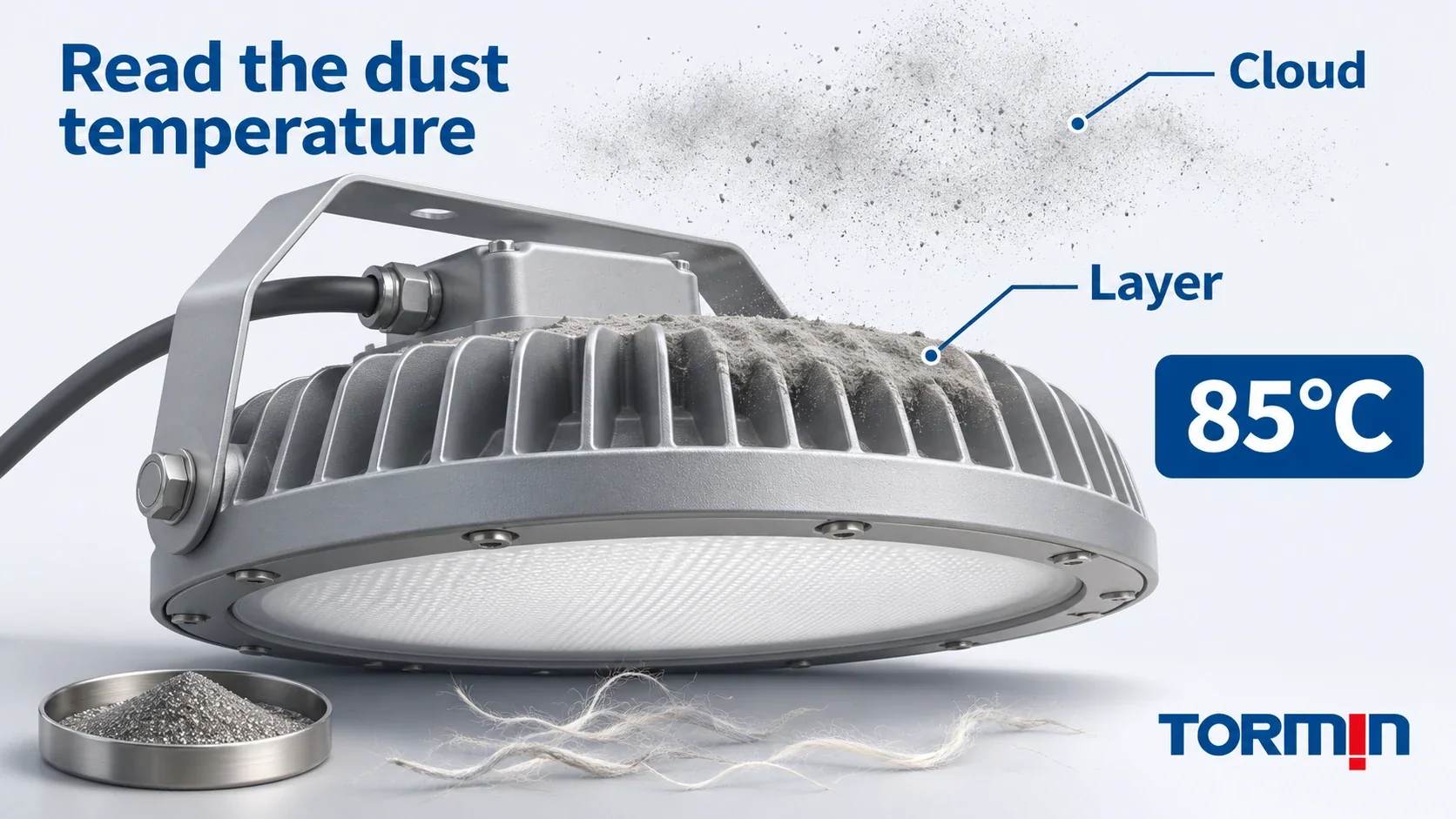
Dust groups IIIA, IIIB and IIIC identify the material group an item of equipment covers. The separate temperature marking, such as T85°C, states its maximum surface temperature under the documented conditions. A dust group does not tell you whether that surface is cool enough for your particular dust.
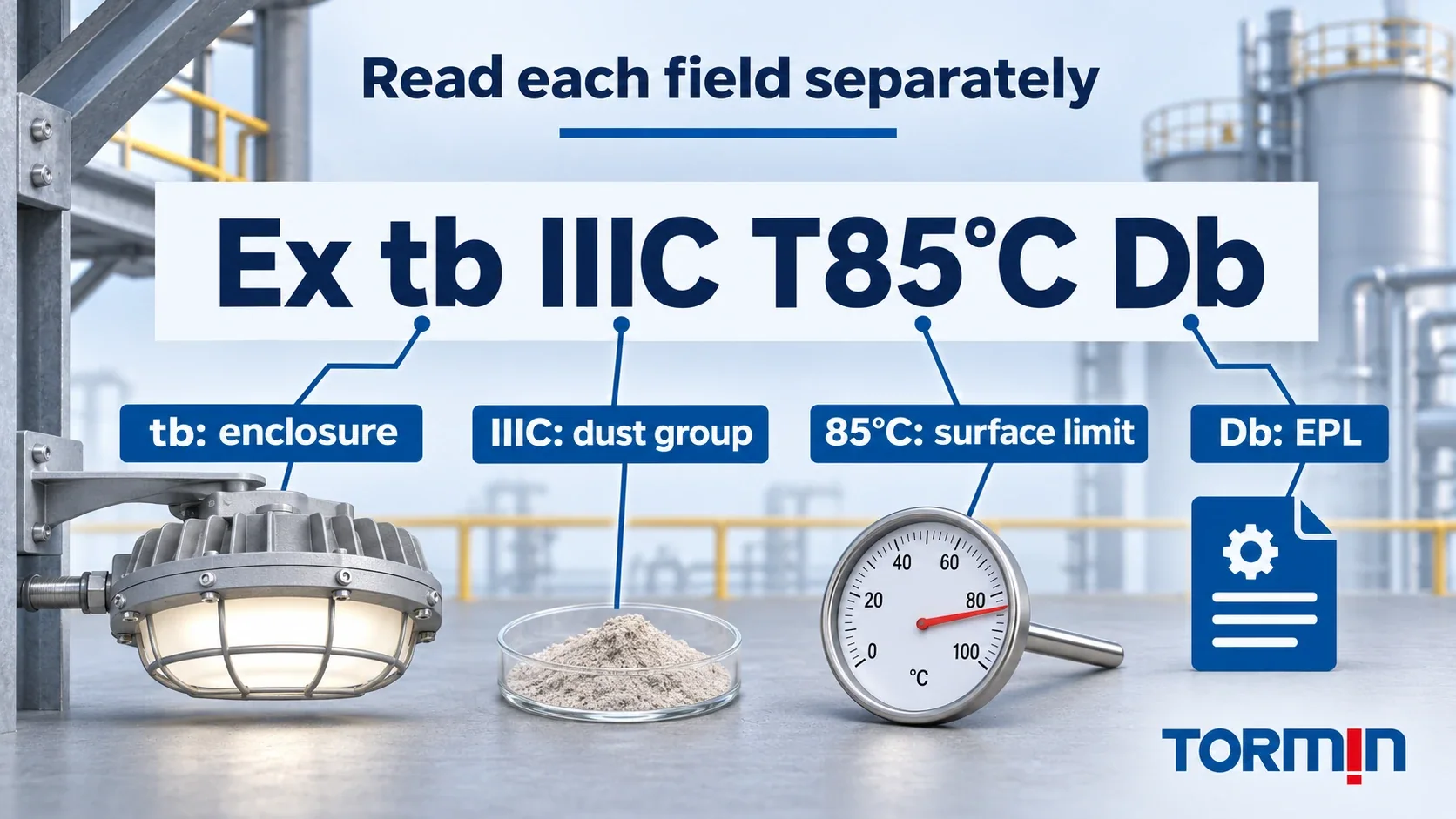
For a light marked Ex tb IIIC T85°C Db, read the group and the 85°C limit separately, then check the protection level and installation conditions. Do not search for a gas T1-T6 class as a substitute for the dust temperature value.
TORMIN’s Explosion Proof Lighting for Combustible Dust Environments covers the broader environment, area-classification and application questions. This article focuses on dust groups and markings; it does not reclassify a site or repeat the dust-zone definitions.
What IIIA, IIIB and IIIC mean
Group III is the IEC equipment grouping for explosive dust atmospheres. Its subdivisions distinguish combustible flyings, non-conductive dust and conductive dust. They are not temperature bands.
| Dust group | Material description | Typical examples, not material test data |
|---|---|---|
| IIIA | Combustible flyings, including fibres | Typical examples include textile fibres such as cotton flyings. |
| IIIB | Non-conductive combustible dust | Typical examples include flour, grain dust and powdered sugar. |
| IIIC | Conductive combustible dust | Typical examples include metal dusts such as aluminium and magnesium powders. |
Use the actual material assessment rather than the example alone. Particle characteristics, mixtures and process conditions can change the relevant hazard. The Irish Health and Safety Authority’s powder/dust guidance explains these material distinctions and identifies organic and metal powders that can form explosive suspensions.
Under the IEC 60079-0 definition, conductive dust has electrical resistivity not greater than 1 kΩ·m, equivalent to 10^3 Ω·m; non-conductive dust is above that boundary. This is a definition threshold, not an invented resistivity assigned to any material in the table. The GSO standards-body preview adopting IEC 60079-0 provides the definition and points to the dust-resistivity test method. Check the edition applicable to the project and certificate.
IIIC is the broadest dust-group coverage, not a complete approval
For group coverage, IIIC equipment can cover IIIC, IIIB and IIIA applications, while IIIB does not cover conductive IIIC dust. IIIC therefore represents the most demanding group in this dust subgroup hierarchy. The IECEx equipment-selection material sets out that coverage relationship.
IIIC has a similar position in its hierarchy to IIC on the gas side. That is a structural analogy, not a certification equivalence: IIIC dust suitability does not establish IIC gas suitability, and IIC gas suitability does not establish IIIC dust suitability.
Conductivity matters because dust entering equipment can create electrical paths that a non-conductive deposit would not. But the IIIC label still says nothing about the ignition temperature of your dust or the suitability of the light’s marked surface temperature.
Why the dust marking gives a temperature in °C
Dust has two different thermal ignition questions:
- Dust cloud: at what tested hot-surface temperature can the dispersed dust/air mixture ignite?
- Dust layer: at what tested surface temperature can the deposited dust ignite, for a specified layer thickness?
A cloud ignition temperature cannot stand in for a layer ignition temperature. Layer thickness also matters: a thicker deposit changes both ignition behaviour and the equipment’s ability to release heat. HSA’s guidance on dust characterisation distinguishes the cloud and layer tests, including the usual 5 mm layer test basis.
The IEC dust marking therefore uses a numeric maximum surface temperature rather than the gas system’s fixed T1-T6 class bands. The “T” at the start of T85°C introduces a temperature value; it does not turn that value into a gas T-class. Compare the numeric value with a limit calculated from the actual dust’s accepted cloud and layer data.
This is consistent with IEC 60079-31: type “t” protection combines an enclosure with surface-temperature limitation for explosive dust atmospheres. A cool-looking housing, a gas T6 label or an IP rating alone cannot replace the required dust marking and documentation.
Set the permissible surface temperature from both dust tests
For the conventional IEC 60079-14 selection case using accepted cloud data and a 5 mm layer ignition temperature, calculate:
Permissible maximum surface temperature = min[(2/3 × dust cloud ignition temperature), (5 mm dust layer ignition temperature – 75 K)]
Use the cloud ignition temperature in degrees Celsius in the two-thirds calculation. Subtracting 75 K means a temperature difference of 75°C; do not convert the cloud input to kelvin before multiplying it.
This method is specified in IEC 60079-14:2013, sections 5.6.3.2-5.6.3.3. The current published edition is IEC 60079-14:2024; use the edition adopted by the project and check any equipment-specific layer conditions. The rule here is a bounded selection screen, not approval for every dust deposit or installation.
The lower result controls because the luminaire must satisfy both the cloud and layer constraints. It is not enough to select the more convenient test value.
For layers over 5 mm, the allowable temperature needs further reduction and assessment for the actual layer conditions. Do not invent a fixed decrement per millimetre or reuse the 5 mm result unchanged. Deposits around the sides and underside, complete burial, self-heating materials or equipment marked for special layer conditions require a different assessment basis. Where the simple method is not applicable, obtain the necessary test evidence and competent review.
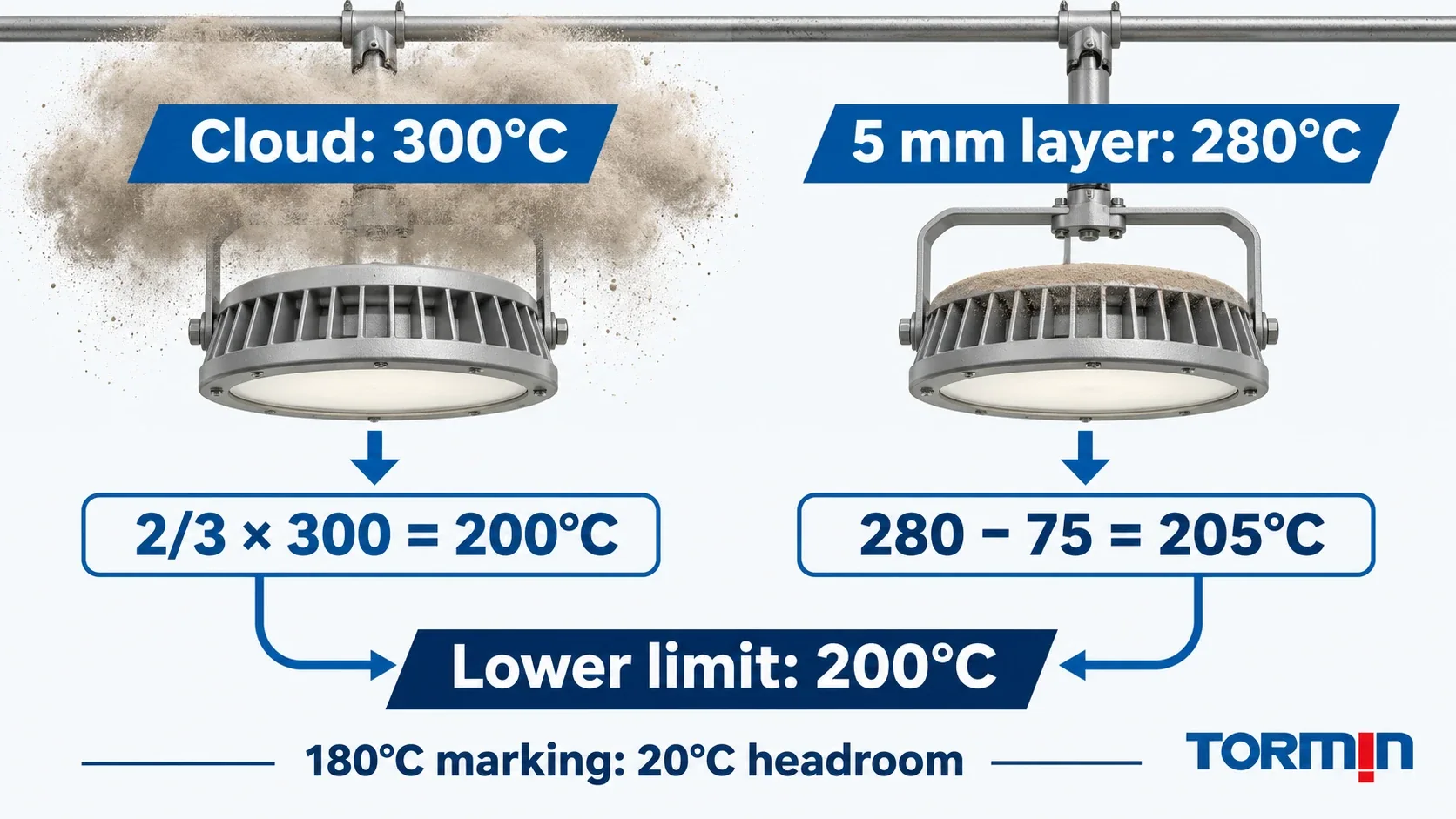
Worked example: cloud 300°C, layer 280°C, light 180°C
Use these hypothetical teaching inputs, matching the TORMIN calculator example:
| Input or check | Calculation | Result |
|---|---|---|
| Dust cloud ignition temperature | 300°C × 2/3 | Cloud-based limit 200°C |
| Ignition temperature of a 5 mm dust layer | 280°C – 75 K | Layer-based limit 205°C |
| Permissible surface-temperature ceiling | min(200°C, 205°C) | 200°C, controlled by the cloud |
| Luminaire’s marked dust surface temperature | 180°C ≤ 200°C | Passes this temperature comparison |
| Headroom below the controlling ceiling | 200°C – 180°C | 20°C, equivalently 20 K |
The light marked 180°C passes this numerical temperature check with 20°C of headroom. That is not a measured operating temperature, an extra universal safety allowance or proof of complete installation compliance. Group coverage, EPL, Ta, certificate conditions and the actual layer basis must also match. The hypothetical inputs are not test results for flour, aluminium or any TORMIN model.
Use the Dust Surface Temperature Checker with your own accepted dust data. For this example, enter 300°C cloud, 280°C layer, 180°C marked surface temperature and 5 mm expected layer thickness. The tool suppresses a simple pass/fail for layers above 5 mm; do not treat that as permission to ignore the deposit.
Decode Ex tb IIIC T85°C Db one field at a time
This is an illustrative dust marking, not a marking assigned here to every TORMIN product.
| Field | Meaning | What to check |
|---|---|---|
| Ex | Indicates the explosion-protection marking context. | Read the complete marking with its certificate and instructions. |
| tb | Dust ignition protection by enclosure “t”, level “b”. | Enclosure protection and surface-temperature control belong to the documented assembly; do not substitute gas flameproof protection. |
| IIIC | Conductive-dust group coverage, also covering IIIB and IIIA on the group axis. | Match the assessed dust group; this field does not determine the temperature limit. |
| T85°C | Marked maximum surface temperature of 85°C under the specified conditions. | Compare 85°C with the permitted temperature for the actual dust and layer basis; also verify Ta. |
| Db | Dust Equipment Protection Level Db. | Normally suitable for Zone 21 and Zone 22 on the EPL axis, subject to the complete selection conditions; not Zone 20. |
The type “t” and tb/Db relationship is covered by IEC 60079-31’s published scope and standard preview; the IECEx selection material explains the EPL-to-zone relationship.
Use the Ex Marking Decoder to inspect the individual fields on your own marking. Keep the full ordering code and certificate schedule alongside the decoded text: parsing a label does not establish that the label applies to the offered variant.
Group and temperature remain two independent axes
A light can pass the group check and fail the temperature check. For example, IIIC coverage does not rescue a surface-temperature marking that exceeds the dust-specific permissible ceiling. Conversely, a sufficiently low temperature marking does not upgrade IIIB equipment for conductive IIIC dust.
That is the same selection discipline as on the gas side: establish group suitability and thermal suitability separately, then require both. For the gas framework and its combined selection matrix, see How to Choose Explosion Proof Lighting by Gas Group and Temperature Class. The gas class table must not be reused as a dust-temperature selection table.
Three common misreadings
Looking for T1-T6 on the dust line. A dual gas/dust product can show a gas T-class on one line and a numeric dust temperature on another. Read the dust line. T85°C is an actual numeric limit in the marking, not a request to find a matching gas class.
Assuming IIIC resolves the whole selection. IIIC covers the dust-group axis. The marked temperature, EPL, permitted ambient range and certificate conditions remain separate checks. Grain dust is not automatically IIIC simply because its explosion consequences can be serious; group selection follows material characterisation, not a general impression of severity.
Ignoring the layer on the luminaire itself. A deposit is both a potential fuel and thermal insulation. It can obstruct heat rejection while its ignition behaviour changes with thickness. The relevant condition is the layer that can actually accumulate on the housing and around it, not just a dust sample on a test plate. Keep cleaning and deposit control consistent with the thermal assessment; a low marked temperature is not permission for unlimited accumulation.
TORMIN products: use the verified dust line
The following individual first-party pages were checked on November 7, 2026. Each publishes a dust marking. These are catalogue listings, not confirmation of current certification for every ordering code.
| Product page | Published dust marking | What the listing does and does not establish |
|---|---|---|
| BC5402A linear light | Ex tb op is IIIC T80°C/T95°C/T130°C Db | Publishes a type t dust line with additional optical-radiation protection notation; the applicable temperature must be checked for the selected variant. |
| BC9306P | Ex tb IIIC T80°C/T95°C/T130°C Db | Publishes IIIC/Db dust information and alternative temperature values; it does not make 80°C universal across the series. |
| BC9306S area/floodlight | Ex tb IIIC T80°C/T95°C/T130°C Db | Publishes the dust line but identifies family certificate copies as archived with current status unverified. Request the applicable current documents. |
| BC9306S spotlight | Ex tb IIIC T80°C/T95°C/T130°C Db | Publishes the dust marking; confirm its exact configuration and temperature value rather than borrowing another BC9306S listing’s scope. |
Dust suitability and the applicable marked temperature are subject to the specific model’s nameplate, matching certificate schedule, permitted ambient range and conditions of use. The example T85°C above is deliberately separate from these pages’ T80°C/T95°C/T130°C alternatives. Do not relabel one as the other or assign the coolest alternative to every model.
A product page that supplies only gas evidence cannot support a dust-zone approval claim. For an enquiry, provide the assessed dust group, cloud and layer test reports, expected deposit conditions, required EPL and local Ta, then ask for the exact proposed configuration’s dust documents.
FAQ
Why does a dust light have no T-class?
Its dust line normally states a numeric maximum surface temperature, such as T85°C, rather than a gas T1-T6 class. The prefix “T” introduces the value. Compare that value with the dust-specific cloud and layer limits. A dual-certified light may still carry a separate gas T-class on its gas line.
Does grain dust require IIIC equipment?
Not automatically. Grain dust is a typical non-conductive IIIB example, but the actual material, mixtures and test assessment decide the required group. IIIC can cover IIIB on the group axis; it does not remove the separate temperature, EPL or installation checks. Do not assign a group solely from the facility being a grain store.
What does T85°C mean?
It means a marked maximum surface temperature of 85°C for the documented equipment configuration and conditions. It is not the dust’s ignition temperature, an ambient limit of +85°C, or a universal reading of the operating housing temperature. Check the certificate’s Ta and any layer conditions separately.
Can a light with only gas certification be installed in Zone 21?
Gas certification alone does not demonstrate dust suitability. Require the applicable dust protection, group, surface-temperature and EPL/category evidence for the exact model and intended installation. A gas IIC or T6 marking and a high IP rating cannot substitute for that evidence.
How do I determine my dust’s surface-temperature limit?
Obtain accepted cloud and layer ignition data for representative process dust. For the conventional 5 mm case, use the lower of two-thirds of the cloud ignition temperature in °C and the 5 mm layer ignition temperature minus 75 K. Thicker layers or special deposition conditions need further assessment and a lower allowable temperature as applicable. The worked example explains the arithmetic; a calculated pass does not approve a complete installation.
Sources
- Gulf Standardization Organization – GSO IEC 60079-0:2024, preview adopting IEC 60079-0 definitions – Conductive/non-conductive dust and flyings definitions, including the 1 kΩ·m threshold.
- Health and Safety Authority, Ireland – Guidance on Combustible Dusts / Powders – Material examples, characterisation and distinct cloud/layer ignition tests.
- IECEx – Electrical installations design, selection and installation of equipment, including initial inspection, Edinburgh Symposium 2023 – Dust-group coverage and EPL/zone selection; training material, not current mandatory clause numbering.
- IEC – IEC 60079-31:2022, Equipment dust ignition protection by enclosure “t” – Published scope and enclosure/surface-temperature protection; public standard preview supports the tb/Db relationship.
- IEC – IEC 60079-14:2013, selection and erection of electrical installations – Sections 5.6.3.2-5.6.3.4 provide the conventional cloud/layer rule and thicker-deposit limits. This is an earlier edition; use the project’s adopted requirements.
- IEC – IEC 60079-14:2024, Electrical installation design, selection and installation of equipment, including initial inspection – Current published edition and selection-standard scope; the public record does not provide the complete selection text.
TORMIN first-party product documents
- BC5402A linear light product page – First-party published dust marking: Ex tb op is IIIC T80°C/T95°C/T130°C Db.
- BC9306P product page – First-party published dust marking: Ex tb IIIC T80°C/T95°C/T130°C Db.
- BC9306S area/floodlight product page – First-party published dust marking: Ex tb IIIC T80°C/T95°C/T130°C Db.
- BC9306S spotlight product page – First-party published dust marking: Ex tb IIIC T80°C/T95°C/T130°C Db.