
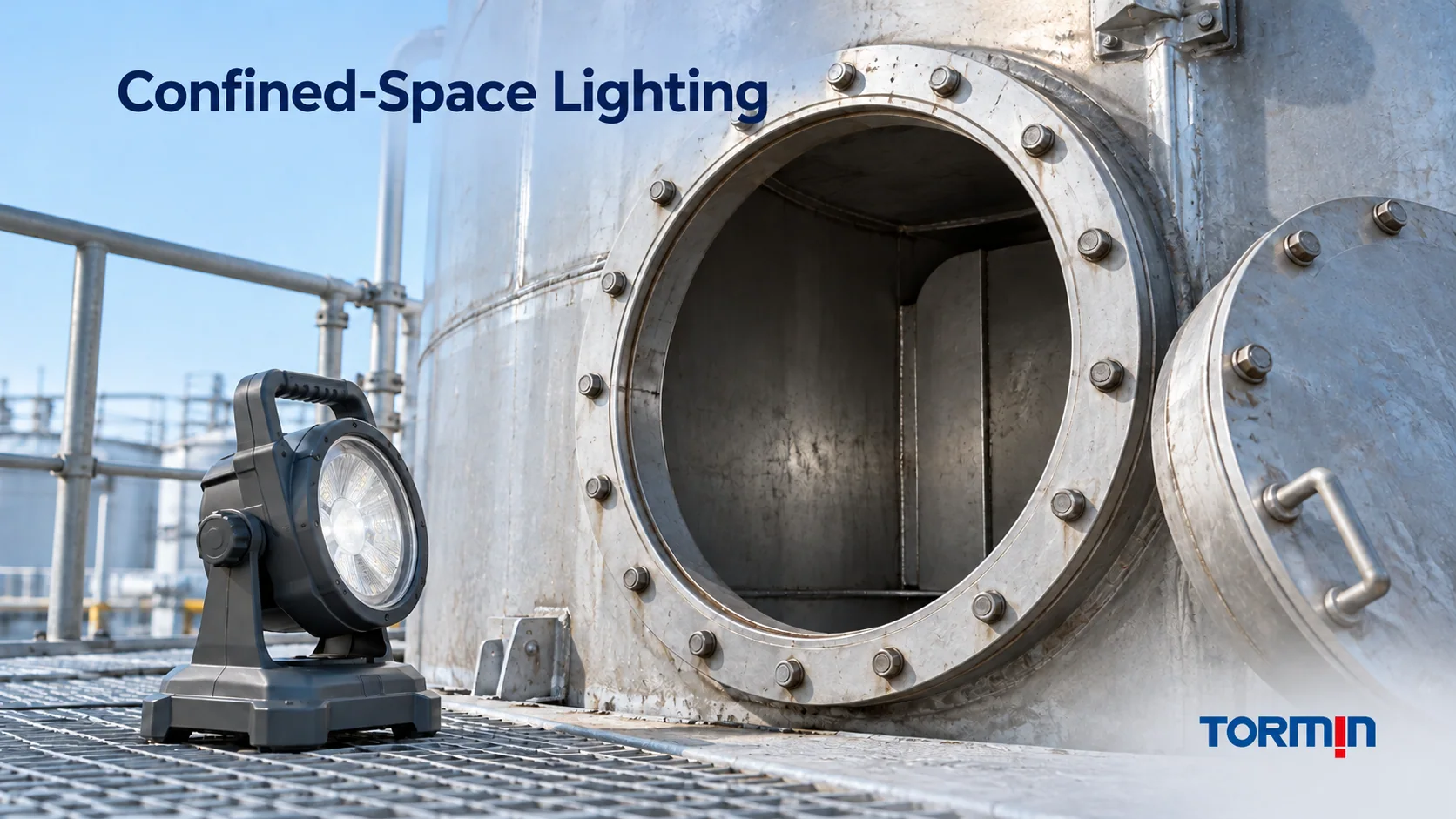
Selecting explosion-proof lighting for a confined space starts with three separate checks: the equipment must match the assessed atmosphere, the complete power arrangement must suit the electrical conditions, and the light must support the task without obstructing access. A battery, a low-voltage label or an Ex marking answers only part of that review.
For a tank or vessel inspection, start with a lighting brief agreed by the responsible site team. Confined-space status does not automatically establish an explosive atmosphere, and explosion-protected lighting does not resolve oxygen deficiency, toxic exposure, engulfment or restricted escape. OSHA’s US general-industry rule distinguishes confined spaces from permit-required hazards; its lighting provision addresses both safe work and quick emergency exit. The lighting choice cannot authorize entry. OSHA 29 CFR 1910.146, definitions and (d)(4)(v)
Build a hazard, power and access lighting brief
Use the matrix below to join the site’s decisions to the supplier’s exact offer. It is a lighting briefing tool, not an entry checklist. “Held” means the lighting selection remains unresolved until the named input or document is supplied.
| Check | Site input to record | Evidence to request for the offered configuration | Hold the selection when… |
|---|---|---|---|
| Hazard: work state | Vessel contents/residues, inspection or maintenance state, jurisdiction and the responsible team’s equipment requirement | Exact model/variant documents against that requirement | The atmosphere requirement is assumed from the vessel name or a product-category label |
| Hazard: equipment locations | Assessed conditions at the task, opening, connection points and power-source location | Applicable equipment scope and instructions for each relevant item | Only the lamp has been reviewed; other items or locations are undefined |
| Power: supply arrangement | Voltage, AC/DC, source, electrical safeguards and wet/conductive contact conditions | Exact input variant, permitted supply arrangement and accessory requirements | “Low voltage” substitutes for a defined, compatible electrical system |
| Power: battery operation | Required output mode, task duration, service conditions and planned charging location | Mode-specific runtime basis, battery identity and charging instructions | Work-mode suitability is treated as permission to charge, or runtime has no stated conditions |
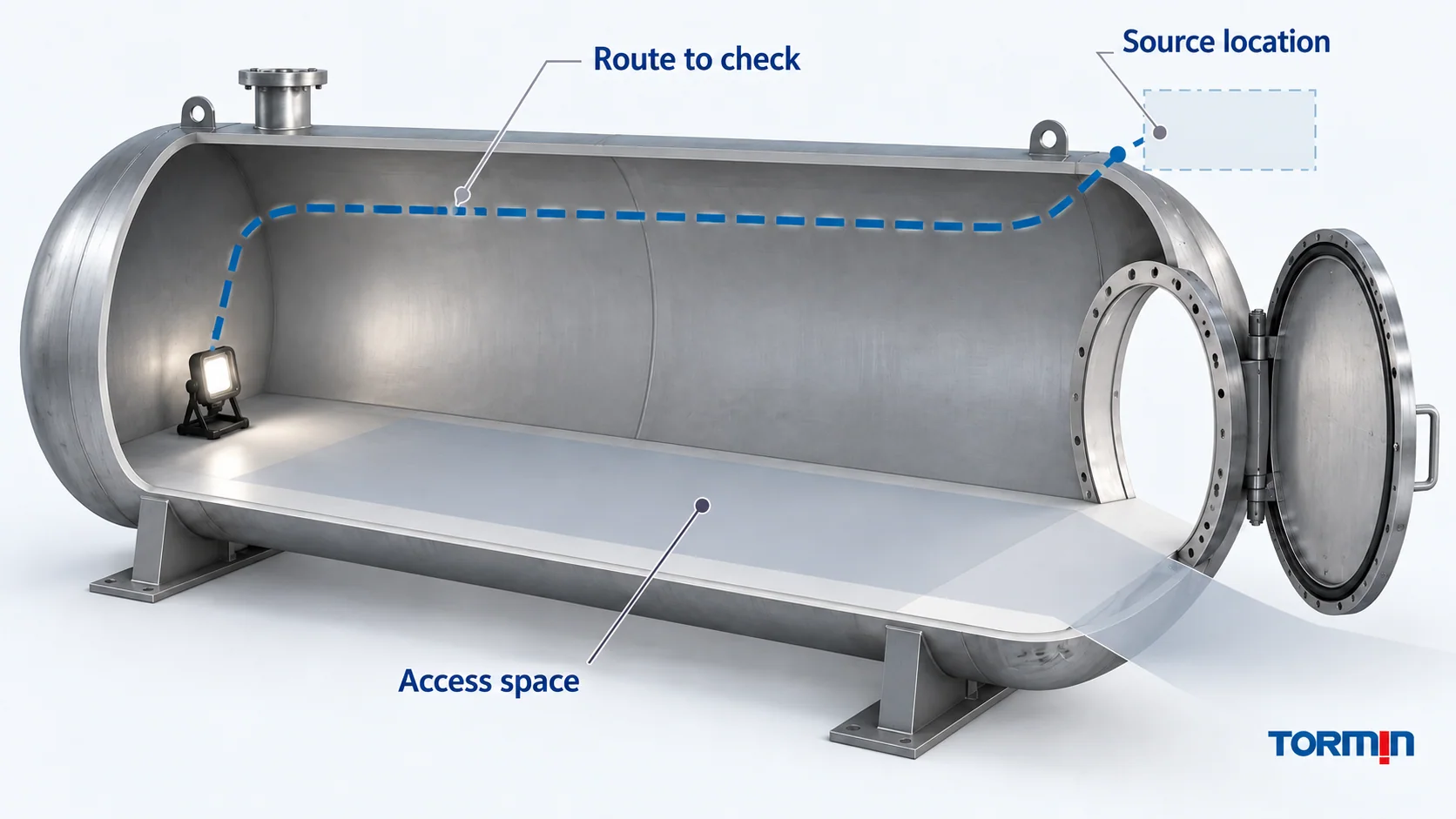
| Access: equipment envelope | Actual opening and route geometry, equipment transport and approved support positions | Dimensions, mass, handling and mounting information | The selected light/support cannot be accommodated without compromising access |
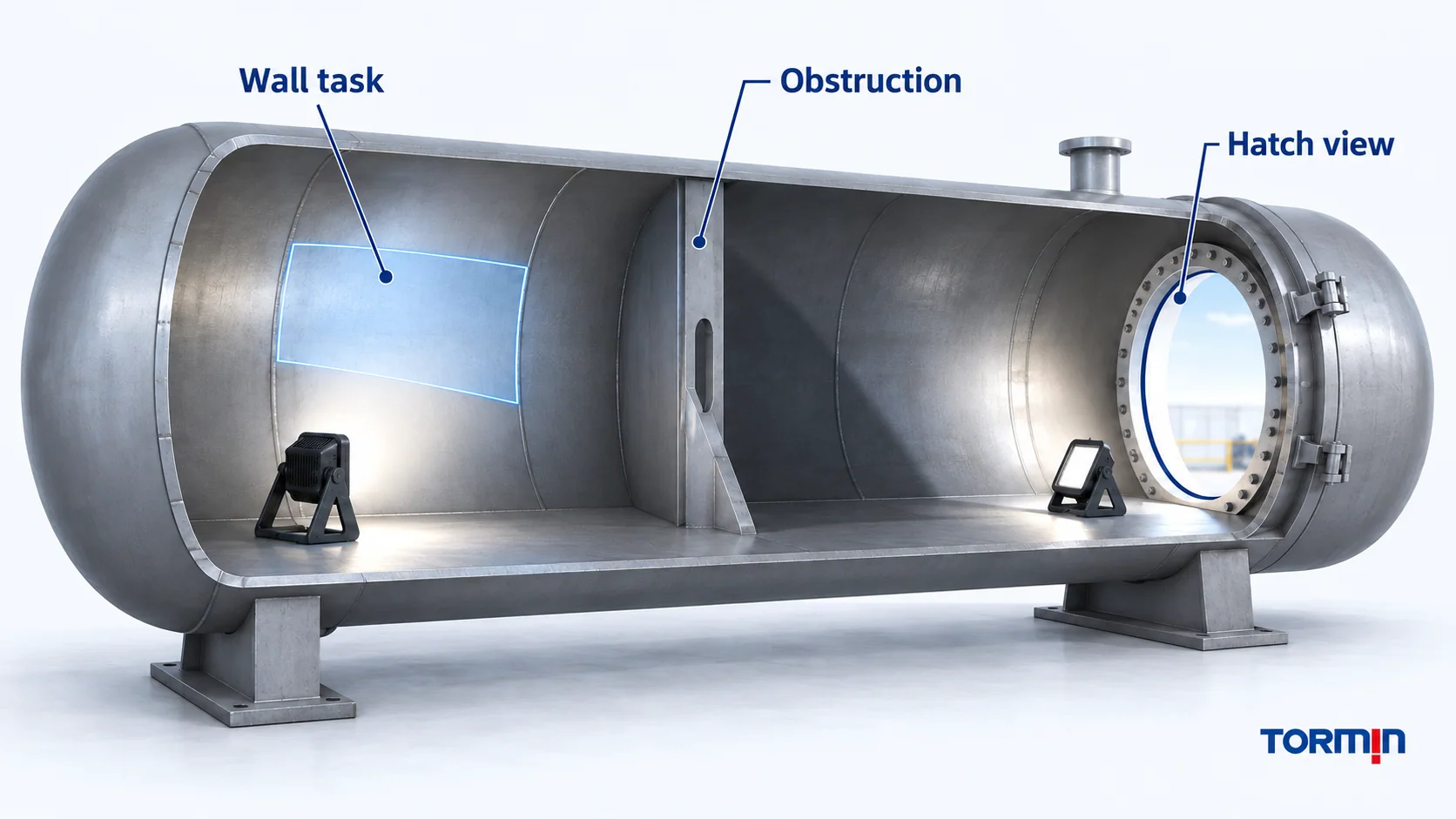
| Access: cable and visual task | Cable route, contact/pinch points, work surface, viewing positions and obstructions | Cable/accessory information and relevant light-distribution data | The arrangement damages a lead, blocks movement or leaves the necessary view unresolved |
| Access: loss of light | Required visibility and response if the primary light or common supply fails | Evidence for the defined backup function, if required | A second lamp is assumed independent despite a shared failure point |
The responsible site team establishes work conditions and acceptance criteria. The supplier identifies the offered assembly and its documented limits. A complete offer should connect these two records, rather than leave the buyer to infer compatibility from a headline rating.
Hazard: separate the space assessment from the equipment requirement
An enclosed metal vessel can present an electrical-contact problem without being a classified explosive-atmosphere location. Conversely, a dry inspection space may require equipment suitable for its assessed flammable atmosphere. Keep those questions separate in the brief.
HSE’s confined-space guide places lighting within a wider safe system of work. It distinguishes specially protected lighting where flammable atmospheres are likely from electrical precautions needed in certain spaces, such as metal tanks. It also asks whether the opening accommodates the necessary equipment and ready emergency exit. HSE, Confined spaces: A brief guide to working safely, INDG258(rev1), 2013
Describe the work state, not just the normal plant service: inspection after shutdown, cleaning, maintenance and changing residues may present different questions for the responsible assessor. An acceptable gas reading at one moment should not be used by the buyer to erase the documented equipment requirement.
Also identify where the whole lighting arrangement will be used. “Outside the hatch” is a geometric description; it does not establish an unclassified location for a connector, transformer or charger. In the US general-industry electrical framework, OSHA requires each area to be considered individually. Its hazardous-location provisions address equipment, wiring methods and installations, including suitability for the specific ignitable substance. OSHA 29 CFR 1910.307(a)–(c)
For detailed marking and document interpretation, use the separate nameplate and certificate guide. Here, the result needed is an equipment requirement tied to the actual task and locations, ready for exact-configuration review.
Power: review the complete arrangement and operating mode
Low voltage is an electrical safeguard, not an Ex approval
A nominal voltage does not identify the source’s separation, protective arrangement, connector compatibility or the lamp’s explosion protection. Record the complete supply system and have it reviewed under the applicable local rules and site conditions.
UK handlamp example: HSE PM38, third edition (2015), warns that conducting surroundings and cramped conditions can increase shock risk even at 110 V. For handlamps in confined, conducting conditions, it recommends supply voltages not exceeding 25 V. It separately states that extra-low voltage does not prevent ignition of a potentially explosive atmosphere; that protection depends on the equipment’s construction. This guidance does not make every 24 V light an acceptable assembly. HSE, Selection and use of electric handlamps, paragraphs 3, 5, 10 and 14
US construction example: OSHA’s temporary-wiring provision specifies portable lighting at 12 V or less in wet and/or conductive locations such as drums, tanks and vessels, with a stated exception for 120 V lights protected by a GFCI. This is a construction-sector rule, not a worldwide confined-space voltage requirement or the general-industry rule cited above. A GFCI is not evidence of explosion protection. OSHA 29 CFR 1926.405(a)(2)(ii)(G)
These examples explain why an enquiry should state the jurisdiction and electrical conditions before requesting a “safe-voltage” version. Do not merge their numbers into a universal specification.
Battery and cable-fed versions need different evidence
For a battery light, name the intended operating mode and the required useful duration. Ask for runtime at that mode, the test conditions and any relevant temperature or battery-condition limits. A maximum-runtime headline without its output mode cannot settle a sustained inspection task. Portable battery equipment is not automatically intrinsically safe or an emergency-lighting system.
Charging is a separate operating state. Request the permitted charger, battery arrangement and charging-location instructions. Suitability during battery-powered work does not establish permission to charge at the task location, at the opening or while the light is operating.
For a cable-fed light, identify the complete chain: supply source, any conversion/separation equipment, lead, connectors and luminaire input. Request the permitted arrangement and accessory details instead of accepting “12/24 V” as a complete specification. Record where connections will be located and how the lead will reach the task without interfering with the opening.
Access: check the task view and the withdrawal view
A light that fits through the opening may still be awkward to carry, support or retrieve in its working configuration. Review the lamp, handle, stand or hook together with other equipment using the same opening. HSE’s opening-size question is about the necessary equipment and emergency exit, not a universal clearance dimension. HSE INDG258(rev1), safe systems of work
Then distinguish two visual tasks:
- Inspection or maintenance: Which surface must be seen, from which position, and what blocks that view? Record reflective walls, close viewing distances, tools and internal structures that could create glare or shadows.
- Movement and withdrawal: Which opening, footholds and changes in level must remain visible? Define what happens to that visibility when the primary light, battery or common feed fails, using the site’s approved work arrangements.
Do not turn nominal lumens into a promised result inside a vessel. A broad beam may illuminate nearby metal while an internal baffle hides the inspection surface. Request relevant distribution data and assess the proposed positions against the actual geometry and project lighting criteria.
For a cable route, record sharp edges, hatch pinch points and contact with hot, wet or chemically exposed surfaces for electrical review. Do not use the lead as a support unless the light was designed for that use. US construction temporary-lighting rules explicitly address cord damage protection and suspension by cords; their scope remains construction. OSHA 29 CFR 1926.405(a)(2)(ii)(F) and (I)
A second light needs a defined role. Two lights on one feed may both go dark together; a handheld inspection torch may not illuminate the route required for withdrawal. The brief should identify the failure case and the visibility needed, then request evidence for that function. It should not invent a universal backup duration or entry response.
Example: prepare a vessel-inspection request without choosing too early
Consider an illustrative request for visual inspection behind a baffle in a metal vessel. The opening is restricted, the interior may be damp, and the buyer is comparing a battery handlamp with an externally supplied version. No classification, voltage choice, dimensions or runtime have yet been approved for this example.
The lighting request becomes reviewable when it records three decisions:
- Hazard: Attach the responsible team’s work-state and location requirements. Identify the intended locations of the lamp and any associated electrical items. Leave equipment acceptance held until the exact offered configuration can be checked against those requirements.
- Power: State the locally reviewed supply arrangement, or the battery operating mode and duration needed. Obtain the relevant instructions and accessory identity; keep charging permission as a separate question.
- Access: Provide an opening/task sketch with the baffle, viewing position, proposed support and any lead route. Ask how the task view and required withdrawal visibility will be maintained under the defined failure case.
This produces a useful comparison. The battery proposal must answer the required work-mode duration and charging conditions. The externally supplied proposal must answer the compatible supply arrangement and cable/access constraints. Neither is selected simply because it removes a cable or offers a low-voltage input.
Use TORMIN product documents to narrow the configuration
The supplied hazardous-area lighting category and its portable lighting category are discovery routes. Product-category membership does not establish suitability for the assessed space.
One relevant document example is the BW6650 product page. Its earlier/alternative configuration description distinguishes BW6650A with a built-in battery from BW6650B with an external supply, listing 12/24/36 V AC and DC inputs for the latter. It also describes handheld, stand and hook forms. Treat these as first-party configuration descriptions and confirm the exact version offered. TORMIN — BW6650 Explosion-Proof Hand Lamp
| Candidate configuration | Question it helps frame | Evidence still needed |
|---|---|---|
| BW6650A battery description | Can the offered work mode cover the defined task without introducing a charging dependency at the work location? | Exact ordering identity, applicable certificate/schedule, instructions, mode-specific runtime and charging limits |
| BW6650B external-supply description | Can the offered input version and complete supply/accessory arrangement meet the locally defined electrical conditions and access route? | Exact ordering identity, compatible supply and accessories, applicable certificate/schedule and operating instructions |
The published configuration description alone does not approve either version for this example. Nor does the listed 36 V option satisfy every local handlamp requirement. Confirm the offered variant and documents before reviewing its fit with the completed matrix.
Send the matrix, the opening/task sketch and the applicable site requirements through TORMIN’s contact page, and request the documents for the exact configuration. Use the broader explosion-proof lighting selection guide when the project also needs a general hazardous-area selection record.
Sources
- OSHA — 29 CFR 1910.146, Permit-required confined spaces — US general-industry definitions and lighting provision.
- HSE — Confined spaces: A brief guide to working safely, INDG258(rev1), 2013 — lighting, electrical precautions and opening/access considerations.
- OSHA — 29 CFR 1910.307, Hazardous (classified) locations — US area-specific electrical equipment and installation requirements.
- HSE — Selection and use of electric handlamps, PM38, third edition, 2015 — conducting/confined conditions and the distinction between low voltage and ignition protection.
- OSHA — 29 CFR 1926.405, Wiring methods, components, and equipment for general use — explicitly scoped US construction temporary-lighting examples.
- TORMIN — BW6650 Explosion-Proof Hand Lamp — first-party product page; configuration descriptions, not independent approval of this application.