
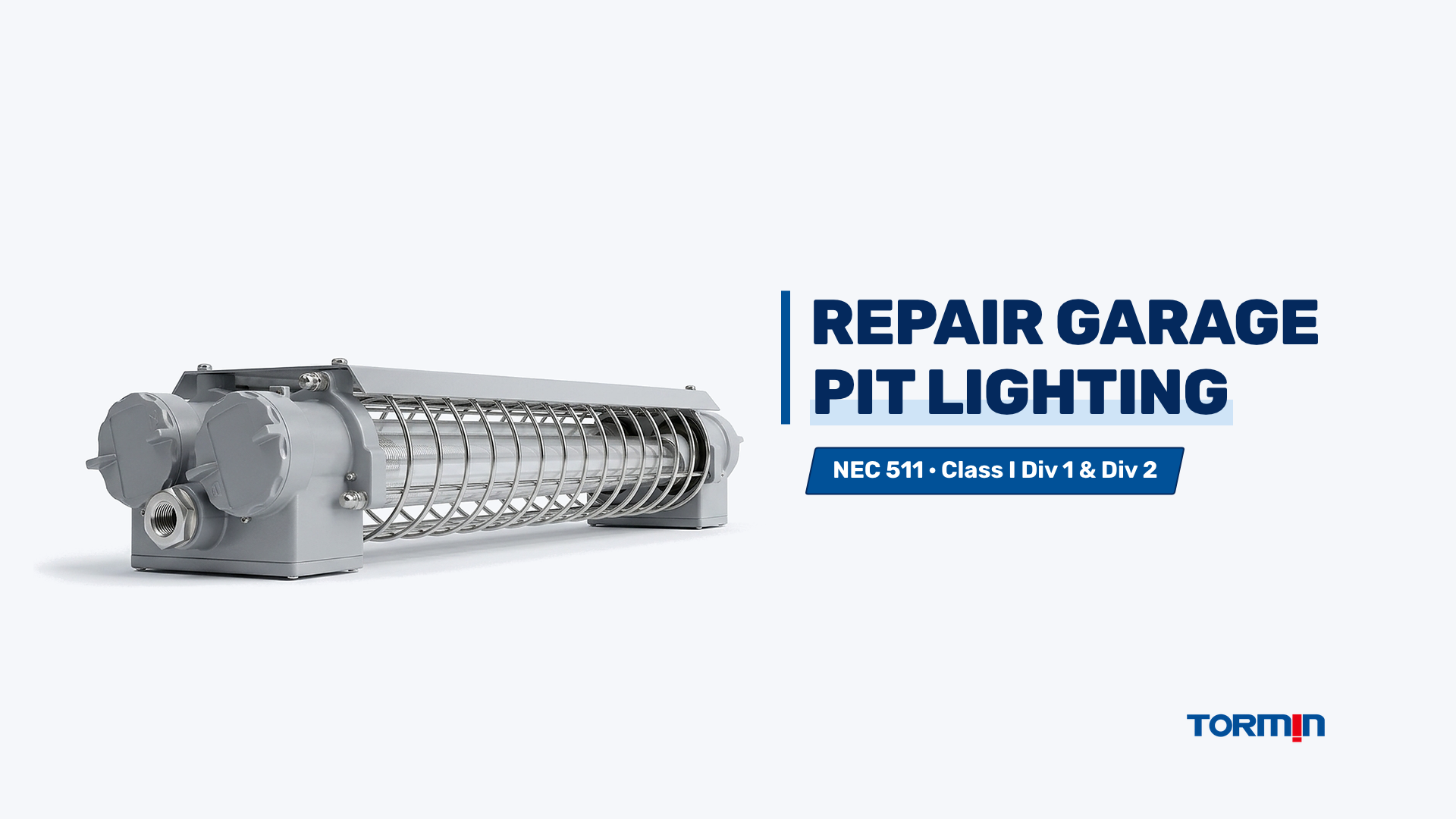
Short answer
Yes—in commercial vehicle repair garages servicing gasoline or other heavier-than-air fuels, any unventilated inspection pit or subfloor work area below the floor line is classified as Class I, Division 1 under National Electrical Code (NEC) Article 511, while the thin air layer from floor level up to 450 mm (18 in.) above the floor is classified as Class I, Division 2. Because fuel vapors sink into recessed pits, installing explosion proof pit lights is a code requirement under NEC 511.3 and 511.4 rather than an optional shop upgrade. Both fixed pit-wall luminaires and portable hand lamps carried down the pit steps must match the hazardous classification of the space they occupy or can reach. (Code basis: clause references below are verified against the 2022 California Electrical Code, based on NEC 2020, where the heavier-than-air repair garage classification schedule appears as Table 511.3(C)—part of the Table 511.3(C) / Table 511.3(C)(1) classification table family extracted from NFPA 30A. Always verify the exact NEC edition and area classification drawings adopted by your project and authority having jurisdiction, or AHJ.)
Article 511 applies specifically to facilities performing service and repair operations on self-propelled vehicles using volatile flammable liquids or flammable gases (NEC 511.1). Facilities used strictly for parking or vehicle storage without repair operations follow a separate determination under NEC 511.3(A).
| Elevation Zone in the Repair Bay | NEC Article 511 Classification (Heavier-Than-Air Fuels) | Luminaire & Portable Lighting Consequence |
|---|---|---|
| Below floor level (inspection pit, depression, or subfloor work area) | Class I, Division 1 (Group D / Zone 1 Group IIA for unventilated major repair pits under Table 511.3(C); modified only where documented code ventilation and repair-scope criteria are met on the classification drawing). | Fixed pit luminaires must be identified for Class I, Division 1 (NEC 511.4(B), 501.130(A)(1)) and protected against impact in recessed niches or behind guards. Portable hand lamps entering or capable of reaching the pit must also be identified for Class I, Division 1 (NEC 511.4(B)(2)). |
| Floor level up to 450 mm (18 in.) above the floor | Class I, Division 2 (Group D / Zone 2 Group IIA; horizontal reach across the bay or around pit openings is governed by the adopted NEC classification table and area classification drawings). | Fixed electrical equipment within this 450 mm (18 in.) floor band must comply with Class I, Division 2 rules under NEC 511.4 and Article 501; portable lamps reaching into this zone remain governed by NEC 511.4(B)(2). |
| Above the 450 mm (18 in.) floor layer | Unclassified for heavier-than-air vapors (unless designated otherwise by the project’s area classification documents or lighter-than-air fuel rules under Table 511.3(D)). | Standard commercial garage rules under NEC 511.7 govern fixed overhead luminaires and wiring, while boundary conduit seals are still required where raceways cross out of the classified zones below. |
Why the pit is the collector
NEC Article 511 treats a below-grade service pit differently from the upper bay ceiling because of vapor density and pit geometry. Gasoline vapor and liquefied petroleum gas (LPG) are heavier than air. When a vehicle enters a repair bay for fuel-system, drivetrain, exhaust, or undercarriage work, small fuel weeps, filter removals, line disconnects, or evaporating drips do not rise toward the roof. Instead, heavier-than-air vapors sink to the floor and spill over the pit curb into the recessed trench below.
Once fuel vapor drops below the floor line, the concrete pit walls act as a collection basin. Natural air currents that move across the main shop floor when bay doors open pass straight over the pit opening, leaving a stagnant pocket of hydrocarbon vapor at the bottom of the pit—right where technicians stand beneath the chassis and where pit luminaires operate. Because the vehicle parked overhead blocks ceiling light, pit illumination has to run continuously during undercarriage work. That combination of trapped heavier-than-air vapor and close-range electrical equipment is why NEC Article 511 and NFPA 30A assign strict classifications below the floor line.
The three layers of a repair garage
To specify or inspect explosion proof pit lights accurately, read the repair bay as three vertical layers under NEC 511.3(C) and the Table 511.3(C) / Table 511.3(C)(1) classification schedule, after confirming three scope inputs:
- Repair garages versus parking-only structures: NEC 511.1 covers service and repair operations on vehicles using volatile flammable liquids or flammable gases. Parking garages used solely for parking or storage without repair work follow NEC 511.3(A) and are not interchangeable with active maintenance bays.
- Major versus minor repair scope: Within Table 511.3(C) for heavier-than-air fuels, the code distinguishes major repair garages (where Class I liquids or gaseous fuels are transferred or dispensed) from minor repair garages (where fuels are not transferred or dispensed). While Table 511.3(C) includes specific Division 2 or unclassified rows for minor repair pits or pits with code-specified continuous subfloor exhaust ventilation, electrical contractors never assume a downgrade on their own—the binding classification comes from the facility’s area classification drawings under NEC 500.4; see how to determine Class, Division, and Zone ratings for how classification records establish those boundaries.
- Repair bays versus motor fuel dispensing areas: Fuel-dispensing units and fuel-island transfer zones inside or outside buildings are governed by NEC Article 514 (per NEC 511.3(B) and 511.4(B)(1)) alongside NFPA 30A; for fuel-dispensing zones, see our guide on gas station canopy explosion-proof lighting.
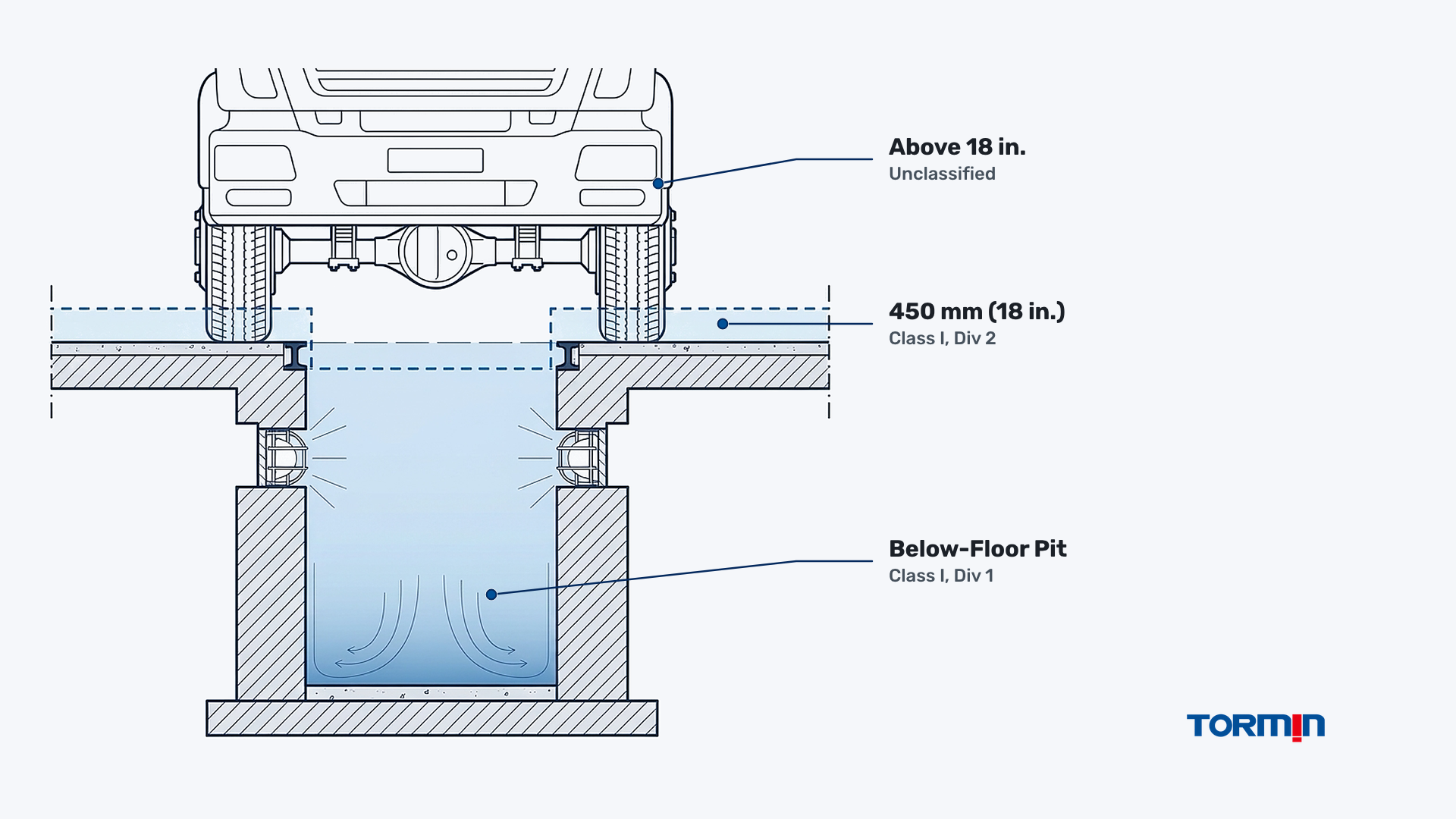
Across a heavier-than-air repair bay, the three vertical layers work as follows:
- Below floor level (the pit or depression): Class I, Division 1: From the pit floor up to the shop floor plane, an unventilated major-repair pit or subfloor work area is Class I, Division 1 (Group D, or Zone 1 Group IIA). Because ignitible vapor concentrations can collect below grade during normal service, electrical equipment inside the pit must satisfy Division 1 protection rules.
- Floor level up to 450 mm (18 in.) above the floor: Class I, Division 2: Immediately above the shop floor sits a 450 mm (18 in.) horizontal layer classified as Class I, Division 2 (Zone 2). Its horizontal extent across the room or around pit openings is set by the adopted NEC table and the project’s classification drawings.
- Above the 450 mm (18 in.) floor layer: Unclassified: Above the 450 mm (18 in.) plane, the upper bay air volume is unclassified for heavier-than-air vapors unless the classification documents designate otherwise.
Fixed lights inside the pit
Fixed luminaires mounted inside a Class I, Division 1 pit sit below the floor line and must conform to NEC Article 501 (per NEC 511.4(B)). Under NEC 501.130(A)(1), each fixed luminaire in a Class I, Division 1 location must be identified for Class I, Division 1 locations—with suitability established under NEC 500.8(A) (commonly via third-party listing to hazardous-location luminaire standards) and a permanent rating plate matching the required gas group (Group D) and maximum operating temperature or T-code under NEC 500.8(C).
A Division 2 fixture or an ordinary IP-rated vapor-tight shop light cannot be substituted inside a Class I, Division 1 pit. For how Division 1 containment differs from Division 2 luminaire rules, see Class I, Division 1 vs Division 2 lighting, and use our guide on reading an explosion-proof lighting nameplate and certificate to verify the rating plate before installation.
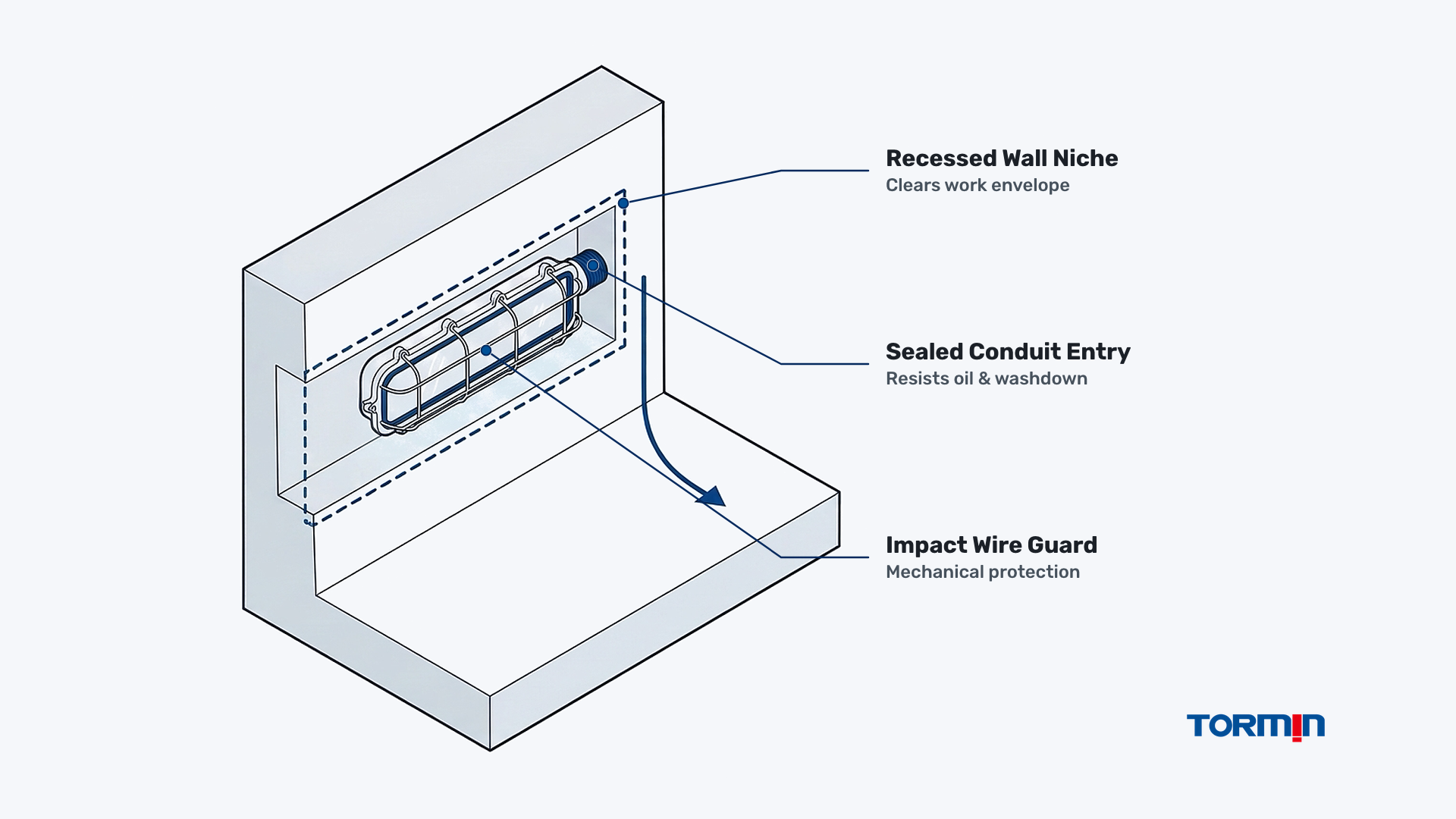
Fixed explosion proof pit lights must also handle the physical abuse of undercarriage maintenance:
- Recessed placement and impact guards (NEC 501.130(A)(2)): Every Class I, Division 1 luminaire must be protected against physical damage by a suitable guard or by location. Because mechanics handle pry bars, impact wrenches, and rolling pit jacks along the pit walls, pit luminaires should be recessed into concrete wall niches (alcoves) behind flush stainless-steel wire guards or grilles so tools and vehicle parts cannot strike the glass lens.
- Oil, chemical, and washdown durability: Pit fixtures face motor oil, gear lube, brake cleaner, road salt, degreasers, and hose washdowns. Select cast housings, tempered glass lenses, and gaskets rated to resist hydrocarbon fluids and wet cleaning, and keep all guards and fasteners intact during maintenance.
The light mechanics actually carry in
Because a vehicle chassis blocks light from wall niches, the luminaire mechanics rely on most inside an inspection pit is the portable hand lamp (drop light).
NEC Article 511 governs portable lamps directly in NEC 511.4(B)(2). Unless a portable lamp and its cord are supported or arranged so they cannot be used in the Class I locations classified in 511.3 (including the pit and the 450 mm / 18 in. floor layer), the portable luminaire must be identified for Class I, Division 1 locations. It must also feature a handle, lampholder, hook, and substantial guard attached to the lampholder or handle, nonconducting or effectively insulated exterior surfaces, an unswitched lampholder with no plug-in receptacle, and a molded-composition or other suitable outer shell. For the three-part check required on the lamp itself—verifying the nameplate rating, protective cage, and cord/plug boundary—see our guide to explosion-proof drop lights.
Ventilation: part of the design, not an eraser
Subfloor exhaust ventilation drawing near the pit bottom is a core part of repair-garage design under NEC Article 511 and NFPA 30A, but installing a fan does not automatically erase a pit’s hazardous classification.
While Table 511.3(C) provides specific classification rows for pits with continuous code-specified floor-level exhaust ventilation, whether a particular pit’s classification changes from Division 1 to Division 2 or unclassified depends on the adopted code edition, verified exhaust design, repair-scope classification, and formal acceptance by the engineer of record and AHJ on the area classification drawings. Never treat an aftermarket exhaust fan as permission to install ordinary commercial lights in a pit.
Wiring and seals at the floor line
Under NEC 511.4(A), wiring inside Class I pit zones must follow NEC Article 501. For underground raceways beneath Class I locations, NEC 511.8 requires threaded rigid metal conduit (RMC) or intermediate metal conduit (IMC), or allows qualifying buried nonmetallic conduit only when installed under code-required cover and transitioned to threaded RMC or steel IMC for the emergence run with an equipment grounding conductor.
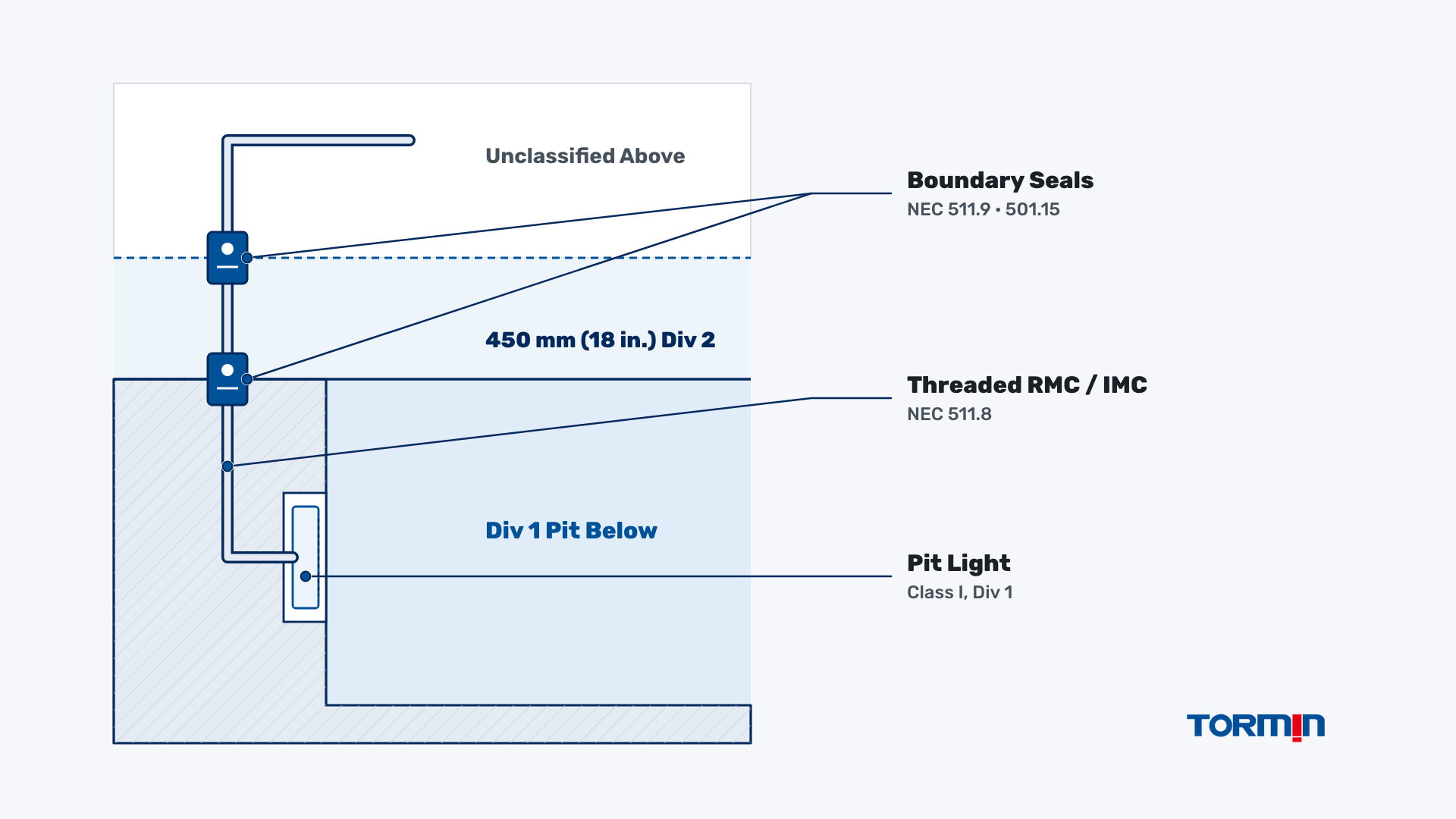
Under NEC 511.9 (Sealing), conduit seals complying with NEC 501.15 and 501.15(B)(2) apply to both horizontal and vertical boundaries of the defined Class I locations—including where raceways cross out of the below-floor pit or pass through the 450 mm (18 in.) floor boundary. For how boundary and enclosure seals work, see whether explosion-proof light fixtures need conduit seals.
Mistakes
Check for four common errors during repair-garage pit reviews:
- Treating the pit like an ordinary basement and installing commercial vapor-tight strip lights: Gasketed washdown lights do not prevent vapor ignition; a Class I, Division 1 pit requires luminaires identified for Class I, Division 1 (NEC 511.4(B), 501.130(A)(1)).
- Assuming the 450 mm (18 in.) Division 2 floor layer covers the pit cavity below grade: The 450 mm (18 in.) Division 2 band sits above the floor line; using Division 2 fixtures inside a Division 1 pit violates Article 511.
- Installing a pit exhaust fan and declaring ordinary shop lights acceptable: Only a code-engineered ventilation system documented on the formal area classification drawings and accepted by the AHJ can alter a pit’s classification.
- Leaving drop-light plugs inside the pit or dragging unprotected cords across the pit curb: Plugging in inside the pit or pinching cords under jacks and creepers creates an arc hazard; follow the cord and plug rules in our explosion-proof drop light guide.
When comparing heavy-duty industrial and IEC hazardous-area luminaires across regional project standards, browse our hazardous area lighting product category and confirm on the approval record that any fixture selected for a North American NEC Article 511 pit carries the exact Class I, Division 1 (or documented Division 2) suitability evidence, gas group, and temperature marking required by your classification schedule and AHJ.
FAQ
Is every garage pit a Class I Division 1 area?
In a repair garage servicing heavier-than-air fuels, NEC Table 511.3(C) classifies an unventilated pit in a major repair garage as Class I, Division 1 up to the floor line (while minor repair pits or pits with code-compliant floor-level exhaust ventilation follow their respective rows in Table 511.3(C), and pure parking garages without repair work follow NEC 511.3(A)). Always check the facility’s area classification drawings.
What rating does a fixed light inside a pit need?
Inside a Class I, Division 1 pit, fixed luminaires must be identified for Class I, Division 1 locations (NEC 511.4(B), 501.130(A)(1)) with matching gas group (Group D) and temperature markings verified on the rating plate (see our nameplate and certificate guide), plus physical impact protection under 501.130(A)(2).
Can I take a normal drop light into the pit?
No. Under NEC 511.4(B)(2), any portable lamp that can reach into the Class I zones classified in 511.3 must be identified for Class I, Division 1 locations and built with an unswitched lampholder, no plug-in receptacle, insulated exterior surfaces, and a substantial guard and hook. See our explosion-proof drop light guide for the three-item check.
Does ventilating the pit remove the classification?
Ventilation is part of the design, not an automatic exemption. Whether a pit’s classification is adjusted under Table 511.3(C) depends on the adopted NEC/NFPA 30A edition, engineered floor-level exhaust criteria, and formal approval on the area classification documents accepted by the AHJ.
Our shop’s pit lights were installed decades ago — are they grandfathered?
An article cannot issue an exemption ruling for existing wiring. Existing installations are evaluated by the local AHJ and insurance or fire inspectors. Because pit fixtures face decades of tool impact, oil exposure, and gasket wear, scheduling a qualified electrical inspection of your pit luminaires, guards, and boundary seals is the safest step.
Sources
- NFPA 70 / 2022 California Electrical Code (NEC 2020 basis), Article 511 (Commercial Garages, Repair and Storage) — Scope (
511.1), parking versus repair (511.3(A)), dispensing boundary (511.3(B),511.4(B)(1)), heavier-than-air classification schedule (511.3(C),Table 511.3(C)/Table 511.3(C)(1)family), Class I equipment and portable lamps (511.4(B)), underground wiring (511.8), and boundary sealing (511.9); verify the project’s adopted NEC edition. - NFPA 70 / 2022 California Electrical Code (NEC 2020 basis), Article 500 and Article 501 (Class I Locations) — Suitability and markings (
500.8), Class I wiring (501.10), conduit seals (501.15), and Class I luminaires (501.130(A)(1)–(2)). - NFPA 30A — Code for Motor Fuel Dispensing Facilities and Repair Garages — Source standard referenced by NEC Article 511 for repair garage classification and pit ventilation rules.