
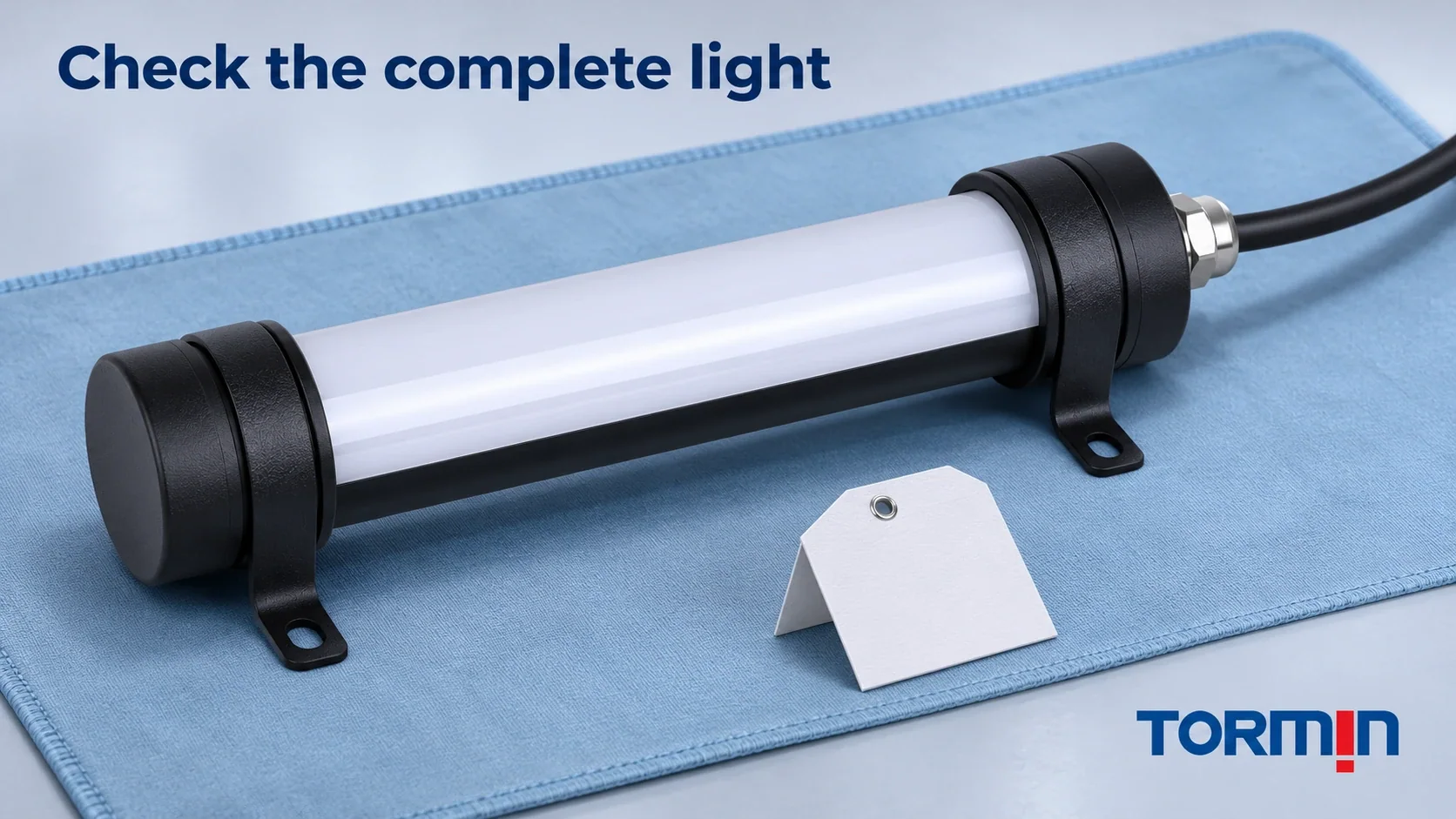
Short Answer
An “explosion proof drop light” product name is not proof that a lamp can enter a classified location. Check three things together: the complete light’s hazardous-location identification, its required guard or other physical protection, and its cord-and-plug arrangement. A metal cage cannot supply a missing rating, and a suitable lamp body cannot compensate for an unsuitable connection.
Start with the requirement for the exact position where the light will be used. Then inspect the actual assembly being issued, including its accessories and condition. If its identity or permitted configuration cannot be established, hold it for verification rather than relying on appearance or previous use.
| Check | What to inspect | Typical failure |
|---|---|---|
| Rating | Readable equipment identity, location suitability, thermal marking and documents for the complete portable assembly | A workshop light described as “industrial” with no evidence matching the classified position |
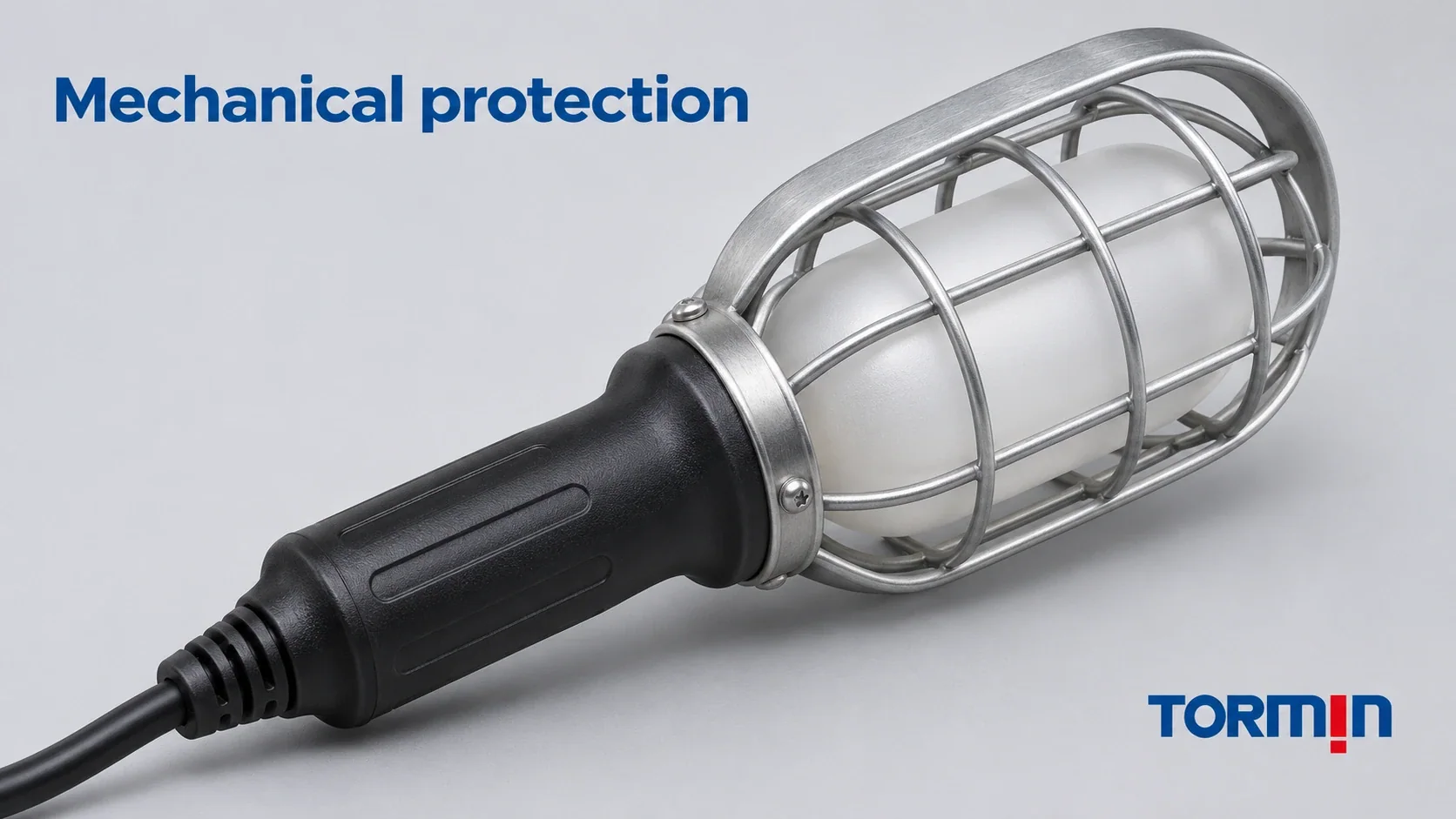
| Guard and physical protection | The required guard, protective enclosure and support arrangement, intact and consistent with the approved construction | An added cage presented as an approval, or a required guard missing or bent against the lamp |
| Cord and plug | Extra-hard-usage continuous cord, sound jacket, grounding, strain relief and location-appropriate connection | A taped splice, loose entry, damaged plug or ordinary connection used without the required location suitability |
These checks concern the light itself. They do not authorize the work or establish the area’s classification.
A light that goes where the work is
Here, a drop light means a flexible-cord-fed portable work light that can be carried, held or suspended while work proceeds. “Trouble light” and “hand lamp” are common names for this equipment. The term does not describe a handheld flashlight or a permanently installed pendant luminaire.
Its defining problem is movement. A worker may start at a bench, move through an opening and place the light beside the component being repaired. A supply socket in an ordinary workshop does not establish conditions at the lamp’s destination. The lamp, its connection points and any accessories must be reviewed for where they will actually go.
Use the controlled classification information for that position; if the requirement is unclear, resolve it through the responsible site team before selecting the light. The guide to determining Class, Division or Zone requirements explains that upstream task.
A fixed luminaire has an established installed position; a portable light needs its intended positions checked whenever its assignment changes. A tag saying “maintenance equipment” does not extend its approval to every location on site.
Check 1: the rating is on the nameplate, not in the product name
For a Class I, Division 1 position, the NEC requires the luminaire to be identified as a complete assembly for that location, with portable luminaires specifically listed as complete assemblies for portable use. Approval of a lampholder or enclosure alone does not establish approval of the finished hand lamp. This distinction is explicit in NEC Article 501, in the adopted-code text used here.
Match the equipment’s marking and supporting documents to the required classification, gas group and operating-temperature limitation or temperature class. Use the approval framework required by the project. An IEC or ATEX marking is not, by itself, evidence of acceptance for a North American Division installation; a Zone designation also needs the appropriate approval context.
Read the plate on the actual light, not a photograph of a similar model in a catalogue. Compare its identity with the instructions and certification information, including any limitations on lamps, guards, accessories, ambient conditions and portable use. A nameplate that cannot be read leaves the check unresolved. The nameplate and certificate guide covers how to join those documents.
Division 2 has its own portable-lighting provisions: the inspected NEC text directs portable equipment to its luminaire thermal requirements, rather than universally imposing the Division 1 listing route. A regular workshop lamp does not qualify automatically, and a fixed-equipment allowance should not be borrowed without checking its scope. The general-purpose lighting discussion for Division 2 provides the broader context.
None of these descriptions establishes hazardous-location suitability:
- “Heavy-duty”: a durability claim without the required location identification.
- “Industrial grade”: a market description, not a classified-location approval.
- “Rugged”: a claim about construction or handling, not ignition protection.
- An IP enclosure rating: environmental ingress protection, not the complete hazardous-area assessment.
- An unsupported “explosion-proof” claim: wording without traceable equipment evidence.
The practical question is whether the evidence belongs to this complete portable light, in this configuration, for this location. An order description cannot answer that on its own.
Check 2: the guard protects the lamp — it does not create the rating
A guard provides mechanical protection. It can keep surrounding objects from striking or contacting a vulnerable lamp surface, but an open wire cage is not a flame-containing enclosure. It cannot be assumed to retain hot fragments or prevent ignition if a lamp fails. Where falling hot material presents an ignition risk, the applicable protective enclosure or other effective means must also be addressed.
NEC Article 501 recognizes protection against physical damage by a suitable guard or by location. The correct construction therefore depends on the equipment and its permitted use; not every approved portable LED design must resemble a traditional caged bulb. For a trouble light whose assessed construction requires a guard, however, that guard must be the correct part of the complete assembly.
Adding a hardware-store cage to an unapproved lamp changes none of its electrical or thermal evidence. It does not assess the lampholder, switch, lens, entry or operating temperature. The cage may improve impact protection while leaving the classified-location problem entirely unresolved.
Before issue, inspect the guard’s attachment, shape and clearance from vulnerable parts. A guard bent against the glass no longer provides its intended separation. Missing fasteners, improvised wire repairs, removed covers or a substituted cage are reasons to hold the light for competent review against the original construction and instructions.
The immediate field decision is to stop using an assembly that is damaged or no longer demonstrably matches its approved condition. Return it only after the required repair and verification have been completed. OSHA’s portable-equipment use rule supports removing unsafe damaged equipment from service pending repair and testing.
Check 3: the cord and the plug are part of the luminaire
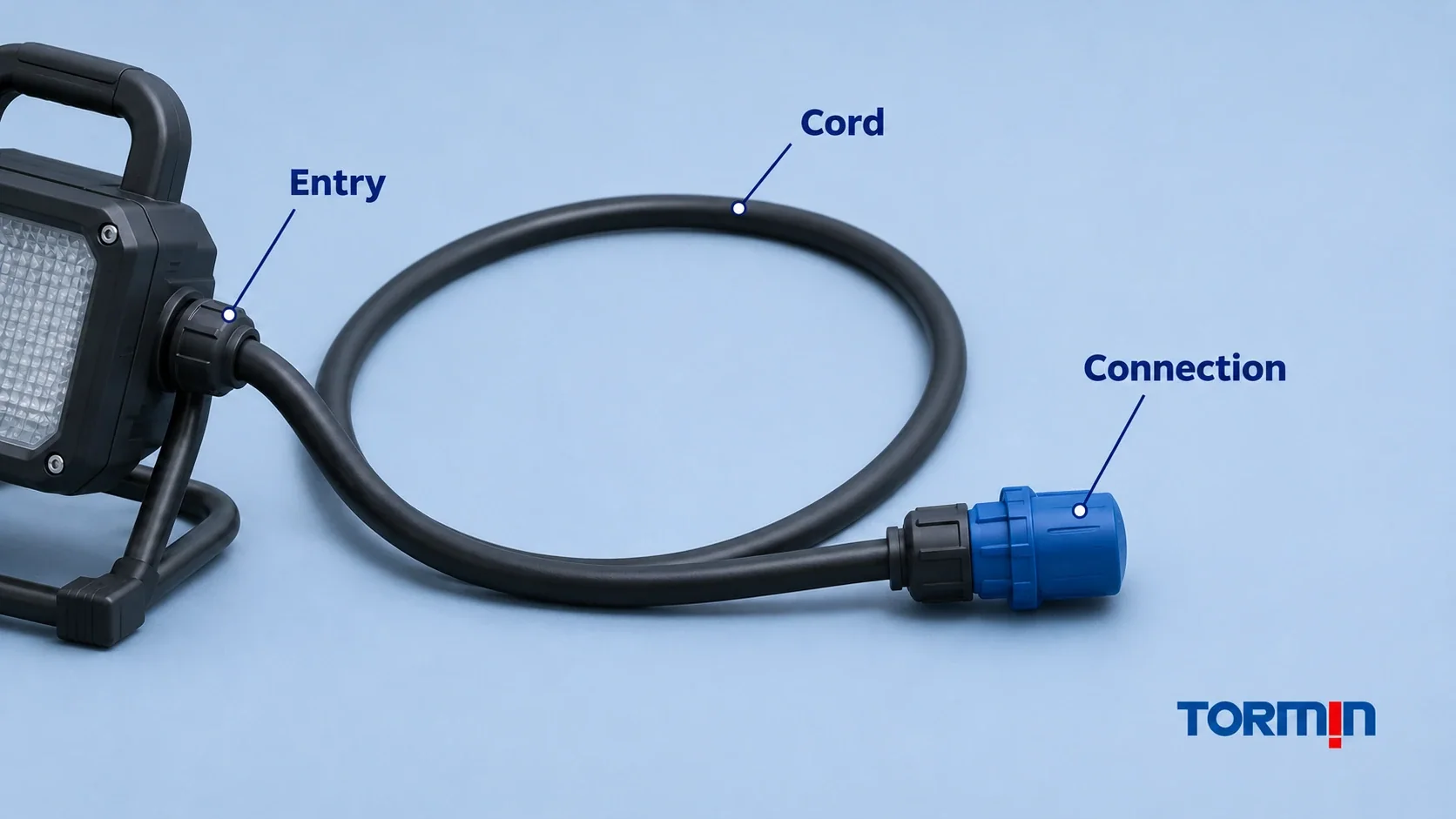
Inspect the whole route from the light’s entry to its connection. A sound housing with a damaged lead is not a satisfactory portable assembly. Under the inspected Class I provisions of NEC Article 501, flexible cords must be listed for extra-hard usage, contain the required equipment grounding conductor, remain continuous and be supported so that the terminals do not take mechanical tension. Article 400 supplies the general flexible-cord framework.
Follow the cord, not just its outer jacket
Check the cord identification and compatibility with the documented assembly; thickness or a rubber-like appearance does not prove the usage classification. Look for cuts, crushing, exposed material, deterioration and unauthorized repairs. Check the entry and strain relief for looseness, damage or evidence that the cable has pulled through.
A taped joint is not an acceptable substitute for the continuous cord required by these Class I provisions. The fact that a general cord rule may allow a particular repair elsewhere does not override the more specific classified-location requirement. Send a damaged lead through the authorized repair process rather than making a field splice to finish the shift.
Use the intended support or hanger. Do not raise or lower the light by its power cord, or improvise suspension that damages the jacket. OSHA’s handling rule addresses those practices separately from the hazardous-location rating. Support and cable routing must also avoid transferring the lamp’s weight or a worker’s pull to its terminals.
Review the connection as a separate ignition point
Plugging and unplugging can produce an arc. The connection must meet the requirements for its actual location and permitted operating conditions. For the Class I applications discussed here, attachment plugs need location identification and the grounding connection required by the permitted cord arrangement.
The NEC distinguishes termination requirements where explosionproof equipment is required from Division 2 arrangements where it is not. Do not turn that distinction into permission to use any ordinary connector. Check the specified plug, receptacle, cord connector and any required seal as an arrangement, including the manufacturer’s restrictions on connection and disconnection.
Alternatively, keep the connection genuinely outside the classified location where the design and instructions permit. That only resolves the connection’s location; the light entering the classified space still needs its own suitability. An extension arrangement that moves the plug inside later must be reviewed again.
GFCI protection answers a different question
A GFCI provides ground-fault protection intended to reduce electric-shock hazards. It does not make normal switching contacts non-sparking, lower the lamp’s operating temperature or establish a hazardous-location approval. Installing one upstream cannot qualify an ordinary trouble light for a classified position. OSHA’s GFCI guidance explains its protective function; retain required electrical safeguards alongside suitable equipment.
Heat, lamps and LED
An incandescent trouble light can present a hot bulb and, if damaged, a vulnerable filament and broken glass. Mechanical protection and the approved enclosure arrangement matter, but neither replaces the equipment’s thermal assessment.
An LED design can remove the incandescent filament hazard and reduce some breakage or heating concerns, depending on construction. Its light source, driver and housing still generate heat. An LED label therefore cannot replace the required location identification and operating-temperature marking or temperature class.
Keep the specified light source, covers and accessories consistent with the instructions. A replacement that physically fits is not necessarily an approved substitution. Likewise, an LED conversion does not automatically preserve the original assembly’s assessment. Stop and verify the documented configuration rather than assuming the newer source must be acceptable.
When an ordinary drop light is fine
An ordinary light can be appropriate in a documented unclassified location, subject to its intended-use instructions and ordinary electrical and environmental requirements. A tank, pit or machine compartment is not classified merely because of its shape or name, but neither should its status be guessed by the person collecting the lamp.
Another option is to keep the light itself outside the classified location and illuminate the task from there, provided the arrangement actually keeps the equipment outside and remains suitable for the work. A lamp laid across an opening or later pushed inside has changed position; the original decision must still hold at the final placement.
For lighting kept outside an opening and system-level decisions about gas detection, ventilation or low-voltage arrangements, use the confined-space lighting guide.
A battery-powered or low-voltage portable light is another equipment option, but taking it inside a classified location still requires matching identification and permitted accessories. For the protection-concept choice, see intrinsically safe versus explosion proof portable lights.
The portable-light product category is a browsing starting point; category membership does not establish approval for a particular location or cord arrangement.
Mistakes
- Taking a hardware-store trouble light into Division 1 equipment. A cage, tough handle and familiar workshop history do not provide the required complete portable-assembly listing. Check the actual destination and equipment evidence before issue.
- Adding a metal cage and calling the result explosion proof. The added part does not assess the original electrical or thermal construction. Use the documented protective arrangement of equipment suitable for the location.
- Treating a GFCI outlet as permission to use an ordinary light. Ground-fault protection does not establish ignition protection. Keep the required shock safeguards, but resolve equipment suitability independently.
- Continuing with a spliced lead or casually connecting inside the area. Hold the damaged assembly for repair and verification, and check the location and permitted operation of the connection before use.
FAQ
Is a drop light with a metal cage explosion proof?
No. A cage supplies mechanical protection. If it is required by the approved construction, it must match that assembly. Adding a cage to an ordinary lamp creates no hazardous-location rating.
Can I use a regular trouble light in a Division 2 area?
Not automatically. Portable lights have specific requirements, including the applicable luminaire thermal provisions and cord-and-connection conditions. As Check 1 explains, do not assume either ordinary workshop acceptance or a universal Division 1 listing requirement.
Does a GFCI outlet make a standard drop light safe for classified locations?
No. A GFCI addresses ground-fault hazards; it does not establish the lamp’s thermal suitability or prevent normal connection arcing. The complete light and connection still need the appropriate location suitability.
Are LED drop lights automatically acceptable?
No. LED construction may reduce particular heat or breakage hazards, but acceptance depends on the complete equipment’s identification, thermal marking, permitted configuration and condition.
What should I check on a second-hand or site-issued drop light before taking it in?
Confirm readable identity and matching location evidence, the correct intact guard or protective construction, and a sound continuous cord with secure strain relief and suitable plug arrangement. Hold equipment with missing documents, unauthorized modifications or unresolved damage.
Sources
- NEC Articles 500, 501 and 400, accessible in the 2022 California Electrical Code. This adopted text is based on the NEC 2020 edition; check the edition adopted for the project. Used for suitability, portable luminaires, flexible cords and attachment plugs.
- UL 844, Luminaires for Use in Hazardous (Classified) Locations. Public standard identity and scope covering fixed and portable luminaires; not evidence of any particular product’s listing.
- OSHA, Use of equipment. Portable-equipment inspection, handling, grounding and removal of damaged equipment from service.
- OSHA, Ground-Fault Circuit Interrupters. Ground-fault protective function and its distinction from hazardous-location suitability.