
Short answer
Restricted breathing fixtures can achieve a lower maximum surface-temperature rating because a tested enclosure limits gas entry, allowing the luminaire’s temperature classification to be based on its external surface. That rating is conditional on the restricted-breathing construction remaining effective. It does not mean every internal component is equally cool. In the title, “lower” means a lower permitted surface temperature, not a smaller T-number: T6 permits a cooler surface than T5. The concept is identified by nR under IEC 60079-15, with equipment protection level Gc for Zone 2 gas applications. [1]
A buyer therefore needs more than a temperature code. Check the exact configuration, its certified ambient range and the conditions that keep the enclosure effective throughout service.
| What you see | What it means | When the claimed rating cannot be relied on |
|---|---|---|
| nR and Gc | Restricted-breathing protection for a Zone 2 gas application | The position requires Zone 1 protection, or the enclosure’s documented restricted-breathing condition is unverified |
| Ex nR IIC T6/T5 Gc | Read the certificate’s configuration and ambient-temperature schedule | The selected T-class does not cover that configuration at the actual ambient temperature |
| Certificate number ending in X | Specific conditions of use require attention | An applicable condition has not been met |
| Provision for routine checking | Pressure checks form part of the maintenance obligation | Required verification is missing, unsuccessful or no longer applicable after intervention |
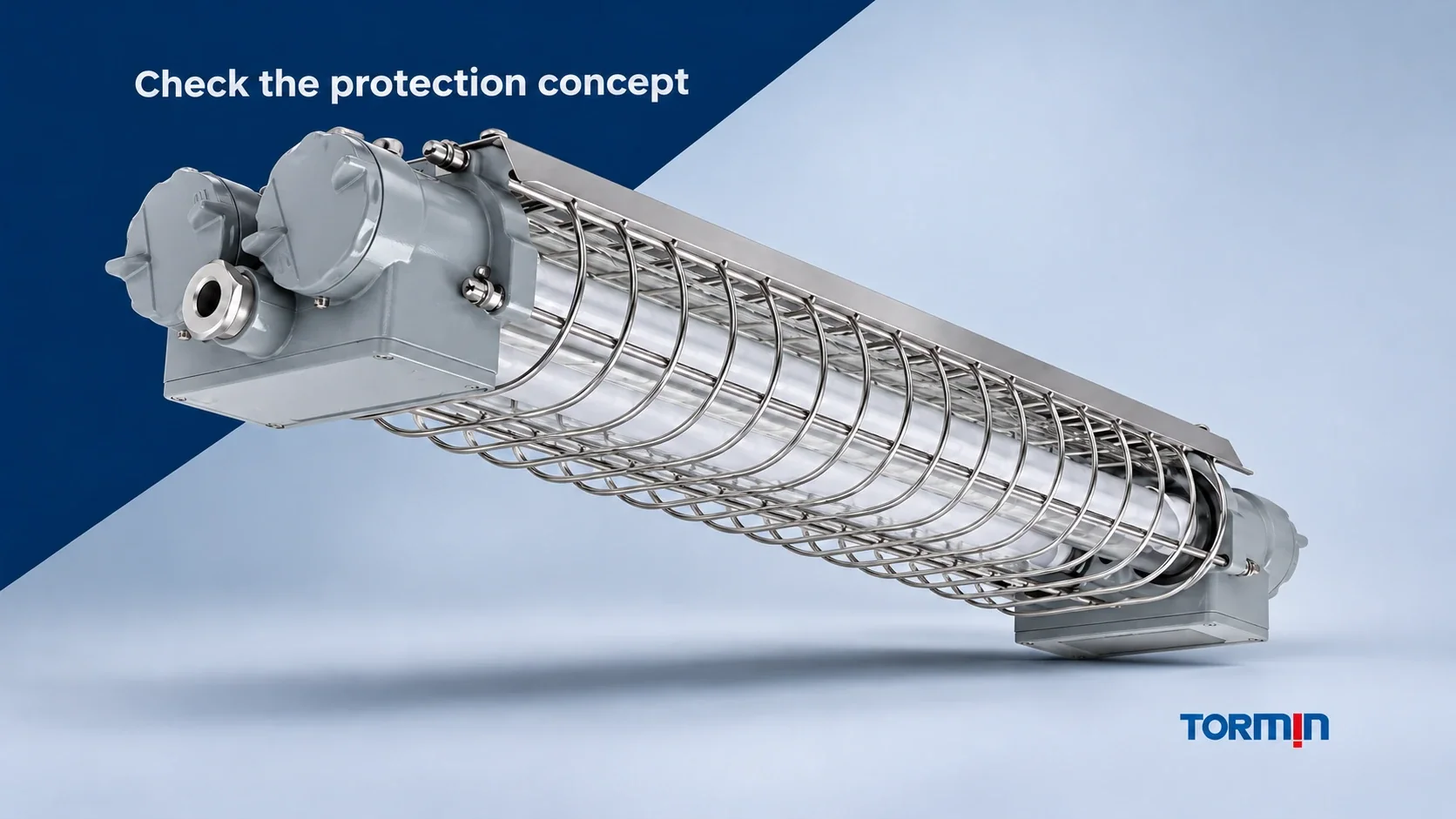
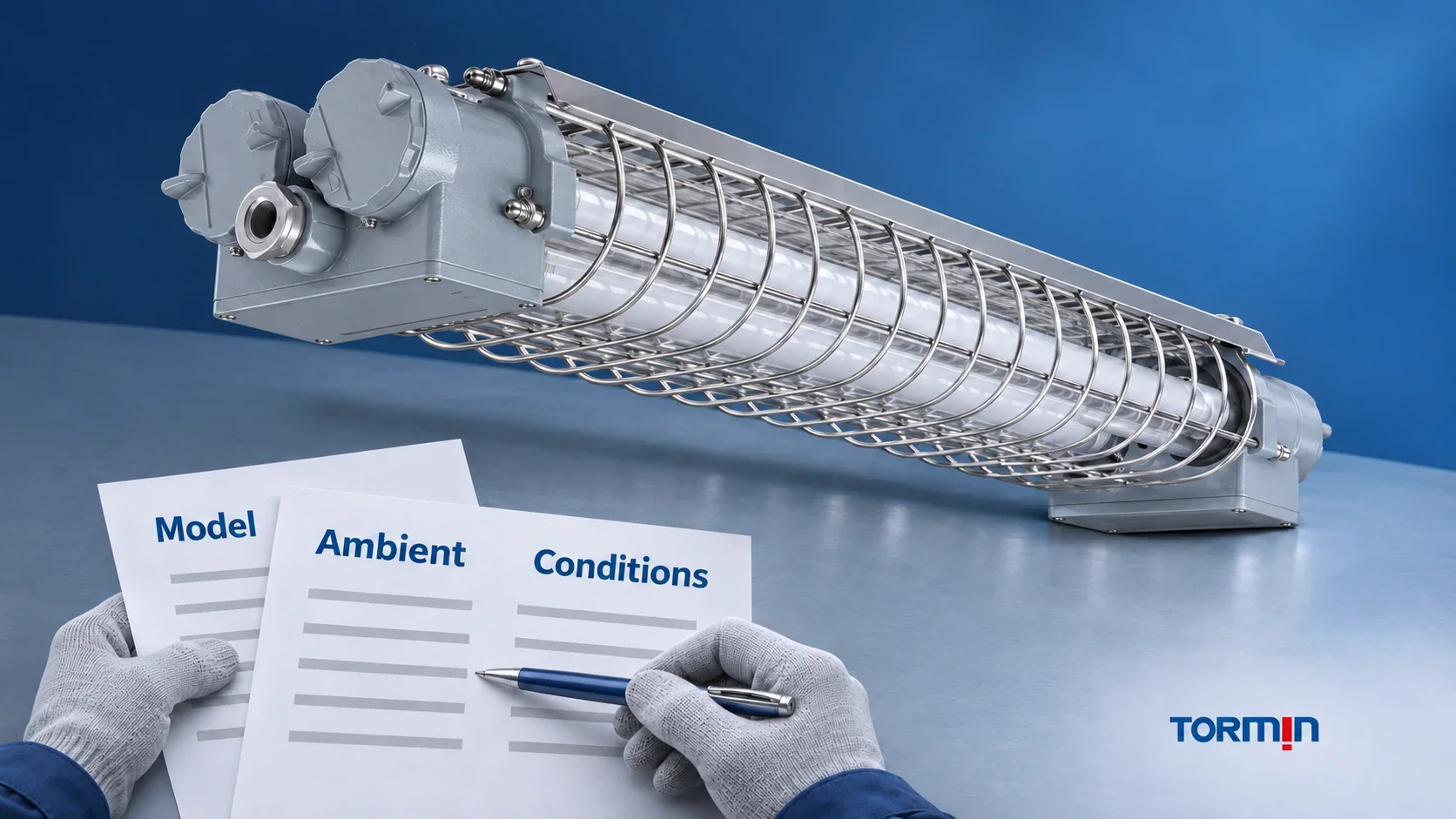
The pictured luminaire is an exterior reference for document review. No restricted-breathing rating is asserted for it.
What restricted breathing actually is
Restricted breathing is an enclosure-based protection concept within IEC 60079-15, Equipment protection by type of protection “n”. Instead of allowing the surrounding atmosphere to enter freely, the construction restricts its rate of entry. The complete assessed assembly matters: the cover, window, sealing interfaces and entry arrangements contribute to the result. A weather-resistant appearance alone establishes none of this. [1]
Restriction is different from hermetic sealing. An nR enclosure is not a promise of zero gas exchange indefinitely. It is also different from a flameproof enclosure designed around containing an internal explosion and preventing its propagation. Do not infer that a tightly closed nR housing could perform that function if an ignitible mixture formed inside.
Nor does its overall sealing replace a separately required conduit seal. Those arrangements perform different jobs and need their own evidence. The conduit-seal guide addresses the wiring-system decision; an integral restricted-breathing arrangement is not automatically an explosionproof seal-off.
For a Zone 2 position, Gc is the relevant protection level of the nR concept discussed here. The marking cannot be stretched to Zone 1. Changing the mounting location does not change what the enclosure was assessed to do.
Why the T-rating looks better than the hardware suggests
The enclosure separates two temperature questions
Zone 2 classification concerns an explosive gas atmosphere that is not likely in normal operation and, if it occurs, persists only briefly. Restricted breathing slows gas entry so that, within the protection concept’s assessed conditions, an ignitible concentration does not develop around the internal ignition-capable parts during that exposure.
The internal components can therefore be hotter than the external temperature-class limit without that fact alone defeating the certified concept. The external surface still has to meet its limit: it is exposed directly to the surrounding atmosphere. IEC 60079-15:2017, Clause 10.4.3, addresses external-surface temperature classification for restricted-breathing luminaires under normal and specified abnormal conditions. [1]
This does not cool the internal components by definition. It changes which surfaces can encounter an ignitible atmosphere while the protection remains effective. Losing the enclosure’s restricted-breathing properties removes that separation, even if the lamp still produces normal light.
The resulting T-class is one selection axis; gas group remains another. The gas-group and temperature-class guide covers that distinction without treating a good group marking as proof of thermal suitability.
Read both values against the ambient schedule
The marking Ex nR IIC T6/T5 Gc appears on a published IECEx certificate. Its schedule relates temperature class to the exact configuration and permitted ambient range. It does not offer an unrestricted choice between the two values. [3]
For a configuration whose schedule assigns T6 at a lower ambient limit and T5 at a higher one, the ambient condition decides which claim applies. The ambient-temperature guide explains why a T-code cannot be separated from Ta or Tamb.
| Schedule condition for the exact configuration | Applicable T-class | Maximum external surface temperature |
|---|---|---|
| Ambient range assigned to T6, per the certificate schedule | T6 | 85°C |
| Ambient range assigned to T5, per the certificate schedule | T5 | 100°C |
| Ambient or configuration outside the applicable schedule row | No class established by these rows | Do not extrapolate |
For example, if the required class is T6 but the applicable schedule row establishes only T5, the presence of T6 elsewhere in the marking does not rescue the selection. Conversely, where the correct row establishes T6 and all other conditions are met, a hotter internal component does not by itself contradict that external-surface classification.
These are standard T-class limits, not measured product temperatures. No numeric ambient boundary is assumed here. A schedule row may cover only particular variants; the presence of two codes elsewhere on a family document does not give both codes to every variant.
The pressure test that backs the rating
A restricted-breathing claim needs evidence of restricted leakage, not simply a lid that feels tight. One published IECEx certificate describes a factory routine test under constant-temperature conditions: establish a nominal internal pressure 0.3 kPa below atmospheric pressure, approximately 30 mm water gauge, and verify that decay to half the initial pressure difference takes at least 180 seconds. [3]
IEC 60079-15:2017, Clause 12.2.2.1.2, addresses this routine-test route for equipment without a test port. The figures above summarize the selected half-decay method; they are not a complete test specification. Applicable tolerances, equipment characteristics and the controlled procedure must still be followed. Do not turn this factory example into a universal field-test recipe for every nR fitting. [1]
Constant temperature matters because a changing air temperature can change enclosure pressure independently of leakage. A pressure result is meaningful only under the prescribed conditions and with the correct test arrangement. A casual check that a cover resists movement does not demonstrate the same property.
The pressure result concerns the enclosure in the state actually tested. It does not establish that an unrelated replacement cover, a later entry modification or an unapproved accessory will give the same result. Keep the test evidence tied to the complete assessed construction rather than treating a passed factory test as a permanent property of the housing material.
Factory verification also does not remove every service obligation. IEC 60079-17:2023, Clause 5.5.2, calls for periodic pressure measurements on restricted-breathing enclosures provided for routine checking, at intervals of six months or more as experience dictates. The published certificate includes that condition. This is not an automatic fixed interval for all models, nor permission to extend an interval without the relevant maintenance basis. [2, 3]
Before purchase, establish whether the particular equipment has a test port, who will perform the required checks and whether the location permits access. Use the inspection guide for the broader maintenance context. A checklist entry saying “seal visually satisfactory” cannot substitute for a required pressure measurement.
Where the protection silently dies
A gasket can deteriorate while the lamp still works
The enclosure’s electrical function and its restricted-breathing function are different. A damaged sealing interface need not interrupt power. Ageing, damage or an unsuitable replacement can therefore undermine protection without a failed lamp drawing attention to it.
IEC 60079-15 addresses gasket and seal properties, protection from normal mechanical damage and the manufacturer’s replacement information. Follow the specified materials and service instructions; a similar-looking gasket is not evidence of equivalent performance. The certificate example also places conditions on gasket and seal replacement. [1, 3]
Opening changes the state that was verified
Opening a compartment may disturb sealing surfaces, gasket location or fasteners. Reclosing it does not, by itself, establish that the original condition has been restored. Follow the exact instructions, including any prohibition on opening a chamber and any required inspection or retest before return to service. [3]
Do not treat a bright lamp after maintenance as proof that its temperature classification remains usable. The question is whether its protection has been restored and verified, not whether the driver starts.
Entry substitutions can create another leakage path
The cable, gland, entry interface and unused-entry closure must preserve the assessed arrangement. Replacing a specified gland or plug with an ordinary accessory merely because the thread fits can defeat that arrangement. An ingress-protection number alone does not demonstrate restricted-breathing performance.
Check the equipment instructions together with entry-device requirements. The published certificate requires suitable certified cable entries and sets installation conditions; the installation framework is addressed by IEC 60079-14. Neither document supports choosing an accessory solely by its physical fit. [3, 4]
Movement and impact need their own suitability evidence
Do not apply a fitting beyond its documented mounting, vibration or shock conditions. A normal fixed installation is not evidence for a more demanding duty. If the proposed location exceeds the supported conditions, treat suitability as unresolved rather than assuming that tightening the cover will compensate.
An absence of visible damage can justify continuing an inspection, but it cannot resolve missing suitability evidence. The exterior condition, the permitted application and any required leakage verification are separate questions. If one remains unresolved, another satisfactory observation does not cancel it.
This is an exact-equipment check, not a claim that every nR product has an identical mechanical limit. Review the documented installation duty before accepting the location. The sealing arrangement cannot be treated as independent of the environment in which it must survive. [4]
The nR marking itself promises no alarm for loss of restricted breathing. Protection can be compromised without an obvious change in light output; visible condition and any prescribed testing therefore serve different purposes.
Why some sites ban them — and when they are a fair choice
An owner or EPC can exclude nR through its project specification even where the concept is an available certified option. The reasons below explain the maintenance and acceptance logic for such a policy; they are not a survey of named companies or a claim about how frequently exclusions occur.
First, protection depends on retaining a restricted-leakage sealing system over time. Its deterioration may not announce itself through a lighting fault. An owner may prefer to avoid that particular dependency rather than rely on discovering its loss during maintenance.
Second, equipment with routine-check provisions brings a pressure-testing obligation. Access, trained personnel, the correct procedure and traceable results must all be available. A fitting that is manageable on a bench may be a poor operational choice if the installed position makes its required verification impractical.
Third, an owner may standardize accepted protection concepts to simplify inspection and spares management. A specification accepting appropriate Ex d or Ex e equipment can avoid maintaining a parallel nR verification regime. Those concepts still have their own conditions and maintenance requirements; the Ex d versus Ex e explanation covers their different principles. They are not maintenance-free alternatives.
There is a fair case for nR too. It is a recognized protection concept, not an improvised exemption for ordinary lighting. In a suitable Zone 2 application, an assessed non-sparking luminaire can use restricted breathing to separate internal hot parts from the hazardous atmosphere. This can permit a less demanding enclosure design than one required to contain an internal explosion, potentially reducing weight or purchase cost. It does not guarantee either advantage for every comparison.
The deciding question is whether the equipment’s documented conditions fit both the location and the site’s maintenance capability. A project exclusion expresses an additional acceptance requirement; it does not establish that the certified concept is inherently noncompliant. Conversely, certification does not cancel a contractual exclusion. Resolve that difference before ordering.
A Zone 2 label in a Division 2 plant
An IEC nR marking does not translate itself into Class I, Division 2 acceptance. The project must establish its applicable classification system and the equipment’s US approval and marking route, including the relevant NRTL evaluation/listing where required. IECEx or ATEX paperwork alone does not establish that approval. OSHA requires equipment suitability for the actual hazardous location and material. [5]
Use the US AEx-marking explanation to resolve that evidence route. The general-purpose lighting article addresses the separate question of unsupported equipment already present in a classified area. Neither a Zone 2 label nor a restricted-breathing description is a shortcut around those checks.
Reading an nR marking before you buy
Read the documents as a connected set. A catalogue temperature code cannot answer all of the following questions:
- Is nR actually part of the complete equipment marking, with Gc? Confirm the protection concept and the classified position. Stop if the installation needs Zone 1 suitability; the nR/Gc claim discussed here is insufficient.
- Which temperature class applies at the actual Tamb? Match the full configuration to the certificate schedule. For a dual marking, record the applicable row rather than copying both values into the purchase specification.
- Does the certificate end in X? Read every applicable specific condition of use. A suffix is an instruction to investigate conditions, not a decorative part of the reference number.
- Is there a test port or another routine-check provision? Establish the inspection and pressure-testing obligations before installation. If a chamber must not be opened, make that restriction visible in the maintenance handover.
- What entries, glands, plugs and sealing arrangements are required? Carry the permitted arrangement into purchasing and installation documents. Do not leave these components to an unchecked field substitution.
- Can the site preserve and verify the protection? Check the supported mounting and environment, access, instructions and maintenance responsibility. Acceptance requires a workable service plan, not only an initial document pack.
The nameplate and certificate guide helps match those records. The final decision is the exact configuration at its actual ambient condition, with its certificate conditions satisfied and its required verification achievable.
FAQ
What does Ex nR mean on a light fitting?
It identifies restricted-breathing protection under IEC 60079-15. The enclosure restricts gas entry; with Gc, the gas protection applies to Zone 2, subject to the equipment’s complete marking and conditions. It is not a general claim of hermetic sealing. [1]
Why does a restricted breathing fixture get a better temperature class?
Its effective enclosure separates internal hot parts from an ignitible atmosphere, allowing the luminaire’s classification to use external-surface temperature. A cooler permitted external limit does not prove cooler internal components, and the claim depends on maintaining the assessed construction. [1]
Can a restricted breathing fixture be used in Zone 1 or Division 1?
Not on the strength of its nR/Gc marking. Gc addresses Zone 2 gas applications, not Zone 1. That IEC marking also supplies no Division 1 approval. Required protection and jurisdictional acceptance must be established independently. [1, 5]
What happens to the rating if the gasket is damaged or the enclosure is opened?
Damage can invalidate the restricted-breathing premise. Opening requires the restoration and verification prescribed for that compartment; some chambers must not be opened by the user. Do not continue relying on the original rating without the required checks. This is not an automatic downgrade to another T-class. [3]
Does a Zone 2 nR marking satisfy a Class I, Division 2 specification?
Not by itself. Confirm the applicable US equipment approval, markings and installation requirements. A similar intended hazard frequency does not make certification transferable between the two frameworks. [5]
Sources
- IEC — IEC 60079-15:2017, Equipment protection by type of protection “n” — nR scope; Clauses 10.2.6, 10.4.3 and 12.2.2.1.2. Construction and external-surface evaluation; the test discussion summarizes one selected route.
- IEC — IEC 60079-17:2023, Electrical installations inspection and maintenance — Clause 5.5.2, restricted-breathing enclosures provided for routine checking.
- Published IECEx certificates for Ex nR luminaires: marking
Ex nR IIC T6/T5 Gc. The document examined was IECEx TUR 25.0015X, Issue 0, dated 2025-06-05: marking, specific conditions, ambient schedule and routine-test attachment. Certificate records can be checked through the official IECEx certificate system. This is documentary evidence for the explanation, not a product recommendation or a claim of current certificate status. - IEC — IEC 60079-14:2024, Electrical installation design, selection and installation of equipment, including initial inspection — public scope for selection, installation, documentation and competence; exact equipment instructions remain necessary.
- OSHA — 29 CFR 1910.307, Hazardous (classified) locations — US hazardous-location equipment suitability and marking context.