
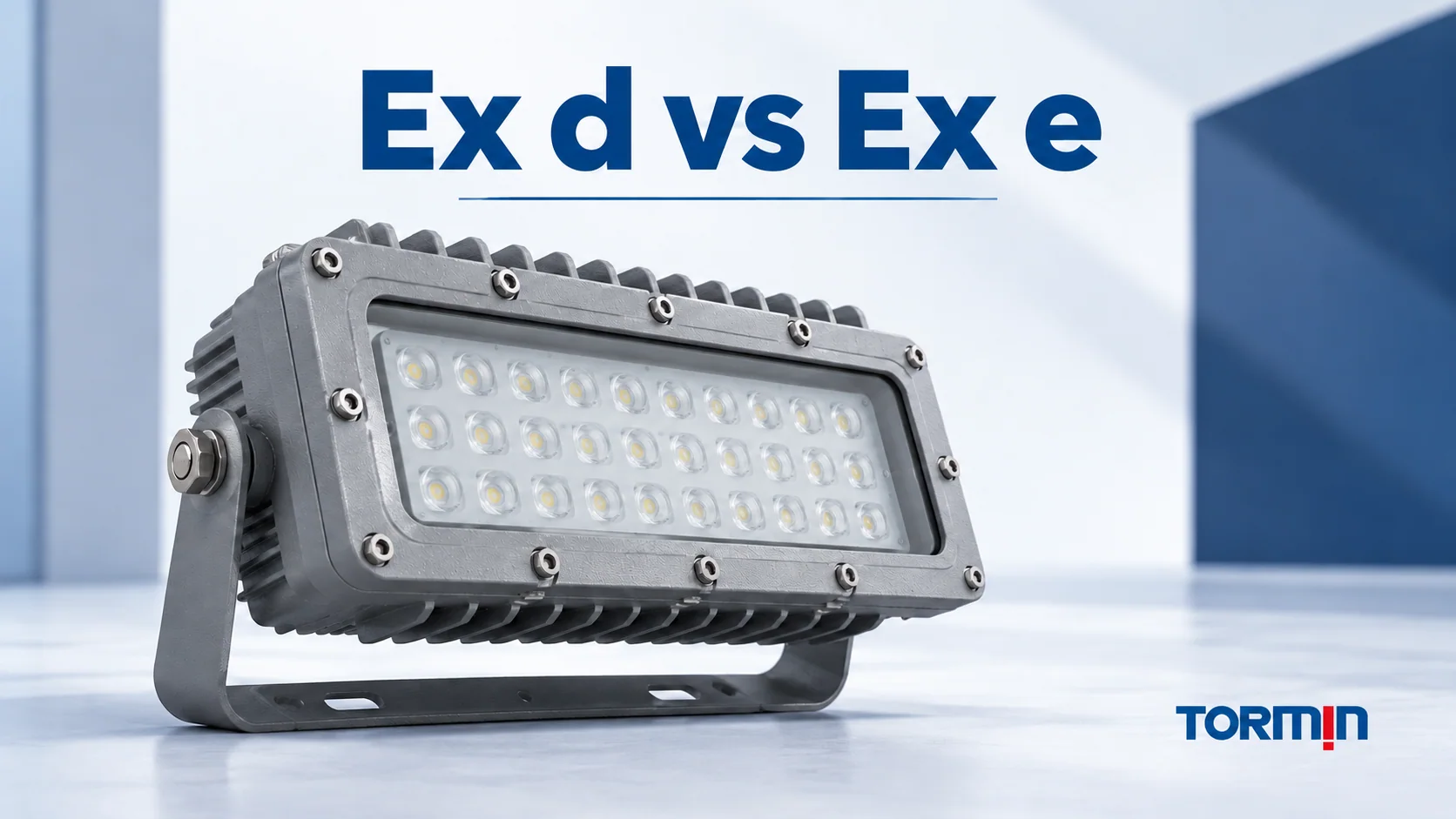
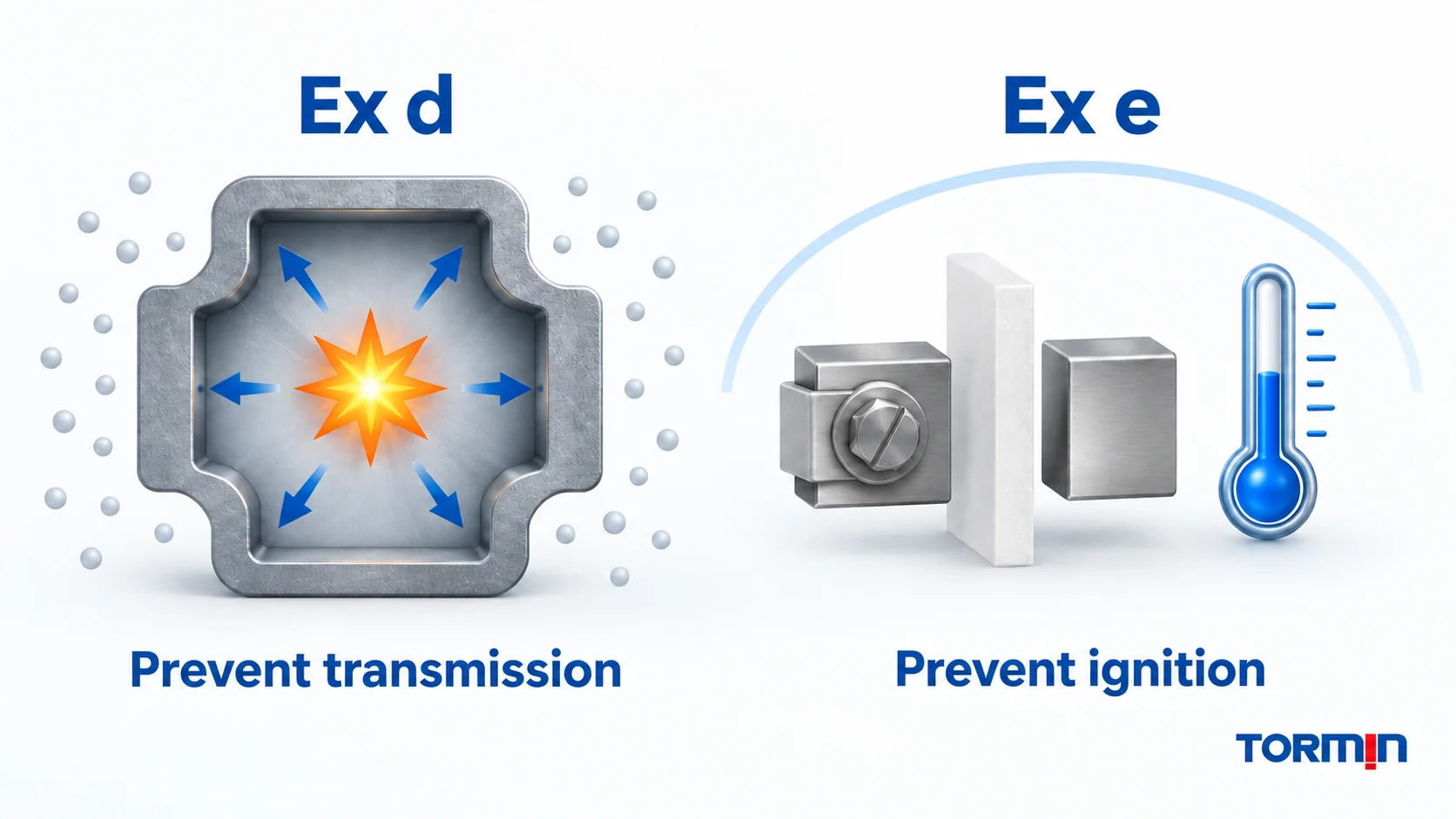
The key difference in Ex d vs Ex e lighting is how the equipment controls ignition risk. Ex d uses a flameproof enclosure to withstand an internal explosion and prevent its transmission to the surrounding explosive atmosphere. Ex e uses additional construction measures against arcs, sparks and excessive temperature. These principles are described in TestSafe’s flameproof and increased-safety guidance.
A luminaire can combine protection methods. The useful procurement question is therefore: which parts and interfaces provide each method, and which documents establish that arrangement for the offered configuration? A short catalogue label or similar-looking housing cannot answer this.
This comparison concerns IEC-based gas-atmosphere protection concepts. Establish the project’s classification and acceptance requirements through the wider hazardous-area lighting selection process, then use the checks below to compare construction evidence.
Ex d and Ex e depend on different construction features
| Comparison dimension | Ex d: flameproof enclosure | Ex e: increased safety |
|---|---|---|
| Protection principle | Withstand internal explosion pressure and prevent transmission to the surrounding atmosphere | Reduce the possibility of ignition from arcs, sparks or excessive temperature |
| Construction focus | Enclosure integrity and the documented flameproof joints and interfaces | Insulation, creepage and clearance, secure connections and thermal behavior |
| Buyer’s first construction question | Which enclosure parts and interfaces maintain flameproof protection? | Which parts use increased safety, and how are the remaining circuits protected? |
| Practical comparison evidence | Construction description, permitted parts and enclosure assembly instructions | Construction description, terminal/circuit limits and assembly instructions |
The first two rows summarize the TestSafe guidance linked above. The document questions are a practical way to compare offers; they are not installation instructions.
Ex d: an internal event must not ignite the outside atmosphere
Flameproof protection accounts for an internal explosion. It should not be described as a promise that gas cannot enter. The enclosure must withstand the event, prevent its transmission and control the external surface temperature. Flameproof joints can take different forms, including threaded or flanged interfaces. Their design is part of the protection, as TestSafe’s Ex d guidance explains.
For a buyer, this makes the documented enclosure assembly important. Ask which cover, light-transmitting assembly and entry interfaces belong to the assessed construction. Request the permitted parts and the manufacturer’s opening and reassembly instructions. Do not infer acceptable joint dimensions or fastener settings from a photograph.
Ex e: prevent ignition sources through additional safeguards
Increased safety depends on measures such as reliable electrical connections, suitable insulation, creepage and clearance distances, and temperature control. Its protection level determines the operating and malfunction conditions addressed. It is not an explosion-containment enclosure. TestSafe’s Ex e guidance identifies these construction measures and external-terminal arrangements.
Ask for the permitted terminal arrangement, conductor range, loading limits and connection instructions. A spacious terminal chamber or an ingress rating alone does not establish increased-safety compliance.
Preserve the protection level when comparing LED luminaires
The shorthand “Ex e” conceals an important distinction. IEC’s published IEC 60079-7 scope distinguishes eb, associated with EPL Gb/Mb, from ec, associated with EPL Gc. These are different levels, so a purchase specification should preserve the complete designation.
The same public scope excludes semiconductors and electrolytic capacitors from the eb scope, while including them under ec. This is especially relevant to LED electronics: an increased-safety terminal compartment does not, by itself, explain how the driver is protected.
Request the certified construction description identifying the protection of the driver and LED circuits. Do not assume all electronics use eb because a catalogue calls the complete light “Ex e.” Equally, do not infer that every LED design must use the same alternative method. The actual equipment records must establish the arrangement.
Combined protection is a map of the assembly
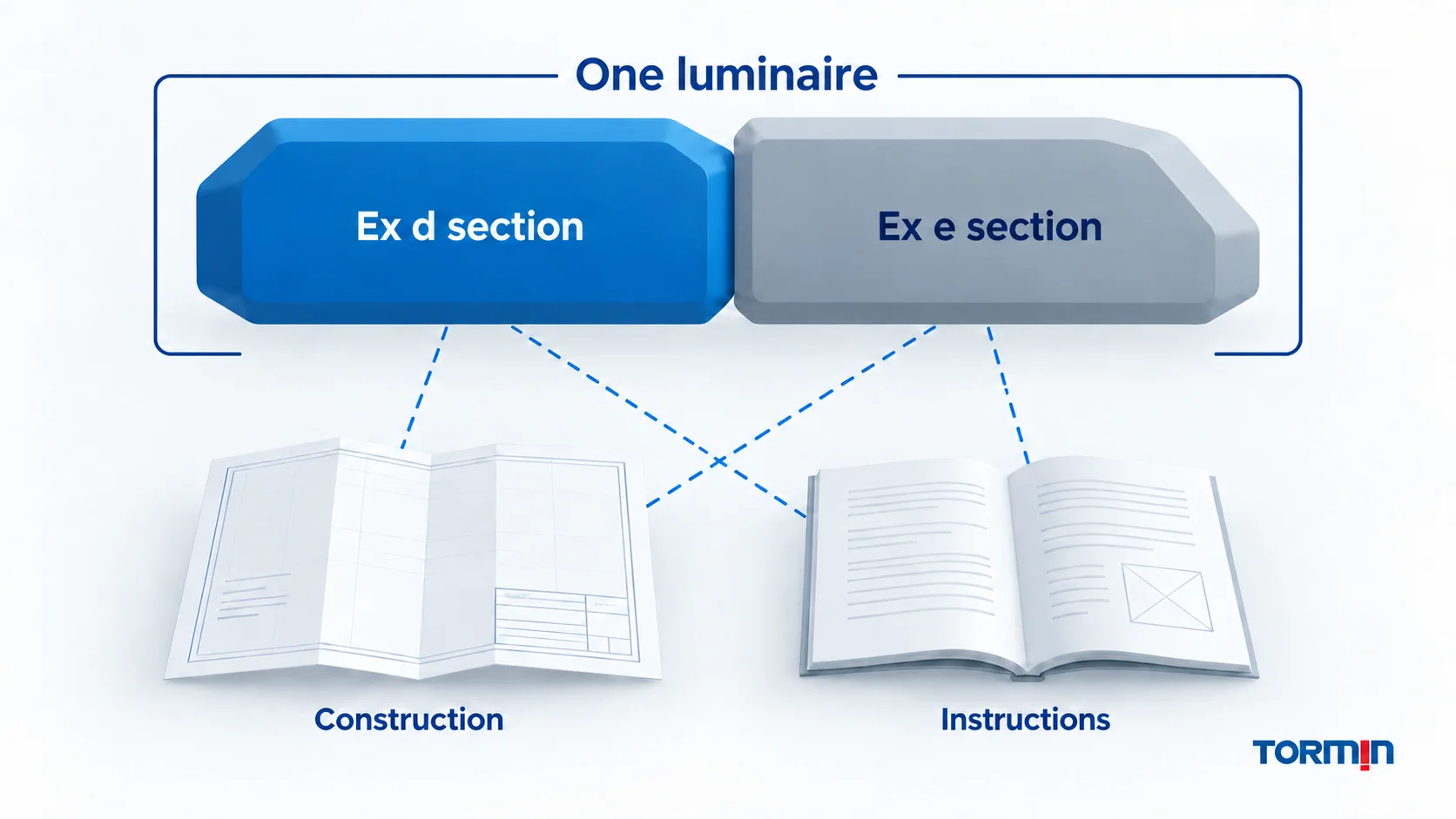
TestSafe describes other Ex techniques being used with increased-safety elements in luminaires and assemblies. A combined designation can point to different protection responsibilities within one item of equipment. Identify the layout from its assessed construction and compare the complete equipment EPL stated in its records with the project requirement. Adding methods is not, by itself, evidence of a higher EPL.
As a generic construction-review example, suppose the offered documents identify a flameproof section and a separate increased-safety termination section. The buyer should map the enclosure interfaces to the first section, the field terminals to the second, and the connection between sections to the approved assembly description. This is a document-review example, not a specification for any TORMIN model.
Some designs also use encapsulation, Ex m. This embeds potentially sparking or heating parts in a compound under assessed conditions. TestSafe’s encapsulation guidance explains why the compound and its thermal and mechanical behavior matter. Visible potting does not establish Ex m certification, and an encapsulated component does not settle the protection of the rest of the luminaire.
For every method identified, record the section or component, its interface with the rest of the equipment, and the document reference that establishes its scope. Use the existing nameplate and certificate guide for the full marking interpretation.
Compare the receiving section before specifying the cable entry
A combined luminaire’s external cable may terminate in a section that uses a different protection method from another part of the equipment. Identify that receiving section from the construction description and instructions before comparing the entry accessories.
Ask the supplier to identify the entry arrangement, gland or other entry device, blanking elements, thread specification and permitted cable configuration. Have the competent project reviewer check these against the equipment instructions and the applicable installation requirements. “Ex-certified gland” is too incomplete a description to close that review.
IECEx’s OD 504 competence specification treats entries, flameproof integrity, increased-safety components and equipment documentation as protection-specific knowledge. The procurement implication is to request the actual interface evidence. A general d/e comparison cannot prescribe a gland, decide whether a barrier gland is required, or authorize an accessory substitution.
Use a structure-to-document crosswalk for each offer
Keep the comparison tied to the exact ordering code and options. The following worksheet turns the protection differences into questions for the supplier. It complements the project’s wider selection record.
| Structure or interface | Construction question | Evidence to request | Hold the comparison when… |
|---|---|---|---|
| Flameproof enclosure section | Which joints, covers, light-transmitting parts and entries form the assessed assembly? | Construction description and permitted assembly/replacement instructions | The offered enclosure or parts cannot be mapped to the documents |
| Increased-safety section | Which terminals, conductors and circuit arrangements use this method? | Terminal identification, conductor/loading limits and connection instructions | Only the phrase “Ex e housing” is supplied |
| LED driver and LED circuit | How is each electronic subassembly protected in this variant? | Equipment construction description and applicable subassembly records | Driver identity or protection allocation is unresolved |
| Boundary between protected sections | What connects the sections, and what preserves their protection? | Approved assembly description and applicable interface/component references | A proposed connection or substitute lacks documented coverage |
| Field cable entry and unused entries | Which section receives the cable, and which accessories/configurations are permitted? | Entry instructions, accessory identification and cable/thread requirements | The receiving section, accessory or cable configuration is unclear |
| Encapsulated part, when present | Which assessed component is supplied, and what replacement is permitted? | Component identity, applicable limitations and replacement instructions | Ordinary potting or a similar-looking replacement is offered as proof |
These are evidence requests, not a direction to obtain every confidential certification drawing. A supplier’s controlled construction description and applicable instructions may answer the question. If they leave a material interface unresolved, obtain clarification from the responsible manufacturer or issuer.
IECEx purchaser guidance identifies the online certificate as the controlled version and explains that design changes are referred to the issuing certification body. Check the applicable certificate issue, status and schedule against the offered construction. A component record supports the assembly assessment; it does not replace evidence for the complete luminaire. See the IECEx Ex component definition.
Resolve construction differences before accepting the offer
Imagine two offers with the same nominal wattage. One supplier identifies the protected sections, driver, terminal arrangement and entry accessories with document references. The other supplies a product-family certificate and “Ex d/e” in a quotation. The second offer still has a construction-evidence gap, even if the housings look alike.
Record each difference as documented, clarification required, or outside the documented scope, with the evidence reference and reviewer. Missing evidence calls for a hold. A conflicting configuration calls for responsible technical review, rather than a buyer selecting whichever document looks more favorable.
Compare access, mounting loads, permitted replacement parts and maintenance provisions using each exact offer’s documents. The protection letters do not establish a universal ranking for weight, price, light output or maintenance effort. Completion of this comparison also does not constitute installation approval.
For a TORMIN enquiry, use the hazardous-area lighting range to identify candidates and the certification library as a document starting point. Send the exact ordering code, required market/protection level, driver or emergency options and intended cable configuration when requesting the document set. Ask: “Please map every protection method to the supplied construction and identify the documents covering its parts and interfaces.”
Sources
- NSW Government / TestSafe — Flameproof enclosue Ex d — flameproof principle and construction dependencies.
- NSW Government / TestSafe — Increased safety Ex e — preventive construction measures and combined techniques in luminaires.
- IEC — IEC 60079-7:2015+AMD1:2017 CSV, Equipment protection by increased safety “e” — public catalogue scope for eb/ec and electronic components; no licensed clause text is reproduced.
- NSW Government / TestSafe — Encapsulation Ex m — encapsulation principle and assessed compound behavior.
- IECEx — OD 504, Specification for units of competence assessment outcomes, Edition 5.0, October 2022 — protection-specific construction, entry and documentation review topics.
- IECEx — FAQs from Ex Equipment Manufacturers, Purchasers and Users, Guide 01D, Edition 2.0 — controlled certificate records and design-change assessment.
- IECEx — Terms and Definitions, IECEx 01C, Edition 1.0, August 2016 — Ex components intended for incorporation into equipment.