
A T4 marking is valid within the ambient temperature range and configuration covered by the luminaire’s nameplate and certificate. It is not a promise that the light will remain below its temperature limit in any environment. If the specified upper Ta is +40°C and the local environment reaches +60°C, the installation is outside the certified range. This is loss of certification coverage for that use, not merely reduced lighting performance.
The missing input in many hot-plant specifications is the temperature at the installed light, including local heat exposure. Establish that condition before selecting a model. The basic relationship is also reflected in UL’s hazardous-location guidance: temperature markings depend on the ambient basis for which equipment was investigated.
For the underlying group and temperature-class selection method, see How to Choose Explosion Proof Lighting by Gas Group and Temperature Class. Here, the question is narrower: will the selected temperature class remain valid at the site’s Ta?
Read T4 and Ta as one specification
Ta, sometimes written Tamb, is the ambient temperature around the equipment. It is different from the temperature of the luminaire’s surface. Read the marked temperature class together with the permitted ambient range, model configuration and conditions of use.
| Marking used in this example | Maximum surface temperature represented | Necessary qualification |
|---|---|---|
| T4 | 135°C | Applies under the conditions covered by the exact equipment’s certification, including Ta |
The T4 limit is a ceiling, not a measurement showing that every T4 light operates at 135°C. OSHA’s temperature-code comparison identifies that limit; it does not establish a particular lamp’s measured temperature.
For example, -40°C ≤ Ta ≤ +55°C would mean that the stated configuration has a permitted ambient range from -40°C to +55°C. This is an illustrative marking, not a specification assigned here to every TORMIN model. A different version of the same family may have a different upper Ta or temperature class.
Look for Ta/Tamb on the nameplate, then locate the corresponding model and temperature information in the certificate schedule or annex and the operating instructions. Read any specific conditions attached to an “X” certificate suffix. Under the IEC convention, the normal -20°C to +40°C range may be unmarked; a missing Ta line is not permission for unlimited temperature. The IECEx installation-selection training material explains both the normal range and specific conditions of use. Resolve missing or inconsistent information before selection.
Why surface temperature can follow ambient temperature approximately 1:1
A working luminaire generates heat. At steady state, its surfaces must be hotter than the surrounding air to release that heat. A simple thermal-resistance model is:
Surface temperature ≈ local ambient temperature + temperature rise
Temperature rise ≈ dissipated heat × effective thermal resistance
If heat generation, mounting, airflow and effective thermal resistance stay approximately unchanged, a 1 K increase in ambient temperature produces approximately a 1 K increase in surface temperature. The same temperature difference is 1°C; kelvin is convenient for expressing a rise. This is a first-order application of the heat-flow and thermal-resistance relationships in NPTEL’s steady-state heat-transfer material.
The 1:1 approximation is not a universal test result. Convection, radiation, power-control behavior and external heating can change the rise. It explains the risk; it cannot extend a certificate or predict every hot spot in a real luminaire.
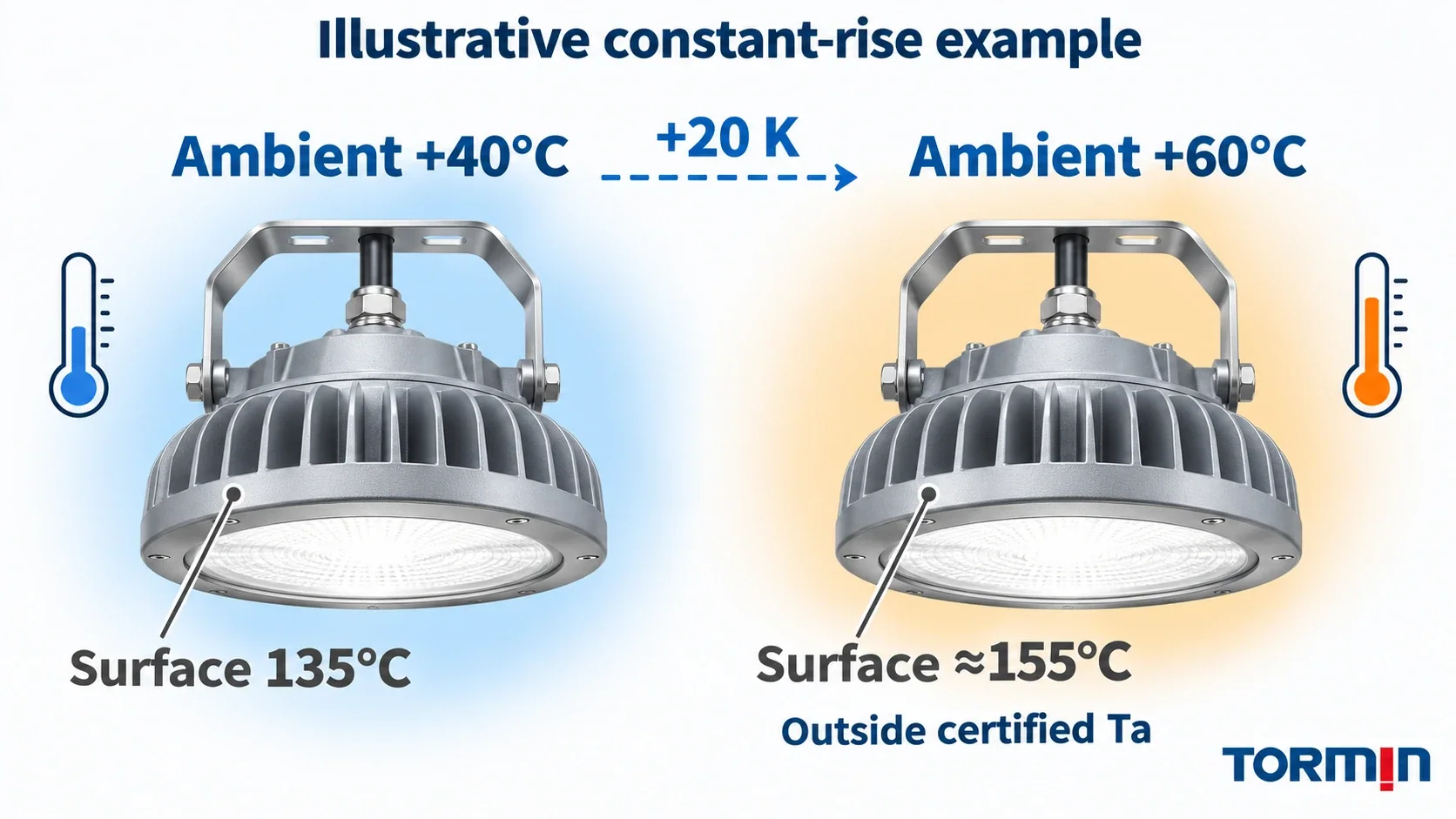
Worked example: T4 at +40°C, installed in +60°C
Consider a hypothetical T4 luminaire with a certified upper Ta of +40°C. For this teaching example, assume its relevant maximum surface temperature is near the T4 ceiling of 135°C at that ambient, and its temperature rise remains approximately constant. These are stated assumptions, not measured TORMIN product data.
- Temperature rise at the rated ambient: 135 – 40 = 95 K.
- Ambient exceedance: 60 – 40 = 20 K above the certified upper Ta.
- Estimated surface temperature: 60 + 95 = 155°C, equivalently 135 + 20 = 155°C.
The estimated 155°C exceeds T4’s 135°C ceiling. On the coarse IEC temperature-class scale, it is only at a T3 temperature level because it is above 135°C but below the T3 ceiling of 200°C. That numerical comparison does not make the equipment certified T3 at +60°C. The class limits are documented in OSHA’s comparison.
Exceeding Ta means operating outside the certification scope: certification is not valid for that use. It is not a performance downgrade or permission to relabel the light T3. The certificate itself is not automatically withdrawn worldwide; its approved conditions do not cover this installation. A cooler measured surface would not, by itself, restore that coverage. Conversely, the calculation does not prove that every T4 light will reach exactly 155°C.
Use the Ambient Temperature (Ta) Derating Checker to enter your nameplate upper Ta and highest site temperature. Start with T4, +40°C and +60°C to reproduce this sensitivity check, then substitute your own inputs. Treat an exceeded limit as a stop in selection, not a newly certified T-class.
Hot locations that a weather forecast can miss
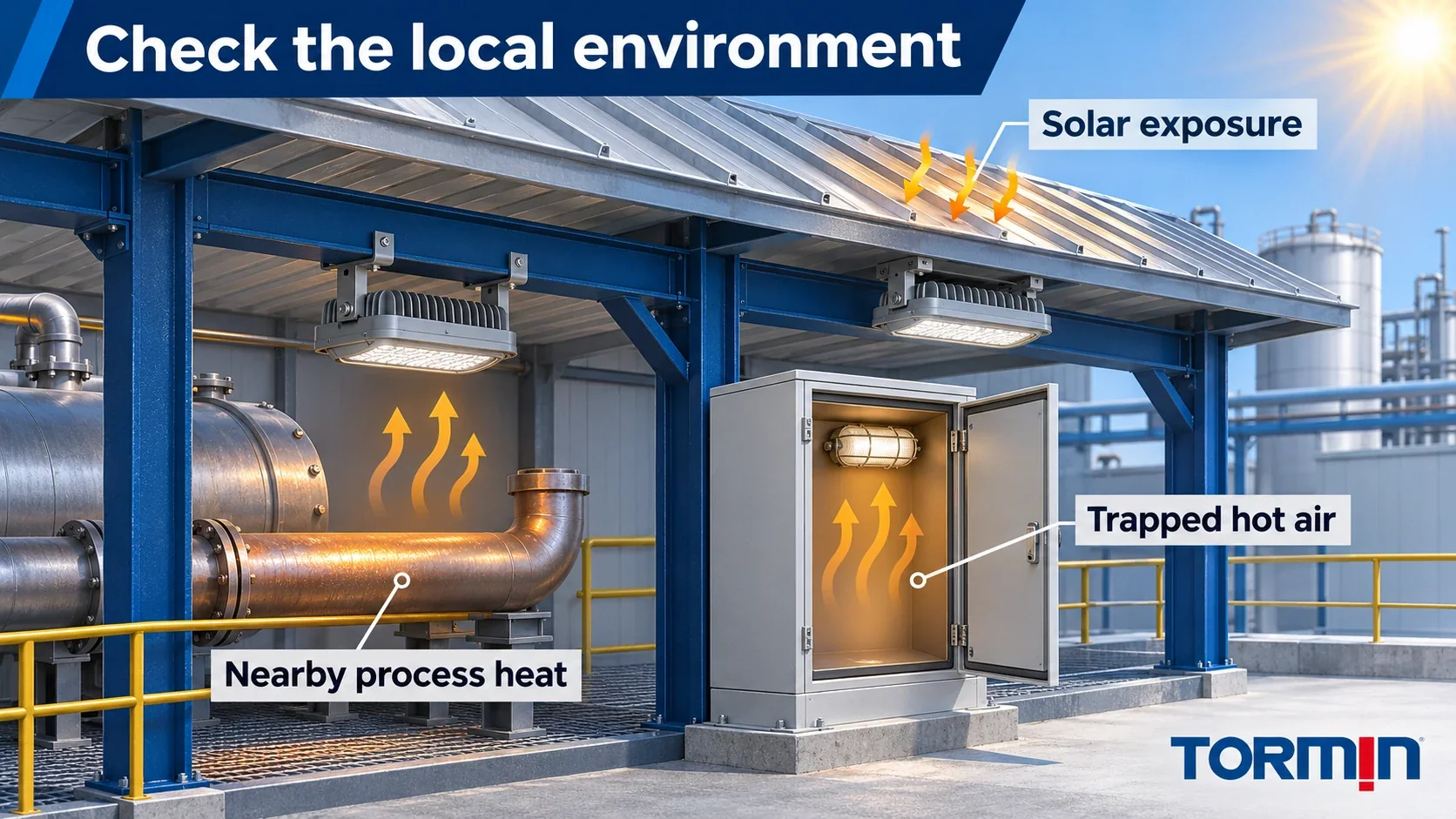
Use the highest credible conditions at the actual mounting position during operation. A regional temperature, a room average or a brief morning measurement may miss the controlling exposure.
| Location | What the temperature assessment must capture |
|---|---|
| Middle Eastern and desert plants | Peak seasonal air temperature together with solar exposure and location-specific ventilation; do not assign one temperature to every desert site. |
| Beside boiler rooms or hot process equipment | Local hot air, radiant heat from nearby surfaces and any heating conducted through the mounting structure. |
| Summer rooftops | Roof heat, direct or reflected sunlight, mounting height and airflow at the luminaire. |
| Inside closed cabinets | Internal air temperature with the cabinet in its normal closed operating condition and other heat-producing equipment running. |
| Sun-exposed housings | Absorbed solar heat, even when a shaded air sensor indicates an acceptable ambient temperature. |
Solar radiation is an additional heat load, not simply another name for air temperature. Include it and neighboring heat sources in the assessment; do not invent a universal “+10°C for sunlight” allowance. IECEx’s selection training includes ambient ranges and solar radiation among site inputs. For enclosed spaces, UL explains why internal heating can make cabinet conditions hotter than the external atmosphere.
Select the ambient envelope first, then the exact configuration
First establish the site’s maximum local ambient temperature and external heat exposure. Record the installation position, operating state, seasonal maximum, solar exposure, nearby hot equipment and ventilation assumptions. Where these inputs are uncertain, establish them through the project thermal assessment rather than choosing a lamp from a regional weather average.
Then select a model whose documented upper Ta covers that environment while retaining the required T-class. Passing the air-temperature comparison alone does not resolve an unassessed radiant heat source. Verify exposure restrictions and installation instructions as well. Check the lower Ta separately where cold conditions matter.
Finally, match the complete ordering code to the nameplate and certificate schedule. Check power, supply version, driver arrangement and any emergency configuration against the applicable document rows. Both T-class and Ta can differ within a series. A family listing such as “T6/T5/T4” and “+40/+55°C” is not a matrix allowing every possible combination.
A useful procurement record places these items on the same line: full ordering code; required T-class; documented T-class; permitted Ta range; assessed site maximum and heat exposure; certificate number/issue and schedule row; applicable conditions. If a required pair of T-class and Ta cannot be tied to that ordering code, the thermal selection is unresolved.
For an existing installation above its permitted Ta, do not continue under an assumed lower temperature class. Have the responsible site team address the nonconformity and establish a documented compliant configuration or installation condition. Field dimming, an improvised shade or a surface-temperature reading cannot independently create a new certified ambient rating.
TORMIN candidates: verify each listing separately
The following are first-party product-page listings, checked on November 6, 2026. They identify candidates for document review, not confirmed suitability for a +60°C installation.
| Product page | Listed gas temperature marking | What the page establishes about Ta |
|---|---|---|
| BC5402A Zone 1 linear light | Ex eb mb op is IIC T6/T5/T4 Gb | Ambient entry shows -40 to +40°C / +55°C. Confirm which endpoint and class belong to the ordered version. |
| BC9306P series | Ex db eb IIC T6/T5/T4 Gb | Catalogue ambient options are -50 to +40 / +55°C; the page requires confirmation of exact variant and temperature class. |
| BC9306S area/floodlight | Ex db eb IIC T6/T5/T4 Gb | The page states that temperature classes and ambient limits vary by configuration. No specific Ta value is assigned here. |
| BC9306S spotlight | Ex db eb IIC T6/T5/T4 Gb | Catalogue ambient options are -50 to +40 / +55°C; confirm the exact variant and temperature class. |
The applicable T-class and Ta are subject to the specific model’s nameplate, the matching certificate schedule and conditions of use. None of these entries means that T6 or +55°C is standard across the series. The BC9306S area/floodlight page also labels family certificate copies as archived with current status unverified; obtain the applicable current documents before approving an ordering code.
For the separate group-selection issue, use IIB vs IIC Explosion Proof Lighting: When IIB Stops Being Enough. Heat dissipation and service-life implications are addressed separately in Industrial LED Lighting Lifetime: L70, Driver Life and Ambient Temperature.
A short NEC temperature-code cross-reference
The NEC Division temperature-code scheme includes these intermediate maximum surface temperatures: T2A 280°C, T2B 260°C, T2C 230°C, T2D 215°C, T3A 180°C, T3B 165°C, T3C 160°C and T4A 120°C. In particular, T4A’s 120°C ceiling is lower than IEC T4’s 135°C ceiling; T4A is not another spelling of T4. This is a temperature-value comparison only, not interchangeability of approvals, and it does not remove either equipment’s Ta limits. See OSHA’s Electrical Standard final rule, Table 2.
FAQ
Is a T4 light still T4 in a 50°C plant?
Only if the exact configuration is documented as T4 at an upper Ta of at least +50°C, and the installation meets its other conditions, including external heat exposure. A T4 version limited to +40°C is outside its certified ambient range there. A family catalogue showing +55°C is insufficient without the matching configuration. UL’s marking guidance explains the ambient basis of temperature markings.
Where do I find Ta on the nameplate and certificate?
Look for “Ta”, “Tamb” or an ambient-temperature range on the nameplate. Match the full model code to the certificate schedule/annex and read the specific conditions of use, especially where the certificate number ends in “X”. There is no universal label position. Under the IEC convention, an unmarked normal range is -20°C to +40°C; verify the documentation rather than assuming a higher limit. See IECEx’s marking and selection guidance.
Does exceeding Ta permit downgraded use, or invalidate certification?
It invalidates reliance on the certification for that out-of-range use. It does not automatically cancel the manufacturer’s certificate, but the installation is outside its scope. A calculation suggesting a T3 temperature level does not certify a T4 light for T3 service at a higher Ta. Resolve the configuration or site condition against the applicable certification documents.
What should I check first for a desert project?
Establish the highest local temperature and heat exposure where each light will operate, including sunlight and adjacent process equipment. Then verify that the selected ordering code retains the required T-class throughout its documented Ta range under those conditions. Do not start from a generic “desert-rated” description or the coolest class advertised for an entire series.
How does NEC T4A differ from IEC T4?
T4A specifies a 120°C maximum surface temperature; IEC T4 specifies 135°C. The lower T4A ceiling does not make an approval under one system automatically valid under another, or authorize operation beyond the marked Ta. OSHA’s Table 2 provides the temperature-code comparison.
Sources
- UL – 2013 Guide Information for Electrical Equipment, AAIZ section – Historical technical guidance on temperature markings and their ambient basis, not a current certificate for any listed product.
- OSHA – Electrical Standard; Final Rule, February 14, 2007, temperature-code discussion and Table 2 – Surface-temperature values and the bounded NEC comparison.
- IECEx – Electrical installations design, selection and installation of equipment, including initial inspection, Edinburgh Industry Symposium 2023 – Training material on ambient selection, solar exposure and specific conditions; its draft-standard clause numbering is not cited as a current mandatory clause.
- NPTEL – Module 2: One Dimensional Steady State Heat Conduction – Thermal-resistance reasoning underlying the explicitly assumed constant-rise example, not luminaire certification data.
- UL Solutions – Expanded Temperature Testing for HazLoc Control Panels, November 26, 2020 – Internal enclosure heating and ambient assessment; panel ratings are not transferred to lights.
TORMIN first-party product documents
- BC5402A Zone 1 linear light product page – Listed Ex marking and ambient entry.
- BC9306P product page – Listed marking, ambient options and variant-confirmation note.
- BC9306S area/floodlight product page – Configuration-dependent class/ambient statement and archived-certificate warning.
- BC9306S spotlight product page – Listed marking, ambient options and variant-confirmation note.