
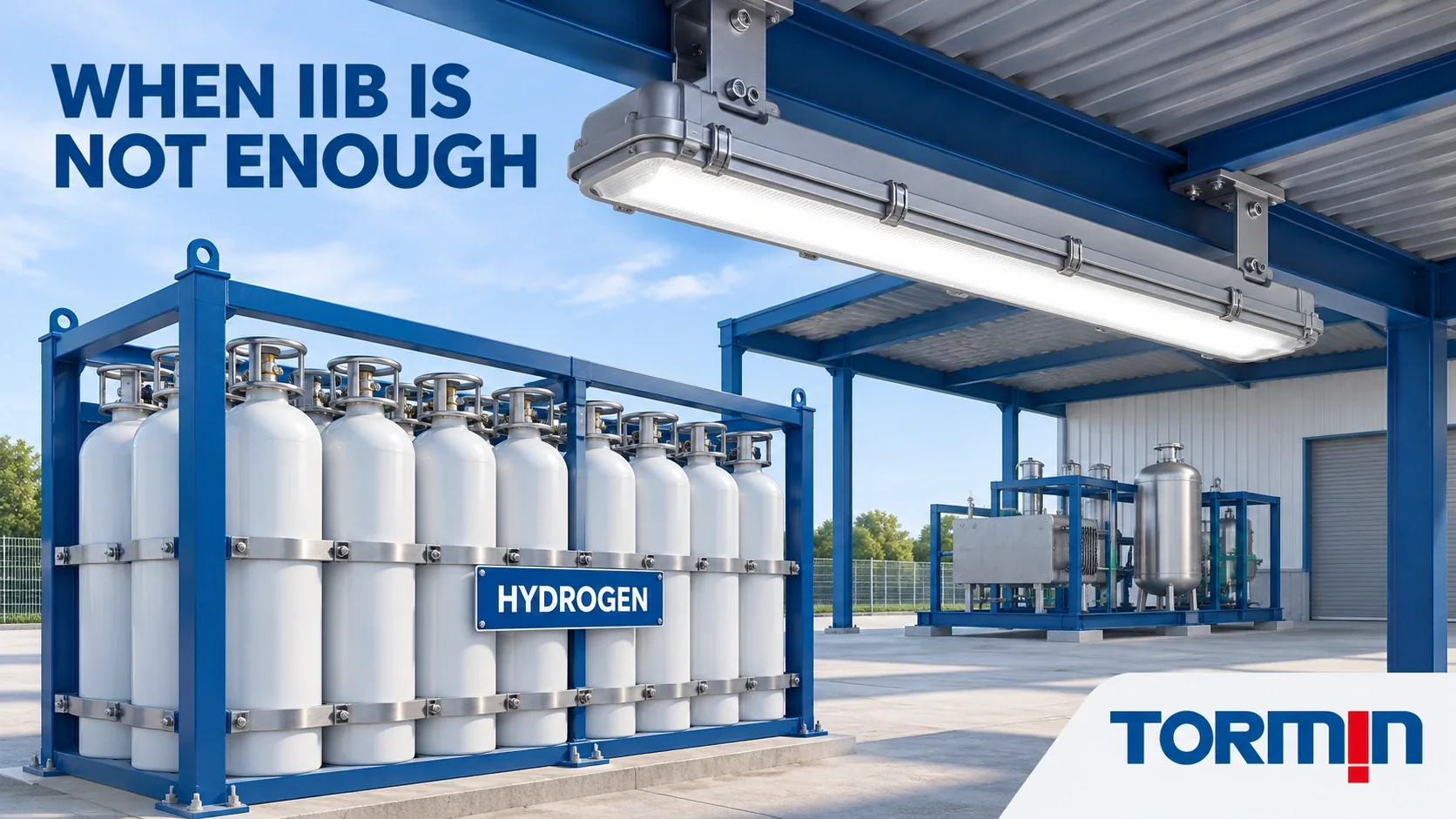
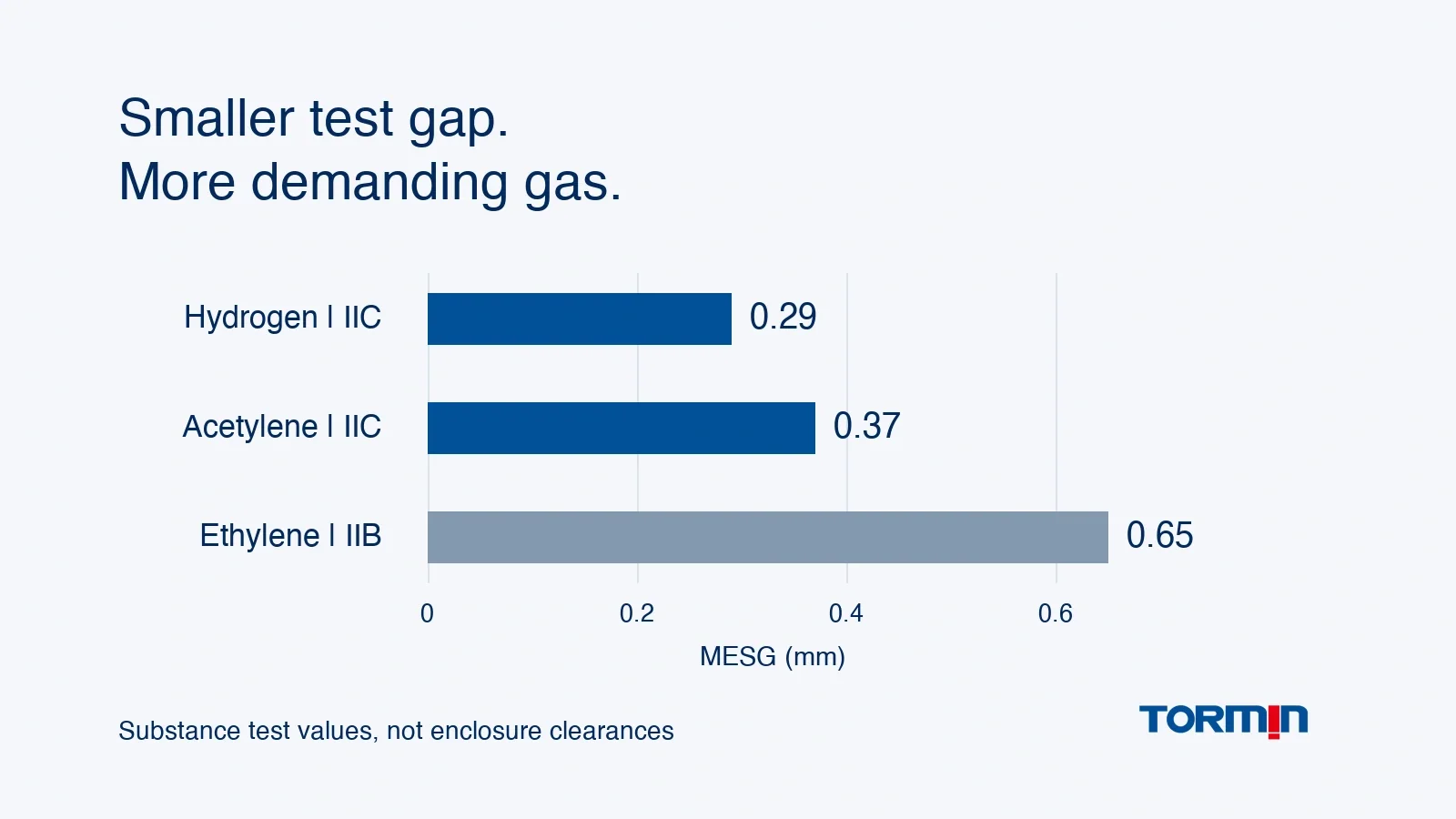
IIB stops being enough when the assessed gas or vapour atmosphere at the light requires IIC. The three common substances to check first are hydrogen, acetylene and carbon disulfide. Hydrogen has a reference MESG of 0.29 mm and acetylene 0.37 mm in the IEC-referenced NSW TestSafe substance table. A luminaire marked only IIB does not satisfy that IIC requirement. For the full definitions and independent thermal check, use the gas group and temperature class selection guide.
Two further situations trigger a review: hydrogen-containing mixtures and planned or reasonably foreseeable process changes that introduce hydrogen. A mixture needs a composition-specific classification; a trace of hydrogen does not automatically make every mixture IIC. A future hydrogen project may justify buying IIC now, but it does not, by itself, reclassify today’s installation.
The useful IIB vs IIC explosion proof lighting decision is therefore specific: does the actual location require IIC, or would IIC be a deliberate standardisation choice? Those are different purchasing reasons.
The small comparison that decides the gas-group boundary
MESG measures flame transmission through a standardized test gap. MIC ratio compares electrical ignition current with the reference methane test. Neither is a temperature-class rating.
| Gas group | MESG classification criterion | MIC ratio classification criterion |
|---|---|---|
| IIB | Greater than 0.5 mm and less than 0.9 mm | 0.45 to 0.8, inclusive |
| IIC | 0.5 mm or less | Less than 0.45 |
These are the separate criteria in IEC 60079-20-1:2010, clauses 4.2 and 4.3. Clause 4.4 requires confirmation using both properties in specified boundary ranges; the columns are not a rule that every substance must independently meet both entries. Use the accepted substance classification rather than assigning a group from an isolated number. The IEC record identifies ISO/IEC 80079-20-1:2017 as the replacement; apply the edition accepted by the project.
An IIC marking covers the IIB and IIA gas-group requirements within the equipment’s certified scope. An IIB marking covers IIA, but not IIC. This coverage hierarchy is stated in IEC 60079-0:2007, clause 4.2, Note 2; it does not waive the other equipment-selection conditions.
Why the flamepath makes IIB insufficient for IIC
A flameproof enclosure does not work by keeping every gas molecule outside. An explosive mixture can enter. If ignition occurs inside, the enclosure must withstand the pressure and prevent the internal explosion from igniting the surrounding atmosphere. NSW TestSafe’s Ex d guidance explains these two requirements alongside the external surface-temperature limit.
The flamepath is the controlled joint between mating enclosure parts. Hot combustion products passing through that joint interact with its metal surfaces and lose energy. The joint geometry and the conditions of the escaping flow must prevent ignition outside. A joint that arrests one gas-air flame does not necessarily arrest another: flame propagation and quenching depend on the reacting mixture, not simply on whether a housing looks sealed.
IIC mixtures can transmit ignition through narrower test gaps than typical IIB mixtures. In the standardized MESG test, hydrogen’s 0.29 mm value is much smaller than ethylene’s 0.65 mm. An enclosure qualified only for IIB has not demonstrated the necessary IIC non-transmission performance. That is the physical reason an IIB-only flameproof light cannot simply be carried into an IIC area, even if its housing is thick, its IP rating is high or its temperature class is T6.
The 0.29 mm scale describes the severity of hydrogen’s experimental flame-transmission behaviour, not an allowable luminaire joint clearance. IEC 60079-20-1 defines MESG using a standardized apparatus and a 25 mm flamepath. An IIC flameproof enclosure must instead meet the applicable construction and testing requirements of IEC 60079-1 for its joint type, enclosure and certified design. A designer must address that demanding gas-group behaviour; an installer must not manufacture, measure or repair a joint to “0.29 mm” on the strength of the gas table. Use the certified drawings and manufacturer’s instructions. IEC 60079-1’s official scope covers construction and testing of flameproof equipment.
This mechanism explains the Ex d case. Not every IIC luminaire uses a flameproof enclosure as its protection technique; equipment using other protection techniques still needs the appropriate gas-group scope. Do not infer a hidden flamepath from an IIC label alone.
The three common IIC substances, plus two review triggers
Hydrogen: check cylinder manifolds, hydrogen supply points and electrolyser systems wherever the approved classification identifies a hydrogen atmosphere at the mounting location. Hydrogen’s IIC requirement cannot be satisfied by an IIB-only light.
Acetylene: treat an acetylene atmosphere as IIC. Its reference MESG is 0.37 mm, and hydrogen-specific equipment scope must not be assumed to cover acetylene.
Carbon disulfide: this is also IIC, with a reference MESG of 0.34 mm in the NSW TestSafe table. It also requires a particularly careful independent temperature check. Selecting IIC alone does not complete the specification.
These are common examples, not an exhaustive list of all IIC substances. Review the complete inventory, including cleaning chemicals and abnormal releases considered by the area assessment.
Hydrogen-containing mixtures: obtain the composition range and the accepted mixture classification. A stream’s normal composition may not describe startup, shutdown or a credible release. IEC 60079-20-1:2010, clause 4.6, generally calls for a specific MESG or MIC determination for mixtures and limits its estimation method. Do not average the group letters or assume that the bulk carrier gas controls. If the assessed mixture is IIC, select IIC equipment; if the assessment supports IIB, hydrogen content alone does not overturn that result. See the IEC material-classification reference.
Future hydrogen introduction: put a defined electrolyser project, hydrogen conversion or cylinder-bank addition into the change review before ordering lights. Choosing IIC in advance can avoid a later group-related replacement. However, an unspecified possibility of hydrogen somewhere on the site is not proof that every existing luminaire needs IIC today. The future release sources, affected locations and classification still matter.
Where IIB is enough
IIB is sufficient on the gas-group axis when the approved atmosphere requires IIB or IIA and the exact luminaire meets the remaining conditions. Common candidates include:
- Ethylene process areas: where ethylene is the controlling classified gas and no more demanding substance applies.
- Ethanol handling: using the specified substance and operating basis. The IEC Annex B reference for anhydrous ethanol is IIB; do not silently substitute another water-content basis.
- Hydrogen sulfide service: the IEC Annex B entry for hydrogen sulfide is IIB. The word “hydrogen” in the compound’s name does not make it equivalent to hydrogen gas.
- Diethyl ether handling: the gas-group requirement is IIB; ether’s temperature requirement still needs its own check.
- All properly classified IIA gas/vapour applications: IIB equipment covers the group requirement, including an IIA propane or hydrocarbon application whose actual inventory remains within that classification.
Substance groups above follow IEC 60079-20-1:2010, Annex B, with ethylene, ethanol and ether also listed by NSW TestSafe. These are substances and assessment conditions, not a blanket classification of every refinery, solvent store or wastewater facility.
“IIB is enough” does not mean an ordinary industrial light is acceptable. Zone/EPL, temperature class, ambient range, protection technique, installation conditions and the accepted certificate remain separate checks. Nor does IIB gas suitability establish suitability for combustible dust or mining Group I.
What IIC can cost you
IIC is the necessary choice where the hazard requires it. Elsewhere, compare actual quotations and configurations rather than assuming that the higher group is free or always burdensome.
- Price: an IIC-qualified design may carry additional construction, testing or configuration costs. Ask for like-for-like offers; do not treat an assumed price premium as a universal market rule.
- Lead time: a suitable IIC configuration may be stocked, while another may require a different production schedule. Confirm the exact ordering code and delivery date rather than estimating from the group marking.
- Weight and handling: the protection technique and enclosure construction can affect mass, mounting and servicing. IIC does not mean every luminaire is heavier than every IIB alternative; compare the actual products and supports.
- Model choice: applying IIC alongside the required temperature class, ambient range, optical distribution, emergency function and approvals may reduce the shortlist. An available IIC model is not necessarily the right light for the task.
These are procurement questions, not measured TORMIN premiums or delivery promises. The commercially useful comparison holds the lighting duty and all other mandatory requirements constant. If an IIC candidate already meets those requirements at an acceptable delivered cost, there may be little reason to maintain a separate IIB choice. If it compromises the needed optics, installation arrangement or availability, a documented IIB requirement should not be upgraded casually.
When whole-plant IIC standardisation is worth it
Standardising on IIC is worth considering when it removes a real operational problem: several affected areas already need IIC, maintenance stores serve both IIB and IIC locations, identical-looking spares create a substitution risk, or a defined hydrogen programme will expand the IIC requirement. A smaller approved spare list can simplify purchasing and reduce one kind of selection mistake. Compare that benefit with the actual cost of supporting the approved configurations.
It can be wasteful when the plant has a stable IIA/IIB inventory, no credible IIC change programme and well-controlled area-specific spares, especially if the IIC alternative compromises the required lighting function or procurement schedule. There is no reason to replace serviceable, correctly specified IIB lights solely to make every nameplate look the same.
Even a whole-plant IIC policy does not create one universally interchangeable light. Keep temperature class, EPL, ambient range, emergency options and certificate scope attached to each approved ordering code. An IIC spare with the wrong thermal rating is still the wrong spare.
Worked example: adding a hydrogen cylinder bank
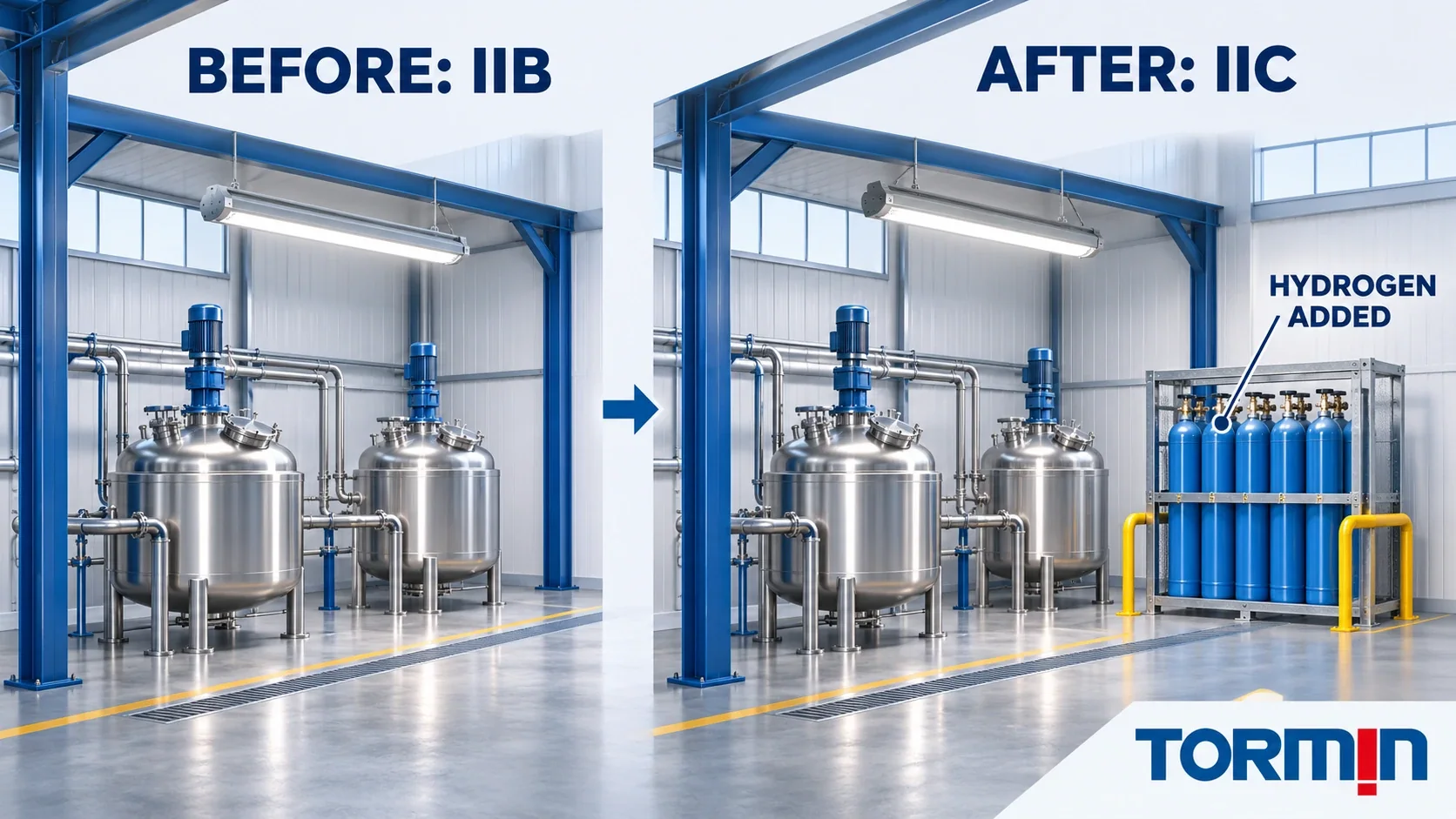
Assume a process bay originally handles an IIB solvent hazard. Its approved classification identifies the existing luminaires’ positions as Zone 1, and the installed lights are marked IIB only. A project now adds a hydrogen cylinder bank to feed a new process. This is a hypothetical change-review example, not a TORMIN installation case.
First, reassess the change rather than relabelling the whole building. The responsible hazardous-area engineer reviews the new release sources, ventilation and classification extent. Assume the revised approved assessment places two existing light positions in a hydrogen IIC atmosphere and retains the relevant Zone 1 requirement. The illustration below assumes that result; cylinder proximity alone does not establish it. NSW TestSafe identifies competent area classification as the basis for equipment selection.
Next, compare the old equipment with the revised requirement. The two lights have not necessarily deteriorated, and the zone number has not changed. The gas-group basis has. Their IIB-only marking does not cover hydrogen IIC; a T6 marking, if present, cannot repair that mismatch. For Ex d equipment, the missing assurance is the more demanding flame-transmission performance.
Then, resolve the affected installation before hydrogen service begins. Under the assumed unchanged mounting locations, replace the two IIB-only luminaires with equipment accepted for the IIC duty. Alternatively, an engineered relocation or process-layout change would need a revised assessment that demonstrably removes those positions from the IIC requirement. Do not keep the lights in place and treat an administrative label change as an equipment upgrade.
Finally, recheck the complete duty and close the change. Retain any more demanding temperature requirement from the original solvent hazard; check the replacement’s ambient range, EPL and exact certificate scope. Record the replacement ordering codes and update the area equipment and spare-parts schedules. An electrolyser addition follows the same logic: identify the assessed hydrogen release locations and compare the actual equipment positions, rather than replacing every light on the site indiscriminately.
If an existing fitting has a special marking such as IIB + H2, do not treat it as plain IIB or as unrestricted IIC. Equipment can have a specific-gas scope under IEC 60079-0; check exactly what the certificate permits. Hydrogen-specific scope does not automatically cover acetylene or carbon disulfide. The worked example deliberately assumes IIB-only equipment with no such extension.
Finish the decision in four steps
- Check the substance inventory. Include normal contents, relevant mixtures, assessed releases and defined process changes. Identify where each can affect the proposed light, not merely whether it exists somewhere on site.
- Determine the required group. Use the accepted substance or mixture data and the approved area-classification schedule. If the location requires IIC, reject IIB-only equipment. If it requires IIB or IIA, IIC is optional on this axis. Determine temperature class independently using the gas-group and temperature-class method.
- Check the actual nameplate. Match the precise ordering code, gas group, temperature class, EPL and ambient conditions. Use the explosion-proof lighting nameplate and certificate guide rather than relying on a catalogue family label.
- Check the certificate scope. Confirm that the offered configuration, protection technique and any specific-gas restrictions or special conditions are covered. For IECEx equipment, check the controlled online certificate record; the IECEx equipment-scheme FAQ explains its status and the limits of national acceptance.
The decision is complete when the required group and the exact candidate’s scope match, with the independent thermal and installation conditions satisfied. IIC is mandatory for an IIC duty; whole-plant IIC standardisation is a separate lifecycle choice.
For an IIC enquiry, TORMIN’s BC5402A Zone 1 linear light page lists Ex eb mb op is IIC T6/T5/T4 Gb. The BC9306P, BC9306S area/floodlight and BC9306S spotlight pages each list Ex db eb IIC T6/T5/T4 Gb. The applicable T6, T5 or T4 rating varies with the offered model/configuration, subject to the specific model’s nameplate. These first-party listings do not establish that every variant is T6 or replace the certificate review. Supply the required group, separate temperature class, ambient conditions and lighting duty when requesting the exact configuration.
FAQ
Which gases require IIC instead of IIB?
Hydrogen, acetylene and carbon disulfide are three common IIC substances. The IEC-referenced NSW TestSafe table lists hydrogen at MESG 0.29 mm and acetylene at 0.37 mm. A light marked only IIB does not meet an IIC requirement. The list is not exhaustive, and hydrogen-containing mixtures need their own accepted classification rather than automatic assignment from one ingredient.
Is IIC always the safer default?
IIC provides broader gas-group coverage than IIB, but it is not a complete safety specification. An IIC light can still have an unsuitable temperature class, EPL, ambient range or certificate scope. IIC is a useful default where mixed-area spare stocks or a defined hydrogen expansion justify it. In an established IIA/IIB application, a correctly selected IIB light remains suitable on the gas-group axis; compare complete configurations before standardising.
What happens if IIB equipment is installed in an IIC area?
Equipment marked only IIB does not meet an IIC gas-group requirement. For flameproof equipment, its certified scope does not establish the required IIC flame-transmission protection, so an internal ignition could ignite the surrounding atmosphere. That does not mean an explosion occurs every time it operates. Treat the mismatch as a hazardous-area nonconformity and have the responsible competent team make the situation safe and resolve replacement or an engineered alternative before continued hazardous service. A specific-gas extension requires its own certificate review; a cooler T-class alone does not solve the mismatch. See TestSafe’s Ex d explanation.
Does choosing IIC also cover the temperature class?
No. IIC identifies gas-group suitability; it does not select the equipment’s temperature class. Determine the required T-class independently from the accepted substance ignition-temperature data and project conditions, then verify the exact model’s marking and ambient range. An IIC light with the wrong T-class is still unsuitable. The gas group and temperature class selection guide explains the separate checks and their combined application.
When is standardising the whole plant on IIC worth it?
Whole-plant IIC standardisation is worth considering when several areas already require IIC, shared spare stocks create substitution risk, or a defined hydrogen project will expand the requirement. Compare those benefits with actual configuration prices, delivery, mounting and lighting performance. It is less compelling for a stable IIA/IIB plant with controlled spares and no credible IIC expansion. Standardisation must preserve separate temperature-class, EPL, ambient and certificate checks for every approved model.
Sources
- NSW Government, TestSafe – Electrical and non-electrical testing resources – IEC-referenced substance groups and MESG values; competent hazardous-area classification.
- IEC – IEC 60079-20-1:2010, Material characteristics for gas and vapour classification – Test methods and data – MESG definition, separate MESG/MIC criteria, boundary confirmation, mixture classification and Annex B substance entries. The official record identifies ISO/IEC 80079-20-1:2017 as its replacement.
- IEC – IEC 60079-0:2007, Equipment – General requirements – clause 4.2 group coverage and clause 4.4 specific-atmosphere scope. Historical reference for these principles; use the edition applicable to the equipment certificate.
- NSW Government, TestSafe – Flameproof enclosure Ex d – containment, non-transmission and external surface-temperature requirements.
- IEC – IEC 60079-1:2026, Equipment protection by flameproof enclosures “d” – official construction/testing scope; not used as a source of uninspected joint dimensions or as an assertion of local adoption.
- IECEx – Frequently Asked Questions, Certified Equipment Scheme – controlled certificate records and national acceptance boundaries.
TORMIN first-party product documents
The following live pages were checked on 2026-11-05. They support the published marking statements, not independent validation of an offered unit’s certificate.
- TORMIN – BC5402A Zone 1 linear light – IIC T6/T5/T4 Gb listing with eb, mb and op is protection marking.
- TORMIN – BC9306P series – Ex db eb IIC T6/T5/T4 Gb listing.
- TORMIN – BC9306S area/floodlight – Ex db eb IIC T6/T5/T4 Gb listing and configuration-dependent conditions.
- TORMIN – BC9306S spotlight – Ex db eb IIC T6/T5/T4 Gb listing.