
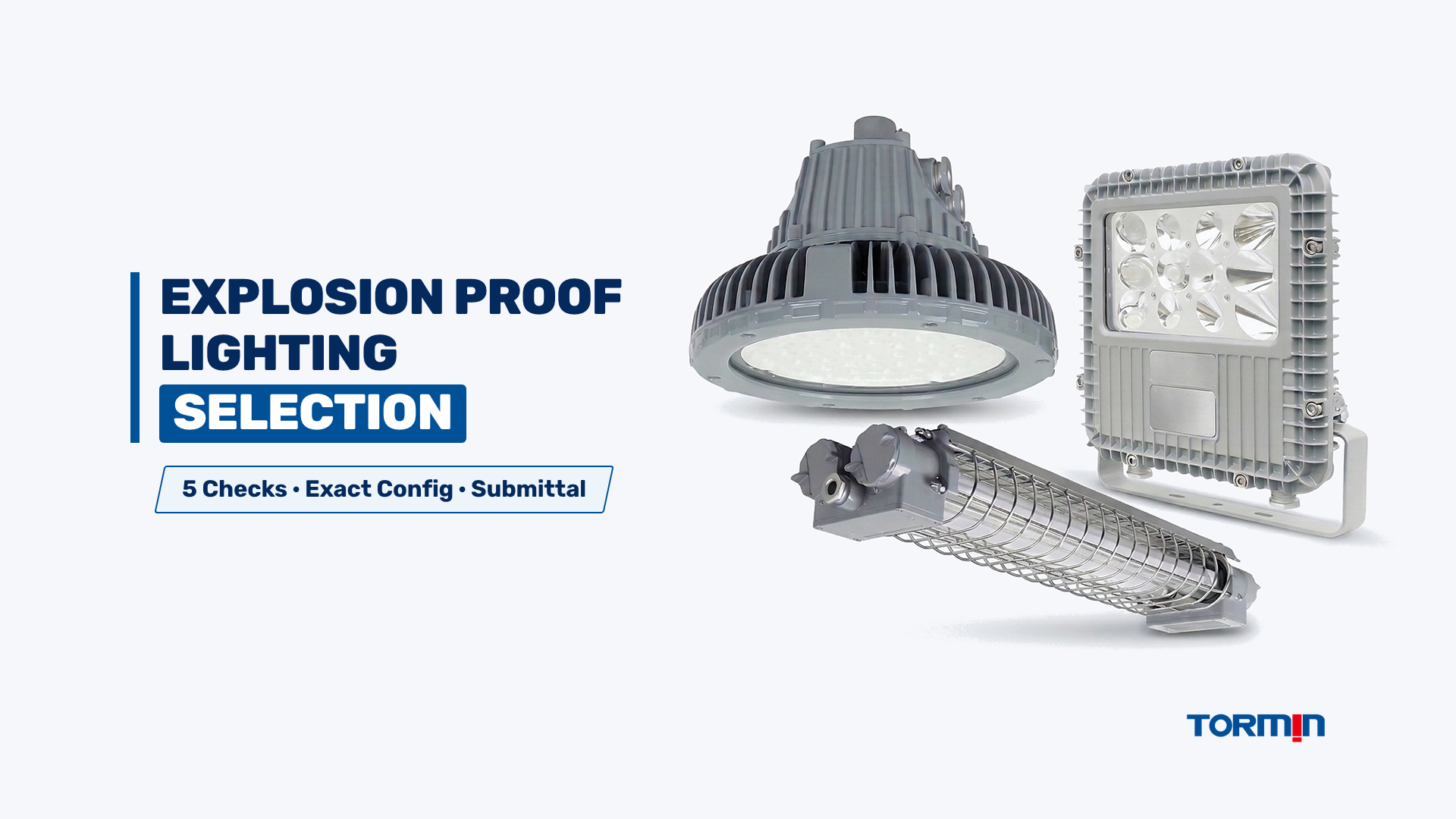
Select explosion proof lighting by matching five project-controlled inputs: the documented hazardous area, the exact equipment approval, the visual task, the operating environment, and the installation interfaces. Start with the project’s controlled area-classification documents, not a wattage, a beam-angle label, or a product photograph. A luminaire is a defensible choice only when its exact orderable configuration and supporting documents meet all five requirements together.
This guide turns that workflow into an auditable per-area selection record, screens out three compliant-looking offer traps that regularly derail submittals, and routes specialized facilities to their governing application checks. It is written for electrical engineers, lighting specifiers, and technical buyers comparing candidate luminaires; it does not classify an area, approve an installation, or replace the adopted electrical code, authority having jurisdiction (AHJ), or manufacturer instructions.
1. Establish what the project requires before choosing a light
Obtain the approved area-classification drawing and schedule, its current revision, and the jurisdiction and acceptance route specified by the project. Identify the exact mounting location—not merely the building, unit, or plant name—and record whether the classified atmosphere involves flammable gas or vapor, combustible dust, or ignitable fibers and flyings. Where the boundary inputs or engineering responsibilities behind those drawings are still unclear, review how a Class, Division or Zone rating is determined before issuing a luminaire enquiry.
The U.S. workplace framework illustrates why location-level documentation comes first: OSHA 29 CFR 1910.307 evaluates hazardous (classified) locations area by area and requires documented classification boundaries alongside equipment approved for the specific location and ignitable properties present. A classification assigned to a process skid or pit elsewhere in the same building is not evidence for an adjacent ceiling, walkway, or canopy mounting point.
Record the governing classification framework, required equipment protection level (EPL) or equipment category where applicable, gas or dust group, required temperature class or maximum surface temperature limit, ambient temperature range, and any owner engineering restrictions. Because North American Class/Division rules and IEC/NEC Zone systems operate on different boundary definitions and approval markings—even where both exist within the same regulatory landscape—never translate “Zone 1” or “Zone 2” into a Class/Division purchase specification without a project-approved engineering assessment; our Class I Division 1 versus Division 2 lighting comparison sets out where those two systems align and where direct substitution fails.
Keep the conformity and approval route explicit from the start. Within the European Union, the European Commission’s ATEX guidance separates equipment placing-on-the-market conformity under Directive 2014/34/EU from employer workplace zoning and explosion-protection duties under Directive 1999/92/EC. IECEx is a separate international certification scheme, and North American installations enforce their own Nationally Recognized Testing Laboratory (NRTL) and AHJ acceptance paths. Neither a broadly worded “ATEX/IECEx” catalog badge nor an approval accepted on an earlier project settles the legal or engineering requirements for a new site.
If the controlled classification schedule or local acceptance route is missing, hold final luminaire selection. A manufacturer or supplier can discuss candidate optical forms for preliminary layout planning, but cannot close a missing area-classification input by guessing from the process name.
2. Match hazardous-area requirements to the exact configuration
Ask the supplier for the complete proposed ordering code and the exact compliance documents covering that specific configuration. Compare the project’s classification schedule line by line against the nameplate marking, certificate and schedule (or annex), installation instructions, and any special conditions of use ("X" suffix conditions in IECEx/ATEX or listing conditions in North America). Check the model suffix, driver/voltage version, optical lens or globe variant, cable-entry arrangement, mounting style, and emergency battery option wherever those choices change the certified scope.
| Project requirement | Evidence to compare | Reason to keep the candidate on hold |
|---|---|---|
| Required local approval or conformity route | Exact equipment approval or certificate accepted by the project and AHJ | A different certification scheme is offered without an approved acceptance path |
| Gas or dust atmosphere and material group | Applicable gas or dust marking and certificate group scope | Gas-only evidence is offered for a combustible-dust location, or the required group is omitted |
| Protection level, category, or division/zone suitability | Exact location suitability under the project’s specified framework | Only a generic “explosion-proof” or “hazardous-area” marketing claim is supplied |
| Temperature requirement and site ambient range | Temperature class or maximum surface temperature, Ta ambient range, and mounting conditions for the exact wattage/version |
Site ambient temperatures fall outside documented Ta limits, or the temperature class changes at higher wattages |
| Complete luminaire configuration | Exact ordering code matched across quotation, datasheet, nameplate, and certificate annex | Certificate, photometric file, datasheet, and commercial offer describe different variants |
Under OSHA 29 CFR 1910.307 and OSHA 29 CFR 1910.399, equipment suitability depends on the ignitable or combustible properties of the specific gas, vapor, or dust—and its operating temperature limits—not merely the general location class. For how gas groups, dust groups, and T-codes interact with ambient ratings, check the gas group and temperature class selection guide. Remember also that “explosionproof” names one specific enclosure protection technique in the North American Class/Division vocabulary rather than every accepted Ex protection concept worldwide; specify the exact protection concepts and markings permitted by the project rather than forcing every submittal through a single informal label.
For an IECEx conformity claim, verify the exact certificate number and issue status directly in the IECEx Certified Equipment Scheme online system rather than relying on a static PDF summary or brochure icon. Obtain the full certificate and schedule, confirm that the revision is current, and remember that an equipment certificate is only one piece of compliance evidence—it does not by itself verify a compliant installed wiring and mounting system.
Above all, verify hazardous-area lighting by exact orderable configuration, never by product family name. Within a single luminaire series, changing LED wattage, optic cover, ambient package, entry thread, or integral battery backup can alter the temperature class, narrow the certified ambient window, or fall outside a certificate annex altogether. Audit every candidate in strict three-step order: proposed or physical nameplate marking -> matching certificate and schedule for that exact configuration -> controlled project classification requirements. A step-by-step walkthrough of how those fields cross-check appears in how to read an explosion-proof lighting nameplate and certificate.
Selection traps: three ways a compliant-looking offer goes wrong
Even when a quotation carries hazardous-area terminology on the cover sheet, three recurring shortcuts regularly cause technical rejection during engineering or AHJ review.
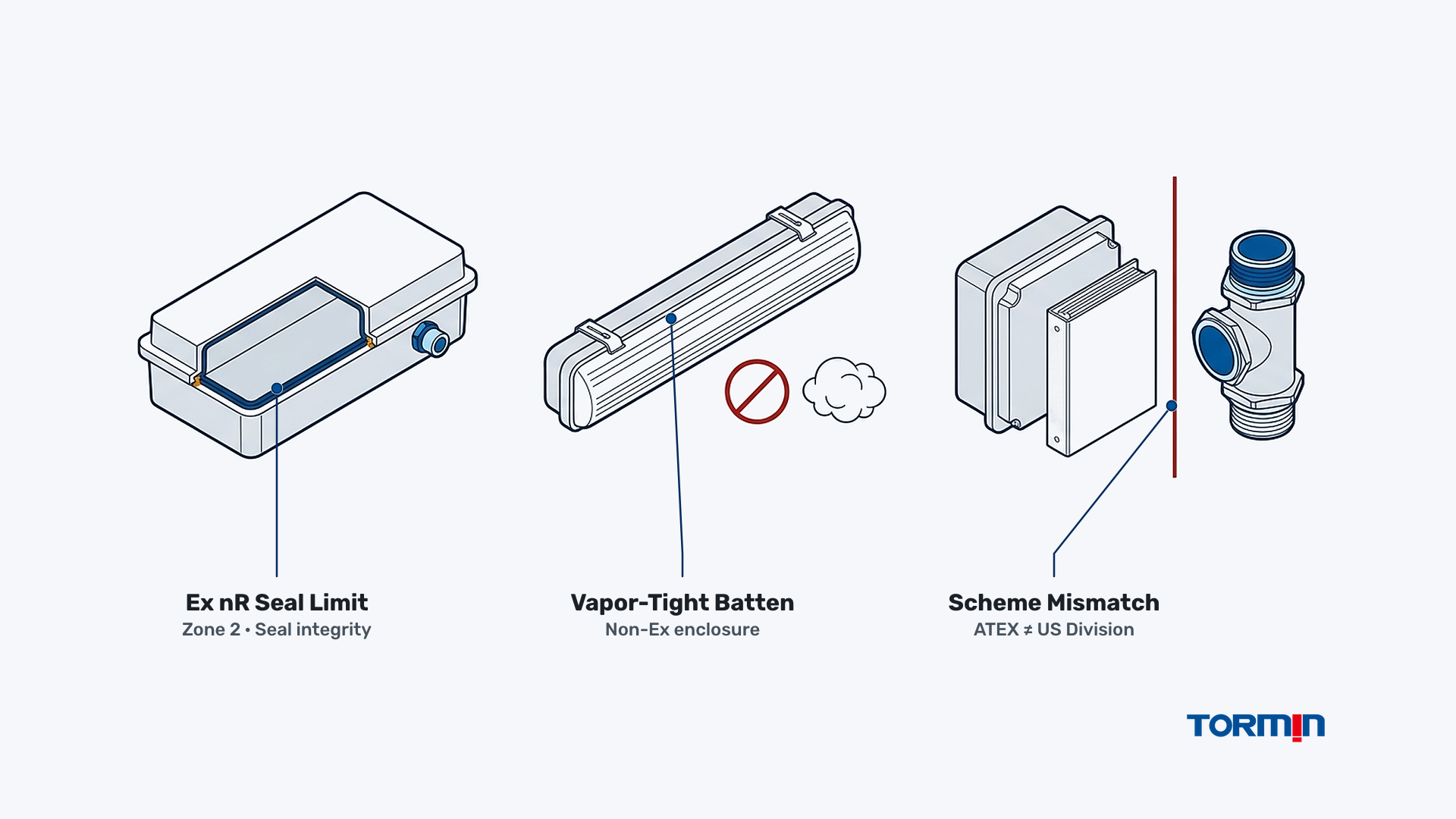
Restricted-breathing (Ex nR) offers chasing a lower temperature class. Some quotations meet a demanding temperature class by offering a restricted-breathing (Ex nR) luminaire evaluated under IEC 60079-15:2017. Ex nR is restricted strictly to Zone 2 / EPL Gc gas atmospheres, and its certified temperature rating depends on maintaining enclosure gaskets, cable entries, and sealing interfaces intact so surrounding gas ingress remains limited across service life and periodic inspection under IEC 60079-17:2023. Because routine maintenance or gasket aging can compromise that seal, some site standards prohibit Ex nR fixtures outright. Whenever a quote relies on nR, clarify the protection concept and owner policy first; see restricted-breathing explosion-proof lighting.
Mistaking “vapor-tight” shop fixtures for hazardous-area ratings. Sealed, splash-resistant industrial “vapor-tight” or tri-proof shop lights are ordinary environmental enclosures, not hazardous-location approvals. In North American Division 2 locations governed by NFPA 70 (National Electrical Code) and OSHA 29 CFR 1910.307, situations where non-explosionproof fixed general-purpose luminaires may be installed depend on strict conditional code exceptions—such as normal operating surface temperatures staying within the code’s ignition-temperature threshold and the absence of exposed arcing components—not on a hazardous-area rating carried by a “vapor-tight” housing. Treat any unrated shop-light proposal as unverified until checked against general-purpose lighting rules in Division 2 and Zone 2.
Wrong-market certificates (ATEX or IECEx alone in U.S. Division locations). A luminaire supplied only with ATEX or IECEx certificates cannot be accepted as listed hazardous-location equipment in U.S. Class/Division workplaces, because IECEx and EU conformity documents do not replace mandatory U.S. national listing requirements (IECEx Certified Equipment Scheme FAQs; OSHA NRTL Program FAQs). U.S. project acceptance requires NRTL-listed equipment matching the project’s adopted code path—either a U.S. Class/Zone listing bearing the AEx marking under OSHA 29 CFR 1910.307 or the traditional Class/Division route (UL 844). Confirm which inspection framework governs the site first, and review using IECEx or ATEX equipment in the USA and the AEx marking.
3. Turn the visual task into a lighting specification
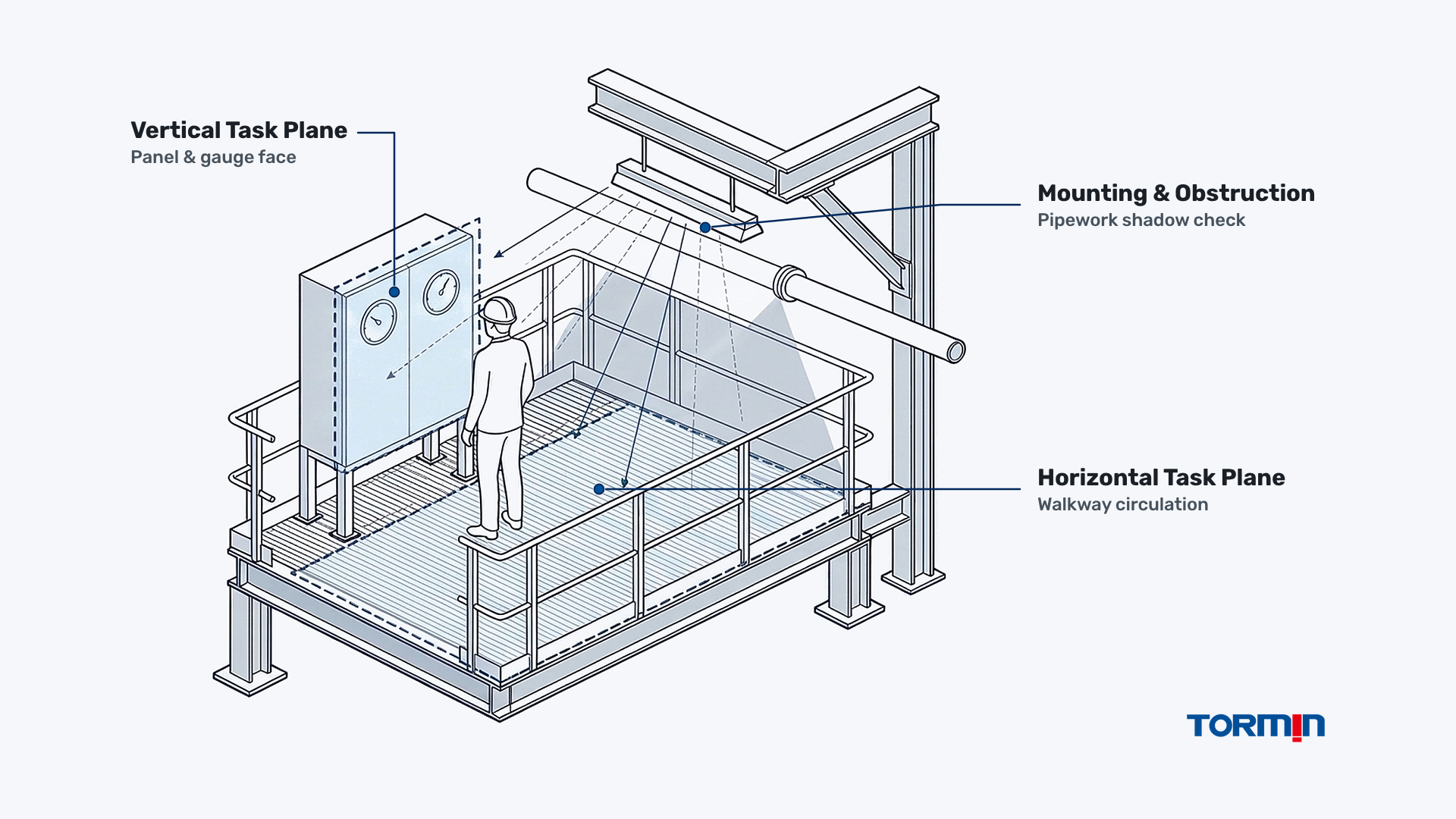
Once hazardous-area eligibility is locked, define what operators and technicians must actually see and from what viewing angle. A horizontal grating walkway, an upright pressure gauge or control panel face, a localized valve-inspection point, and an open process bay represent distinct visual tasks—even when every mounting point shares the exact same hazardous-area classification.
Select a candidate luminaire form and optical role before comparing wattages. Linear battens, high-bay and low-bay luminaires, directional floodlights, and portable inspection lights offer different starting geometries for beam spread, aiming, glare control, and maintenance reach. Form factor alone proves nothing about compliance or visibility: each candidate still requires verified hazardous-area documents for its exact configuration plus an optical distribution matched to the task.
For an auditable lighting specification, define five project inputs:
- Task planes and viewing geometry: whether the critical visual surface is horizontal, vertical, or inclined, together with operator viewing direction and working height;
- Maintained lighting criteria and governing authority: required maintained illuminance, uniformity, and glare limits specified by the owner, applicable workplace standard, or regulator;
- Mounting envelope and physical obstructions: permissible support points, mounting heights, aiming angles, and shadow-casting pipe racks, vessels, ducts, or crane bridges;
- Visual quality and operating duty: glare sensitivity, shadow control, color-rendering needs for safety signage or gauge reading, switching/control behavior, and duty cycle;
- Calculation and verification method: required lighting calculation submittals and commissioning acceptance checks.
International workplace standard ISO/CIE 8995-1:2025 addresses lighting quantity and quality for indoor workplaces across varied visual tasks, while explicitly excluding emergency lighting from its scope. Apply the workplace lighting rules adopted for the project’s jurisdiction and actual task, and specify emergency escape or standby lighting under its own governing standard and runtime criteria.
Require a point-by-point lighting calculation built from the exact proposed optical variant and its verified electronic photometric file (IES or LDT), which the IES Computer Committee defines as the standard photometric input for lighting calculation software. Require the submittal to state room or structure geometry, task-plane coordinates, surface reflectances, and light-loss (maintenance) assumptions explicitly. Catalog watts, nominal LED chip lumens, or a single beam-angle number cannot demonstrate maintained performance on a real task plane.
Consider an educational review of an elevated walkway running beside a vertical local control panel: a wide-distribution ceiling luminaire that satisfies horizontal circulation along the grating can still leave the vertical gauge faces in body shadow or produce disabling glare in the operator’s line of sight. Evaluating both planes alongside pipework obstructions determines whether a repositioned linear fixture, an asymmetric optic, or a dedicated task luminaire is needed—without guessing from wattage equivalences.
4. Resolve the interfaces before accepting the configuration
Verify the non-Ex operating environment at the exact mounting point: minimum and maximum ambient temperatures, radiant heat from nearby vessels or exhausts, washdown water, dust accumulation, cleaning chemicals, offshore or coastal salt mist, continuous mechanical vibration, impact exposure, and the planned maintenance access method. Cross-check every exposure against exact-model housing materials, coatings, lens materials, elastomer seals, and documented operating limits.
Keep environmental ingress distinct from explosion protection. An IP code under IEC 60529 defines enclosure ingress protection against solid foreign objects and water under standardized test conditions; it establishes neither ignition protection in an explosive atmosphere nor resistance to specific process chemicals or salt corrosion. Require independent evidence for each exposure, and use TORMIN’s IP rating versus explosion-protection guide when separating washdown ratings from Ex markings.
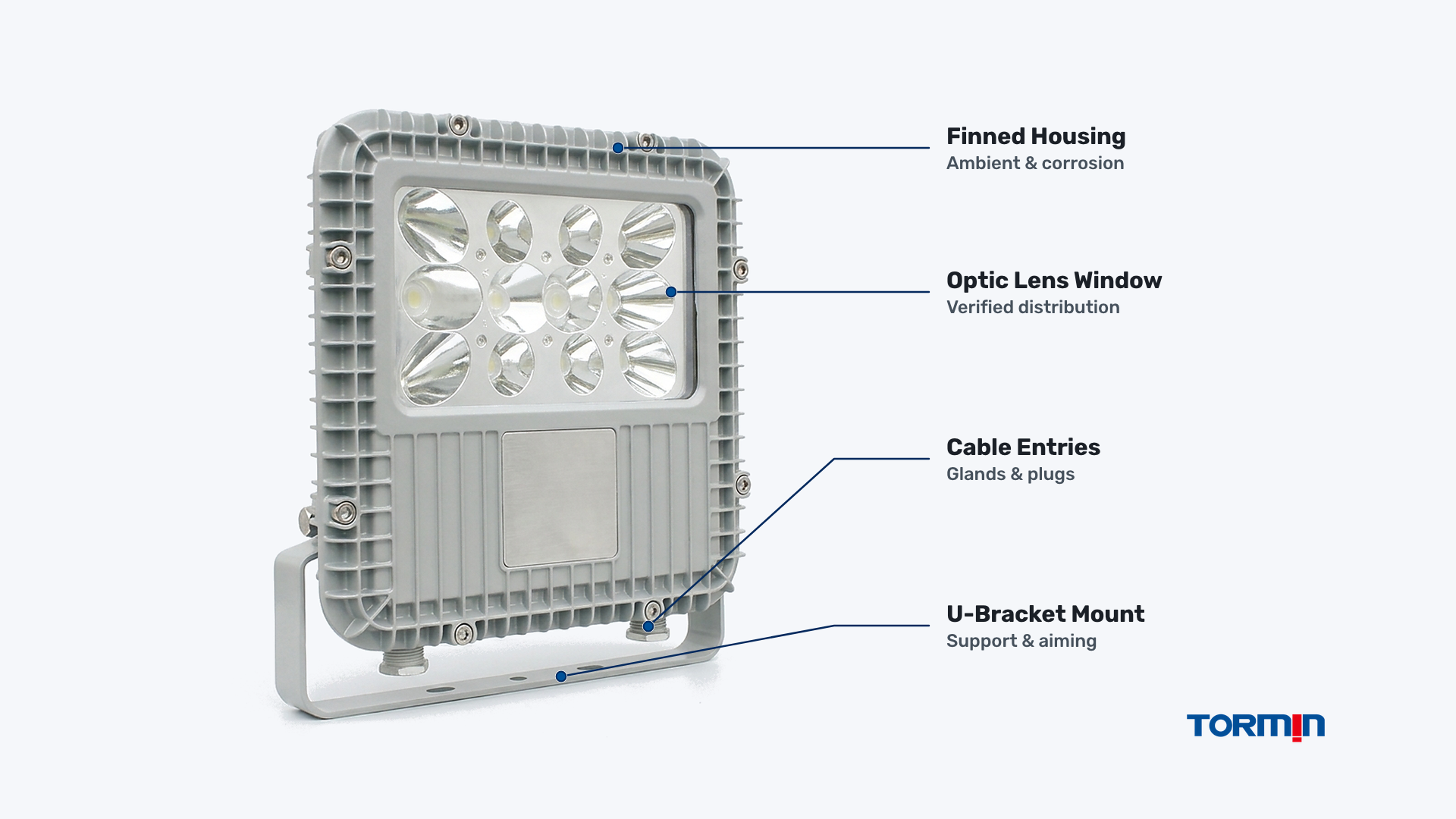
Next, resolve the four physical and electrical interfaces that routinely change the orderable part number or field accessories:
- Electrical supply and controls: nominal voltage and tolerance, supply frequency or DC range, surge environment, dimming or control wiring interface, circuit looping capacity, and restart behavior after power interruption.
- Mounting, structure, and maintenance access: pendant stem, ceiling bracket, stanchion, or trunnion U-bracket geometry, fixture weight and wind/vibration load, permitted burning orientation (where temperature class depends on mounting attitude), thermal clearance, and safe isolation/relamping or driver access.
- Raceway, sealing, and cable-entry hardware: conduit or armored/unarmored cable system, hub thread form and size (such as
NPTversus metric threads), boundary or enclosure conduit seal obligations—see whether explosion-proof light fixtures need conduit seals—and exact certified entry hardware, distinguishing live cable entries from unused openings via explosion-proof cable glands versus stopping plugs. - Emergency operation, where specified: maintained versus non-maintained mode, emergency lumen fraction, rated battery duration, battery ambient-temperature limits (often narrower than standard AC driver limits), and self-test or remote testing provisions for that exact emergency variant.
Never assume that a dimming driver, trunnion bracket, thread adapter, or integral battery pack shown in a series catalog applies to every certified configuration. Require the complete combination of luminaire and entry accessories to remain traceable across the certificate schedule and manufacturer installation instructions.
Treat these interface checks as procurement and specification inputs, not field wiring instructions. International standard IEC 60079-14:2024 (alongside adopted national codes such as NFPA 70 in North America) governs Ex electrical installation design, equipment and gland selection, erection, documentation, and initial inspection by competent personnel. Qualified project engineers and licensed installers must execute the physical installation under the adopted code and exact product instructions.
5. Create one selection record for each area or mounting group
Capture all five checks on a single controlled selection record per classified area or mounting group so an approved luminaire configuration is never accidentally swapped onto a different gas group, higher-ambient ceiling bay, or incompatible conduit thread during purchasing. Treat this worksheet as an engineering proposal-review record, not a substitute for formal compliance certification or initial inspection dossiers.
| Selection-record field | What the project team records |
|---|---|
| Location and controlling documents | Area ID, classification drawing/schedule number and revision, jurisdiction, adopted code, and project specification |
| Hazardous-area requirement | Gas/vapor or dust atmosphere, Class/Division or Zone, required group, EPL/category, temperature requirement, and Ta ambient range |
| Lighting requirement | Horizontal/vertical task planes, maintained lighting criteria, obstruction geometry, and accepted photometric calculation basis |
| Operating and interface requirement | Corrosion/washdown environment, supply/controls, mounting orientation, conduit seal needs, entry threads, glands/plugs, and emergency mode |
| Exact proposed configuration | Complete manufacturer ordering code covering wattage, optic, driver, mounting hardware, cable entries, accessories, and emergency option |
| Supporting evidence | Exact certificate number/revision and schedule, datasheet revision, installation manual ID, and photometric file/calculation report |
| Deviations and review status | Every open question or supplier alternative, assigned technical reviewer, and explicit Hold or Release decision |
Never treat a blank cell as silent approval. Where a site parameter remains unconfirmed, log the open item and the engineer responsible for closing it. Where a supplier proposes an alternate wattage, optic, protection technique, or cable-entry arrangement, record it as an explicit technical deviation for engineering sign-off rather than overwriting the baseline requirement.
Keep the candidate on Hold whenever the area-classification schedule is missing, the local approval scheme is unconfirmed, the exact ordering code cannot be matched to the certificate annex, a special condition of use ("X" condition) is unaddressed, or the photometric and interface documents do not substantiate the installed task. Unit price or short lead time never closes a compliance or interface gap.
Release a configuration for ordering only after authorized project engineering review accepts the complete document package and closes every deviation. Carry the exact ordering code and document revisions onto purchase orders and receiving inspection checklists; field installation and statutory pre-commissioning inspection remain separate post-procurement stages.
TORMIN’s explosion proof lighting category provides an overview of fixed and portable candidate forms once your area inputs are defined—not a shortcut around document verification. To request a configuration-traceable technical proposal, send your per-area selection record and classification schedule through the TORMIN contact page and ask for exact-variant certificates, photometric files, and a written deviation log. If site inputs are still being gathered across departments, use the industrial lighting enquiry checklist to consolidate them before going out to bid.
Start from your area: application guides on this site
Different facilities arrive at Step 1 with very different governing boundaries—from vapor-pit floor lines and hydrogen ventilation rates to combustible-dust layer rules. If you are scoping a specific work area, use the matching guide below to see which facility variables control its classification and luminaire specification before building your selection record.
| Area / application | What decides the light | Guide |
|---|---|---|
| Paint booth (new installation) | The classified boundary inside and around the booth openings decides which luminaires and viewing-panel arrangements apply. | Explosion-proof paint booth lighting |
| Existing spray booth, adding ceiling lights | How cutting in or mounting new fixtures affects the booth’s original listing and acceptance route decides the retrofit path. | Adding ceiling lights to an existing spray booth |
| Grain silo / feed mill | The combustible-dust layer surface-temperature method decides the luminaire’s maximum permissible thermal limit. | Explosion-proof lighting for grain silos and feed mills |
| Battery room (hydrogen) | Room ventilation effectiveness and hydrogen’s gas grouping decide whether the space is classified and which group rating is required. | Explosion-proof lighting for hydrogen areas |
| Battery energy storage (BESS) | Thermal-runaway off-gas behavior, ventilation, and gas-detection architecture decide whether hazardous-area classification applies. | Explosion-proof lighting for battery energy storage (BESS) |
| Gas station canopy | Because the overhead canopy deck typically sits above the dispenser’s classified envelope, standard canopy luminaires usually apply outside classified zones. | Gas station canopy explosion-proof lighting |
| Repair garage pit | Below-grade pit volume is often Class I, Division 1 when unventilated, while the thin floor-level vapor layer above grade can be Division 2. | Explosion-proof pit lights for repair garages |
| Combustible dust areas (general) | Separating North American Class II rules from IEC/NEC Zone 20, 21, and 22 dust markings comes before comparing any luminaire. | Explosion-proof lighting for combustible dust environments |
| Confined space entry work | Portable luminaire certification, supply voltage, cord routing, and staging equipment must be selected together as one entry system. | Confined space explosion-proof lighting |
Frequently asked questions
What information do I need before selecting explosion proof lighting?
Architectural floor plans or general room labels are not enough: before comparing any luminaire model, obtain the controlled hazardous-area classification documents for the exact mounting point—Class/Division or Zone designation, gas or dust group, required temperature class or maximum surface temperature limit, site ambient range, and accepted certification scheme (OSHA 29 CFR 1910.307; IEC 60079-14:2024). Optical and mounting details come after those safety boundaries are fixed.
Can one fixture cover both Division 1 and Division 2 areas?
Only when the exact configuration’s nameplate marking and listing cover the more severe Division 1 location—and simultaneously satisfy the gas or dust group, temperature code, ambient range, and wiring interface of both areas under OSHA 29 CFR 1910.307 and NFPA 70. Always verify suitability against the exact ordering code rather than the product series name, and never install a Division 2-only fixture inside a Division 1 boundary.
Is specifying the highest gas group and T-class always the safe choice?
Meeting or exceeding the area’s documented group and temperature requirement is mandatory, so a luminaire marked for a broader gas-group scope (such as IIC in IEC schemes, or explicitly marked for every required letter group in NEC Class/Division) and a stricter temperature class can satisfy less demanding limits within the same scheme. However, blanket over-specification narrows optical, wattage, emergency-battery, and high-ambient choices, raises hardware cost, and still cannot replace line-by-line verification of scheme acceptance, dust versus gas scope, Ta range, and installation conditions.
Do I need classification documents before asking a supplier for an offer?
Yes for any binding quotation or submittal. Suppliers can share preliminary catalog forms during early layout budgeting, but without controlled area-classification schedules any compliance offer is a guess from room names—which neither OSHA 29 CFR 1910.307 nor IEC 60079-14:2024 permits for hazardous-location selection. Complete the project’s classification workflow first so every bidder prices the same verified safety boundary.
What should a complete selection record include?
Maintain one separate record per classified area or mounting group—rather than one plant-wide lighting schedule—linking five auditable blocks: (1) area ID and controlled classification requirements, (2) exact selected luminaire ordering code, (3) matching certificate number, schedule/annex, and Ta limits for that configuration, (4) electronic photometric file and task-plane calculation basis, and (5) electrical, mounting, conduit-seal, cable-gland/stopping-plug, and deviation sign-off status.
Sources
- OSHA — 29 CFR 1910.307, Hazardous (classified) locations — U.S. workplace requirement for area-by-area classification documentation, approved equipment matching class/group/temperature, conditional Division boundaries, and Class I Zone
AExmarkings. - European Commission — Equipment for potentially explosive atmospheres (ATEX) — Distinction between EU ATEX Equipment Directive 2014/34/EU and ATEX Workplace Directive 1999/92/EC.
- OSHA — 29 CFR 1910.399, Definitions applicable to Subpart S — Regulatory definitions of Class I/II/III Divisions and “approved/acceptable” hazardous-location equipment.
- IECEx — Certified Equipment Scheme Overview — Online verification of current IECEx Certificates of Conformity, exact covered configurations, and schedules.
- IEC — IEC 60079-15:2017, Explosive atmospheres — Part 15: Equipment protection by type of protection “n” — Scope and construction/testing basis for restricted-breathing (
Ex nR) enclosures in Zone 2 / EPL Gc gas atmospheres. - IEC — IEC 60079-17:2023, Explosive atmospheres — Part 17: Electrical installations inspection and maintenance — Ongoing inspection and maintenance obligations supporting seal-dependent protection concepts such as
Ex nR. - NFPA — NFPA 70, National Electrical Code (NEC) — Governing U.S. installation code for Class/Division and Zone wiring, sealing, and conditional Division 2 luminaire rules.
- IECEx — Frequently Asked Questions, Certified Equipment Scheme — Scope of IECEx certification versus national regulatory and local authority acceptance.
- OSHA — Nationally Recognized Testing Laboratory (NRTL) Program FAQs — U.S. workplace requirement for NRTL-listed electrical equipment under applicable U.S. test standards.
- ISO / CIE — ISO/CIE 8995-1:2025, Light and lighting — Lighting of work places — Part 1: Indoor — Task-specific indoor workplace lighting quantity/quality framework and explicit exclusion of emergency lighting.
- Illuminating Engineering Society — IES Computer Committee — Role of standardized luminaire photometric data files as inputs to lighting calculation software.
- IEC — IEC 60529:1989+AMD1:1999+AMD2:2013 CSV, Degrees of protection provided by enclosures (IP Code) — Scope of enclosure solid/water ingress ratings as distinct from explosion protection and chemical resistance.
- IEC — IEC 60079-14:2024, Explosive atmospheres — Part 14: Electrical installation design, selection and erection — Requirements for Ex equipment selection, cable glands and stopping plugs, documentation, personnel competency, and initial inspection.