
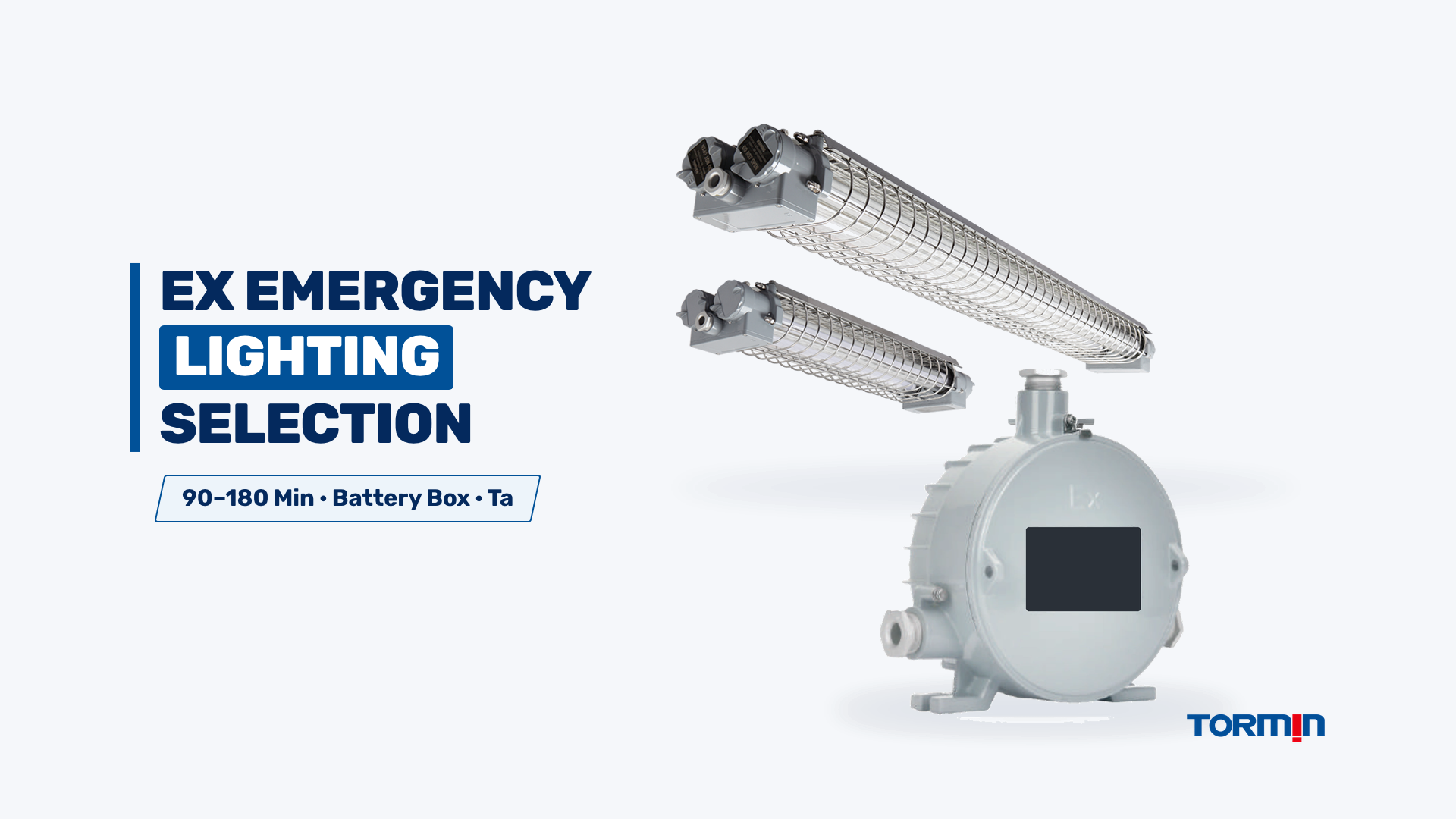
Selecting explosion-proof emergency lighting for Zone 1, Zone 2, Zone 21, and Zone 22 facilities requires balancing three constraints that general industrial fixtures rarely face together: battery architecture (self-contained luminaire vs. separate Ex db emergency power box), statutory discharge runtime (60, 90, or 180 minutes), and the narrowed ambient temperature (Ta) window imposed by electrochemical cells. A standard hazardous-area LED fixture rated for -40 °C to +55 °C often drops to -25 °C or 0 °C once a battery pack enters the enclosure.
This engineering guide breaks down the trade-offs between self-contained emergency fixtures and external Ex db battery boxes, maps 90-minute and 180-minute runtime rules against published load-versus-duration curves, and provides a verified specification table across TORMIN ATEX and IECEx certified emergency models.
Self-Contained Explosion-Proof Emergency Luminaires vs. External Ex db Battery Boxes
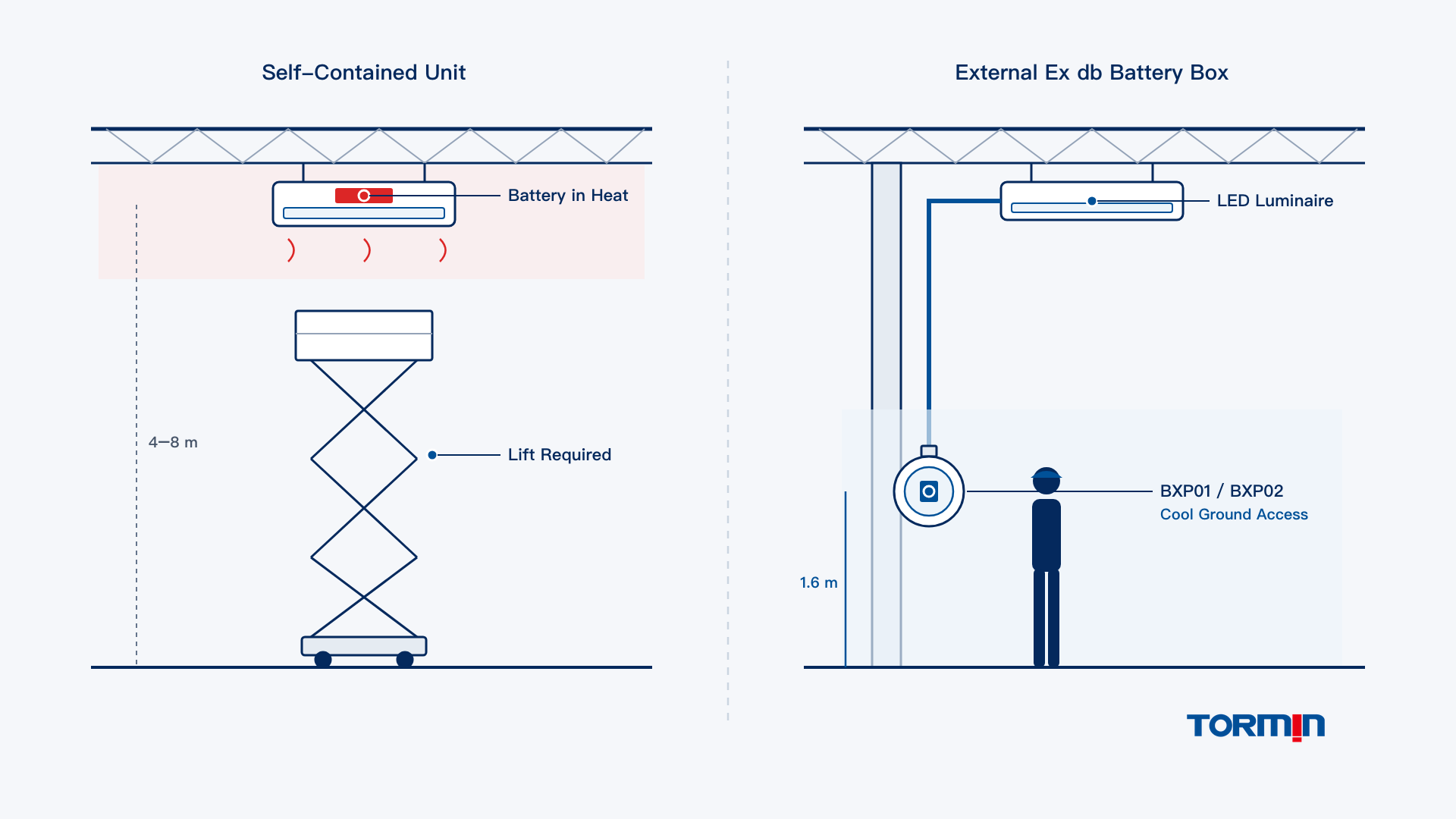
Self-contained explosion-proof emergency luminaires house the LED driver, charging circuit, and battery pack inside one hazardous-area enclosure, whereas external battery box architectures separate the luminaire at ceiling height from an Ex db emergency power supply mounted at accessible wall or column level. Separating the battery from luminaire heat directly extends cell service life and eliminates scaffolding during routine battery replacement.
In refineries, chemical pipe racks, and offshore process decks, mounting height and thermal stratification usually decide the architecture. Process piping and roof decks frequently run 10 °C to 15 °C warmer than walkway elevation. Placing lithium or NiMH cells inside a high-bay or linear luminaire exposes the battery to both elevated ambient air and internal LED driver waste heat, accelerating electrolyte degradation and capacity fade.
When engineers decouple the battery into a dedicated Ex db emergency box such as TORMIN BXP01 or TORMIN BXP02, maintenance teams gain three operational advantages:
- Ground-level battery servicing: Technicians can test, isolate, and replace battery packs at 1.5 m to 2.0 m walkway height without erecting scaffolding or requesting aerial work platform permits in congested process modules.
- Thermal isolation from luminaire heat: Keeping the battery outside the LED driver cavity reduces continuous cell operating temperature, helping batteries retain their 90-minute or 180-minute discharge capacity across multi-year inspection cycles.
- Flexible luminaire pairing: External battery boxes can back up linear tube fixtures like BC5401 Emergency (via BXP01) or high-wattage area luminaires up to 200 W normal load on BXP02B (40 W to 50 W on BXP02A), switching to 5 W–25 W emergency output during power loss.
| Architecture Type | Typical Mounting Height (m) | Thermal Exposure on Battery | Normal Load Coverage (W) | Battery Replacement Access | Best-Fit Hazardous Areas |
|---|---|---|---|---|---|
| Self-contained exit or twin-head unit (BC4210, BC5210, BC5200) | 2.0 to 3.5 m | Low internal LED heat (1.5 W to 6 W); subject to local room Ta | 1.5 W to 6 W dedicated | Direct ladder or walkway access | Escape doors, stairwells, control-room exits, indoor corridors |
| External Ex db battery box for linear tubes (BXP01 + BC5401) | Luminaire 3 to 8 m; box 1.5 to 2.0 m | Isolated from luminaire driver heat; confirm Ta on Ex certificate | 10 W to 30 W emergency load (2.6 Ah / 14.8 V pack) | Ground-level access; no scaffolding | Pipe racks, pump houses, offshore walkways, transfer stations |
| External low-voltage DC emergency box (BXP02A / BXP02B) | Luminaire 4 to 12 m; box 1.5 to 2.0 m | Isolated from luminaire heat; rated -25 °C to +55 °C | 40–50 W (BXP02A) or Max. 200 W (BXP02B); 5 W to 25 W emergency | Ground-level access; 360° mounting bracket | High-bay process halls, loading bays, compressor buildings |
Choose self-contained units for low-wattage egress signage and dedicated stairwell heads installed within ladder reach. Specify an external Ex db battery box whenever luminaire mounting exceeds 3.5 m, ambient ceiling temperatures exceed +40 °C, or normal luminaire power exceeds 40 W.
Emergency Lighting Runtime Requirements: 60, 90, and 180 Minutes Under EN 1838, IEC 60598-2-22, and NFPA 101
Emergency lighting runtime is dictated by local life-safety codes and facility evacuation complexity, with 90 minutes mandated under NFPA 101 in North America and 60 to 180 minutes specified under EN 1838 and national European annexes for hazardous industrial sites. Higher emergency wattage drains a fixed battery capacity proportionally faster, forcing an explicit trade-off between emergency illuminance and duration.
Under EN 1838, escape routes up to 2 m wide require at least 1 lx along the center line, open anti-panic areas require at least 0.5 lx across the core floor zone, and high-risk task areas require at least 10% of normal maintained illuminance (and never less than 15 lx) so operators can safely shut down rotating machinery or isolate pressurized valves. Under NFPA 101, emergency egress lighting must operate for at least 90 minutes, delivering an initial average of 10.8 lx (1 fc) along the path of egress and declining to no less than 1.1 lx (0.1 fc) at any point by the end of the 90-minute test. Meanwhile, IEC 60598-2-22 establishes the luminaire construction, changeover voltage, recharge recovery, and battery endurance testing requirements for emergency fixtures worldwide.
Because hazardous-area battery enclosures have strict internal volume and flamepath limits, engineers cannot simply drop in oversized battery banks without re-certifying the enclosure. Instead, external emergency boxes pair a fixed certified battery pack (such as 2.6 Ah at 14.8 V in BXP01 or 2600 mAh at 7.4 V / 14.8 V in BXP02) with discrete emergency power taps:
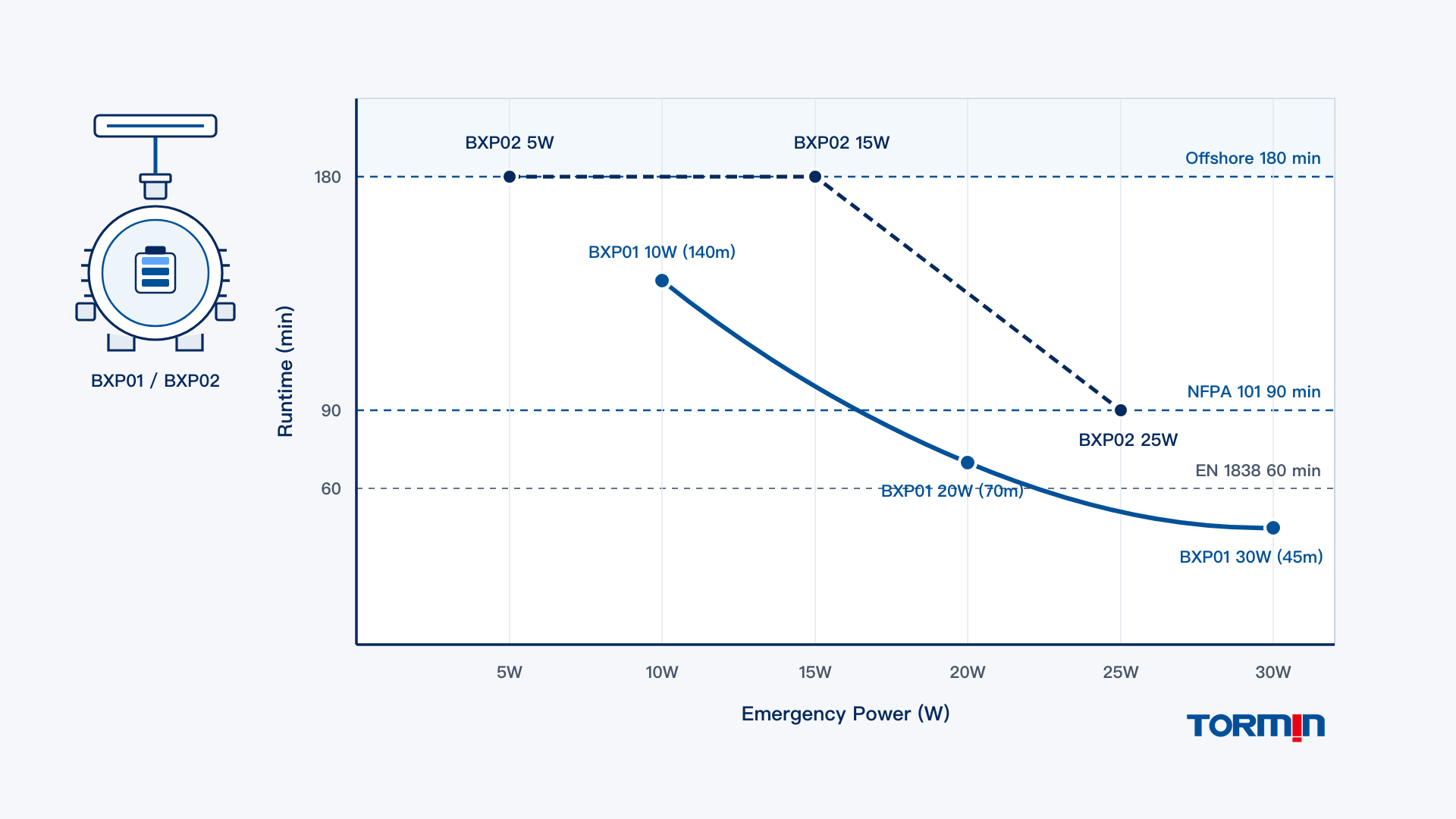
- 180-minute duty (3 hours): Required on many offshore platforms, chemical plants with shelter-in-place protocols, and UK/European public-access industrial sites. Achieved at 1.5 W on BC4210 / BC5210 and at 5 W to 15 W on matching BXP02A / BXP02B configurations (≥ 180 min).
- 90-minute duty (1.5 hours): Standard baseline for NFPA 101 facilities and general industrial escape paths. Achieved at 2×3 W on BC5200 (≥ 90 min), at 10 W to 25 W on BXP02 variants (≥ 90 min), and at 10 W on BXP01 (over 140 min, providing comfortable margin above 90 min).
- 60-minute and short-duration high-output duty: Meets the minimum EN 1838 60-minute escape-route baseline on BXP01 at 20 W (over 70 min — suitable for 60-minute EN 1838 zones, not 90-minute NFPA 101 paths), while BXP01 at 30 W (over 45 min) is strictly reserved for short-duration high-output task shutdowns rather than 60-minute or 90-minute egress codes.
| Standard or Project Code | Minimum Runtime (min) | Minimum Egress Illuminance (lx) | High-Risk Task Illuminance (lx) | Primary Geographic / Industry Scope |
|---|---|---|---|---|
| EN 1838 (Escape Route) | 60 min (180 min common in O&G) | 1.0 lx center line (0.5 lx open area) | 10% of normal (minimum 15 lx) | Europe, Middle East, IECEx offshore projects |
| NFPA 101 (Life Safety Code) | 90 min | 10.8 lx initial avg; 1.1 lx min at 90 min | Site-specific shutdown protocol | North America, US-EPC global facilities |
| OSHA 29 CFR 1910.37 | Adequate for safe egress | Continuous visibility of exit routes and signs | Site-specific hazard assessment | US general industry workplaces |
| Offshore / Petrochemical Spec | 90 to 180 min | 1.0 to 5.0 lx along decks and muster areas | 15 to 50 lx at muster and ESD panels | FPSOs, refineries, LNG terminals |
Verify whether the project specification demands 180 minutes across all zones or permits 90 minutes on escape walkways while reserving 180 minutes for muster stations and emergency shutdown (ESD) valve skids. Matching emergency wattage to actual task-plane lux prevents overspecifying fixture counts.
Ambient Temperature (Ta) Limits: Why Batteries Shrink the Hazardous-Area Operating Window
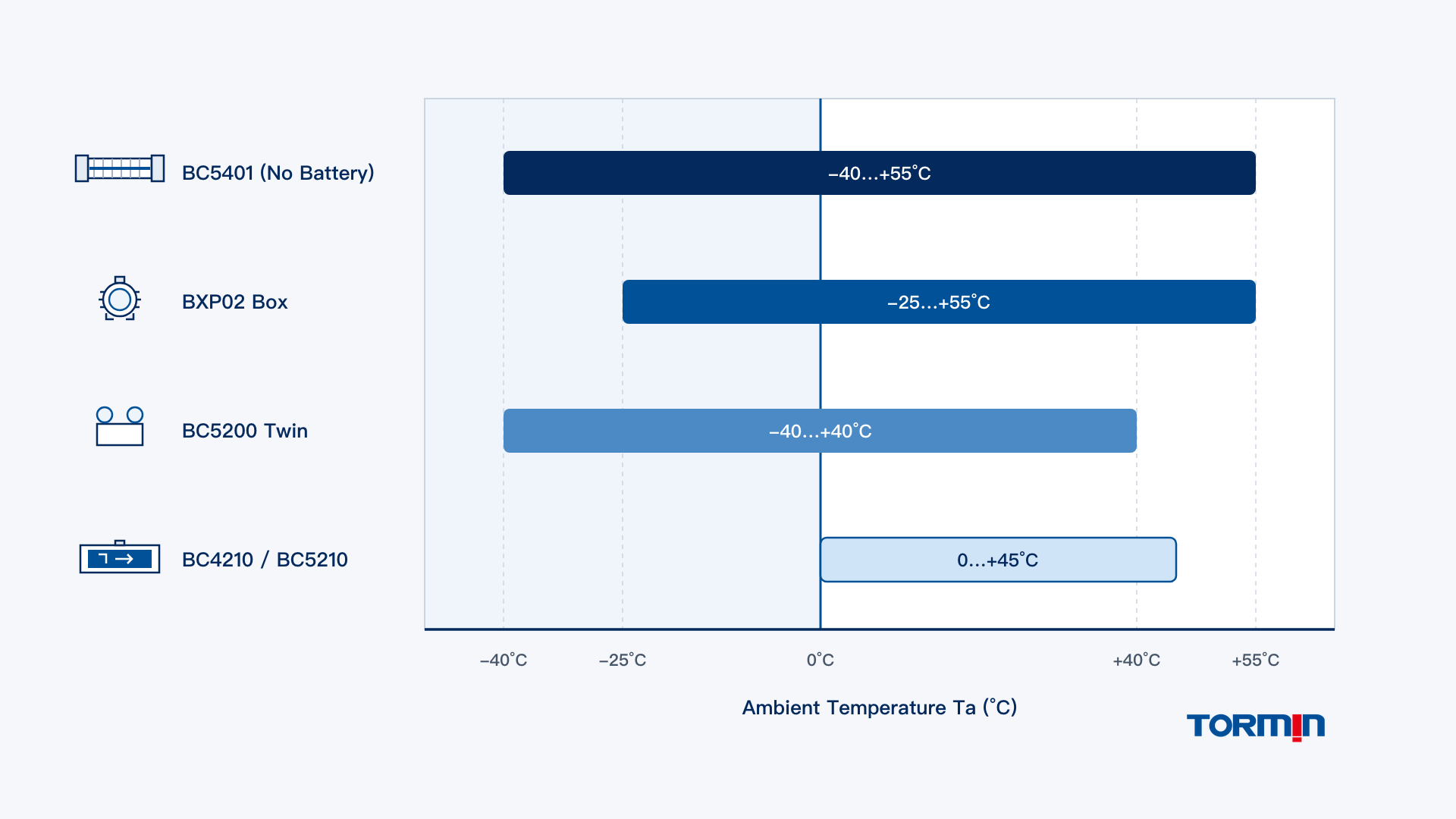
Rechargeable batteries narrow the certified ambient temperature (Ta) window of explosion-proof emergency lighting compared with standard LED fixtures. While non-emergency luminaires like BC5401 operate from -40 °C to +55 °C, battery-backed models tighten to -25 °C to +55 °C (BXP02) or 0 °C to +45 °C (BC4210 / BC5210).
Two separate physical limits govern emergency luminaire Ta ratings, as explained further in our guide on temperature class and ambient temperature (Ta):
- Cold-weather discharge and charging cutoffs: Below 0 °C, standard lithium-ion cells cannot be safely fast-charged without risking lithium plating, and below -20 °C to -25 °C internal impedance rises sharply enough that voltage sag trips low-voltage cutoffs well before 90 minutes. Even if a luminaire housing carries a -40 °C mechanical seal rating, the emergency pack dictates the lowest usable operating temperature.
- High-ambient thermal runaway and T-class limits: Above +45 °C to +55 °C, trickle-charging heat combined with ambient temperature accelerates cell aging and increases enclosure surface temperature toward the T6 (85 °C) or T80 °C dust surface limit. Under IEC 60079-0, the certified ambient range printed on the nameplate is a hard compliance boundary; installing a 0 °C to +45 °C exit sign in an unheated outdoor pipe rack that reaches -15 °C in winter invalidates the Ex certificate.
For sub-zero LNG terminals, arctic compressor stations, or outdoor winterized refineries operating below -25 °C, engineers should not force self-contained emergency fixtures onto exterior walkways. Instead, route emergency lighting circuits from a heated indoor central battery system (CBS) located in a non-hazardous electrical room, or mount external Ex db battery boxes inside temperature-controlled analyzer shelters while feeding standard -40 °C or -50 °C rated LED luminaires outdoors.
Verified TORMIN Explosion-Proof Emergency Lighting Specifications (2026 Catalogue)
TORMIN manufactures five core hazardous-area emergency models covering exit signage, twin-head egress lighting, linear emergency fixtures, and separate Ex db battery boxes. All specifications below reflect the verified TORMIN live product documentation and Brief Catalogue (01.07.2026) certificate records.
| Model | Architecture | Input Voltage (V AC) | Emergency Output (W) | Published Runtime (min) | Ambient Ta (°C) | Ex Marking & IP | ATEX / IECEx / Marine Certs |
|---|---|---|---|---|---|---|---|
| BC4210 / BC5210 | Self-contained exit light | 100–240 V AC | 1.5 W | 180 min | 0 to +45 °C | Ex db eb IIC T6 Gb; Ex tb IIIC T80°C Db; IP66 | IMQ 22 ATEX 037X; IECEx IMQ 22.0008X; ABS |
| BC5200 | Self-contained twin-head | 220 V AC (50 Hz) | 2 × 3 W | ≥ 90 min | -40 to +40 °C | Ex d IIC T6 Gb; Ex tD A21 IP66 T85°C; IP66 | Confirm project certificate scope |
| BC5401 Emergency | Linear tube + BXP01 box | 90–264 V AC | 10 W (2×10W) / 20 W (2×20W) | over 140 min / over 70 min | Confirm on Ex certificate | Ex db eb IIC T6 Gb (lamp); Ex db IIC T6 Gb (box); IP66 | CNEX 23 ATEX 0008 X (lamp); EPT16 ATEX 2510 X (box); ABS |
| BXP01 | External Ex db battery box | 90–264 V AC | 10 W / 20 W / 30 W | over 140 / over 70 / over 45 min | Confirm on Ex certificate | Ex db IIC T6 Gb; Ex tb IIIC T80°C Db; IP66 | EPT16 ATEX 2510 X; IECEx CML 24.0117X; ABS |
| BXP02 | External Ex db box (DC 3–54 V out) | 100–240 V AC | 5 W / 10 W / 15 W / 25 W (40–50 W on BXP02A; Max. 200 W on BXP02B) | ≥ 180 min / ≥ 90 min | -25 to +55 °C | Ex db IIC T6 Gb; Ex tb IIIC T80°C Db; IP66 | CNEX 23 ATEX 0025 X; IECEx CNEX 23.0023X |
Notice the electrical pairing difference between BXP01 and BXP02: BXP01 pairs directly with dedicated emergency tube assemblies such as BC5401 (10 W to 30 W load taps, 2.6 Ah / 14.8 V pack), whereas BXP02 interfaces with the luminaire LED array at adaptive low-voltage DC (3 V to 54 V DC depending on the BXP02A or BXP02B reference) while passing through 40 W–50 W normal load on BXP02A or up to 200 W on BXP02B. Always verify exact adaptive light-source voltage, ambient Ta conditions on the certificate, and cable entry threads (M20×1.5, M25×1.5, NPT 1/2″, NPT 3/4″, or G3/4″) before issuing a purchase order. For projects requiring North American UL 844 or CSA Class I/II listings, confirm applicable regional certification requirements with TORMIN engineering before specification.
Wiring, Cable Entry, and Maintenance Inspection Checklist for Hazardous-Area Emergency Systems
Installing explosion-proof emergency lighting requires matching flameproof cable glands, maintaining separate unswitched live feeds for battery charging, and scheduling periodic duration tests without violating hot-work rules. Improper gland selection or unswitched-phase wiring errors are the two most frequent commissioning faults on industrial emergency circuits.
When pairing an external battery box like BXP01 or BXP02 with a ceiling luminaire, follow these field-verified engineering checks:
- Provide an unswitched charging phase: Maintained emergency circuits require a permanent unswitched live feed to keep the battery charged while allowing normal lighting to be switched locally or via photocell. Cutting the charging phase nightly cycles the battery unnecessarily and cuts pack life dramatically.
- Match Ex db cable glands and entry threads: Every unused entry on an Ex db battery box must be sealed with a certified flameproof stopping plug matching the exact thread form (M20×1.5, M25×1.5, NPT, or G3/4″). Review thread compatibility and sealing rules in our explosion-proof cable glands vs. stopping plugs guide and junction box terminal selection guide.
- Observe the post-test recharge window: After a full 90-minute or 180-minute annual discharge test, emergency circuits operate with depleted reserves until recharged (6 hours published on BC5401 + BXP01, up to 24 hours on larger industrial packs). Stagger annual discharge tests across alternating fixtures so no escape corridor is left completely dark during recharge.
- Inspect flamepaths and gaskets before re-closing: Whenever an Ex db battery box cover is opened in a safe-condition (gas-free) window to replace a 7.4 V or 14.8 V battery pack, verify zero corrosion on the flamepath flange, check IP66 O-ring integrity, and torque cover bolts evenly.
Next Step: Match Your Zone, Runtime, and Ambient Temperature to a Certified Configuration
Specifying explosion-proof emergency lighting cleanly comes down to four project inputs: hazardous zone classification (Zone 1/2 or 21/22), required runtime (60, 90, or 180 minutes), worst-case site ambient temperature (minimum winter and maximum ceiling Ta), and whether maintenance teams need ground-level battery access.
If you are preparing a bill of materials for a chemical plant, refinery, or offshore platform, review the TORMIN Explosion-Proof Emergency & Exit Lighting range or contact TORMIN engineering with your lighting layout, mounting heights, and Ta range for a verified luminaire-plus-battery-box configuration and certificate package.
Sources
- IEC 60598-2-22: Luminaires – Part 2-22: Particular requirements – Luminaires for emergency lighting (IEC Webstore)
- IEC 60079-0: Explosive atmospheres – Part 0: Equipment – General requirements (IEC Webstore)
- IECEx Certified Equipment Scheme Online Certificate Database (IECEx)
- Directive 2014/34/EU (ATEX Directive) – Official Journal of the European Union (EUR-Lex)
- NFPA 101: Life Safety Code – Emergency Lighting Requirements (NFPA)
- EN 1838: Lighting Applications – Emergency Lighting (iTeh / CEN Standard Reference)
- OSHA 29 CFR 1910.37: Maintenance, Safeguards, and Operational Features for Exit Routes (OSHA)