
For explosion-proof junction box selection, separate three questions: what conductors arrive, what connection functions the circuit requires, and which exact terminal/enclosure arrangement can meet those requirements. A cable schedule helps answer the first question. It cannot, by itself, determine terminal-block quantity, circuit loading or acceptance of the completed assembly.
The useful purchasing output is a traceable configuration-review request. It should preserve the cable facts, identify the circuit information still needed and ask the manufacturer to return a documented arrangement. Selecting a box from its outside dimensions or a family headline rating leaves those decisions unresolved.
This article prepares that request. It does not provide a wiring diagram, a field termination procedure or approval for a particular installation. TORMIN’s junction and terminal box range remains the commercial starting point for comparing product families.
Separate cable facts from connection functions
A cable schedule can identify cable references, conductor count and conductor cross-section. Depending on the project, it may also identify destinations and construction. Preserve the actual schedule revision and distinguish confirmed data from assumptions.
Then obtain the responsible designer’s circuit or connection requirements. A conductor count does not explain each conductor’s role, which connection functions are required, or how protective conductors and screens are addressed. Nor does it establish the terminal type, permitted conductor combination, segregation or loading conditions.
Keep these records linked, but separate:
| Record | What it contributes to the request |
|---|---|
| Cable schedule | Identified cable and conductor facts, with a revision reference. |
| Circuit/connection requirements | Defined functions and circuit duties against an approved design reference. |
| Spare-provision requirement | Whether future functions require fitted terminals, reserved space or another agreed provision. |
| Manufacturer’s proposed arrangement | Exact terminal references, quantities, layout and supporting limits for review. |
These distinctions matter beyond whether parts appear to fit. NSW TestSafe’s increased-safety guidance identifies secured connections, external-terminal arrangements and measures against excessive temperature among the relevant construction considerations. It supplies no universal conversion from cable cores to terminal quantity or allowable current.
Work through a fictional requirement request
Fictional requirement example — not a wiring diagram or approved configuration.
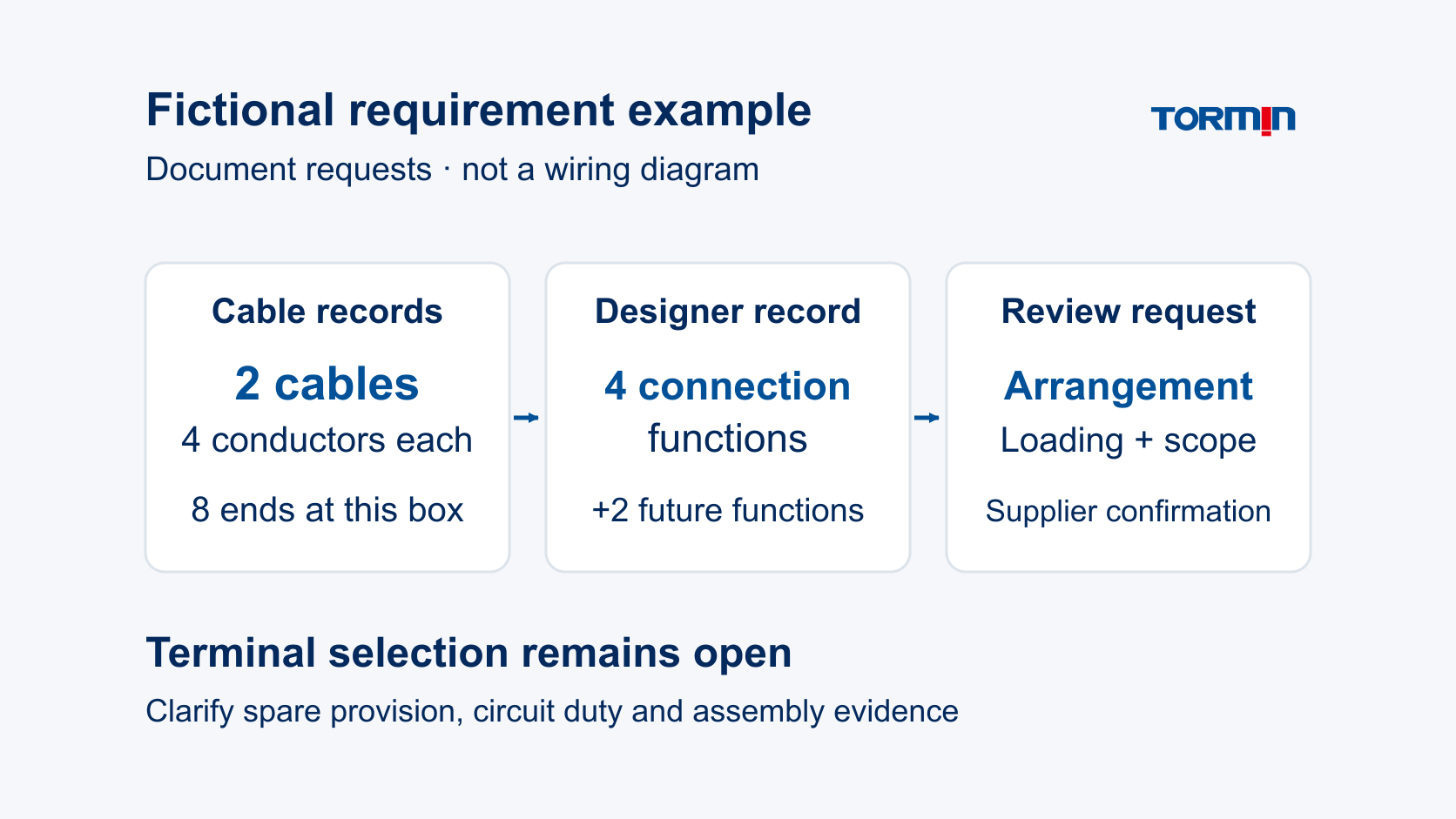
An invented cable schedule lists C-01 and C-02. Each presents four conductor ends of 2.5 mm² at the proposed box. For this example only:
2 cables × 4 conductor ends = 8 conductor ends at the box.
That is an input count. It is not a count of terminal blocks, clamping points or electrical connection functions.
A separate fictional designer requirement record calls for four distinct connection functions, to be defined by an approved circuit/connection drawing, plus two future connection functions. The article supplies no conductor-to-terminal assignment, grouping topology or bridging arrangement. These function quantities are independent request data; they were not calculated from the eight ends.
| Item in the fictional records | What is known | What the request must keep open |
|---|---|---|
| C-01 and C-02 | Four 2.5 mm² conductor ends from each; eight ends in total. | Their circuit roles, protective-conductor and screen requirements, and the applicable connection design. |
| Present connection functions | The designer’s record requests four distinct functions. | Their definitions and the approved drawing that identifies the required arrangement. |
| Future connection functions | Two are requested. | Whether this means fitted spare terminals, reserved rail/space or another documented provision. |
| Terminal selection | No physical terminal quantity or model is established. | Exact terminal references, connection limits, arrangement and supporting evidence. |
| Circuit loading and assembly scope | No values or approval are supplied. | The offered arrangement’s documented ratings, loading/thermal conditions and applicable equipment scope. |
The next action is to resolve the missing function information with the responsible designer and carry the resulting requirements into the manufacturer’s review. It is not to order eight blocks because there are eight ends, or six blocks because four present functions plus two future functions were requested.
The spare question deserves an explicit answer. Fitted spare terminals and space reserved for a later change are different deliverables. A request that merely says “two spare” can produce quotations for different arrangements. Record the intended provision without assuming that a later addition will be permitted by the original arrangement.
At this stage the disposition is: request prepared; terminal and box selection remain unapproved until the missing circuit, arrangement and evidence requirements are resolved. No BXJ5310 enclosure code is selected by this fictional example.
Read a capacity column without turning it into a loading approval
A real catalogue can help shortlist an enclosure, provided the column and its limits remain visible. It does not replace the configuration review.
In TORMIN’s official BXJ5310 datasheet, PDF page 2 / printed page 09, enclosure code I has the following entries under the maximum fitted-terminal heading:
| Separate nominal terminal-size column | Catalogue maximum fitted-terminal count for enclosure I |
|---|---|
| 2.5 mm² | 18 |
| 4 mm² | 16 |
These are first-party catalogue counts for two separate columns. The table also has a distinct intrinsically safe 2.5 mm² column; do not collapse it into the ordinary 2.5 mm² column.
The two counts do not establish a mixed-size arrangement, a conductor clamping range, the number of conductors permitted at a connection or an allowable current. They do not approve the fictional request above. Obtain the exact proposed arrangement and its limits rather than extending a single table cell to a different configuration.
Review loading separately from available space
A fitted-terminal count answers a different question from an electrical rating. Physical accommodation does not show that every proposed circuit can operate at its required loading under the offered arrangement’s conditions.
Specify the circuit duties that the designer has confirmed. Ask the manufacturer to identify the exact terminal models and connection limits, the ratings applicable to the offered configuration, and the documented circuit-loading and thermal conditions. Keep any relevant ambient or construction conditions attached to that response. Do not substitute a family maximum for the permissible loading of every terminal or circuit.
The request should also identify which protection arrangement and equipment documentation apply. This article has not assessed an exact BXJ5310 certificate or approved configuration. A catalogue selection table, product photograph or certificate for a different model cannot complete that assessment.
The nameplate and certificate guide covers document identity and scope review. Use it for that task while keeping the present request focused on terminal and circuit requirements.
Ask for a return that can be checked against the request
Ask the supplier to respond against the same cable and function references. A generic model quotation is difficult to compare if it does not explain which requested functions, spare provision and loading conditions its arrangement addresses.
| Supplier return | Review question |
|---|---|
| Exact offered model and configuration reference | Can the proposal be traced to the submitted requirement revision? |
| Terminal list and arrangement drawing | Are the terminal types, quantities, connection limits and functions identified without unexplained substitutions? |
| Spare-provision description | Does the proposal provide the agreed fitted or reserved provision? |
| Applicable ratings and loading conditions | Do the documents address the actual circuit requirements and the proposed arrangement? |
| Relevant equipment documents and limitations | Can the reviewer identify the scope applicable to the offered assembly? |
| Deviations and unresolved items | Is anything still awaiting designer or manufacturer confirmation before selection? |
Cable entries remain a related review, but they have their own information object. Link the terminal requirement record to the entry schedule rather than repeating gland, seal or thread selection here. The cable-gland and stopping-plug article explains that separate schedule.
IEC 60079-14:2024’s public scope includes electrical-system design, equipment selection, installation, documentation, competence and initial inspection. A completed purchasing request is an input to that wider project work; it is not installation acceptance. The licensed full standard was not consulted for this article.
Send the request with a clear selection status
A concise cover record can preserve the distinction between requirements and the supplier’s proposed solution:
Requirement and cable-schedule revisions:
Cable references, conductor facts and circuit-design reference:
Present connection functions and designer confirmation:
Future provision: fitted / reserved / other defined arrangement
Required terminal/connection data and circuit-loading conditions:
Offered model, terminal list and arrangement-drawing reference:
Applicable equipment documents, deviations and open decisions:
Disposition: request prepared / clarification needed / selection reviewed
Responsible reviewer and date:
The BXJ5310 product page supplies the current family information and the official exterior reference used in these illustrations. Its capacity tables remain first-party product information; no photograph establishes the internal arrangement or its approval.
Contact TORMIN with the cable facts, designer-defined connection functions, spare intent and document references. Request a configuration-specific return and keep unresolved loading or scope questions visible until the responsible reviewers resolve them.
Sources
- NSW TestSafe — Increased safety Ex e — technical context for secured connections, external-terminal arrangements and excessive-temperature control; no generic count/current formula.
- TORMIN — BXJ5310 product datasheet, five-page catalogue extract — first-party maximum fitted-terminal counts, PDF page 2 / printed page 09; the two cited cells do not establish loading or assembly approval.
- IEC — IEC 60079-14:2024, Electrical installation design, selection and installation of equipment, including initial inspection — public scope for the wider documentation and competent project review; licensed full text was not consulted.
- TORMIN — BXJ5310 Explosion Proof Junction Box — first-party product identity, current family information and exterior reference only; no exact certificate or offered configuration was assessed.