
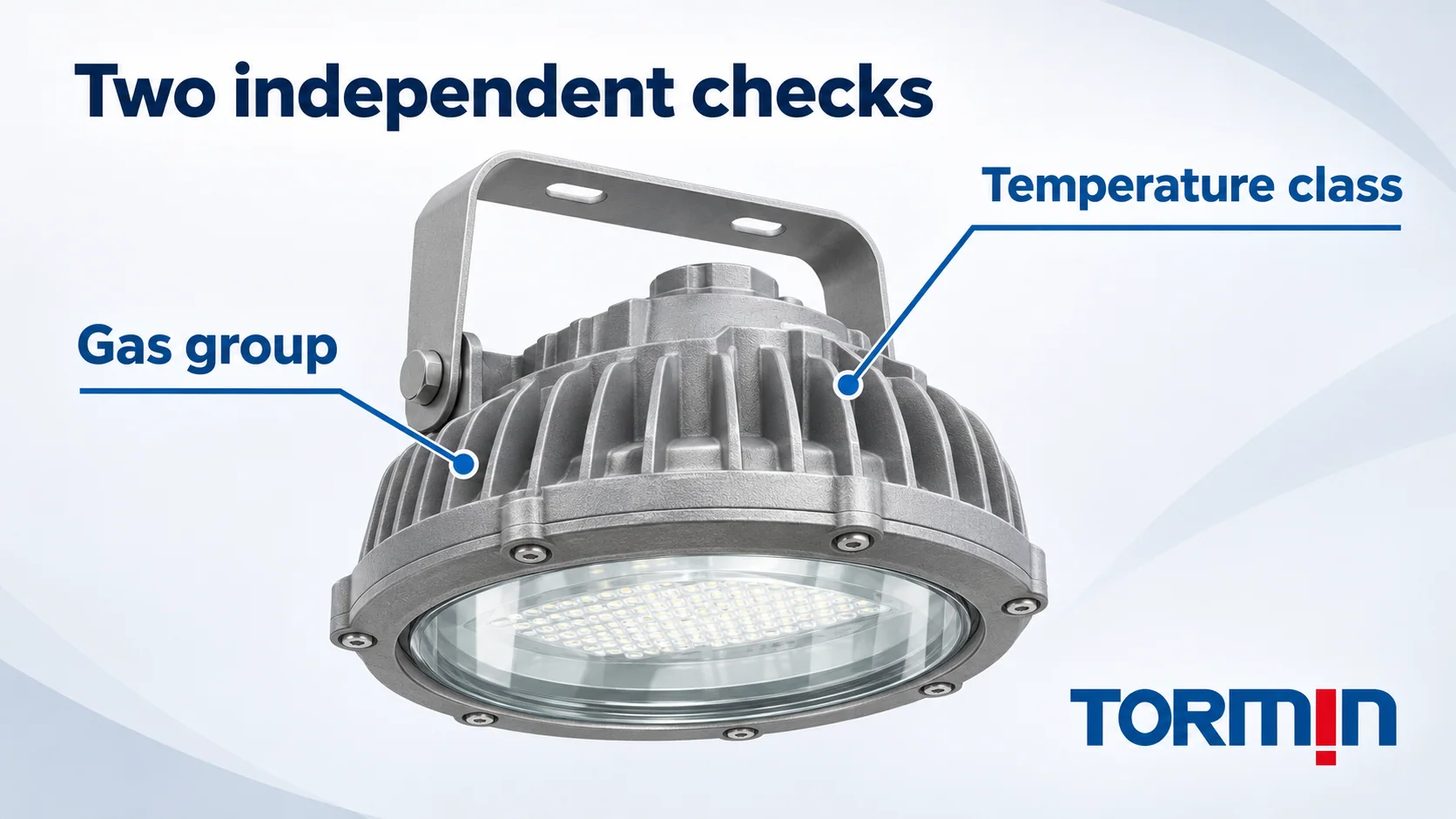
Choose the gas group and temperature class independently. The gas group addresses ignition and flame-transmission characteristics; the temperature class limits the equipment’s surface temperature relative to the substance’s auto-ignition temperature (AIT). A luminaire must satisfy both, at the specified ambient temperature and in its certified configuration.
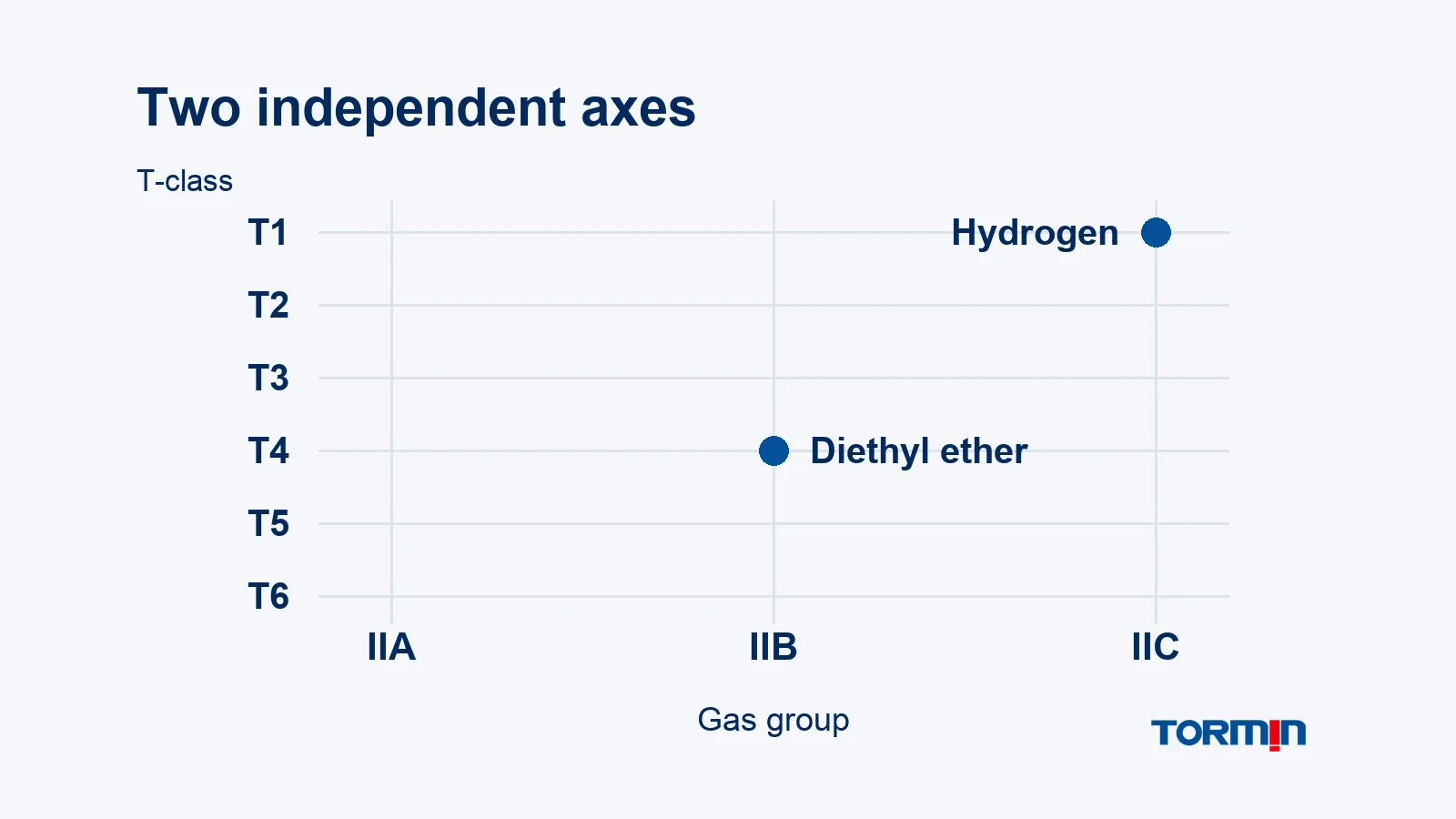
Hydrogen makes the distinction clear: it is IIC, the most demanding of the three industrial gas subgroups, yet its reference AIT of 560°C allows T1 on temperature grounds. Diethyl ether is IIB, but its much lower 175°C AIT requires T4 or cooler. These substance values are documented by NSW Government TestSafe.
This guide develops those two checks into a selection method for IEC-based gas and vapour applications. It complements the overall explosion-proof lighting selection guide; it does not assign a hazardous zone or replace the project’s installation and acceptance requirements.
Why gas group cannot tell you the temperature class
A small electrical spark and a hot surface are different ignition mechanisms. A mixture can be readily ignited by a spark without having a particularly low auto-ignition temperature. Conversely, a vapour that requires a less demanding gas subgroup can still demand a cool equipment surface.
For selection, think of two coordinates:
- Gas-group coordinate: IIA, IIB or IIC, derived from the substance’s flame-transmission and electrical-ignition behaviour.
- Temperature coordinate: T1 through T6, selected from AIT and the permitted equipment surface-temperature limit.
There is no dependable ranking relationship between these coordinates: IIC does not mean T6, and IIA does not mean T1. Neither label lets you infer the other. Hydrogen and ether demonstrate why both checks are necessary.
IEC gas groups: IIA, IIB and IIC
Group II covers non-mining explosive gas atmospheres and is subdivided into IIA, IIB and IIC. Group I concerns equipment for mines susceptible to firedamp and is outside this guide.
What MESG and MIC actually measure
MESG—maximum experimental safe gap—is a flame-transmission test property, expressed in millimetres. It describes the test gap that prevents an internal ignition from igniting the external mixture. A smaller MESG indicates that flame transmission must be controlled through a tighter gap under the defined test conditions.
MIC ratio compares minimum igniting current with that for laboratory methane. It is dimensionless and concerns spark ignition under a prescribed electrical test. It is not an ignition-energy value in joules; describing gas grouping only as “minimum ignition energy” loses that distinction.
These are substance-classification measurements, not permission to measure or modify a luminaire’s flamepath. Use the equipment’s certified gas marking and the accepted substance classification. The definitions and classification method appear in IEC 60079-20-1:2010, clauses 3 and 4.
| IEC gas subgroup | Representative gas | MESG, mm | MIC ratio, methane = 1 |
|---|---|---|---|
| IIA | Propane | 0.92 | 0.82 |
| IIB | Ethylene | 0.65 | 0.53 |
| IIC | Hydrogen | 0.29 | 0.25 |
| IIC | Acetylene | 0.37 | 0.28 |
Reference measurements: NSW TestSafe’s gas and vapour classification table, which directs readers to AS/NZS or IEC 60079-20-1.
Keep the boundary values precise
The often-quoted bands are approximately 0.9/0.5 mm for MESG and 0.8/0.45 for MIC ratio. Their endpoints matter:
| Subgroup | MESG classification boundary | MIC-ratio classification boundary |
|---|---|---|
| IIA | MESG ≥ 0.9 mm | MIC ratio > 0.8 |
| IIB | 0.5 mm < MESG < 0.9 mm | 0.45 ≤ MIC ratio ≤ 0.8 |
| IIC | MESG ≤ 0.5 mm | MIC ratio < 0.45 |
These are the boundaries in IEC 60079-20-1:2010, clauses 4.2–4.3. Its combined method in clause 4.4 requires additional checks in boundary bands. Do not independently reclassify a substance from one rounded measurement or choose whichever column gives the easier group; use the applicable standard’s assigned group and the approved project data.
Which equipment groups cover which gases?
For this gas-group check, IIC equipment covers IIC, IIB and IIA; IIB covers IIB and IIA; IIA covers IIA only. The reverse substitution does not work. This coverage rule is stated in IEC 60079-0:2007, clause 4.2, Note 2; check the edition and any restrictions applicable to the equipment certificate.
That hierarchy does not waive any other requirement. An IIC T3 luminaire can still fail an IIB T4 application because its surface-temperature classification is too hot. Equally, an IIA T6 luminaire does not become suitable for hydrogen merely because its surface is cooler.
T1–T6: higher number, cooler surface
Higher T number = cooler surface. A T-class is an equipment maximum surface-temperature limit under its specified conditions. It is neither the ambient-temperature rating nor the LED colour temperature.
| IEC temperature class | Maximum surface temperature, °C | Maximum surface temperature, °F |
|---|---|---|
| T1 | 450 | 842 |
| T2 | 300 | 572 |
| T3 | 200 | 392 |
| T4 | 135 | 275 |
| T5 | 100 | 212 |
| T6 | 85 | 185 |
Celsius limits are shown in the SGS technical wallchart. Fahrenheit values above are calculated as °F = (°C × 9/5) + 32.
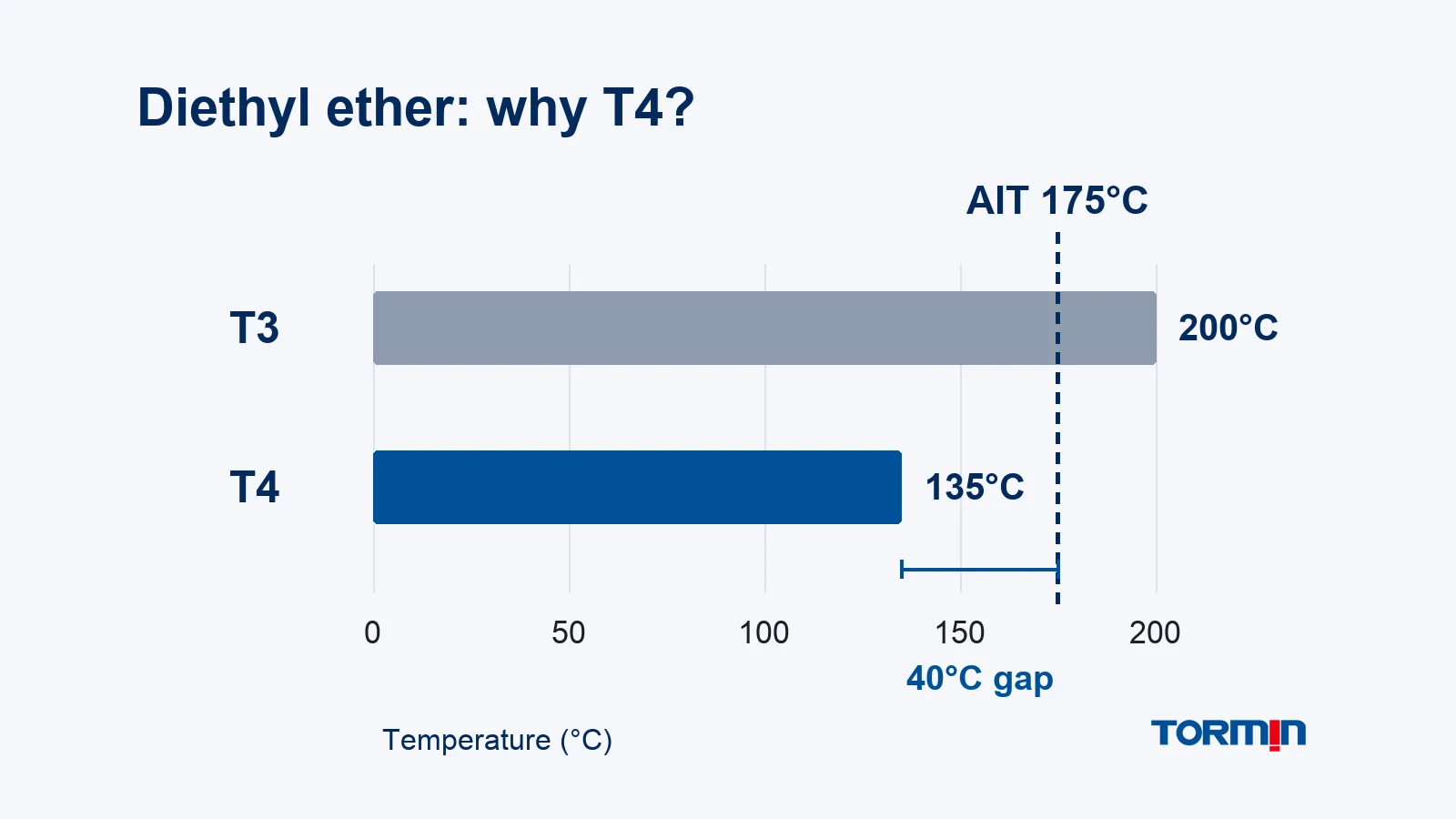
Select a T-class whose upper limit is below the site’s accepted substance AIT, with the margin required by the project assessment. Equality is not a lower temperature. IEC 60079-20-1:2010, Table 1, places an AIT of 450°C in the T2 band, not T1. Do not invent a universal extra margin in degrees or apply a dust-temperature formula to a gas selection.
For ether at 175°C, T3 permits 200°C and fails; T4 permits 135°C and provides a nominal separation of 175 − 135 = 40°C. T5 and T6 are cooler alternatives, subject to the rest of the equipment review. That arithmetic is a selection comparison, not a measurement of an operating luminaire.
Substance reference: match the group and AIT separately
The following values use the IEC 60079-20-1 data framework, not a mixture of IEC gas groups and North American substance tables. IEC lists the 2010 standard as replaced by ISO/IEC 80079-20-1:2017; use the edition accepted by your project. IEC’s publication record establishes that replacement.
AIT depends on the test method and conditions. The approved project substance data sheet governs the actual selection. The table is a reference for reasoning, not a replacement for checking substance identity, composition or operating conditions. The last column is derived from the listed AIT using a strictly lower equipment-class ceiling; it does not include any additional project margin.
| Substance | IEC gas group | Reference AIT, °C | Least restrictive T-class from this AIT |
|---|---|---|---|
| Methane, industrial gas basis | IIA | About 600 | T1 |
| Propane | IIA | 450 | T2—not T1 at this AIT |
| n-Hexane | IIA | 225 | T3 |
| Ethylene | IIB | 440 | T2—not T1 at this AIT |
| Ethanol, anhydrous basis | IIB | 400 | T2 |
| Hydrogen sulfide | IIB | 260 | T3 |
| Diethyl ether | IIB | 175 | T4 |
| Hydrogen | IIC | 560 | T1 |
| Acetylene | IIC | 305 | T2 |
| Carbon disulfide | IIC | 90 | T6 |
Data basis: IEC 60079-20-1:2010, Annex B, with methane, propane, ethylene, ethanol, ether, hydrogen and acetylene values also reproduced by NSW TestSafe. The industrial methane row is not a general classification for every natural-gas mixture. Ethanol’s group must be tied to its specified condition; do not silently substitute a different water-content basis.
Two easy mistakes deserve emphasis. First, 450°C propane cannot be paired with a 450°C T1 ceiling while claiming a lower-than-AIT rule. Second, “T1/T2” is not an interchangeable answer for ethylene at 440°C: T1 exceeds that AIT, while T2 is below it. If another data sheet gives a different AIT, resolve its provenance and project acceptance rather than merging the two answers.
Carbon disulfide is the only substance among these ten common reference examples that requires T6: T5 permits 100°C, above its 90°C AIT. This is not a claim that no other gas or vapour can require T6. The 85°C T6 ceiling leaves only 5°C nominal separation here; acetylene at 305°C similarly sits just 5°C above T2’s 300°C ceiling. Those narrow separations require particular care with data uncertainty and any additional project margin.
Gas-group and T-class checks do not establish dust suitability; assess combustible dust separately using the dust-environment lighting guide.
A six-step matching process
Use the same sequence for each mounting location or group of locations with identical requirements. Record the source and revision of each input so a later solvent or luminaire change can be assessed against the same basis.
1. Start with the area-classification drawing
Locate the proposed light on the approved drawing and classification schedule; see the Zone 0, Zone 1 and Zone 2 lighting guide. Record the gas/vapour hazard, zone, required equipment protection level and local approval route. Do not infer a whole store’s classification from the word “solvent.” The project classification must already exist before final equipment selection.
2. Identify the worst-case substances
List substances that can be present under the assessed operating and release conditions. Include relevant cleaning agents and foreseeable process changes. Identify the controlling gas group and lowest accepted AIT separately: they may come from different substances.
For example, if hydrogen and ether are independently relevant hazards at one location, hydrogen can control the group while ether controls temperature, leading to an IIC + T4 screening requirement. This is not a calculation of the properties of a hydrogen–ether mixture. Mixture classification needs its own accepted assessment.
3. Look up the gas group
Use the substance identity and approved data to establish IIA, IIB or IIC. Write the minimum required group into the schedule and screen the proposed marking using the coverage hierarchy. A cooler T-class cannot repair a gas-group failure.
4. Use AIT to select the T-class
Compare the lowest accepted AIT with the T-class ceilings and apply the project’s margin requirement. Write both the input AIT and the resulting class. A more demanding gas-group marking cannot repair a temperature-class failure.
5. Check Ta and the exact model marking
Compare the site’s minimum and maximum ambient temperatures with the applicable Ta/Tamb range. Match the full ordering code, power version, operating mode and any emergency option to the actual marking and documentation. Do not combine a favourable T-class from one variant with a wider ambient range from another.
T4’s 135°C ceiling is not permission to operate the lamp in 135°C ambient air. Temperature definitions and operating-condition scope are addressed in IEC 60079-0, as previewed by GSO. If the applicable ambient range is unclear, resolve it from the certified documents before accepting the candidate.
6. Verify the certificate scope
Check that the exact offered configuration, complete marking and applicable conditions are covered by the full certificate and instructions. Resolve any special conditions of use and the project’s national acceptance requirements; see ATEX versus IECEx lighting certification. For a North American classification, consult the Class I Division 1 versus Division 2 lighting guide. For IECEx, verify the controlled online record rather than relying on an old downloaded first page; the IECEx equipment-scheme FAQ explains the controlled record and national-acceptance limits.
The output is a justified specification and a traceable candidate review. It is not an installation approval based solely on two matching tokens.
Worked example: a diethyl ether solvent store
Assume an engineer is reviewing lighting for a store whose approved drawing already identifies the mounting location as Zone 1, with the project requiring an appropriate gas EPL and an accepted IEC-based certification route. Assume diethyl ether is the controlling vapour, its approved data sheet gives IIB and AIT 175°C, and the design ambient range at the light is −10°C to +45°C. These are teaching inputs, not measurements from a TORMIN project.
- Drawing: record the location, Zone 1 requirement and drawing revision. The example does not establish that every ether store is Zone 1.
- Substance: confirm that no other assessed substance or mixture creates a more demanding requirement.
- Group: ether requires IIB; an IIB or IIC candidate can pass this axis. IIA cannot.
- Temperature: T3 allows 200°C, which exceeds 175°C. T4 allows 135°C, so the screening requirement is T4 or cooler, with 40°C nominal separation at T4.
- Ambient/model: the exact candidate’s documented range must include −10°C to +45°C while retaining the required marking. A version rated only to +40°C fails the ambient check even if marked IIB T4.
- Certificate: match the offered ordering code, protection/EPL, applicable Ta/T-class combination and conditions to the complete accepted documents. Close any exceptions before release.
The resulting two-axis requirement is IIB + T4. Compare these hypothetical marking pairs:
| Candidate pair | Group result | Temperature result | Two-axis decision |
|---|---|---|---|
| IIB T4 | Meets IIB | 135°C < 175°C | Passes these two checks |
| IIC T4 | Covers IIB | 135°C < 175°C | Passes these two checks |
| IIC T3 | Covers IIB | 200°C > 175°C | Reject: temperature |
| IIA T4 | Does not cover IIB | 135°C < 175°C | Reject: gas group |
The first two remain subject to steps 5 and 6. Neither table entry represents an available or approved TORMIN model. This is why “buy IIC to be safe” is an incomplete specification: IIC solves only one axis.
Read the two relevant parts of Ex db eb IIC T4 Gb
Consider the illustrative marking Ex db eb IIC T4 Gb. It is a teaching string, not a statement of any particular model’s certification.
IIC—the gas-group part. This satisfies the gas-group requirement for IIC and, within the applicable certified scope, covers IIB and IIA. It says nothing by itself about whether the surface is cool enough for ether or carbon disulfide.
T4—the temperature-class part. This limits the applicable maximum surface temperature to 135°C under the certified conditions. It passes the temperature comparison for ether at 175°C but fails carbon disulfide at 90°C, even though both the marking and carbon disulfide use IIC.
The remaining Ex, db, eb and Gb identify explosion-protection marking, protection techniques and the gas equipment protection level (see Ex d versus Ex e lighting); use the nameplate and certificate guide for that separate decoding and document-review task.
Turn the result into a lighting enquiry
State the required gas group and T-class as separate fields, alongside the area-classification reference, controlling substances and AIT basis, ambient range and exact approval requirements. Ask the supplier to identify the offered ordering code and the documents that support that specific combination.
When reviewing the TORMIN hazardous-area lighting range, send that basis with your document enquiry. The useful question is: “Which exact configuration meets this group, this temperature class and this ambient range under the required certificate scope?”
TORMIN’s Zone 1 linear light, BC9306P and BC9306S floodlight product pages list IIC, T6/T5/T4 and Gb, with the applicable temperature class dependent on the model/configuration and subject to the specific model’s nameplate (以具体型号铭牌为准); these listings do not make T6 standard across the series. The BC9306S spotlight page also lists IIC T6/T5/T4 Gb, while the BC9306AP/BP and BC9306AS/BS emergency pages list IIC T6/T5 Gb; verify the offered variant’s complete marking and certified conditions.
FAQ
What is the difference between gas group and temperature class?
Gas group describes a gas or vapour’s flame-transmission and electrical-ignition characteristics, classified as IIA, IIB or IIC using MESG/MIC criteria. Temperature class limits an equipment surface to a defined maximum, from T1 at 450°C to T6 at 85°C, which must be below the accepted substance AIT with the project’s required margin. The two checks are independent: a suitable gas group does not establish a suitable temperature class. See IEC 60079-20-1:2010 for the substance-classification framework.
Can I use an IIB light in an IIC area?
No. A light marked only IIB does not meet an IIC gas-group requirement, even if it has a cooler T-class such as T6. IIC equipment can cover IIB and IIA gas-group requirements; that coverage does not work in reverse. Select equipment with the required group and separately verify temperature class, ambient range, protection level and certificate scope. The coverage hierarchy is stated in IEC 60079-0:2007, clause 4.2, Note 2; apply the edition and restrictions relevant to the equipment certificate.
Is T6 always better than T4?
T6 has a lower maximum surface-temperature ceiling, 85°C, than T4 at 135°C, but it is not automatically the better complete lighting choice. For diethyl ether with an accepted AIT of 175°C, T4 satisfies the basic temperature comparison; a T6 rating adds thermal separation but does not compensate for an unsuitable gas group, ambient range or certificate scope. Choose the class required by the project classification and margin assessment. The SGS technical wallchart lists these surface-temperature limits.
Does hydrogen need T6 lighting?
No, hydrogen does not inherently require T6 lighting. Hydrogen’s IIC classification is a gas-group requirement; with the reference AIT of 560°C, T1’s 450°C surface-temperature ceiling is sufficient on temperature grounds. A higher T number gives a cooler ceiling and additional thermal margin, rather than being compulsory solely because hydrogen is IIC. Follow the approved project classification, including any other substances and stricter temperature requirements, and verify the exact luminaire’s certified conditions. NSW TestSafe lists hydrogen as IIC with an AIT of 560°C.
Where do I find my site’s gas group and temperature class?
Start with the approved hazardous-area classification drawing and its accompanying schedule, then check the approved substance data sheets and project equipment specification. The gas group and accepted AIT must correspond to the substances and conditions assessed for the actual mounting location; use AIT to confirm the required temperature class and project margin. If those inputs are missing or inconsistent, obtain clarification from the responsible hazardous-area engineer before final selection. The Zone 0, Zone 1 and Zone 2 lighting guide explains the classification inputs, and the nameplate and certificate guide covers comparison with the offered equipment.
Sources
- NSW Government, TestSafe — Electrical and non-electrical testing resources — IEC-referenced gas groups, MESG/MIC values and substance AIT data.
- IEC — IEC 60079-20-1:2010, Explosive atmospheres: Material characteristics for gas and vapour classification—Test methods and data — definitions, clauses 4.2–4.4, Table 1 and Annex B; the official record also identifies its replacement by ISO/IEC 80079-20-1:2017.
- IEC — IEC 60079-0:2007, Equipment—General requirements — clause 4.2, Note 2, gas-group coverage; a historical reference for the hierarchy, not a claim that this is the current edition.
- SGS — ATEX and DSEAR reference wallchart, DS03 Issue 6, November 2014 — technical T-class limits and marking fields only; its historical legislative references are not used as current legal guidance.
- GSO — GSO IEC 60079-0:2024, Equipment—General requirements, public preview — temperature terminology and ambient/atmospheric scope; not a full-text installation rule source.
- IECEx — Frequently Asked Questions, Certified Equipment Scheme — controlled certificate records and national acceptance boundaries.
TORMIN product documents
The following first-party product pages support the printed-marking statements in the enquiry section; they do not replace an exact-model nameplate, certificate or instructions. Verified 2026-11-04.
- TORMIN — Zone 1 linear light — printed gas marking Ex eb mb op is IIC T6/T5/T4 Gb.
- TORMIN — BC9306P series — printed gas marking Ex db eb IIC T6/T5/T4 Gb.
- TORMIN — BC9306S floodlight — printed gas marking Ex db eb IIC T6/T5/T4 Gb and configuration caveat.
- TORMIN — BC9306S spotlight — printed gas marking Ex db eb IIC T6/T5/T4 Gb.
- TORMIN — BC9306AP/BP emergency series — printed gas marking Ex db eb IIC T6/T5 Gb.
- TORMIN — BC9306AS/BS emergency series — printed gas marking Ex db eb IIC T6/T5 Gb.