
A light can pass the gas-group check and still fail on temperature. Diethyl ether has an auto-ignition temperature of 175°C in the IEC dataset used here; carbon disulfide, or CS2, has an AIT of just 90°C. Those values defeat the assumption that a familiar IIB marking, or an apparently conservative T4 choice, settles the specification. Low ignition temperature explosion proof lighting selection starts with the substance and its temperature requirement, then returns to the exact fitting’s documents.
The gas-group and temperature-class guide explains the two independent selection axes. This article tackles the temperature traps after your area classification is established. It covers gases and vapours only: combustible dust uses cloud/layer ignition data and a surface-temperature marking in °C, rather than this T-class selection method. The examples establish screening requirements, not approval of a particular installation.
Ten substances that expose the temperature trap
| Substance | Gas group | AIT (°C) | Temperature class required |
|---|---|---|---|
| Carbon disulfide | IIC | 90°C | T6 |
| Diethyl ether | IIB | 175°C | T4 |
| n-Hexane | IIA | 225°C | T3 |
| Hydrogen sulfide | IIB | 260°C | T3 |
| Ethanol | IIB | 400°C | T2 |
| 2-Butanone (MEK) | IIB | 404°C | T2 |
| Methanol | IIA | 440°C | T2 |
| Acetone | IIA | 539°C | T1 |
| Toluene | IIA | 530°C | T1 |
| Hydrogen (comparison) | IIC | 560°C | T1 |
Values from IEC 60079-20-1:2010, Annex B, using the public identical BIS adoption; see the full 32-substance table for the wider reference. The last column gives the minimum class, not the only acceptable class in every row. CS2 is the only substance among these ten that forces T6.
AIT is a standard-test reference, not a universal operating threshold independent of apparatus and conditions. Use this table for screening alongside the accepted substance data and project assessment. The source’s n-hexane entry identifies CAS 110-54-3 but also says “mixed isomers”; check the actual grade rather than extending the row to every commercial hexane product. The 2010 edition is the declared dataset, not a claim that it is the current project standard: IEC identifies its replacement as ISO/IEC 80079-20-1:2017.
Trap 1 – Ether: IIB looks familiar, but T4 changes the decision
Ether can reach the lighting schedule through a solvent store, a laboratory extraction procedure or pharmaceutical processing. University of Edinburgh guidance describes diethyl ether as a common laboratory solvent; NIOSH’s occupational review documents solvent and extraction uses, including pharmaceutical manufacture. In a paint booth, apply this example only if the actual coating, cleaning solvent or process inventory contains diethyl ether. “Solvent-based” does not identify a chemical.
Suppose the quotation offers an IIB T3 fitting for an ether location. The group entry meets the IIB requirement, but T3 permits a maximum surface temperature of 200°C. That bound exceeds ether’s 175°C AIT. The fitting fails the temperature selection check even though the letters appear correct.
T4 limits the relevant maximum surface temperature to 135°C. For this example, the difference is 175 – 135 = 40°C. That arithmetic explains why the class passes the temperature check. It is not an extra ambient allowance, permission to expose the fitting to a heat source, or a measured operating margin for a particular model.
A common procurement error is to challenge only the IIB marking when reviewing a quotation. Ask instead whether the full ordered configuration carries the required T4-or-more-restrictive temperature marking under the site’s conditions. The thermal question remains even if the supplier offers an IIC enclosure.
Keep AIT separate from flash point when reading the SDS. Flash point concerns the conditions under which a liquid gives off an ignitable vapour mixture; AIT concerns ignition without an external flame or spark in the specified test. A flash-point entry cannot replace the AIT input used to select a T-class. Likewise, neither value is the room-temperature limit printed as Ta on the light. Record the field names along with their values so an enquiry cannot silently substitute one temperature for another.
The class describes the certified maximum under specified conditions, not the temperature every fitting reaches continuously. A T3 unit might run cooler in a particular observation, but an informal measurement does not establish a T4 certification. Select from the documented bound; do not approve a rejected class because a sample felt cool during a demonstration.
Trap 2 – Carbon disulfide: the T6 case in this shortlist
CS2 combines IIC with an AIT of 90°C in the IEC source row. Its temperature requirement is more demanding than ether’s. This is why a purchase specification that defaults all hazardous-area lights to “IIC T4” can still fail a chemical-specific review.
Ninety degrees Celsius is below water’s normal boiling point at atmospheric pressure. A steam pipe or hot equipment housing can therefore present an ignition hazard without looking red-hot or producing a spark. This is a comparison of temperature scales, not an assertion that every steam pipe has the same surface temperature. The ILO/WHO carbon disulfide safety card specifically warns against hot-surface contact and describes ignition on contact with hot surfaces and air.
A T4 fitting permits a 135°C maximum, above the 90°C reference. It is a potential ignition source in that atmosphere and must be rejected on the temperature axis. Calling its enclosure explosion-proof does not remove the external hot-surface issue. Actual ignition also depends on the vapour/air conditions and exposure; the class mismatch is sufficient to reject the selection without staging an ignition test.
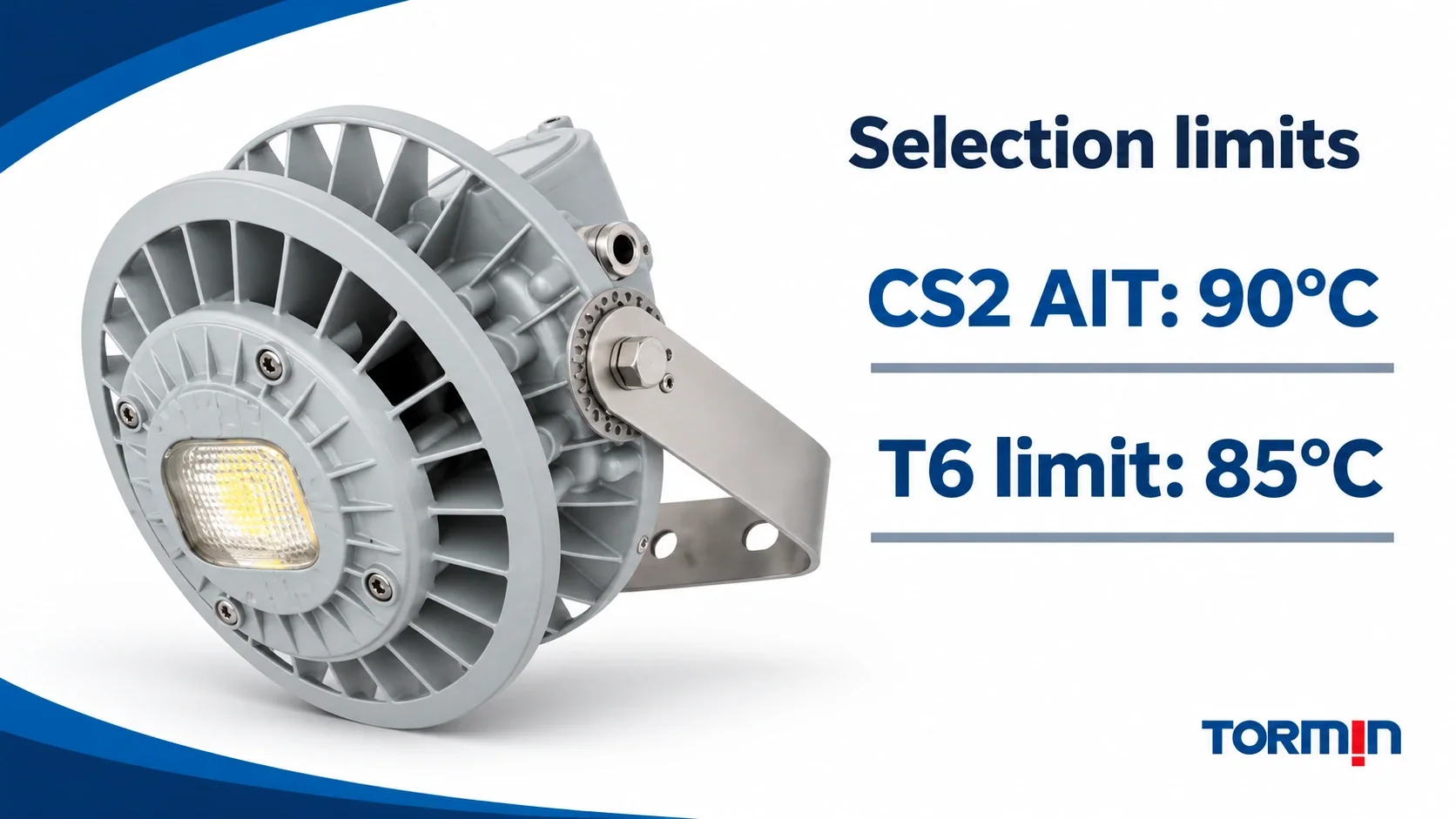
There is no T5 alternative for CS2 in this selection. T5 permits 100°C, also above 90°C. Only T6’s 85°C limit clears the comparison. The nominal difference is just 5°C, which makes exact configuration and operating conditions consequential. Do not treat that difference as a usable allowance for exceeding the certified ambient range.
Trap 3 – Several solvents: the lowest accepted AIT controls the temperature check
Consider a hypothetical solvent drum store containing diethyl ether, n-hexane and CS2. Assume the approved area assessment makes each substance a relevant independent release hazard for the same lighting location. These are teaching inputs, not a description of a TORMIN customer site or permission to store the chemicals together.
For temperature screening, compare their accepted AIT values: 175°C, 225°C and 90°C. CS2 controls because 90°C is lowest. The resulting temperature requirement is T6. Check the gas-group axis independently: the same inventory includes IIC CS2, so the combined screening requirement is IIC T6. An IIC T4 offer passes one axis and fails the other; an IIB T6 offer fails the group axis.
Now suppose CS2 is removed from the process and storage inventory through a documented change. Assume the assessment confirms it is no longer a relevant release hazard, including residues, returns and foreseeable operations. Ether then controls the temperature check at 175°C, giving T4. Ether’s IIB requirement is also the most demanding group remaining, so the revised screening requirement is IIB T4.
Removing one drum for a shift does not establish that change. The requirement follows the assessed hazard at the location, not the visible stock at the moment someone places an order. Keep the substance list, assessed release scenarios and lighting specification aligned when the inventory changes.
This example concerns several substances that can independently create a hazard. It does not calculate the AIT or group of a physical solvent blend or mixed-vapour atmosphere. Obtain accepted mixture data or an appropriate assessment where that is the actual hazard; do not average ingredient temperatures or assume the lowest pure-component value proves the mixture’s properties. The P0 selection method explains how to keep the two controls separate.
The direction rule: a higher T-number means a lower temperature limit
The IEC class limits are T1: 450°C; T2: 300°C; T3: 200°C; T4: 135°C; T5: 100°C; T6: 85°C. The accepted AIT must be strictly greater than the selected class limit. Equality does not pass. These ranges and class assignments are set out in IEC 60079-20-1:2010, Table 1.
Read the numbering in that direction: a higher T-number imposes a lower permitted maximum surface temperature and gives greater protection against thermal ignition, with all other requirements held equal. A T6 fitting satisfies the temperature-class requirements T1 through T5. A T3 fitting does not satisfy a T4 requirement. For CS2, “T5 or T6” is incorrect: its 90°C AIT excludes the 100°C T5 limit.
Specifying a more restrictive temperature class can simplify a mixed inventory, but it is not universal proof of safety. Cost and size can change, and the available output, configuration or ambient envelope may also differ. Compare the actual documented alternatives rather than assuming a fixed premium or that thermal over-specification has no other consequences.
Gas-group coverage is a separate rule: IIC covers the IIB and IIA group requirements within the applicable IEC framework. The IIB versus IIC guide explains that boundary. Neither coverage rule substitutes for the required EPL, certification scheme, installation conditions or chemical compatibility.
Five steps from the solvent list to the fitting
1. List every relevant substance at the lighting location
Start with the approved classification and actual SDS identities. Include operating, cleaning and foreseeable changeover substances. Check a trade name against the chemical identity before using the anchor table. Record which substances can affect this particular location; a whole-plant inventory alone does not describe every light position.
2. Identify the lowest accepted AIT
Use comparable data under the project’s accepted basis. For independently relevant substances, record the lowest accepted AIT as the temperature-screening input, as in the drum-store example. If the hazard is a blend, resolve its data before completing this step. An omitted or unverified substance is a missing input, not a reason to guess.
3. Derive the required temperature class
Apply the strict comparison to the class limit and record the resulting requirement on the schedule. Enter the substance’s group and AIT into the Gas Group × T-Class checker to cross-check the result. The checker tests entered data; it cannot verify that the SDS, substance identity or assessment basis was correct.
4. Check gas-group coverage independently
Return to every relevant substance’s group and take the most demanding requirement, using the coverage rule above. Write the group and temperature class together, such as IIC T6, without allowing one to compensate for the other. Keep the required EPL from the existing area classification as a separate field.
5. Reconcile the exact nameplate, Ta and certificate
Match the quoted ordering code with the actual nameplate and complete certificate schedule. Check the required class at the highest local ambient temperature, including assessed nearby heat sources and solar exposure. The Ta guide explains why a class cannot be separated from its certified ambient range. Exceeding Ta is outside that certified scope, not permission to operate under an assumed lower class.
Use the Ta check available through the lighting calculators to organize an ambient-limit comparison, and the standards and certification archive to identify the documents to request. Read special conditions, mounting restrictions and the applicable operating modes. A family brochure showing several classes does not tell you which one belongs to the delivered unit.
A useful acceptance record keeps three items together: the required group and class, the manufacturer’s exact configuration reference, and the document that connects that configuration to its rated conditions. Record the certificate issue as well as its number. For an emergency fitting, confirm the applicable normal and emergency operating modes instead of carrying over the standard version’s marking. This turns a screening conclusion into a traceable purchase requirement without inventing a variant-to-temperature mapping from a family list.
TORMIN product routes: verify the temperature option, not just the series
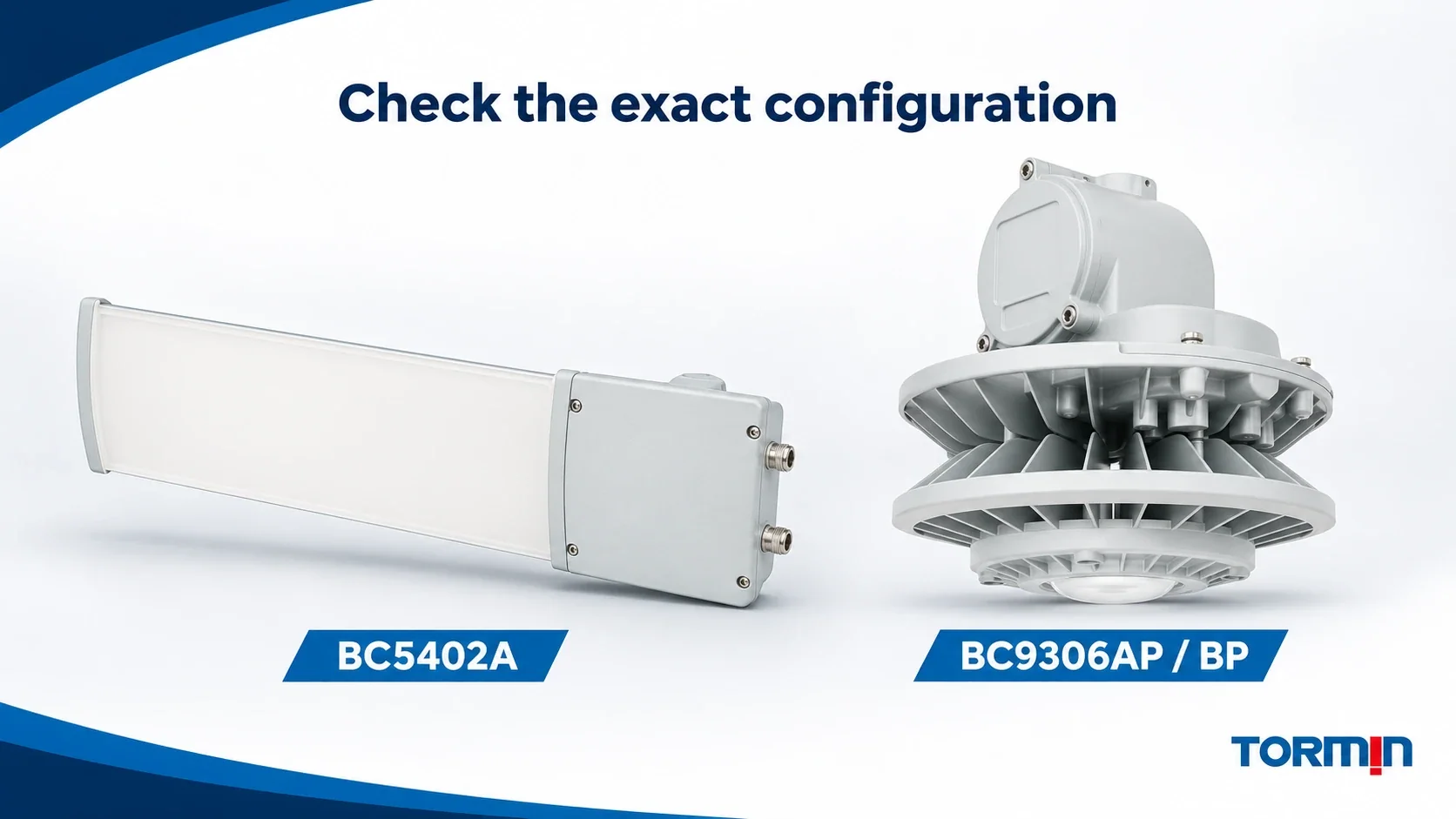
The BC5402A linear-light page publishes Ex eb mb op is IIC T6/T5/T4 Gb. The BC9306P page and BC9306S area/floodlight page publish Ex db eb IIC T6/T5/T4 Gb. These are configuration-dependent choices, subject to the specific model’s nameplate. They do not establish that every power, optic or ambient option is T6. In the enquiry, state the required class and ask for a particular ordering code that meets it. A reply repeating the three-class family string has not resolved that request; the supplier still needs to identify the offered variant and its supporting scope.
For emergency lighting, the BC9306AP/BP page and BC9306AS/BS page publish Ex db eb IIC T6/T5 Gb. Their published gas markings do not list T4. A verified T5 or T6 emergency configuration can nevertheless meet ether’s T4 temperature requirement, subject to the specific model’s nameplate and the other project checks. For CS2, select and verify the T6 configuration; a T5 emergency version is insufficient.
These pages identify the website’s family certificate copies as archived, with current status requiring verification. Request the controlled documents for the quoted version and applicable modes before acceptance. The product routes help screen options for the ten substances discussed here; they do not claim approval for another substance, mixture or project.
Return to the full IEC substance table when the inventory expands. If a North American drawing accompanies an IEC offer, use the NEC versus IEC gas-group guide before comparing the letters; this article’s IEC data and markings do not replace the project’s required certification framework.
FAQ
What temperature class do I need for carbon disulfide?
T6. With the 90°C IEC AIT used here, only T6’s 85°C limit passes among the six classes. T5 permits 100°C and is insufficient. Confirm the exact fitting’s T6 marking, ambient range and certificate conditions.
Is a T4 light safe for diethyl ether?
It meets the temperature-class check: T4’s 135°C limit is below ether’s 175°C AIT; T3’s 200°C limit is insufficient. Overall suitability also requires the correct group, EPL, certified ambient range and installation conditions.
Does a higher gas group mean a higher temperature class?
No. Hydrogen is IIC/T1 in this dataset, while ether is IIB/T4. Group and temperature answer separate questions. See the direction and coverage explanation and the linked selection and subgroup guides.
If my area has several solvents, which one sets the temperature class?
For the independently relevant hazards in the drum-store example, CS2 controls at 90°C. After its assessed removal, ether controls at 175°C. For a physical blend, obtain accepted mixture data rather than treating this inventory example as a mixture test.
Can I use a T6 fitting where only T4 is required?
Yes, on the temperature axis, provided the other requirements match. Its lower permitted surface limit gives more thermal-ignition protection. Compare cost, size and the actual output and ambient options; do not assume the alternative configuration is otherwise identical.
Sources
- Bureau of Indian Standards / IEC — IS/IEC 60079-20-1:2010, identical adoption — Table 1 and Annex B; declared source for all ten AIT/group/class rows. PDF pages 27, 28, 33, 37, 50, 55, 71 and 74.
- IEC — IEC 60079-20-1:2010 publication record — scope, edition and replacement status.
- University of Edinburgh, Health & Safety — Ethers — laboratory use and hot-surface ignition hazards.
- NIOSH — NEG and NIOSH Basis for an Occupational Health Standard: Ethyl Ether, 1993 — solvent, extraction and pharmaceutical-use context; not the numerical AIT source.
- ILO/WHO — International Chemical Safety Card 0022, Carbon Disulfide — hot-surface and air ignition hazard; not an equipment approval.
TORMIN first-party product documents
Checked November 8, 2026. These establish published gas markings and configuration boundaries, not independently verified current certificate status.
- BC5402A linear-light product record — IIC T6/T5/T4 options and exterior reference.
- BC9306P product record — IIC T6/T5/T4 options.
- BC9306S area/floodlight product record — IIC T6/T5/T4 options and exterior reference.
- BC9306AP/BP emergency product record — IIC T6/T5 options and exterior reference.
- BC9306AS/BS emergency product record — IIC T6/T5 options.