

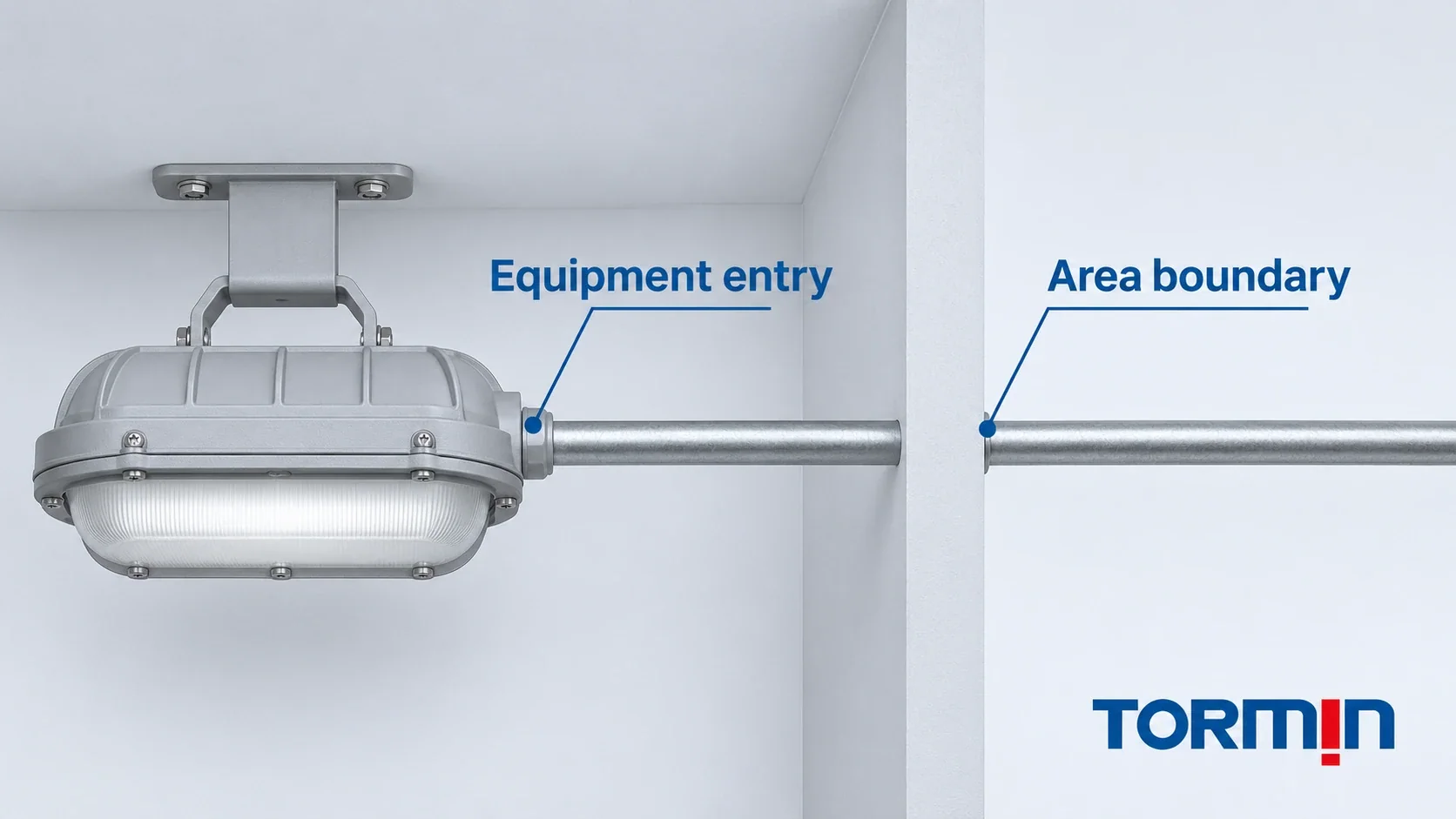
A Class I, Division 2 luminaire that does not require an explosionproof enclosure generally needs no explosionproof conduit seal at its own entry, unless its approved arrangement or instructions require one. A Division 1 luminaire can omit the separate entry seal only where its actual factory-sealed marking, construction and applicable entry conditions permit; Division 1 does not automatically mean “factory sealed”. Neither answer removes a required boundary seal elsewhere in the run.
Keep two decisions separate: sealing the equipment entry and sealing the route between classified and unclassified spaces. This article addresses those installation decisions; establish the location through the classification guide and Class I lighting guide.
Four field scenarios cover a Division 2 fixture, a hotter lamp, a spray-booth plenum and a coal-dust wall crossing. The code references use the accessible NEC 2020-based 2022 California Electrical Code. Apply the edition and amendments adopted for your project, together with the exact equipment instructions.
What a conduit seal actually does
NEC 501.15 Informational Note 1 describes two purposes: reducing gas/vapour migration and preventing flame propagation through the conduit between parts of an installation. The seal controls that communication path; it does not strengthen a luminaire enclosure. The same note warns that ordinary conduit seals are not necessarily barriers against continuous pressure differences. 501.15, PDF page 454
“Seal-off” is field shorthand. An enclosure-entry seal, an area-boundary seal, a cable termination seal and a process-pressure barrier can answer different questions. A weather gasket or unused-entry plug does not resolve them all. Determine which requirement applies before choosing hardware or deciding nothing is needed.
Scenario A – A luminaire in a Class I, Division 2 area
The original field discussion asks, with its lamp-type parenthesis omitted: “In general terms do explosion proof fixtures require seal-offs in a Class 1 Div II area?”
Decision: the Division 2 location alone does not require a seal at every light. For a suitable non-explosionproof luminaire with no applicable entry-seal requirement, no explosionproof seal-off is needed at that entry. However, the words “explosion proof” on an enquiry do not establish its actual construction. If the enclosure is required to be explosionproof, 501.15(B)(1) applies the relevant enclosure-sealing provisions even in Division 2.
The forum’s useful distinction is between temperature-limited Division 2 equipment and an enclosure designed for explosion containment. Do not extend that into a claim that every Division 2 fixture lacks arcing components or that every internal component is bounded by the external T-code. Review the actual approved assembly and any switches or control gear.
| Class I, Division 1 | Class I, Division 2 | Class II dust |
|---|---|---|
| Check enclosure-entry triggers and actual factory-sealed exceptions; the Division label alone does not waive sealing. | A suitable non-explosionproof luminaire generally has no explosionproof entry-seal requirement merely because it is in Division 2. | Apply Article 502 dust-ingress rules, not the Class I gas-boundary rule. |
| Review the separate Division 1 boundary requirement. | Review required explosionproof enclosures and the separate Division 2 boundary requirement. | Review communicating enclosures and dust exclusion under 502.15. |
These are distinct installation paths, not interchangeable fixture approvals. The Division 1/Division 2 comparison supplies the broader equipment context; gas group and T-class remain separate suitability checks. Neither a satisfactory T-code nor group coverage proves that the conduit route meets its sealing requirements.
If you do the opposite: fitting a seal to every non-explosionproof light does not turn the installation into an approved explosionproof assembly. Conversely, omitting one from a required explosionproof enclosure without checking the exceptions can leave a required seal missing. 501.15(B)(1), PDF page 455
Scenario B – A higher-output lamp makes temperature compliance harder
The follow-up field question is: if a hotter lamp makes the required temperature limit difficult to meet, must the installer use a Division 1 fixture, and does that remove the entry-seal requirement? Wattage alone cannot answer either question. There is no universal 250 W changeover established by the cited rule.
Decision: follow the two paths in 501.130(B)(1). Where lamp size or type can produce surface temperatures above 80% of the gas/vapour AIT expressed in Celsius, the luminaire must either meet the Division 1 complete-assembly provision or be a type tested to determine its marked operating temperature or T-code. The tested-temperature route matters: the rule does not say a Division 1 luminaire is the only solution. 501.130, PDF page 461
| Proposed response | What establishes acceptance | Entry-seal consequence |
|---|---|---|
| Use the Division 1 assembly route | Complete assembly identified for the location and suitable temperature conditions. | Check actual marking, entry arrangement and 501.15; factory sealing cannot be presumed. |
| Use the tested-temperature route | Testing establishes the marked operating temperature/T-code, suitable for the gas and conditions. | Apply the actual enclosure requirements; wattage does not decide sealing. |
A larger heat load can make thermal compliance harder, but enclosure design, lamp technology and operating conditions also matter. The 80% provision is a code condition for the stated equipment paths, not a replacement T-class table or a universal allowance to run every surface at that value.
The Ex d versus Ex e guide explains IEC protection principles only; it is not evidence that an IEC product satisfies a NEC Division requirement. If you do the opposite: changing to a nominally “Division 1” product without checking its temperature marking can preserve the thermal mismatch, while assuming factory sealing can miss a required entry seal.
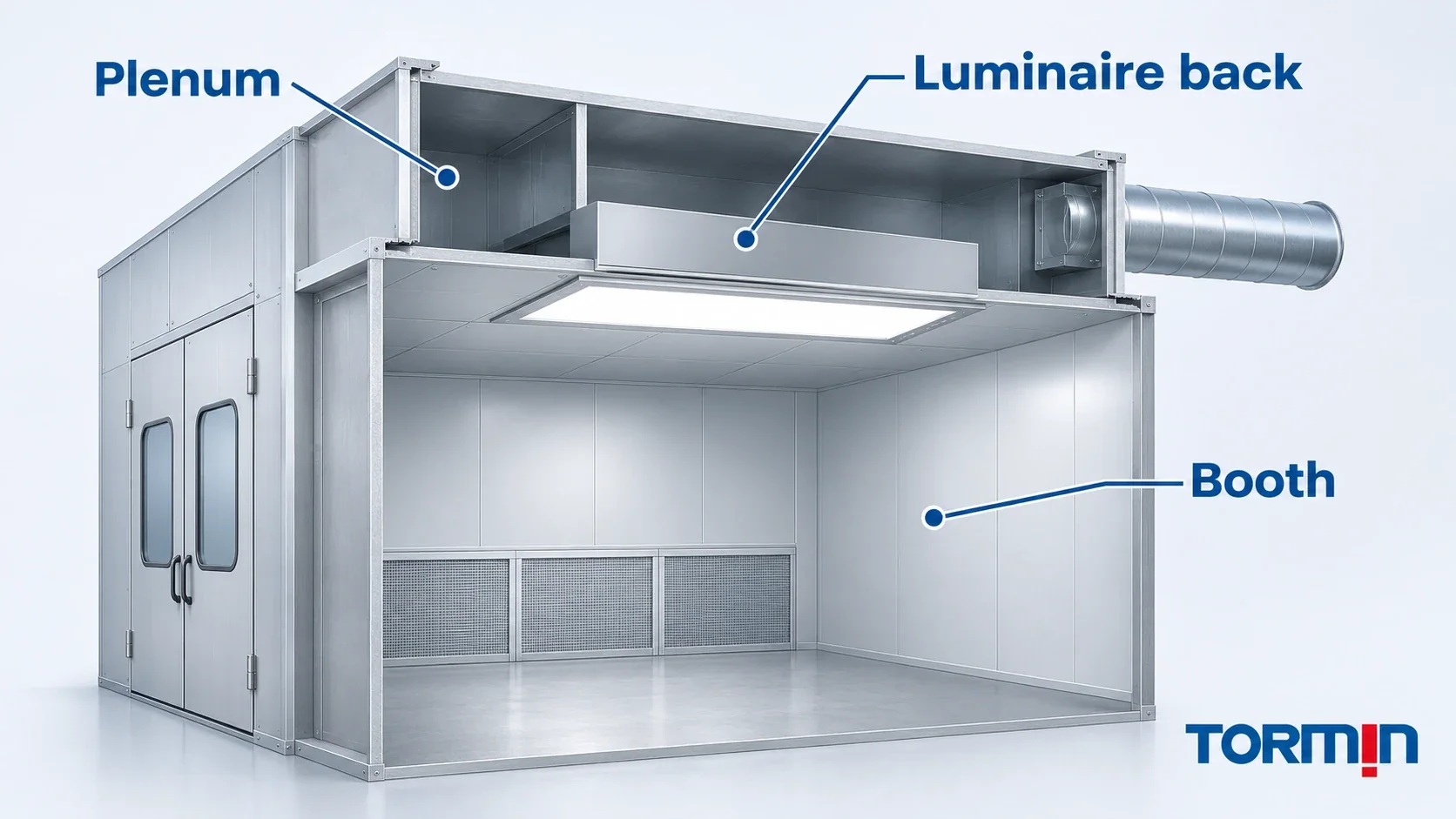
Scenario C – Lights with their backs in a spray-booth plenum
The paint-booth discussion asks whether Division 2 lights with their backs in the supply/return plenum need individual seals, then asks about MC cable, boxes and bonding. Its replies assume the plenum classification is correct; they do not classify every booth plenum as Division 2.
Decision: for a verified Division 2 location and a suitable non-explosionproof luminaire without an entry-seal trigger, no individual explosionproof seal-off is required solely for that light. Reassess if the actual enclosure, switch arrangement or instructions introduce a requirement. Keep any conduit boundary decision separate from the luminaire decision.
| Check | Acceptable basis | What does not settle it |
|---|---|---|
| Plenum and luminaire | Documented classification for operating modes; exact luminaire approval and instructions. | Calling the chamber a supply plenum or assuming its air is always clean. |
| MC cable and connectors | Permitted cable construction, installation conditions and listed termination fittings. | A generic “MC” description or a mechanically fitting connector. |
| Bonding | Approved electrical continuity through metal equipment, boxes and wiring interfaces. | Assuming an equipment grounding wire eliminates every bonding requirement. |
501.10(B) permits specified cable methods, including Type MC with listed fittings. That does not waive cable support, routing, damage protection or the conditions applicable to its use. A factory whip and the field wiring feeding it are separate parts of the arrangement to verify. 501.10(B), PDF page 453
250.100 requires the specified bonding methods whether or not a wire-type equipment grounding conductor is installed. The Class I rule in 501.30(A) also says not to depend on locknut-bushing or double-locknut contact alone; use the required bonding jumpers with proper fittings or other approved means. This is why simply connecting a green wire to a box does not complete every interface review. 250.100, PDF page 163
If you do the opposite: adding a seal at each light cannot correct unsuitable cable fittings, missing bonding or an incorrectly classified recirculating plenum. Keep booth separation and operating-mode design with the paint-booth lighting specification guide.
Scenario D – A conduit crosses a wall into a coal-dust area
The coal-dust thread asks where to put a seal-off when conduit runs from an unclassified room through a wall to equipment in a Class II area. This distinguishes gas flame-propagation sealing from dust exclusion.
Decision: do not impose a Class I boundary seal merely because the conduit crosses into Class II. Article 502.15 has its own rules. Where a raceway communicates between an enclosure required to be dust-ignitionproof and one that is not, suitable means must prevent dust entering the protected enclosure. The inspected text permits a permanent effective seal or specified raceway arrangements; the seal need not be explosionproof. 502.15, PDF page 465
| Actual condition | Decision under the inspected Article 502 text |
|---|---|
| Wall crossing alone | No automatic Class I-style boundary seal-off. |
| Dust-ignitionproof enclosure communicates with one that is not | Evaluate the suitable dust-exclusion means required by 502.15. |
| Protected enclosure communicates with an enclosure in an unclassified location | 502.15 expressly says seals are not required for that arrangement. |
The rule identifies electrical sealing putty as one possible sealing method. That does not justify “ordinary duct seal at every boundary” or “Class II never needs sealing”. The actual communicating enclosures decide the question. Other wall-penetration requirements remain separate.
If you do the opposite: copying a gas seal detail can miss the actual dust-ingress path, while deleting every seal can omit a required dust-exclusion measure. Use the combustible-dust environment guide for that hazard context. The Zone 0/1/2 guide concerns gas zoning, not a conversion for this dust case. Cable glands and stopping plugs address enclosure openings, a different task from conduit sealing; record applicable measures during the installation inspection review.
Where sealing still has to be checked
1. Conduits leaving a Class I location
501.15(A)(4) requires a seal in each conduit run leaving Division 1, subject to its exceptions. 501.15(B)(2) establishes the Division 2 boundary rule, likewise with exceptions. The main rules permit the fitting on either side within 3.05 m (10 ft) of the boundary. The intervening run has restrictions; choosing a fitting within 10 ft does not alone complete compliance.
The inspected text includes qualifying unbroken pass-through exceptions. Division 2 also has conditional transition, pressurization and outdoor-segment exceptions; each requires its complete conditions, not just one convenient feature. Division 1 underground boundaries have a specific placement allowance. Identify any exception relied on against the actual route. Boundary seals under the Division 2 rule need not be explosionproof, but must be identified for their purpose and accessible. 501.15(A)(4)/(B)(2), PDF pages 454-455
For a Division 1-to-Division 2 transition, also check 501.10(B): its stated arrangement extends the Division 1 wiring method to the seal on the Division 2 side. Record the applicable route conditions before applying the general either-side language. An equipment-entry seal may also satisfy a boundary requirement only if its actual location and installation meet both sets of conditions; a factory-sealed label alone cannot establish that result.
2. Entries into required explosionproof enclosures
501.15(A)(1) addresses entries where specified apparatus may produce arcs, sparks or temperatures exceeding its stated 80%-AIT condition. Its exceptions include the specified hermetically sealed chamber, oil immersion, identified factory-sealed marking and nonincendive circuit. Division 1 also has a separate trigger for trade-size 2 or larger entries containing terminals, splices or taps; do not erase that trigger by reading only the arcing-device exception.
501.15(B)(1) applies the referenced enclosure provisions in Division 2. Required enclosure seals are generally within 450 mm (18 in.), or as the enclosure marking requires, with restrictions on intervening fittings. A factory-sealed enclosure cannot serve as the seal for an adjacent enclosure that requires one. “Factory Sealed” is therefore a scoped entry decision, not permission to delete the next seal on the drawing.
3. Cable terminations and migration paths
501.15(D) addresses Division 1 cable seals, including termination and cable-core conditions. Division 2 is not simply “no seals unless process pressure”: 501.15(E)(1) requires sealing cables entering required explosionproof enclosures, and (E)(4) addresses cables without a gas/vaportight continuous sheath at the boundary.
Under (E)(3), a cable with the stated continuous sheath capable of transmitting gas/vapour can require a seal, barrier or other means when process equipment can exert pressure in excess of 1,500 Pa at its end. Construction, termination and process connection all matter. Do not substitute a conduit seal for a verified process-pressure barrier. 501.15(D)/(E), PDF pages 456-457
Restricted-breathing fittings
A restricted-breathing fitting may depend on an integral sealing arrangement that limits gas entry; this is not automatically an explosionproof conduit seal. Preserve its documented arrangement rather than substituting a generic seal-off. The separate topic “Restricted Breathing Fixtures” is forthcoming; dual temperature markings and Zone 2 acceptance are outside this article.
Four mistakes to avoid
- Turning a fixture-entry exemption into “Division 2 needs no seals”. Review the run, boundary, enclosure and cable separately.
- Adding a field seal because every Division 1 light supposedly needs one. Verify actual factory-sealed marking and entry conditions first; additional work does not automatically invalidate certification, but unapproved alterations need review.
- Applying Article 501 gas rules to Class II dust. Use the actual Article 502 dust-ingress conditions.
- Assigning classification from a catalogue. Obtain the controlled documents or commission the missing study through the classification process.
Check the nameplate before installing
Match Class, Division, group, temperature marking, ambient conditions and any “Factory Sealed”, “Leads Factory Sealed” or “Seal not Required” wording to the actual model and entry. Use the nameplate and certificate guide to reconcile identity and instructions. An unfamiliar or missing seal instruction remains unresolved until the exact documentation answers it.
For an IEC marking example only, TORMIN’s BC5402A product page prints Ex eb mb op is IIC T6/T5/T4 Gb, subject to the specific model’s nameplate. Those alternatives depend on configuration; they are not simultaneous ratings for every unit. This IEC catalogue marking establishes neither a North American listing nor a NEC conduit-sealing exemption.
Carry the documented installation requirement into the lighting-selection process. Close both questions: what the exact luminaire entry requires, and what the complete wiring route requires.
FAQ
Do explosion proof light fixtures need conduit seals in Class I Division 2?
Not automatically. A suitable non-explosionproof luminaire generally needs no explosionproof seal at its entry solely because of Division 2. Required explosionproof enclosures, equipment instructions, cable conditions and boundary rules can change the answer.
Do Class I Division 1 light fixtures need seals?
Check the exact assembly. A qualifying factory-sealed marking can remove the separate entry-seal requirement, but not every Division 1 luminaire is factory sealed. Applicable entry conditions and separate boundary requirements remain.
Where are conduit seals still required?
At applicable Class I boundaries and required enclosure entries, subject to the code’s conditions and exceptions. The main boundary placement rule permits either side within 3.05 m (10 ft); an enclosure seal generally has a different, 450 mm (18 in.) placement rule or its specified marking.
Do I need a seal-off for lights in a spray booth plenum?
For a verified Division 2 plenum, apply the actual luminaire-entry rules. A suitable non-explosionproof light without an applicable entry-seal requirement needs no individual explosionproof seal. Verify cable methods, connectors, bonding and the independent boundary conditions.
Do Class II dust areas need conduit seals?
There is no blanket Class I-style boundary rule. Article 502.15 may require suitable dust exclusion between communicating enclosures, and the seal need not be explosionproof. Do not replace that conditional rule with a universal instruction to apply ordinary duct seal.
Sources
- California Building Standards Commission – 2022 California Electrical Code, NEC 2020-based adopted text – 250.100, PDF163; 501.10(B), PDF453; 501.15, PDF454-457; 501.30(A), PDF457-458; 501.130, PDF461; 502.15, PDF465. Confirm the project’s adopted edition and amendments.
- Mike Holt Forum – Lighting Fixture Seal-Off, January 2011 – provenance of the Division 2 field question, not a substitute for code or equipment instructions.
- Mike Holt Forum – Paint booth question, July-November 2016 – conditional plenum, cable and bonding questions; includes later qualifications.
- Mike Holt Forum – Class II division I sealing question, February 2013 – dust-wall-crossing question; the later reply corrects the blanket boundary-seal advice.
- TORMIN – BC5402A Explosion Proof Linear Light – first-party printed IEC marking only, reviewed November 9, 2026; not evidence of North American approval.