
The area’s classification must come from a competent classifier or engineering organization, with review or acceptance by the authority having jurisdiction (AHJ) where required. This guide explains the inputs and preliminary reasoning; it does not replace a classification study. If your project has no controlled classification documents, request them from the owner or commission the study before selecting a light. A luminaire catalogue cannot classify your location.
To determine the relevant Class, Division or Zone rating, three questions organize the work: what material creates the hazard, how an ignitible atmosphere can occur at the proposed location, and which material group applies. The answer belongs to a defined space and operating scenario, not automatically to an entire building.
The tables below help turn process information into a reasoned preliminary requirement. The two worked examples then show how assumptions produce different gas and dust conclusions, and where the competent classifier must confirm them.
Step 1 – Identify the material type and the relevant Class
Start with the substance inventory and its actual physical form at operating conditions. Record the material identity, SDS revision, handling temperature, containment and any process that releases it. A liquid matters here because it can generate a flammable vapour; the mere presence of a liquid container does not automatically make every surrounding space Class I.
The NEC Article 500 framework separates the following material hazards. The accessible adopted-code text used here is the 2022 California Electrical Code, based on NEC 2020; confirm the edition and special provisions adopted for your project. Article 500.5, PDF pages 444-446
| Material type | Preliminary NEC Class | Examples and qualification |
|---|---|---|
| Flammable gases or vapours, including vapours produced by liquids | Class I | Gasoline vapour, hydrogen, natural gas and methane. Assess whether an ignitible mixture can occur at the location. |
| Combustible dust | Class II | Grain dust, flour, coal dust and combustible aluminum or magnesium dust. Dust properties and accumulation require a separate assessment; see the dust-group and surface-temperature guide. |
| Easily ignitible fibres or combustible flyings | Class III | Cotton lint, textile fibres and wood shavings where they fit fibres/flyings not likely to remain suspended in quantities sufficient for ignitible mixtures. Fine combustible wood dust requires a dust assessment instead. |
Material form is a decision input, not a naming detail. A woodworking operation may produce both shavings and fine dust. Writing “wood” on the enquiry does not tell the classifier which condition exists. Similarly, identify the actual gas composition rather than treating every natural-gas stream as pure methane.
Class describes the location’s material hazard; it is not assigned by the light you intend to buy. Where gas and combustible dust hazards coexist, assess both and carry both requirements forward. A gas marking does not supply a missing dust approval. Conversely, the assessment may establish that the relevant space is unclassified when the conditions do not warrant classification. OSHA requires individual consideration of rooms, sections and areas rather than a single assumption for the whole facility. OSHA 1910.307
Step 2 – Assess releases, occurrence and ventilation
For Class I under NEC Article 500.5, Division 1 includes ignitible concentrations during normal operation, frequent repair/maintenance or leakage, and specified process failures that can also create an electrical ignition source. Division 2 includes normally confined material released through accidental breakdown or abnormal operation, locations dependent on mechanical ventilation that can fail, and certain adjacent locations receiving hazardous concentrations. Dust and fibre Divisions have their own criteria; do not apply this gas summary to them. For the framework comparison, use the Class I, Division 1 versus Division 2 guide.
For gas zoning, Zone 0 concerns an explosive atmosphere present continuously, for long periods or frequently; Zone 1 concerns one likely occasionally in normal operation; Zone 2 concerns one unlikely in normal operation and, if present, persisting only briefly. These describe the atmosphere at the location, not the process name. The Zone 0, Zone 1 and Zone 2 guide explains the controlled drawing and position checks that follow. IEC 60079-10-1 addresses gas/vapour classification and treats an area as three-dimensional. IEC 60079-10-1:2020 scope
Those summaries do not decide the result by themselves. Work through the inputs below with the process and ventilation engineers. Record the evidence, including missing information, before proposing a classification.
As a broad occurrence orientation only, Division 1 spans situations associated with Zones 0/1 and Division 2 resembles Zone 2; this is neither a location-by-location conversion nor a certification equivalence.
| Input | What to record | How it changes the judgment |
|---|---|---|
| Release source and grade | Specific opening, seal, transfer point or process interior; continuous, normal intermittent or abnormal release scenario | Establishes how an explosive atmosphere could arise, rather than assuming material presence is enough. |
| Release rate and conditions | Pressure, temperature, available quantity and credible release mechanism | Affects the amount available to form an ignitible atmosphere and its potential extent. |
| Occurrence and persistence | When a release occurs and how long the explosive atmosphere remains | Distinguishes process operating time from actual atmospheric hazard duration. |
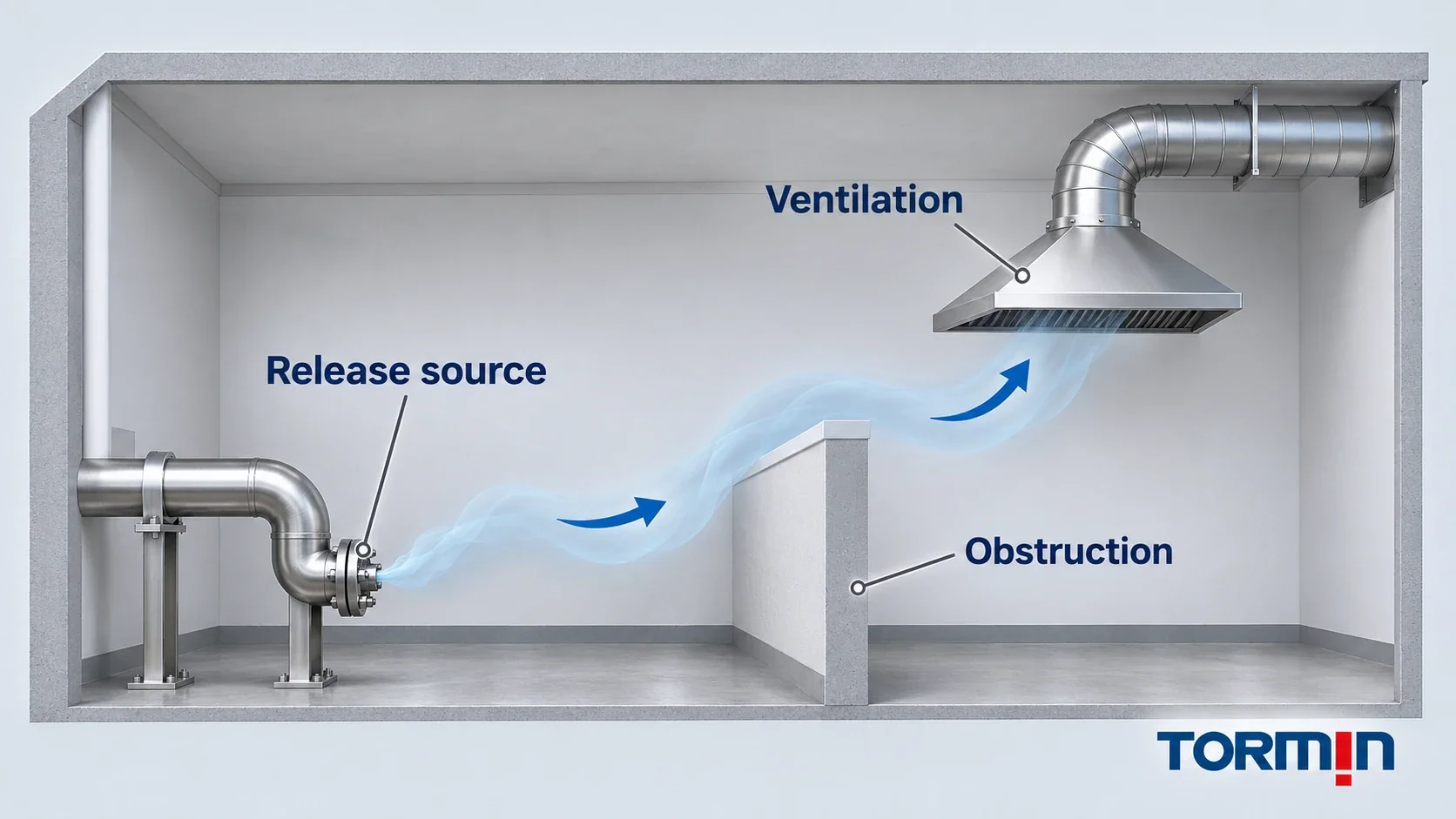
| Ventilation and dilution | Natural or forced airflow, effectiveness at the source, obstructions and availability | Determines whether released material disperses or can accumulate. |
| Failures and communication | Ventilation loss, relevant equipment faults and migration from adjacent spaces | Tests whether normal-operation assumptions remain credible under assessed failures. |
| Three-dimensional extent | Proposed light position, elevations, openings, partitions and connected spaces | Locates the equipment relative to the assessed hazardous volume. |
| Dust deposits and disturbance | Dust clouds, layers, housekeeping and possible re-entrainment | Requires dust-specific reasoning rather than copying a gas-frequency shortcut. |
HSE’s classification guidance links release characteristics, ventilation and dispersion to the resulting zone and extent. A fan’s presence alone does not prove adequate dilution: establish what airflow reaches the release, whether partitions obstruct it, and what happens when ventilation is unavailable. The evidence should explain the normal and relevant abnormal scenarios, not simply state “well ventilated”. HSE area-classification guidance
Keep separate records for separate release points. A routine transfer opening and a normally sealed connection can have different scenarios even when they handle the same substance in the same room. Capture the proposed light’s coordinates and elevation against each relevant source, then let the study establish the combined result. Moving the light or adding a partition can change the relationship that was assessed; a room name on an old enquiry is insufficient evidence.
Use annual hours as guidance figures, not a zoning calculator
HSE reports commonly used figures of more than 1,000 hours/year for Zone 0, more than 10 but less than 1,000 for Zone 1, and less than 10 for Zone 2 where the likelihood still warrants controls. HSE explicitly states that such time limits have not been officially adopted. They are non-normative guidance figures, not numerical thresholds prescribed by IEC 60079-10-1.
These hours concern the presence of an explosive atmosphere, not how long the light is on or the production line operates. Do not turn an estimated release duration into a definitive annual total without accounting for persistence after release. Nor should exactly 10 or 1,000 hours trigger an automatic answer: the qualitative criteria, assumptions and classification method govern the assessment.
If the necessary records are missing, mark the preliminary result as unresolved. Useful questions are whether a release is inherent to normal transfer, how long the atmosphere remains after transfer stops, and whether the assumed extraction remains available. A guessed annual-hours figure does not resolve those missing inputs. The study should leave a traceable rationale, assumptions and drawing references that another engineer can review.
Dust zoning uses IEC 60079-10-2. Its public scope distinguishes explosive dust atmospheres from dust layers and addresses housekeeping and clouds generated from deposits. Do not transfer the gas-hour figures to Zone 20/21/22. Likewise, foreseeable release scenarios in an area study are not a substitute for assessing catastrophic failures through the wider process-safety work. IEC 60079-10-2:2026 scope
Step 3 – Identify the substance group within the chosen framework
Once the material and location scenario are understood, determine the group using accepted material data. Class alone cannot do this: hydrogen and propane are both Class I materials, but their groups differ. Group selection concerns ignition and explosion characteristics, not which substance is used in the largest quantity.
This is an A-G reference for the specified examples, not a complete material directory. Definitions and dust qualifications come from NEC Article 500.6, PDF pages 446-447. Additional Group D examples are checked against the material table reproduced in NFPA’s public 497 committee record; that record is not an adopted code edition.
| Framework | Group | Representative materials | Qualification for use |
|---|---|---|---|
| NEC Class I | A | Acetylene | Identify the actual substance and applicable project requirements. |
| NEC Class I | B | Hydrogen | A Class I designation alone does not establish this group. |
| NEC Class I | C | Ethylene | Use the group in the target framework, not a similar-looking IEC letter. |
| NEC Class I | D | Propane, methane, gasoline vapour and petroleum-naphtha vapour | Verify the identity and composition of the actual material, particularly commercial mixtures. |
| NEC Class II | E | Combustible aluminum and magnesium dust | Combustible metal dusts and other dusts presenting the similar electrical-equipment hazards specified by the code. |
| NEC Class II | F | Coal, charcoal and coke dust | Carbonaceous dust with more than 8% total entrapped volatiles, or sensitized by other materials to present an explosion hazard; classification may require testing. |
| NEC Class II | G | Flour, grain, wood, plastic and chemical dust | Combustible dust not included in Group E or F; do not assign the group from a broad trade name alone. |
For IEC gas equipment, use the separate IIA/IIB/IIC material grouping: the IIB versus IIC guide explains coverage, while the NEC-IEC letter-trap guide explains why letters cannot be substituted. The IEC gas-group and auto-ignition temperature table is an IEC lookup entry point, not evidence for a NEC group assignment.
If your substance is missing, obtain the SDS and accepted standard or test data for the target system. Resolve CAS identity, composition and relevant dust-sample properties. An SDS may not state an electrical group, and a product name may cover different blends. Leave the group unresolved until adequate evidence exists; do not borrow a neighbouring row or infer it from temperature class.
Worked example 1 – A specified position inside a solvent spray booth
Consider a hypothetical light position inside a spray booth. For this example, toluene is the only relevant flammable vapour, the assessment establishes ignitible concentrations during normal spraying, and the proposed position lies within that assessed volume. The real project must also address spraying mists, other ingredients and special spray-finishing provisions, including the applicable NEC Article 516 requirements.
On the NEC side, vapour makes this a Class I question. The stated normal-operation condition supports Division 1 at this position, and independently checked material data identify toluene as Group D. The preliminary description is therefore Class I, Division 1, Group D. OSHA’s spray-finishing rules also contain specific Class I, Group D and Division 1 provisions for spraying areas; actual equipment arrangements need their own review. OSHA 1910.107(c)
For an independently assessed IEC scenario, assume an explosive gas atmosphere is likely occasionally during normal operation and that the ventilation assessment supports Zone 1 at the same specified position. Toluene is IIA, so that separate preliminary description is Zone 1, IIA. It is not a conversion from Division 1. IEC 60079-10-1 warns that strict application may be inappropriate where flammable mists occur, which is a material limitation for spraying processes.
The IEC 60079-20-1:2010 dataset used here records toluene at 530°C, IIA and T1. That temperature result is a separate equipment-selection input; it did not establish the zone or NEC group. IEC identical BIS adoption, PDF page 50 No conclusion here classifies the entire booth exterior or approves a particular luminaire.
Worked example 2 – A grain-loading release point outside a silo
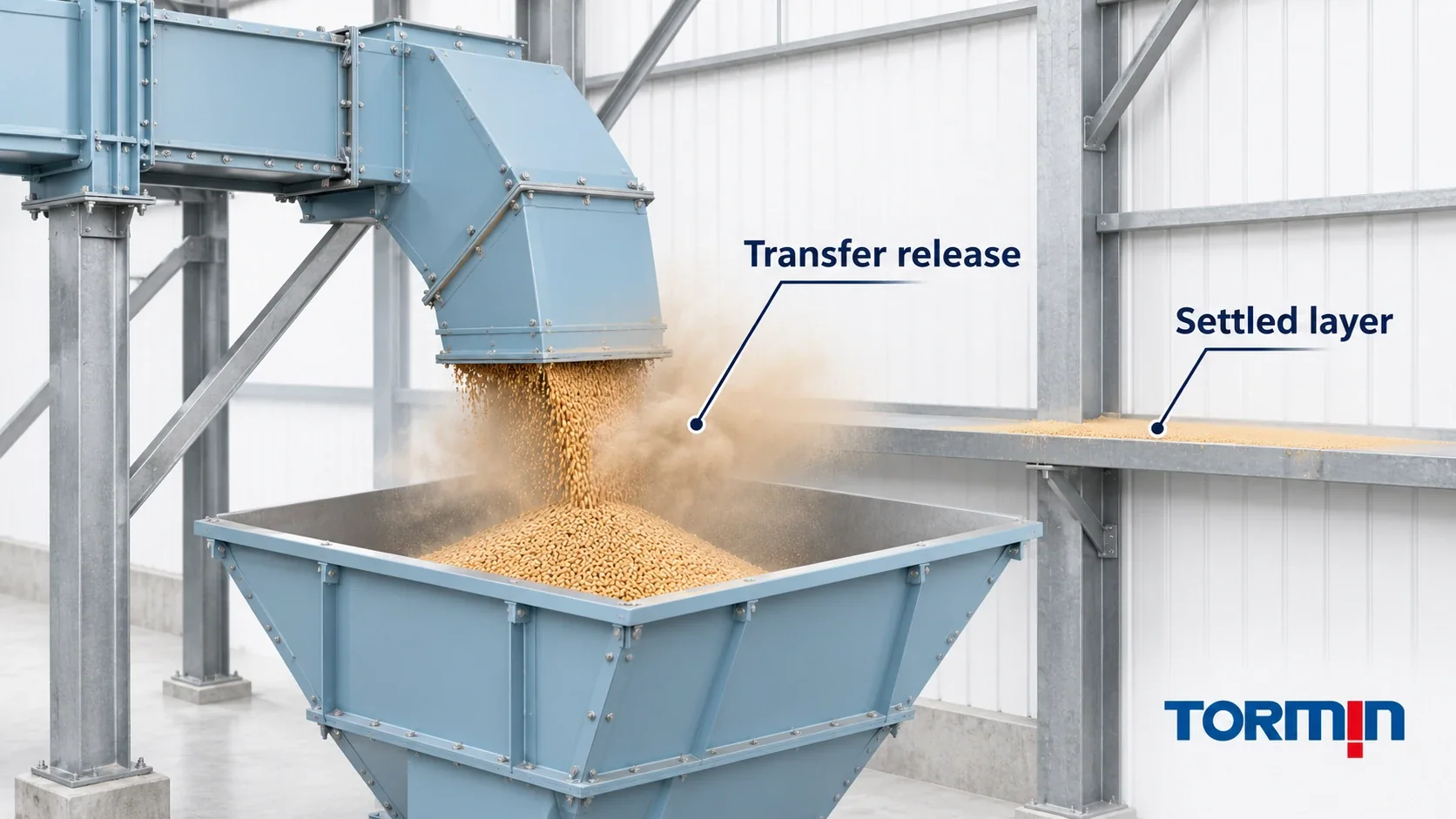
Now consider a hypothetical light beside a grain transfer point outside the silo interior. Assume combustible grain dust forms an ignitible cloud occasionally during normal filling at that location. The dust assessment also covers deposits and disturbance. These are teaching assumptions, not observations from a TORMIN installation.
For NEC reasoning, the material hazard is Class II. The stated normal-operation dust-cloud condition supports Division 1; grain dust falls within Group G when it is not an E/F material. The preliminary result is Class II, Division 1, Group G. Separately, a competent IEC dust assessment establishing occasional explosive dust atmospheres during normal filling supports Zone 21 at the specified position. The same qualitative dust-zone criterion is publicly stated in UK DSEAR Schedule 2.
The silo interior may have different conditions, and a more distant light may sit outside that release volume. Neither result can be extended by drawing a guessed circle around the loading equipment. Settled dust may also become airborne again, so the housekeeping assumption belongs in the assessment. After classification, use the dust surface-temperature rules rather than selecting a gas T-class as the dust criterion.
For this example, “grain loading” supplies context, while the assumed cloud at the specified light position supplies the occurrence evidence. If effective containment prevents that cloud from reaching a different position, the classifier must evaluate that position separately. If the release becomes persistent, the original occasional-release assumption no longer supports the same preliminary conclusion. Keep those changes visible instead of preserving the label because the equipment still handles grain.
After the classification has been established
Carry the approved location requirement into equipment selection. Check the independent gas-group and temperature-class requirements and the permitted ambient-temperature range, Ta. The Gas Group × T-Class checker can screen those inputs; it does not determine a zone or Division.
Then use the Class-based procurement guide for the RFQ and document review, match the nameplate to the exact certificate, and continue through the five-step lighting-selection guide. Keep the study’s revision and exact light location attached to the enquiry so later design changes do not detach the offer from its assumptions.
Four mistakes that break the reasoning
- Treating Division 1 and Zone 1 as interchangeable certification. Broad occurrence similarities do not authorize replacing one system’s equipment with another; check the framework comparison.
- Choosing the group from the Class. Class I identifies the material category, not whether the gas needs Group B or D equipment.
- Using T-class to infer the group. Thermal requirements and groups are independent; the low-ignition trap shows why satisfying one can still fail the other.
- Self-classifying from a fixture catalogue. A product’s available markings cannot establish the area’s releases, ventilation or extent. Request controlled documents, or commission the missing study.
Without classification documents, obtain or commission them first; this guide helps you understand the inputs and does not replace the classification study.
FAQ
Who decides my area’s official classification?
A competent classifier or engineering organization prepares the study; the AHJ reviews or accepts it as jurisdictional rules require. Request the owner’s controlled documents, or commission the study if none exists. This article explains the inputs rather than authorizing a rating from a catalogue.
Is Division 1 the same as Zone 1?
No. Division 1 has broader occurrence coverage, and the systems and certification requirements differ. Use the Class/Division comparison to understand the distinction, not to substitute approvals.
How do I know if my area is Zone 1 or Zone 2?
Assess release scenarios, the atmosphere’s occurrence and persistence, ventilation effectiveness/availability and extent. HSE’s common guidance figures are more than 10 but less than 1,000 hours/year for Zone 1 and less than 10 for Zone 2; they are not IEC thresholds or a standalone decision rule. The classification study determines the result.
What group is my gas or dust?
Start with Step 3 and verify the actual substance or dust sample. For an unlisted material, obtain SDS and accepted test/standard data: NEC Article 500 with relevant material references for NEC, or IEC gas-material data for IEC. Do not infer a NEC group from an IEC lookup or guess from a similar name.
Do I need a different rating for dust than for gas?
Yes. Dust involves a separate assessment, such as NEC Class II and Groups E/F/G, or IEC dust Zones 20/21/22 and dust-specific equipment markings. A location can have both hazards; gas certification alone does not establish dust suitability.
Sources
- California Building Standards Commission – 2022 California Electrical Code, Article 500.5 and 500.6 – accessible adopted NEC 2020-based text, PDF pages 444-447. Check the project’s adopted edition.
- OSHA – 29 CFR 1910.307, Hazardous (classified) locations – location documentation and material-specific equipment requirements.
- IEC – IEC 60079-10-1:2020 public scope – gas/vapour scope, three-dimensional areas and mist limitation; not a claim of access to the full standard.
- HSE – Hazardous Area Classification and Control of Ignition Sources – release, ventilation and extent inputs; commonly used, non-official annual-hour guidance.
- IEC – IEC 60079-10-2:2026 public scope – separate assessment of dust atmospheres and layers, including housekeeping.
- UK – Dangerous Substances and Explosive Atmospheres Regulations 2002, Schedule 2, as made – public qualitative zone definitions, including occasional normal-operation dust clouds for Zone 21; UK jurisdiction, not a universal code adoption.
- NFPA – NFPA 497 public-input committee record, 2023 revision cycle – reproduced material-table entries for methane, gasoline, petroleum naphtha and toluene, PDF pages 12-15. A committee record, not an adopted code.
- OSHA – 29 CFR 1910.107, Spray finishing using flammable and combustible materials – spray-area electrical provisions.
- BIS – IS/IEC 60079-20-1:2010, identical IEC adoption – toluene, CAS 108-88-3, 530°C, IIA, T1; PDF page 50, BIS page 45.