
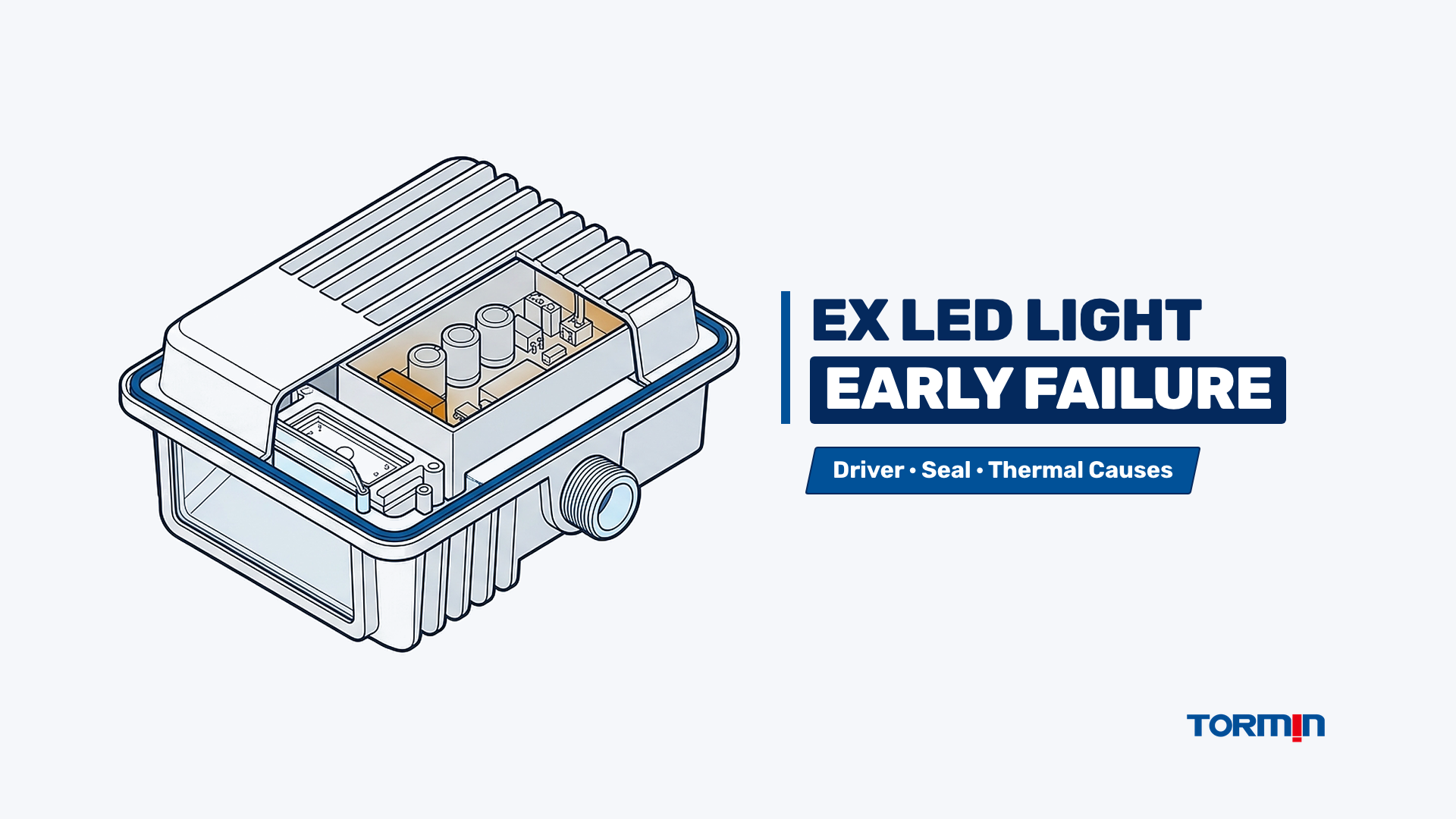
Explosion proof LED lights rarely fail early because the LED chips wear out. In classified industrial areas, premature explosion proof LED light failure almost always traces back to three coupled mechanisms inside a sealed hazardous-area housing: trapped thermal load, electronic LED driver stress, and seal or cable-entry breakdown driven by thermal cycling.
Understanding how those three subsystems interact prevents a costly cycle of swapping failed luminaires into the same destructive operating conditions. It also clarifies a critical safety boundary: unlike ordinary shop lights, a failed hazardous-area luminaire cannot be revived with a generic replacement driver or unapproved sealant without compromising its explosion-protection certification. This guide explains the failure physics, how to separate probable causes from safe external clues, and which specification and maintenance controls stop repeat failures—without replacing qualified Ex inspection, certified repair facilities, or manufacturer instructions.
1. Thermal bottlenecks: why sealed Ex housings accelerate wear
Standard commercial LED luminaires rely on lightweight housings and open airflow to shed heat. Hazardous-area luminaires operate under the opposite physical constraint: to contain internal arcs, maintain flameproof joints, or exclude combustible dust and corrosive spray, their enclosures must remain heavy, sealed, and passively cooled. Every watt of heat generated by the LED array and power supply must conduct through die-cast metal walls and radiate or convect from external fins—with no cooling fans and no open ventilation slots.
When real site conditions push the thermal path beyond the luminaire’s documented operating envelope, internal component temperatures climb steeply even if the plant ambient air feels ordinary at floor level:
- Elevated ceiling-level ambient temperatures: Process piping, boilers, compressors, solar roof loading, and stratified hot air near tank decks or furnace bays routinely create localized ambient temperatures well above ground-level weather or room averages. Every hazardous-area luminaire is evaluated for a specific ambient temperature (
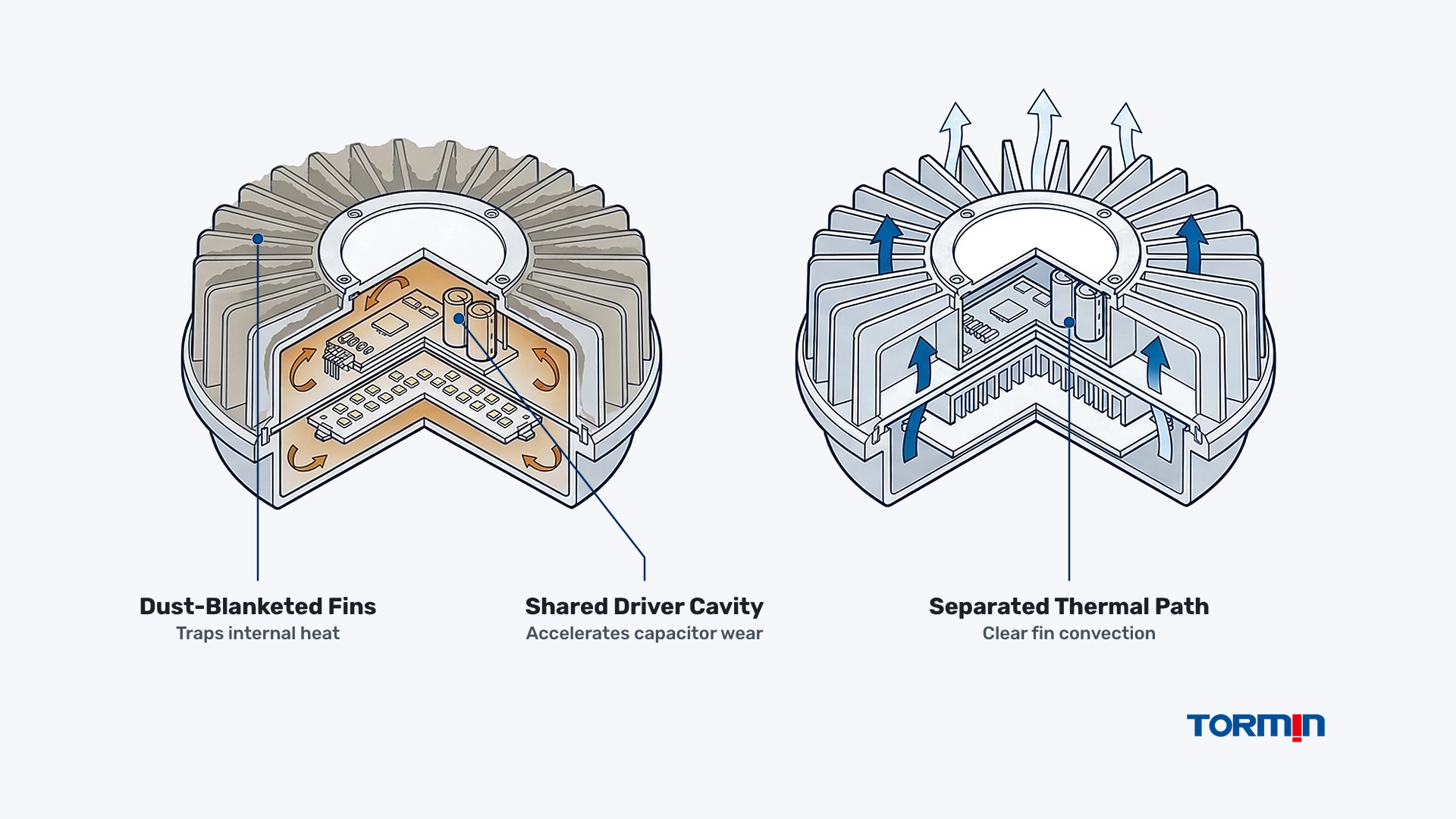
Ta) range; operating above that ceiling compresses both electronic reliability margins and certified surface-temperature limits under IEC 60079-14:2024. - Dust, grease, and process fouling on cooling fins: In grain handling, petrochemical, marine, and heavy manufacturing spaces, airborne dust or oily residue settles across horizontal fin channels. An insulating dust layer restricts external convection, raising both internal component temperatures and external housing surface temperatures—a key inspection point under IEC 60079-17:2023.
- Shared versus separated driver cavities: In compact single-cavity designs where the LED driver shares an enclosed volume directly behind the LED board, heat rejected by the light engine conducts and convects straight into the driver’s temperature-sensitive electronics. Designs that thermally isolate the driver compartment from the LED heat sink reduce that thermal coupling.
- Unapproved mounting orientation: Passive convection depends on fin orientation. Mounting a pendant or upright-rated fixture inverted, tilted against a solid beam, or recessed into a tight structural pocket can stall natural airflow and violate the thermal conditions under which the luminaire was tested.
2. LED driver failure: heat, electrical transients and L70 blind spots
Maintenance teams are often surprised when a luminaire advertised with long LED lumen-maintenance hours goes dark in only a fraction of that time. The mismatch comes from treating component-level LED chip projections as whole-luminaire reliability guarantees.
As documented by the U.S. Department of Energy Solid-State Lighting program and the scope of IES TM-21-21, lumen-maintenance projections (L70 derived from LM-80 package data) measure gradual light-output depreciation of the LED light source alone, whereas catastrophic luminaire failure typically stems from electronics rather than LED chip wear. For how to read those quotation metrics separately during procurement, see our guide to industrial LED lighting lifetime, L70, and driver life.
Inside an explosion-proof LED luminaire, the switched-mode power supply (LED driver) is typically the first electrical subsystem to wear out or fail abruptly, driven by three main stressors:
- Thermally accelerated capacitor wear: Wet aluminum electrolytic capacitors inside LED drivers degrade primarily through gradual electrolyte evaporation, which lowers capacitance and raises equivalent series resistance (ESR). Higher internal driver temperatures—compounded by ambient heat, trapped luminaire heat, and internal ripple current—sharply shorten useful driver life, producing output ripple, visible flicker, slow startup, or complete shutdown long before the LEDs dim to
L70. - Industrial power-quality transients and switching surges: Refineries, chemical plants, pump stations, and substations share distribution networks with large motors, variable-frequency drives (VFDs), capacitor banks, and lightning-exposed outdoor feeders. Repeated inductive switching spikes, neutral shifts, over-voltage events, or inadequate surge coordination degrade driver input rectifiers, metal-oxide varistors (MOVs), and switching MOSFETs—often taking out multiple fixtures on the same circuit after a switching event or storm.
- Thermal stress on integral emergency batteries: Where a hazardous-area luminaire includes an integral emergency battery pack, the battery cells frequently carry a narrower permissible ambient temperature range than the main AC driver. Sustained heat in high-bay or outdoor sun-exposed installations accelerates battery capacity loss and charging-circuit faults, causing emergency-test failures even while normal mains lighting still operates.
3. Seal, gasket and cable-entry breakdown
Many premature failures attributed to “bad drivers” are actually moisture or chemical-ingress failures that reached the electronics through a compromised seal or cable entry. A common misconception is that a high static ingress rating—such as IP66—permanently seals a luminaire against field moisture.
Under IEC 60529, an IP code measures enclosure protection against solid objects and water under standardized short-term laboratory tests. It does not prove explosion protection (see whether an IP rating means a light is explosion proof), does not guarantee long-term elastomer resistance to hydrocarbon vapors or caustic washdown chemicals, and does not eliminate internal pressure cycling.
In real hazardous-area service, thermal breathing defeats weak seals over repeated operating cycles:
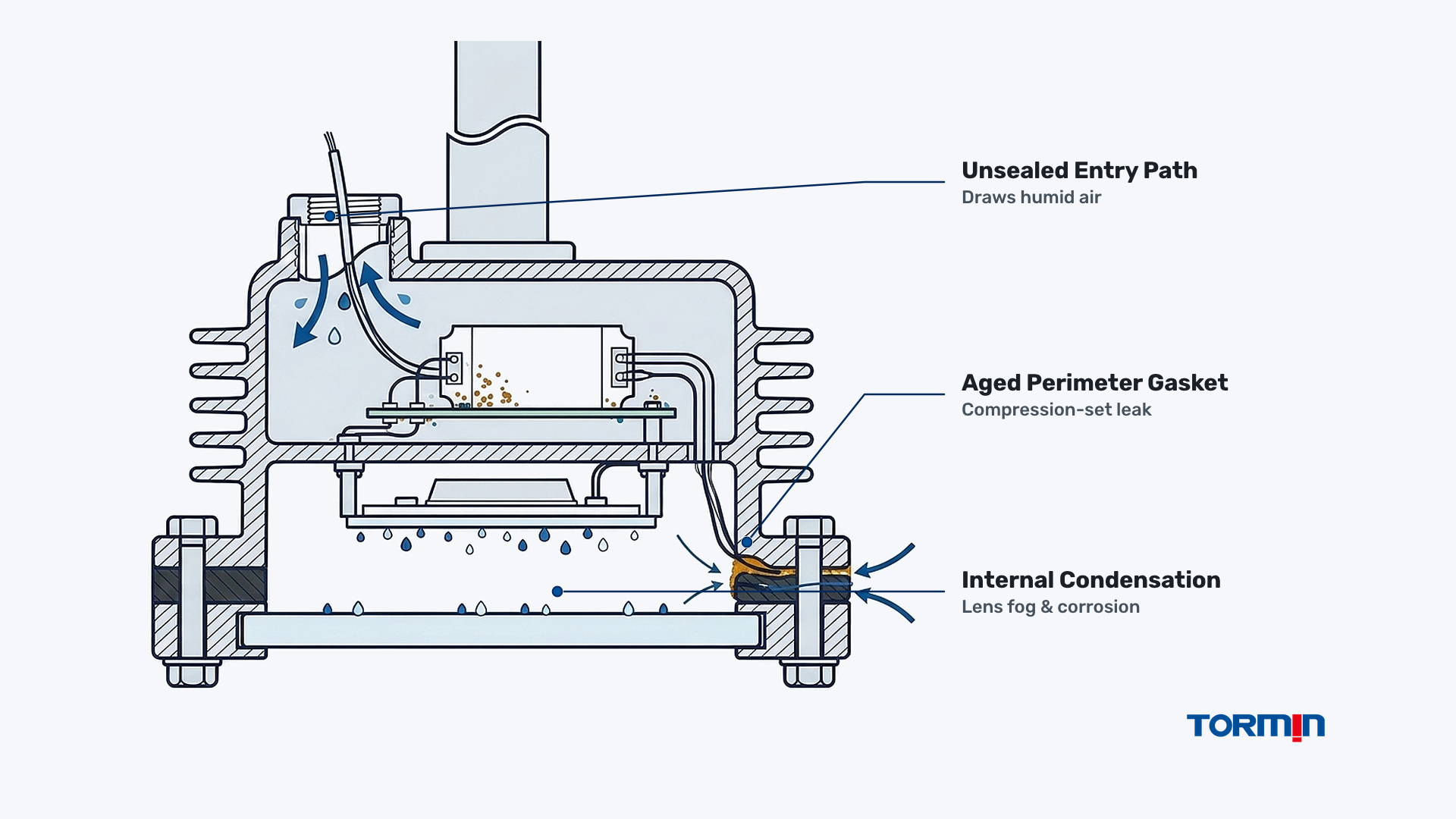
- Warm-up and cool-down pressure differentials: While energized, internal air inside a sealed luminaire heats up and expands. When the circuit switches off—or when a hot outdoor fixture is hit by rain or cold washdown water—the trapped air cools rapidly and contracts, creating negative internal pressure (partial vacuum).
- Ingress through the path of least resistance: That vacuum draws humid ambient air, corrosive mist, or water sitting inside overhead conduit runs through any weak point: an unsealed conduit entry, a cable gland mismatched to cable outer diameter, an open or non-certified spare entry lacking a proper stopping plug, or a perimeter gasket that has taken permanent compression set.
- Condensation and secondary electrical failure: Once humid air enters a sealed housing, moisture condenses on the cooler inner glass lens and metal walls during off-cycles, pooling onto driver terminals, corroding PCB traces, fogging optics, and eventually causing earth-leakage trips or short circuits.
Two installation interfaces deserve special scrutiny whenever moisture appears inside a luminaire:
- Cable glands and unused entries: Using a non-matching thread standard, omitting a sealing washer where required by the housing instructions, clamping a gland onto an undersized cable jacket, or leaving a spare entry closed only with a plastic shipping cap invites immediate moisture pumping and violates IEC 60079-14:2024. Review entry hardware rules in explosion-proof cable glands versus stopping plugs.
- Conduit runs and boundary seals: In North American rigid conduit installations governed by NFPA 70 (National Electrical Code), unsealed or improperly drained conduit runs act like moisture pipes feeding condensation directly into overhead luminaire hubs; see whether explosion-proof light fixtures need conduit seals. Meanwhile, in Zone 2 gas installations using restricted-breathing (
Ex nR) fixtures under IEC 60079-15:2017, gasket or gland degradation does not merely cause condensation—it undermines the exact seal integrity on which the luminaire’s Ex protection and temperature class rely; see restricted-breathing explosion-proof lighting.
4. Separating driver, seal and thermal failure from safe external clues
Before anyone requests a hot-work permit or pulls a luminaire down for workshop evaluation, safe external inspection—conducted in line with visual and close inspection practices under IEC 60079-17:2023—can narrow the probable root cause without opening an energized enclosure in a classified area.
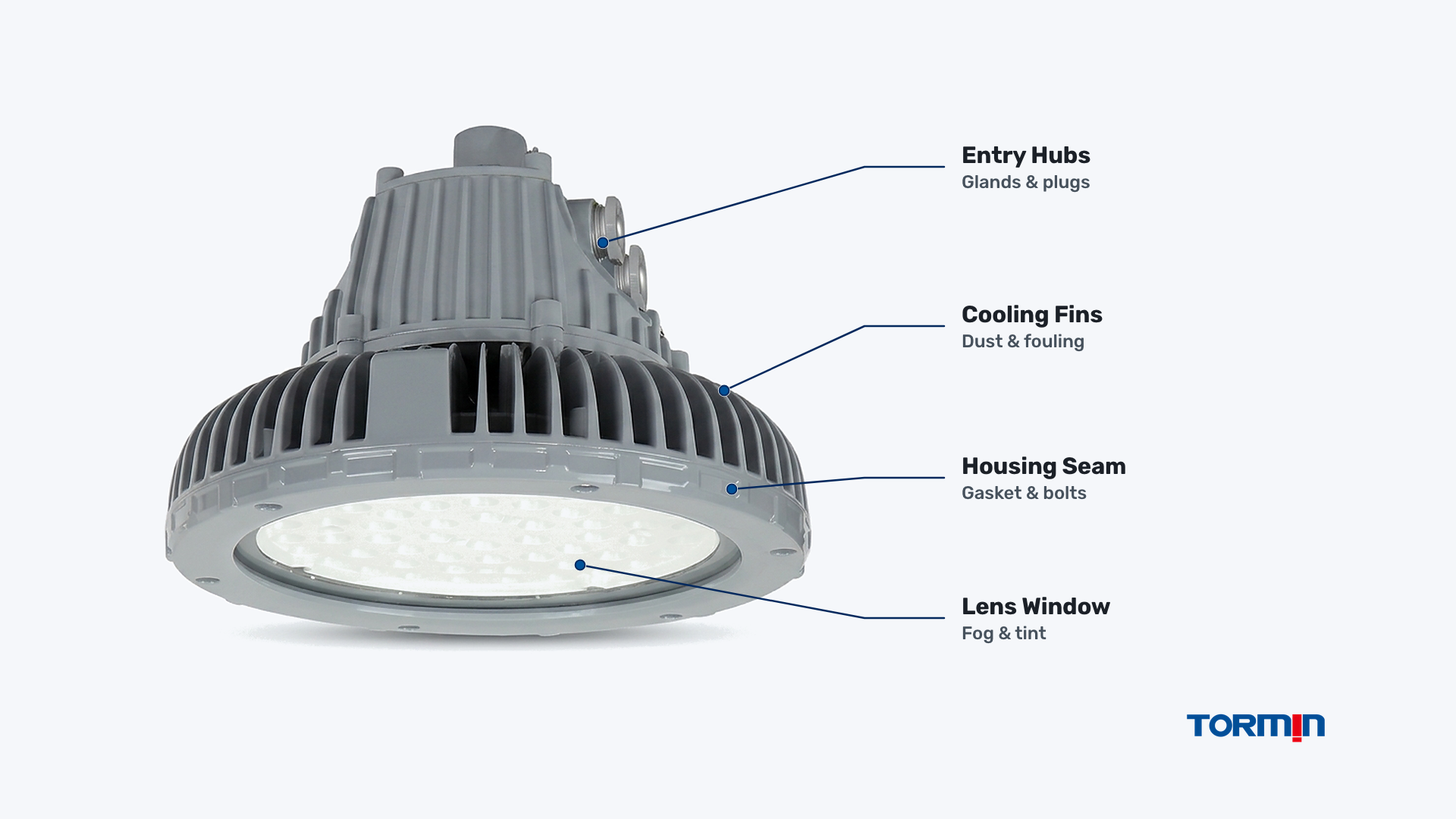
Use the matrix below to connect what maintenance personnel see from the outside to the most probable coupled mechanism and the compliant next step:
| Safe external clue | Most probable coupled cause | What it does not prove alone | Safe next action |
|---|---|---|---|
| Internal lens fogging, water beads, or rust streaks near housing seam | Thermal-cycling breathing via loose gland, missing stopping plug, unsealed conduit, or degraded gasket | Does not prove the enclosure casting itself is cracked or that the original IP rating was misstated |
Isolate per site permit, check entry/conduit sealing and gland torque against instructions, and remove the unit for Ex-compliant inspection/replacement |
| Heavy dust blanket, oil film, or heat discoloration on fins alongside early dimming or shutdown | Chronic thermal bottleneck raising driver and LED temperatures above design Ta limits |
Does not prove the LED chips alone failed; driver capacitors may already be thermally degraded | Verify actual ceiling-level ambient temperature against nameplate Ta, clean external fins safely, and verify mounting orientation |
| Multiple fixtures on one feeder fail simultaneously or flicker after switching/storms | Supply surge, over-voltage, harmonic stress, or loose feeder neutral damaging driver input stages | Does not prove a batch manufacturing defect in the luminaires | Check circuit supply voltage, surge protection devices, and switching loads before installing replacement luminaires on the same feeder |
| Single fixture flickers, cycles on/off, or fails cold startup with clean fins and dry lens | Isolated LED driver wear (capacitor ESR drift, thermal foldback, or internal component fault) | Does not rule out hidden upstream moisture inside a top conduit entry or prior ambient exceedance | Isolate, record nameplate/ordering code and operating timeline, and escalate via structured troubleshooting before replacement |
| Cracked glass, missing cover bolts, corroded flamepath seam, or loose/unplugged entry | Mechanical impact, chemical/salt corrosion, or improper prior installation/maintenance | Does not merely represent a cosmetic defect—this is an active Ex integrity breach | Remove from service immediately under hazardous-area safety rules; do not re-energize until replaced or overhauled by a certified facility |
For the structured grades of hazardous-area visual, close, and detailed checks, see explosion-proof lighting inspection. When logging symptoms, circuit history, and photographs before contacting technical support, follow our explosion-proof LED lighting troubleshooting record guide.
5. Repair versus replacement: why improvised field fixes void Ex certification
When an ordinary warehouse LED fixture stops working, an electrician can often swap in a third-party constant-current driver, replace a flattened gasket with cut rubber sheet, or run silicone sealant around a weeping joint. In a hazardous area, every one of those improvised fixes creates a serious compliance and ignition hazard:
- Generic driver swaps alter thermal and electrical safety: Substituting a non-approved driver changes internal power dissipation, hot-spot temperatures, fault-current behavior, creepage/clearance distances, and electromagnetic compatibility—potentially pushing the enclosure past its certified temperature class (
T-code) or breaching the component list bound to the certificate schedule. - Unapproved gaskets, bolts, or sealants compromise Ex protection: Replacing factory fasteners with lower-grade hardware, altering gasket elastomer chemistry, or applying non-specified RTV silicone across flameproof (
Ex d) or dust-ignitionproof joints can obstruct flamepaths, fail under explosion pressure, or crack after chemical exposure. - Certified repair rules govern Ex overhaul: Under the IECEx Certified Service Facility Scheme (implementing
IEC 60079-19), certified Ex repair and overhaul require assessed service-facility competence and replacement parts conforming to the manufacturer’s specification and certification documentation. Likewise, in U.S. workplaces under OSHA 29 CFR 1910.307, field modifications outside the original listing invalidate equipment approval unless evaluated under an authorized rebuild or field-evaluation route.
For most fixed hazardous-area LED luminaires, if an internal driver or sealed housing fails outside simple manufacturer-authorized external terminal/gland work, the defensible path is either returning the unit to the OEM or an IEC 60079-19 certified service facility, or replacing the luminaire with a verified exact-configuration unit after correcting the underlying thermal, supply, or sealing root cause.
6. Preventing repeat failures at specification and maintenance
Replacing a failed fixture with an identical model—without fixing the ambient, electrical, or cable-entry stressor that killed the first one—guarantees repeat downtime. Lock four prevention controls into both your replacement specification and routine maintenance program:
| Failure domain | Specification check before ordering | Installation & maintenance control |
|---|---|---|
| Thermal margin | Measure actual mounting-height ambient temperature (including process heat and solar load) and verify the exact model’s certified Ta range and mounting attitude |
Include external fin cleaning in scheduled IEC 60079-17 inspections in dusty, oily, or corrosive units |
| Driver & electrical resilience | Evaluate driver thermal rating and electrical surge protection separately from LM-80/TM-21 LED package L70 claims; confirm exact emergency-battery Ta limits where fitted |
Audit circuit voltage stability, motor-switching transients, and distribution surge protection before re-lamping feeders with repeat driver losses |
| Seals, glands & corrosion | Match housing alloy, coating, and gasket elastomer to actual site chemicals, salt spray, and washdown regimes—never rely on IP digits alone |
Specify certified cable glands sized to exact cable outer diameters, certified stopping plugs for all unused entries, and code-required conduit seals/drains |
| Configuration traceability | Keep one controlled per-area selection record tying ordering code, certificate annex, and accessory hardware together | Stock OEM-approved spare assemblies or exact-code replacement luminaires rather than loose generic drivers or non-specified gaskets |
For corrosive marine or coastal environments where salt spray accelerates housing, fastener, and gasket breakdown, review offshore hazardous-area lighting corrosion, certification, and maintenance. When replacing legacy luminaires in an existing plant, document retained conduit threads, supply voltages, and thermal obstructions first using our explosion-proof LED retrofit site survey checklist, and verify every replacement candidate against the complete 5-step process in how to select explosion proof lighting for a hazardous area.
When scoping replacements for a high-ambient, washdown, or surge-prone classified area, browse TORMIN’s hazardous-area lighting range to compare candidate forms, then share your area classification, measured mounting-point ambient range, supply conditions, and entry thread requirements via the TORMIN contact page for exact-configuration documentation and thermal/accessory review.
Sources
- IEC — IEC 60079-14:2024, Explosive atmospheres — Part 14: Electrical installation design, selection and erection — Requirements for matching Ex equipment to ambient temperature limits, mounting conditions, cable glands, stopping plugs, and installation rules.
- IEC — IEC 60079-17:2023, Explosive atmospheres — Part 17: Electrical installations inspection and maintenance — Visual, close, and detailed inspection obligations covering dust accumulation, gasket/seal deterioration, fasteners, and cable-entry integrity.
- U.S. Department of Energy — LED Basics (Solid-State Lighting Program) — Distinction between gradual LED lumen maintenance and catastrophic luminaire electronics failure.
- Illuminating Engineering Society — IES TM-21-21, Projecting Long-Term Luminous, Photon, and Radiant Flux Maintenance of LED Light Sources — Scope boundary confirming that
LM-80/TM-21projects LED light-source flux maintenance rather than complete luminaire driver or enclosure failure. - IEC — IEC 60529:1989+AMD1:1999+AMD2:2013 CSV, Degrees of protection provided by enclosures (IP Code) — Scope of laboratory solid/water ingress protection tests as distinct from explosion protection, chemical compatibility, and long-term thermal-cycling sealing.
- NFPA — NFPA 70, National Electrical Code (NEC) — North American hazardous-location wiring, conduit sealing, and luminaire installation framework.
- IEC — IEC 60079-15:2017, Explosive atmospheres — Part 15: Equipment protection by type of protection “n” — Scope of restricted-breathing (
Ex nR) enclosures in Zone 2 / EPL Gc gas atmospheres and their dependence on seal integrity. - IECEx — Certified Service Facility Scheme Overview (
IEC 60079-19) — Requirements for certified repair, overhaul, and reclamation of Ex equipment without invalidating explosion-protection compliance. - OSHA — 29 CFR 1910.307, Hazardous (classified) locations — U.S. workplace requirement for approved hazardous-location equipment maintained within its listed scope and operating limits.