
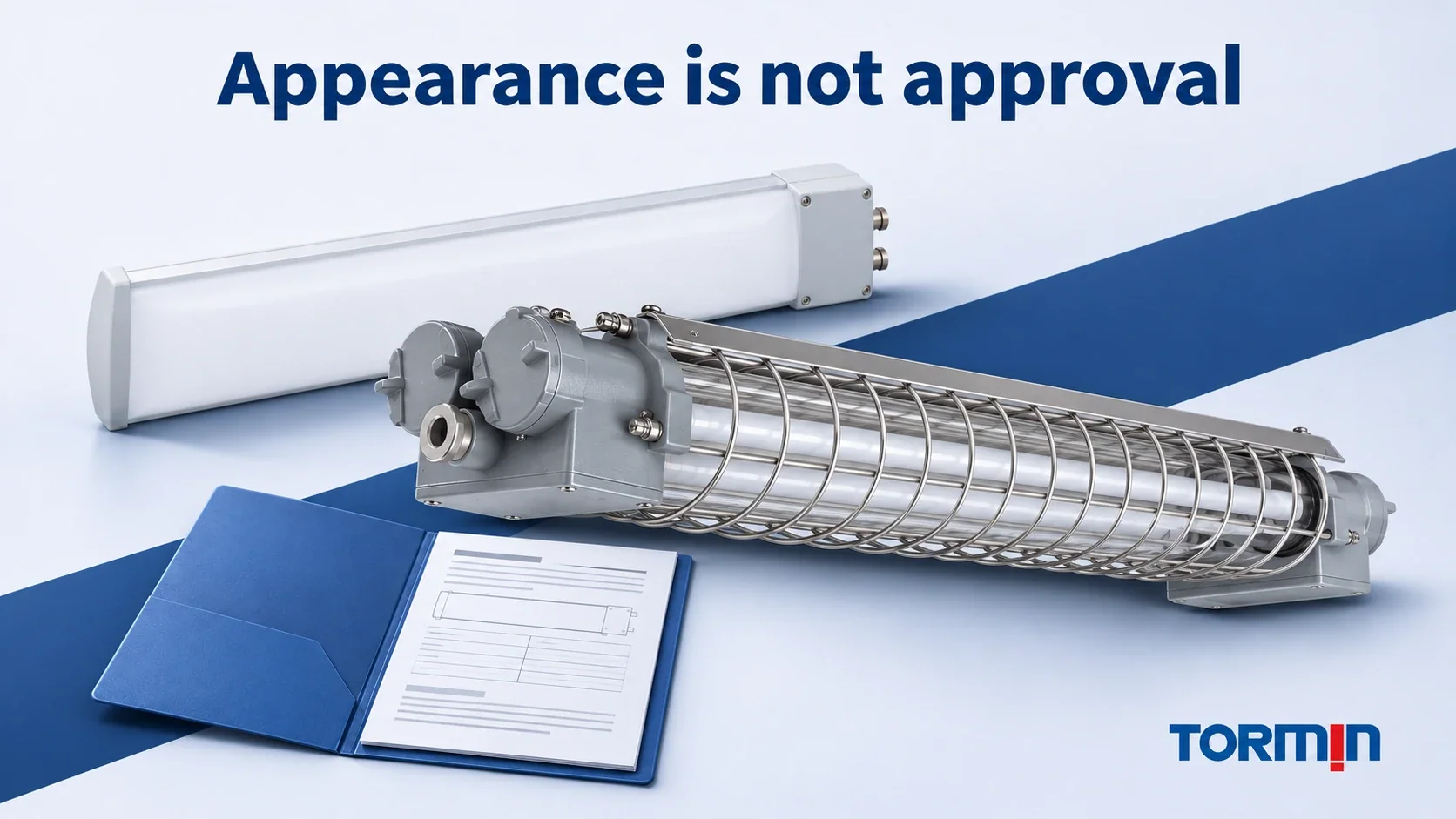
Do not accept an existing general-purpose light in Class I, Division 2 or an IEC Zone 2 location merely because it still works, looks enclosed or has an industrial IP rating. If its suitability and thermal evidence are missing, it has not demonstrated that it can remain. NEC provisions contain conditional paths; that is different from permission to assume an undocumented fitting is safe, or a claim that no ordinary product could ever qualify.
This article addresses equipment acceptance after the area has been classified. Use the Class I lighting comparison for the framework; conduit-seal decisions are a separate installation task. The question here is whether the actual light has an acceptable basis for use, and what to do when it does not.
The retrofit problem: working equipment still needs evidence
Consider an existing analyzer building undergoing a ventilation upgrade. The general-purpose lights and fans are still working, and the project team wants to retain them rather than replace equipment that appears serviceable. At the electrical review, however, the engineer finds that the lighting records contain no applicable hazardous-location evaluation, temperature evidence or documentation tying the installed configuration to the classified conditions. The decision is no longer simply whether the lights work. It is whether there is a defensible basis for accepting them at their actual locations. A sealed-looking housing, years of operation and an improved ventilation system cannot supply the missing equipment evidence.
This illustrative scenario separates two decisions that are easily confused during a retrofit. A competent classification reassessment may change the documented hazardous extent or occurrence conditions. The equipment review must then establish whether each retained light meets the requirements at its resulting location. If that position remains classified, better ventilation alone does not establish the light’s suitability.
The NEC references below use the inspected NEC 2020-based 2022 California Electrical Code. Apply the edition, amendments, workplace rules and equipment requirements governing your project.
What the 80% provision actually requires
501.130(B)(1) addresses lamps that can, under normal operating conditions, reach surface temperatures exceeding 80% of the gas/vapour auto-ignition temperature expressed in Celsius. When that condition applies, the luminaire must meet the Division 1 complete-assembly provision or be a type tested to determine its marked operating temperature or T-code. It does not impose a universal 80% ceiling on every accepted, tested Division 2 luminaire. 501.130, PDF page 461
Suitability itself is addressed by 500.8(A): listing/labeling, evaluation by a qualified testing laboratory or inspection agency, or evidence acceptable to the authority having jurisdiction, such as a manufacturer’s evaluation or an owner’s engineering judgment. None removes the applicable equipment requirements. An ordinary catalogue claim is not that acceptance record. 500.8(A), PDF page 449
For the screening comparison, the threshold is 0.8 × AIT in °C. It is not 80% of a Fahrenheit value, 80% of a lamp’s wattage or a temperature inferred from a hand-touch check. The relevant question includes the lamp temperature, not only the outside of the housing. An external casing measurement cannot silently stand in for an unmeasured lamp or another exposed ignition source.
The threshold also does not replace the independent gas-group and temperature requirements. After the appropriate equipment pathway is established, its marked temperature and permitted ambient range, Ta, must fit the actual service conditions. A cooler assumed room is not evidence for a hotter installation.
The allowance for certain resistance devices is separate. In the inspected text, 501.105(B)(3), not (B)(2), permits a general-purpose enclosure under specified contact and thermal/test conditions; the 80% comparison there concerns the marked maximum operating temperature of an exposed surface. That equipment-specific exception cannot simply be transferred to a luminaire. 501.105(B)(3), PDF page 459
McGraw-Hill’s National Electrical Code 2017 Handbook, commentary to 501.130, describes the GP-luminaire determination as “difficult for any electrical designer and/or installer” and discusses qualified testing-agency work. The practical difficulty is obtaining applicable evidence, not a new legal rule that nobody can ever satisfy the condition. Hartwell, McPartland and McPartland, 29th edition
Why lighting needs its own acceptance decision
1. The thermal assessment covers the actual heat sources
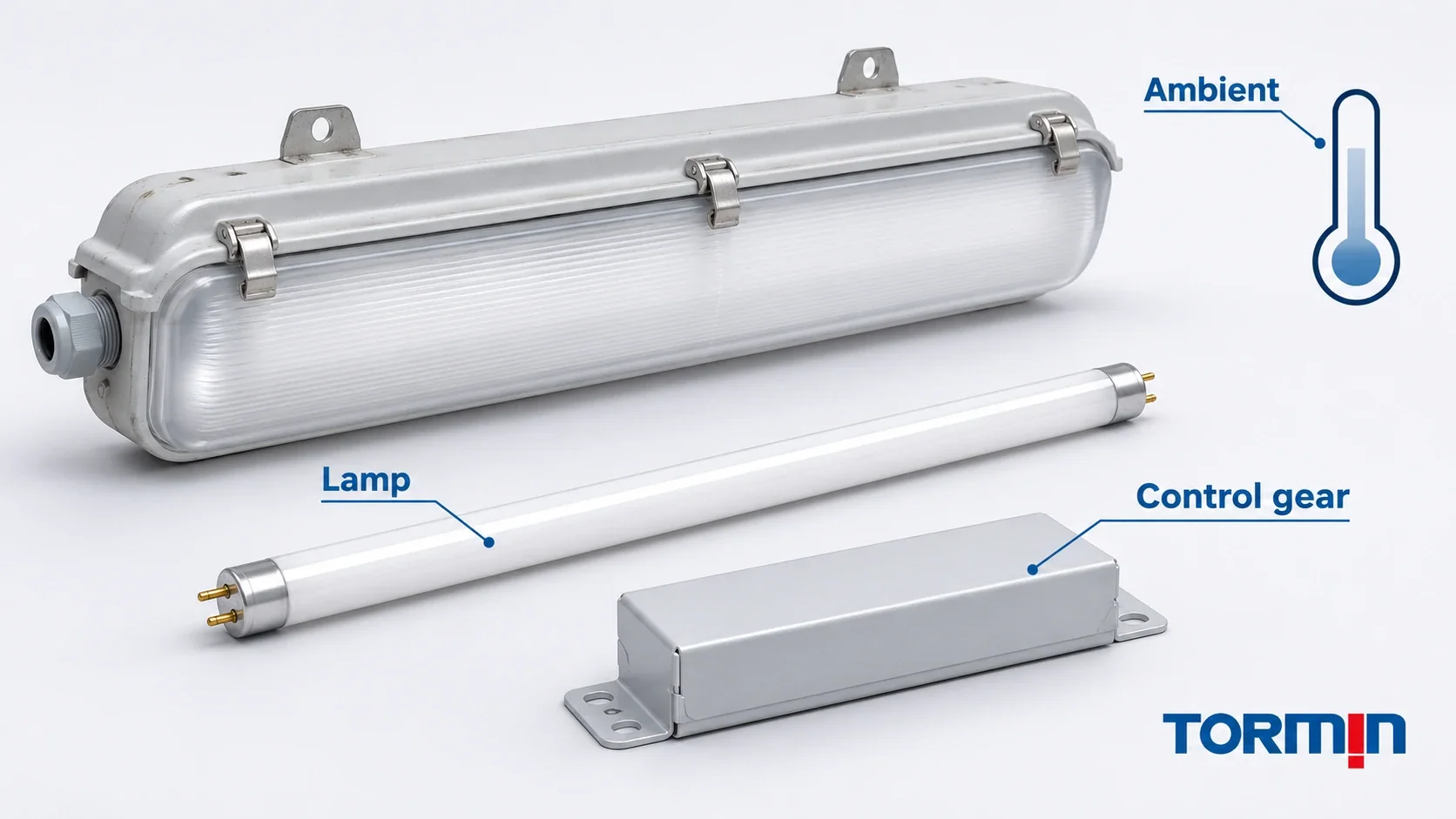
A luminaire is heat-producing equipment. Depending on its technology and design, the lamp, light source, control gear and other parts can matter. Do not assume that the lamp is always the hottest part, or that every general-purpose light is physically incapable of thermal control. The problem with an undocumented assembly is that the necessary temperature performance has not been established for the proposed use.
A familiar enclosure shape, a cool accessible surface or an ordinary-lighting datasheet is insufficient by itself. Resolve the applicable evaluation, its conditions and what parts it covers. A rating for a different lamp type, supply arrangement or operating configuration cannot answer that question for the unit in front of you.
2. General-purpose marking allowances are not uniform
500.8(C)(6)(a) allows certain acceptable fixed general-purpose equipment to omit hazardous-location markings, but expressly excludes fixed luminaires from that general allowance. That is a concrete asymmetry: a permitted ordinary enclosure elsewhere in the room does not prove that an ordinary light has the same marking treatment. 500.8, PDF pages 449-450
Read the complete marking rules, however. 500.8(C)(4) recognizes operating-temperature marking as well as temperature class and contains a limited temperature-marking exception. Consequently, “no T-number” alone is not a universal rejection test. The reviewer must establish the actual allowance and evidence; guessing that an unmarked light probably qualifies does not do that.
3. The evidence must survive configuration changes
Changing a lamp, ballast, driver or other relevant component can change the configuration that was evaluated. A documented permitted replacement may preserve that basis; an undocumented substitution may not. This is why the acceptance record should identify the actual assembly, permitted components, operating limits and relevant instructions.
It is not necessary to declare every replacement invalid. It is necessary to show that the retained arrangement remains within its evidence. Where the records cannot establish that, keep the retention decision unresolved rather than treating past service without a known incident as a thermal test.
The asymmetry: assess each equipment category under its own rule
500.8(B)(3) permits general-purpose equipment or enclosures where the equipment articles specifically allow them and normal operation does not introduce an ignition source. It is not a universal exemption for everything without an obvious switch. The Class/Division guide provides the location context; the following table concerns equipment evidence.
| Equipment category | Class I, Division 2 decision | What must be established |
|---|---|---|
| General-purpose luminaires | Do not retain on an ordinary rating or appearance alone. | The actual luminaire pathway, thermal/marking evidence, configuration and acceptance basis. |
| Non-arcing general-purpose equipment: fans, instrument terminal enclosures and induction motors | May remain where the specific equipment provisions permit; no automatic blanket permission. | Actual contacts, protective devices, temperatures and equipment-specific conditions, including motor requirements. |
| Nonincendive equipment | May be used where appropriately identified and accepted for the location. | Applicable evaluation, gas group, temperature and installation conditions. Older records may reference ANSI/ISA-12.12.01. |
| Equipment with current-interrupting contacts: switches, circuit breakers and relays | Use the required identified enclosure or an applicable permitted alternative. | The relevant rule and exceptions: for example hermetic sealing, oil immersion, nonincendive circuits, factory-sealed arrangements or appropriate listing, as applicable. |
501.105(B)(2), 501.115(B)(1) and 501.150(B) have different scopes and alternatives. Do not truncate them to “all contacts need a Division 1 enclosure”. Equally, an IEC Ex d/Ex e construction description does not prove compliance with those NEC alternatives. Contact provisions, PDF pages 458-459 and 462
For a fan, inspect the complete motor/control arrangement on paper, including integral overload or overtemperature devices. 501.125(B) specifically addresses motor switching and protective devices; a three-phase induction motor is not automatically acceptable just because it has no brushes. Do not bypass overload protection to create apparent compliance. Changes require an engineered, permitted arrangement that preserves required protection. 501.125(B), PDF page 460
For nonincendive records, verify the applicable standard and edition rather than relying on a familiar number. ISA lists ANSI/ISA-12.12.01-2015 among its administratively withdrawn standards. That status does not by itself decide the acceptance of an existing product; it does mean the old designation should not be presented as the sole current route for every new approval. ISA standards record
Class II dust: a different acceptance test
Class I gas suitability does not establish Class II dust suitability. For Division 1, 502.130(A)(1) requires a luminaire identified for the location and marked for the lamp type and maximum wattage. The relevant dust group and temperature requirements must also be satisfied; Group G is not a universal substitute for the actual dust hazard.
For Division 2, distinguish portable from fixed lighting. In the inspected edition, fixed lighting is 502.130(B)(2): its enclosure must be dusttight or otherwise identified for the location, and the luminaire must carry the required maximum-lamp-wattage marking consistent with the surface-temperature condition in 500.8(D)(2). A suitable dusttight arrangement may therefore be accepted under the actual rule; it is inaccurate to ban every product sold as general purpose without examining that basis. 502.130, PDF page 467
NEMA enclosure types describe environmental protection, not automatic approval of the complete luminaire and its heat-producing parts. The actual dust-exclusion characteristics, assembly and temperature evidence matter. Likewise, the sales term “vapor-tight” supplies no Class II acceptance evidence by itself. NEMA enclosure descriptions
Use the combustible-dust lighting guide for the separate hazard context. In this edition, Class II classification is addressed in 500.5(C); NFPA 499 is a dust-classification reference, not a gas-temperature shortcut. A Class I, Division 1 label alone cannot establish dust acceptance. 500.5(C), PDF page 445
IEC Zone 2: ordinary weather protection is insufficient
An IEC Zone 2 selection normally requires equipment providing the applicable explosion protection, with EPL Gc, Gb or Ga as appropriate to the project. It is not a rule that only Gc equipment can be selected. The IECEx installation presentation shows that relationship, while IEC 60079-14:2024 covers selection, installation and initial inspection under its adopted framework. IECEx installation guidance, slide 16
Ex ec is one Gc protection example in IEC 60079-7; it is not an ordinary enclosure with a marketing label added. A general-purpose IP rating cannot replace the required Ex evidence. Confirm the complete marking, group, temperature, ambient conditions and acceptance route. IEC 60079-7 public scope
The Zone lighting guide handles the position and framework context. A Zone 2 label is not automatically Division 2 acceptance; the forthcoming “Restricted Breathing Fixtures” topic addresses a related marking trap separately.
Three ways to resolve an unsupported existing installation
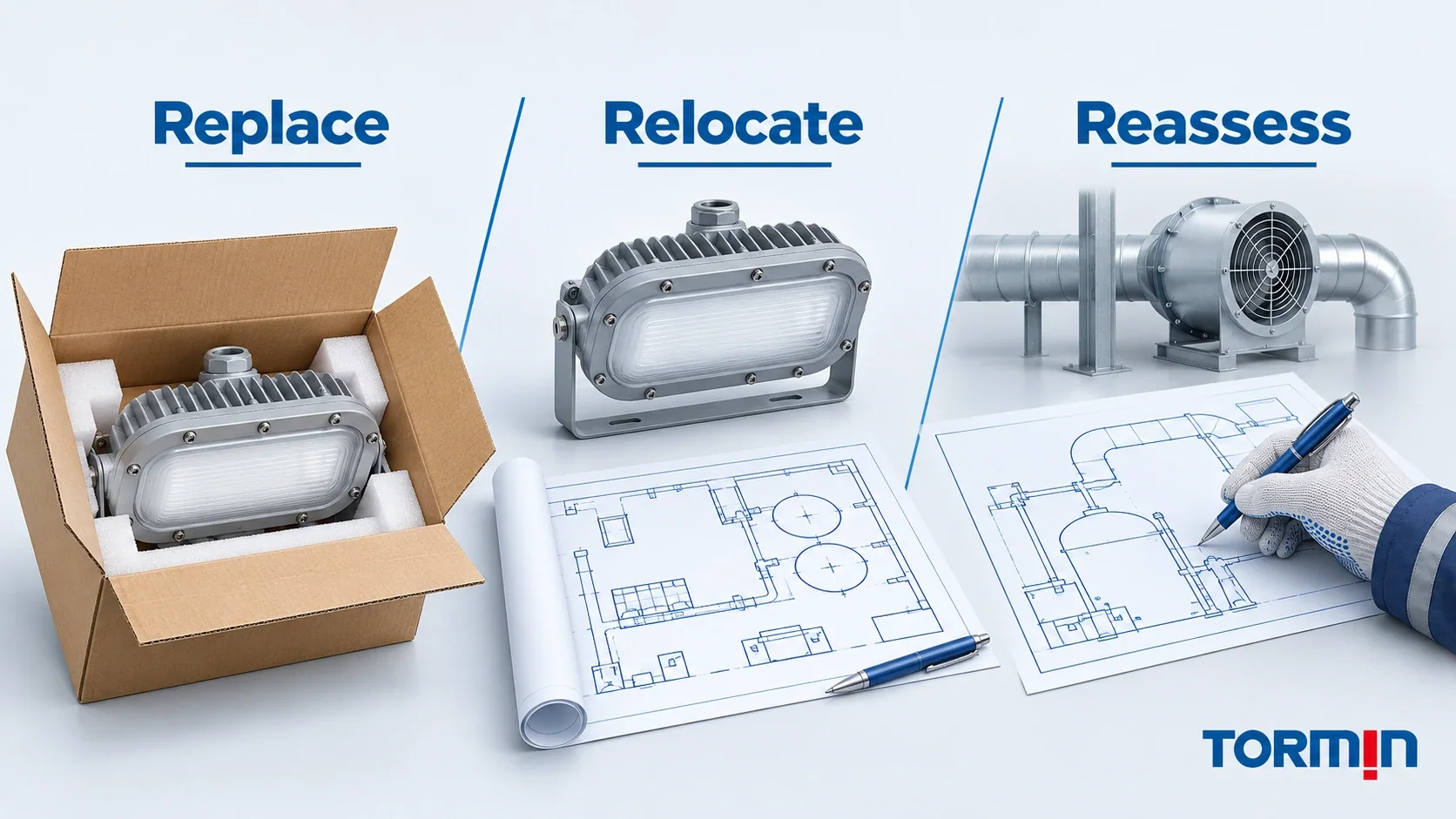
1. Replace the light with an appropriate evaluated assembly
Where applicable evidence cannot support retention, specify a replacement for the actual Class/Division or Zone, material hazard, temperature requirement and operating conditions. Use the lighting-selection process and carry the exact ordering code into the inspection record.
Replacement is complete when the installed configuration matches the accepted documents, not when a similar-sized fixture has been delivered. Keep any unresolved component or location mismatch visible for the responsible reviewer.
2. Relocate the luminaire to a verified unclassified position
Relocation may change the equipment requirement if the complete light and associated equipment are genuinely outside the classified extent. This is a design option for review, not permission to move a light a guessed distance or assume that mounting it higher removes the hazard.
The revised arrangement must still provide the required lighting and meet the applicable installation requirements. This article specifies no window, separation distance, mounting or alternative illumination design.
3. Commission a competent classification reassessment
Ventilation or process changes may support a revised classification only through the applicable study, controlled documents and jurisdictional review/acceptance. NFPA 820 is a wastewater-facility reference, not a generic ventilation waiver for every analyzer building. No airflow rate or automatic declassification is prescribed here.
Ventilation does not change a substance from Group B to Group D. A changed group assessment needs evidence about the actual material hazards remaining. Use the classification guide to organize that work. If the position remains classified, its equipment must still meet the resulting requirement.
If classification documents are missing, obtain them or commission the missing study before selecting a remedy. Do not classify the location from a luminaire catalogue.
Four mistakes that leave the original problem unresolved
- Treating less demanding occurrence conditions as ordinary-location permission. Division 2 still requires the applicable equipment evidence.
- Approving by appearance. Similar housings do not establish the same evaluation, configuration or temperature performance.
- Copying a gas decision into combustible dust. Class II has its own enclosure, marking and thermal rules.
- Checking the light but ignoring integral fan protection or controls. Review the complete equipment and the controlled classification basis rather than the most visible component.
Close the decision against the actual nameplate
Before replacing or retaining a light, reconcile its identity, relevant Class/Division or IEC marking, material coverage, temperature and ambient evidence with the accepted configuration. Apply any specific marking allowances through the actual rule; do not infer them from a missing label. The nameplate and certificate guide explains the document match.
For an IEC example only, TORMIN’s BC5401 tube-light page prints Ex db eb IIC T6 Gb and Ex tb IIIC T80°C Db, subject to the specific model’s nameplate. Confirm the exact variant against its certificate and instructions. This first-party catalogue evidence establishes neither North American listing nor acceptance of a particular existing installation.
The review should end with one traceable outcome: accepted on identified evidence, replaced/relocated under an accepted design, or held pending a specified unresolved assessment. Age, appearance and assumed cool operation are not substitute outcomes.
FAQ
Can I use general-purpose lighting in a Division 2 area?
Do not accept it on an ordinary rating alone. NEC provisions contain conditional paths, but the actual assembly must demonstrate an applicable basis for use. Missing thermal, configuration or acceptance evidence means retention has not been justified; it is not proof that every conceivable GP product is prohibited.
Why can other general-purpose equipment stay in Division 2 but not lighting?
Some equipment has specific allowances, and fixed luminaires are excluded from the general-purpose marking allowance in 500.8(C)(6)(a). Each category still needs its own review. No-arcing assumptions and a generic 80% statement do not automatically qualify every fan, instrument or motor.
What does the 80% rule mean?
For 501.130(B)(1), lamp surface temperature above 0.8 times the gas/vapour AIT in Celsius triggers the stated Division 1-assembly or tested-temperature pathway. It is not a universal operating ceiling for every accepted luminaire. Applicable evidence must establish the actual configuration and conditions.
Can I use general-purpose lighting in a Class II Division 2 dust area?
Only if the actual fixed-lighting arrangement meets the applicable dusttight/identified-enclosure, marking and temperature requirements. A “vapor-tight” sales description or gas approval alone is insufficient. Portable lighting has its own location-identification requirement.
I found general-purpose lights in an existing classified area — what do I do?
Obtain the classification and equipment records, identify the unsupported condition, then evaluate replacement, relocation or a competent classification reassessment. Preserve protection functions and obtain the required acceptance; do not improvise a bypass or assume a ventilation change removes the equipment requirement.
Sources
- California Building Standards Commission – 2022 California Electrical Code, NEC 2020-based adopted text – 500.4/500.5, PDF443-446; 500.8, PDF449-450; 501.105/501.115, PDF458-459; 501.125, PDF460; 501.130, PDF461; 501.150, PDF462; 502.130, PDF467. Confirm the project’s adopted edition.
- Hartwell, McPartland and McPartland – McGraw-Hill’s National Electrical Code 2017 Handbook, 29th edition – commentary to 501.130 on practical evaluation and qualified testing; commentary, not current code text.
- ISA – Administratively Withdrawn Standards – status record for the 2015 ANSI/ISA-12.12.01 edition, checked November 9, 2026.
- NEMA – Enclosure Types, November 2005 descriptions – environmental enclosure characteristics, not whole-luminaire hazardous-location approval.
- IECEx – Installations presentation, Jakarta 2018 – slide 16, zone/EPL relationship; historical technical guidance, not a product approval.
- IEC – IEC 60079-14:2024 public scope – selection, installation, documentation and initial inspection scope; licensed full text not claimed read.
- IEC – IEC 60079-7:2015 public scope – ec protection and EPL Gc; licensed full text not claimed read.
- TORMIN – BC5401 Explosion Proof LED Tube Light – first-party printed IEC marking only, reviewed November 9, 2026.