
Short Answer
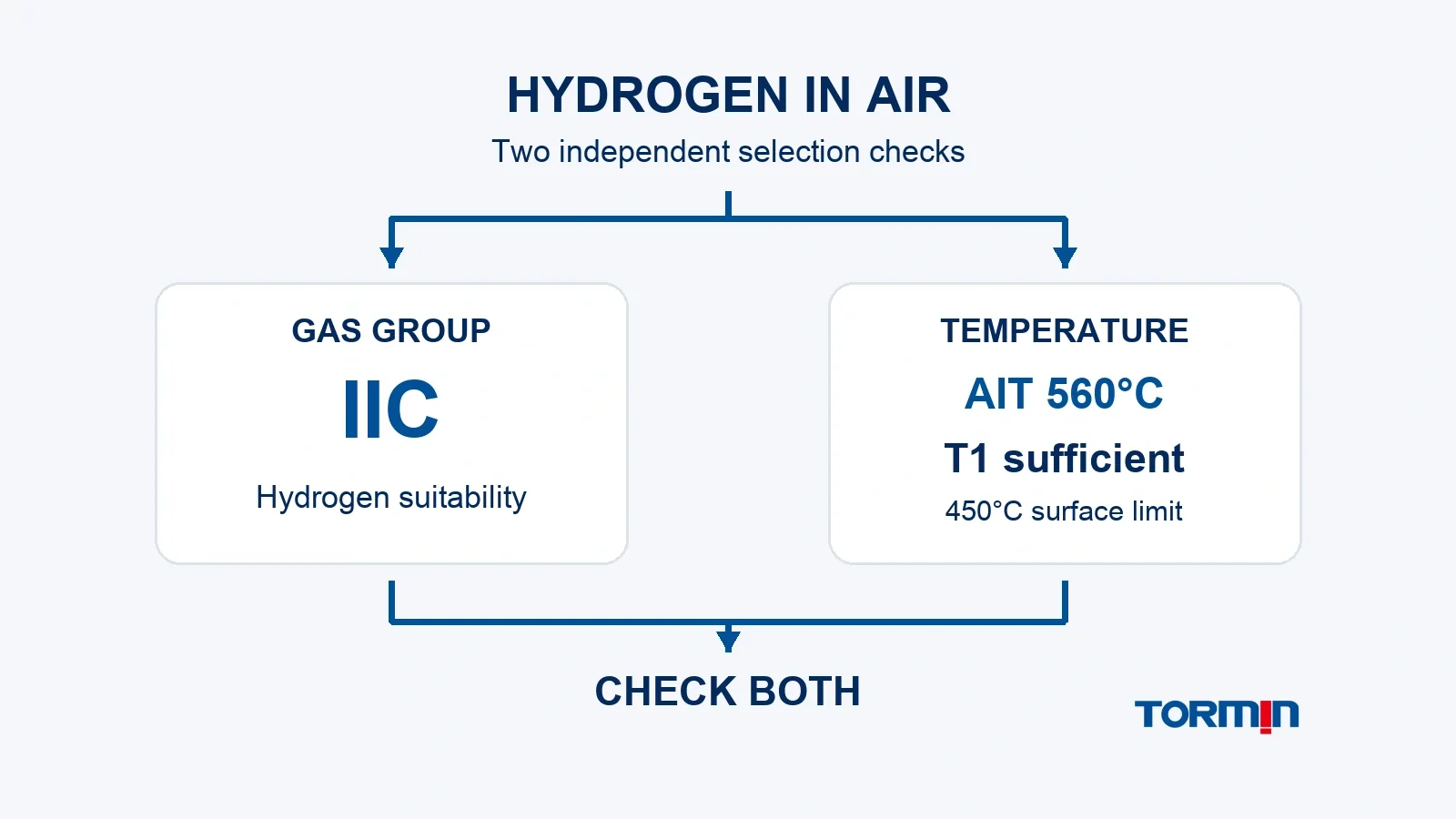
Gas group: specify IIC suitability for hydrogen. Temperature: select from the accepted auto-ignition temperature, not from the IIC label. Hydrogen’s IEC reference AIT is 560°C, so T1 already satisfies the temperature criterion for a hydrogen-only atmosphere under the stated assessment conditions; T6 is not automatically required. A certified IIB+H2 marking can provide a hydrogen-specific alternative, but it is not full IIC coverage. Zone/EPL, ambient conditions and the exact certificate must also match.
Hydrogen is demanding on one selection axis and permissive on the other. Its reference MESG is 0.29 mm and MIC ratio is 0.25: it belongs to IIC, the most demanding of the industrial gas subgroups IIA/IIB/IIC. Yet its 560°C AIT allows T1, the least restrictive numbered temperature class. These values follow the IEC 60079-20-1 data basis used in the parent guide, cross-checked against NSW TestSafe’s substance table.
That combination creates two opposite mistakes. Requiring T6 just because the gas is hydrogen can over-specify the purchase. Choosing an IIB-only light because hydrogen’s temperature requirement is permissive is a safety error. Explosion proof lighting for hydrogen must pass both checks independently.
Why IIC does not imply T6
On the group axis, hydrogen’s small MESG and low MIC ratio describe demanding flame-transmission and ignition characteristics under the relevant tests. MIC 0.25 is a dimensionless ratio, not 0.25 A. MESG 0.29 mm is a reference test result, not an allowable site-measured gap for repairing a luminaire. Do not turn either value into an installation tolerance.
On the temperature axis, the comparison is different: T1 limits the relevant maximum surface temperature to 450°C, below hydrogen’s reference AIT of 560°C. T6 limits it to 85°C, but hydrogen’s IIC classification does not create that much lower surface-temperature requirement. The temperature relationship follows IEC 60079-20-1:2010, Table 1 and the hydrogen entry in Annex B.
For the full definitions and reference tables, use the guide to selecting gas group and temperature class. Here, the decision is specifically about hydrogen in air under the accepted classification conditions; oxygen enrichment, unusual process conditions or other flammable substances require their own assessment.
The expensive mistake: making T6 the default
If the accepted hazard is hydrogen alone and the project has no stricter thermal requirement, rejecting an otherwise suitable IIC T4 light solely because it is not T6 adds an unsupported restriction. Paying extra for T6 in that situation buys no necessary improvement in the hydrogen temperature-class requirement. It can be wasted expenditure.
This is not a claim that every T6 light costs more. Compare actual quotations, output, ambient limits and availability. A suitable T6 model may be the normal stocked option, and a documented plant standard or another substance may justify it. The point is to avoid demanding or paying a premium for T6 because of hydrogen alone. Do not downgrade an installed or specified class without the responsible engineering review.
The unsafe mistake: accepting IIB because T1 is enough
An IIB-only T6 light still fails a hydrogen IIC group requirement. A cooler surface does not extend its certified gas coverage. Conversely, an IIC T4 candidate meets hydrogen’s group and temperature axes, provided its remaining ratings and conditions fit. The IIB vs IIC lighting comparison explains that group boundary without treating a T-class upgrade as a substitute.
Three hydrogen settings that need different selection inputs
The gas identity stays the same; the release sources and lighting locations change. Use the approved hazardous-area classification at each luminaire position, rather than assigning a Zone to an entire building from its name. Ventilation and gas detection belong in that assessment; see the Zone 0, Zone 1 and Zone 2 lighting guide rather than treating either measure as permission to relax the equipment marking. For stationary lead-acid battery rooms, use the hydrogen ventilation calculator for a separate airflow screen, not area classification.
Electrolytic hydrogen production hall
| Release feature to assess | Lighting-selection consequence |
|---|---|
| Hydrogen-bearing connections, valves and pipework associated with the electrolyzer can be release sources. | Map the light to the classified envelope around the actual equipment; an enclosed production hall is not automatically one uniform Zone. |
| Normal operating releases and foreseeable leak conditions may occur at different points. | Use the assessed release locations and operating states, including maintenance conditions, rather than distance from the stack alone. |
| A location assessed for hydrogen alone has the hydrogen group/temperature combination. | Specify IIC; T1 is sufficient on the reference temperature criterion unless the accepted site assessment imposes more. |
| Production equipment, service platforms and surrounding structures shape the lighting task. | Check the chosen model’s ambient limits and mounting conditions, then confirm task coverage with the actual layout and photometry. |
The OECD discussion of leakage in water electrolysis installations identifies pipework, joints and associated components as release considerations. It does not supply a universal luminaire setback or a ready-made classification for a particular hall.
Hydrogen refuelling station
| Release feature to assess | Lighting-selection consequence |
|---|---|
| Dispenser hoses and connections can release hydrogen during a failure. | Check canopy and local task-light positions against the station’s classified drawing; outdoor location alone does not remove the group requirement. |
| Dispensing, compression/storage equipment and vent locations have different release relationships. | Evaluate the relevant location separately rather than selecting every light from the dispenser label. |
| A canopy or nearby structure changes the physical setting around the release. | Supply actual elevations and mounting positions to the classification and lighting teams; do not assume that a high-mounted light is outside the hazardous area. |
| Hydrogen may be the only assessed gas at one location while another part of a multi-fuel site has different hazards. | Retain IIC for hydrogen and determine temperature from every substance relevant to that light, not from the station’s overall branding. |
A Clean Hydrogen Knowledge Hub incident record documents a dispenser-hose hydrogen release. It supports including the hose in the source review, not a failure-rate claim or a universal Zone boundary.
Lead-acid battery room: the existing hydrogen source that is easy to overlook
| Release feature to assess | Lighting-selection consequence |
|---|---|
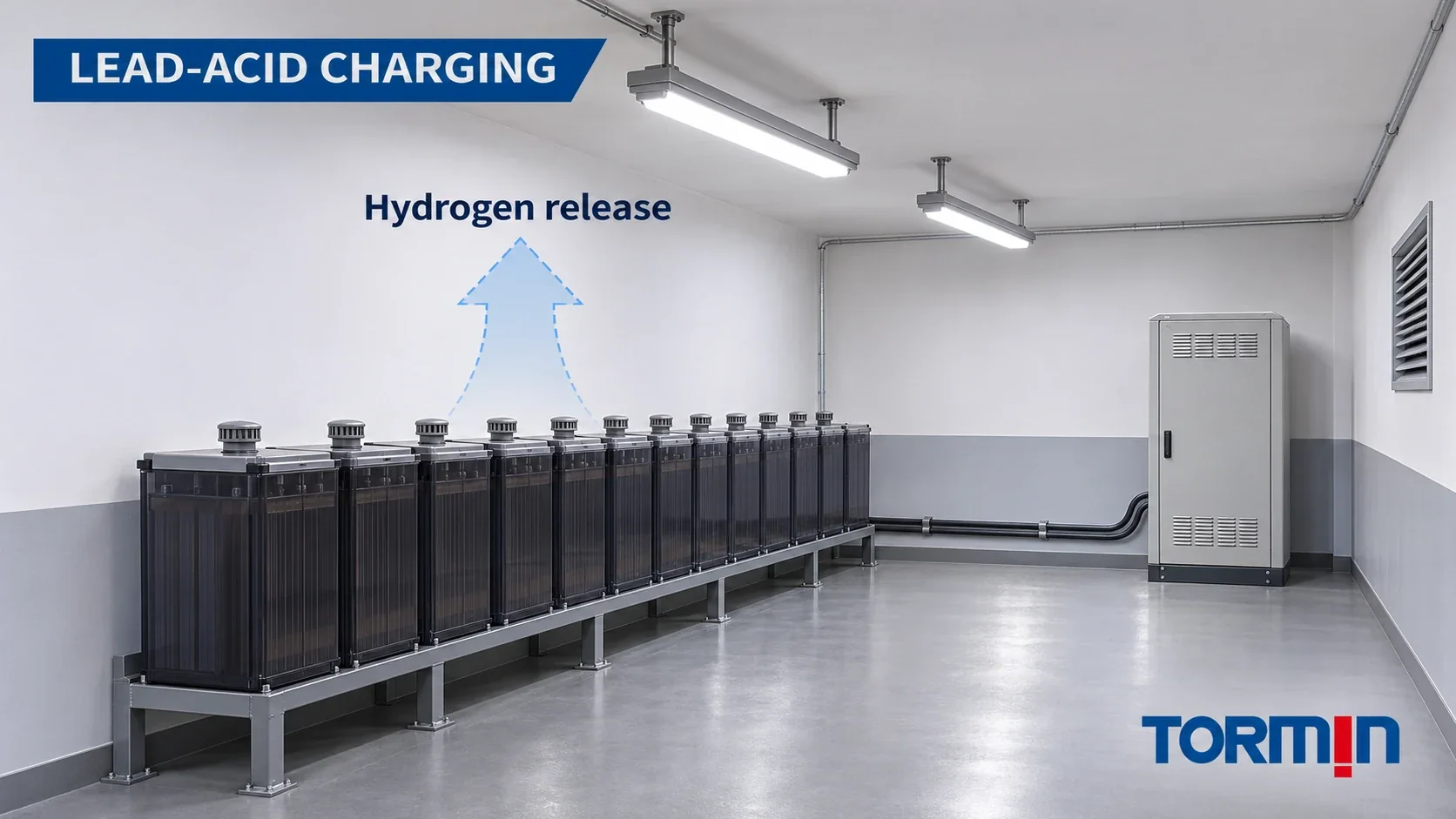
| Lead-acid batteries can generate hydrogen during charging; a dedicated hydrogen process is not necessary. | Include charging rooms, standby-power battery rooms and relevant charging bays in the hydrogen review. |
| Continued charging after full charge can increase gas generation. | Review battery type, charging regime and foreseeable abnormal conditions, not only the room’s normal unattended state. |
| Gas originates at battery vents; the light may be mounted above the rack. | Check the actual classified extent at the luminaire position. Ceiling mounting does not itself prove separation from the hazard. |
| An existing room may still have ordinary industrial lights or IIB-only fittings. | Verify the classification and installed markings before assuming the original lighting remains suitable; hydrogen requires IIC suitability or an accepted specific-gas route. |
HSE’s battery guidance describes hydrogen generation during charging and increased gassing with overcharge. A lead-acid room therefore can be a hydrogen application, but not every battery room is automatically Zone 1, and this reasoning must not be transferred indiscriminately to other battery chemistries.
IIB+H2: a valid specific-gas concept, not an IIC equivalent
IIB+H2 means IIB coverage plus hydrogen-specific coverage. Among the additional IIC gases, the extension is hydrogen only: it does not cover acetylene or carbon disulfide. It is therefore inaccurate both to reject it simply because the marking contains IIB and to describe it as interchangeable with full IIC.
IEC 60079-0 provides for equipment intended for a particular explosive atmosphere. Its specific-gas marking convention adds a chemical formula after a plus sign when that gas is covered in addition to a group. The accessible IEC 60079-0:2007 text, clauses 4.4 and 29.3(c), explicitly illustrates IIB+H2. This explains the standard concept; the edition, scope and conditions on the actual equipment certificate control an offered unit.
For procurement, the boundary is practical:
- Hydrogen-only group requirement: a genuinely certified IIB+H2 candidate may be acceptable if its protection type, EPL, temperature class, ambient range and certificate conditions meet the project, and the responsible specification permits this route.
- Acetylene or carbon disulfide also relevant: the H2 extension does not establish coverage. Require equipment whose certificate covers the actual atmosphere; do not substitute IIB+H2 for a full IIC requirement.
- Plant specification explicitly requires IIC: a supplier’s hydrogen-suitability argument does not amend that specification. Obtain an approved technical acceptance before substitution.
The case against blanket IIC purchasing can therefore be valid for a tightly defined hydrogen application. It is not valid as a claim of identical coverage or unrestricted future flexibility. This section describes a standards concept only; no TORMIN IIB+H2 product is claimed here.
Worked example: selecting lights for an electrolyzer hall
Consider a hypothetical indoor production hall. The responsible classification team has already issued an approved drawing identifying the proposed light positions as Zone 1, with a project requirement of EPL Gb. The assessed flammable atmosphere at those positions is hydrogen in air only. There is no solvent overlap, oxygen enrichment or special process condition changing the accepted substance data. The project supplies its actual ambient range and requires full IIC marking, with no additional T6 procurement rule. These are teaching assumptions, not a classification of a real installation.
- Read the location input. Zone 1 and the specified Gb requirement establish the protection-level screen. Do not derive them from the word “electrolyzer” or from hydrogen’s AIT. TestSafe identifies competent hazardous-area classification as the basis for equipment selection.
- Set the group independently. Hydrogen is IIC on the accepted IEC substance-data basis. Record IIC on the luminaire schedule. An IIB-only candidate fails here, regardless of its T-class; this example’s full-IIC specification also excludes an unapproved IIB+H2 substitution.
- Set the temperature requirement. Use hydrogen’s AIT of 560°C. T1’s 450°C maximum surface-temperature class is below that value, so T1 satisfies the temperature criterion. T2 through T6 are more restrictive surface-temperature classes and also satisfy this hydrogen-only temperature comparison. Do not infer that the proposed product actually operates at its class ceiling.
- Compare complete candidate documents. A hypothetical IIB T6 Gb candidate fails group coverage. A hypothetical IIC T4 Gb candidate passes these group, thermal and EPL screens. An IIC T4 Gc candidate fails this project’s Gb screen. These are candidate comparisons, not TORMIN ordering codes.
- Check the conditions that could reverse acceptance. Verify the exact model’s certificate/schedule, protection technique, declared ambient range at the selected T-class, external heating limits and installation instructions. Then confirm supply, cable-entry arrangement, mounting, lighting performance and any emergency duty against project inputs. A T4 rating that is unavailable at the required ambient cannot be assumed from a family heading.
- Issue the resulting specification. Record: “Zone 1; project EPL Gb; hydrogen IIC; temperature class T1 or a more restrictive class at the specified ambient; accepted certification and installation conditions required.” An IIC T4 Gb offer can satisfy this stated core specification once its exact documents and remaining project requirements pass. There is no hydrogen-driven reason to reject it for not being T6.
If diethyl ether can also create a flammable atmosphere at the same light, repeat the thermal screen: the accepted reference AIT is 175°C, so T4’s 135°C ceiling fits while T3’s 200°C ceiling does not. The resulting ordinary selection is IIC + T4 or a more restrictive temperature class: hydrogen controls the group, ether controls temperature. These values follow IEC 60079-20-1:2010, Table 1 and Annex B. For an actual combined gas mixture, obtain the accepted mixture classification rather than assuming pure-substance values always characterize it.
Conclusion: buy the required combination, then verify the model
For hydrogen, keep the demanding group requirement and the comparatively permissive thermal requirement separate. IIC does not force T6; T1 sufficiency does not permit IIB-only equipment. Use the classified location and actual substance inventory to determine the combination before comparing luminaires.
TORMIN’s current first-party pages provide these enquiry routes, subject to the specific model’s nameplate:
| Lighting role and product page | Printed gas marking on the referenced page |
|---|---|
| Zone 1 linear light | Ex eb mb op is IIC T6/T5/T4 Gb |
| BC9306P | Ex db eb IIC T6/T5/T4 Gb |
| BC9306S floodlight | Ex db eb IIC T6/T5/T4 Gb |
| BC9306S spotlight | Ex db eb IIC T6/T5/T4 Gb |
| BC9306AP / BC9306BP emergency lights | Ex db eb IIC T6/T5 Gb |
| BC9306AS / BC9306BS emergency lights | Ex db eb IIC T6/T5 Gb |
The slash-separated classes are configuration-dependent listings, not a promise that every variant is T6 or that one unit has every rating under the same conditions. In particular, the cited emergency pages list T6/T5, not T4. Send the classification, required group and temperature class, ambient conditions and lighting duty when requesting a model-specific offer; confirm the nameplate, certificate and schedule before acceptance.
FAQ
Do hydrogen lights have to be T6?
No. For hydrogen in air under the accepted reference conditions, the IEC AIT of 560°C allows T1 on the temperature criterion because T1 limits maximum surface temperature to 450°C. The light still needs IIC group suitability, or an accepted certified hydrogen-specific extension, plus the required EPL and operating conditions. Another substance or an approved project specification may require a more restrictive class. See IEC 60079-20-1:2010.
Can IIB+H2 replace IIC?
A certified IIB+H2 light can be accepted for a defined hydrogen application if the project permits it and the full certificate, EPL, temperature class and ambient limits fit. IIB+H2 covers IIB plus hydrogen; its hydrogen extension does not cover acetylene or carbon disulfide. It cannot be substituted indiscriminately for full IIC or an explicit IIC procurement requirement. The specific-gas convention is illustrated in IEC 60079-0:2007, clause 29.3(c).
Does a battery room count as a hydrogen application?
A lead-acid battery room can count because charging can release hydrogen, with increased gassing under overcharge conditions. The classification must establish whether each luminaire lies within a hydrogen hazardous area; the words “battery room” alone do not establish Zone 1 or make every light require Ex protection. If a location requires hydrogen suitability, check IIC or an accepted certified IIB+H2 route independently of temperature class. HSE’s battery guidance explains the charging-gas hazard.
What governs when hydrogen and diethyl ether are both present?
If both can form relevant flammable atmospheres at the same light, hydrogen normally sets IIC and diethyl ether’s 175°C reference AIT sets T4 or a more restrictive temperature class: T4 is 135°C, while T3 is 200°C. Do not use hydrogen’s permissive temperature requirement to ignore ether. An actual combined mixture needs its own accepted classification, and the required EPL, ambient limits and certificate conditions still apply. See IEC 60079-20-1:2010.
What if a workshop with existing IIB lights adds hydrogen production equipment?
Treat the addition as a hazardous-area change requiring reassessment before commissioning. Identify which existing lights fall within the revised hydrogen-classified extent, then review their exact markings and certificates. IIB-only equipment does not become hydrogen-suitable by being T6. Have the responsible competent team resolve replacement, relocation or an approved alternative for affected lights before hazardous service; do not assume every light in the building must be replaced. TestSafe explains the classification basis for equipment selection.
Sources
- NSW TestSafe – Electrical and non-electrical testing resources – IEC-referenced substance data and competent hazardous-area classification.
- IEC 60079-20-1:2010 – Material characteristics for gas and vapour classification: Test methods and data – Table 1 and Annex B substance entries; technical text checked in the identical BIS adoption. This is the stated reference-data edition, not a claim that it is the latest project-adopted edition.
- OECD – Risk-based Regulatory Design for the Safe Use of Hydrogen, “Production: Leakage in water electrolysis installations” (2023) – Electrolyzer release-source considerations.
- Clean Hydrogen Knowledge Hub – Leak at a filling hose of a hydrogen dispenser – Documented dispenser-hose release mechanism.
- HSE – Using electric storage batteries safely, INDG139 – Charging and overcharging gas hazards.
- IEC 60079-0:2007 – Equipment: General requirements, identical BIS adoption – Clauses 4.4 and 29.3(c), specific-atmosphere certification and additional-gas marking. Historical text is used to explain the convention; the actual certificate and applicable adopted edition govern equipment acceptance.
TORMIN first-party product documents
- Zone 1 linear light – Printed IIC T6/T5/T4 Gb gas marking with eb, mb and op is protection.
- BC9306P – Printed Ex db eb IIC T6/T5/T4 Gb listing.
- BC9306S floodlight – Printed Ex db eb IIC T6/T5/T4 Gb listing.
- BC9306S spotlight – Printed Ex db eb IIC T6/T5/T4 Gb listing.
- BC9306AP / BC9306BP emergency lights – Printed Ex db eb IIC T6/T5 Gb listing.
- BC9306AS / BC9306BS emergency lights – Printed Ex db eb IIC T6/T5 Gb listing.