
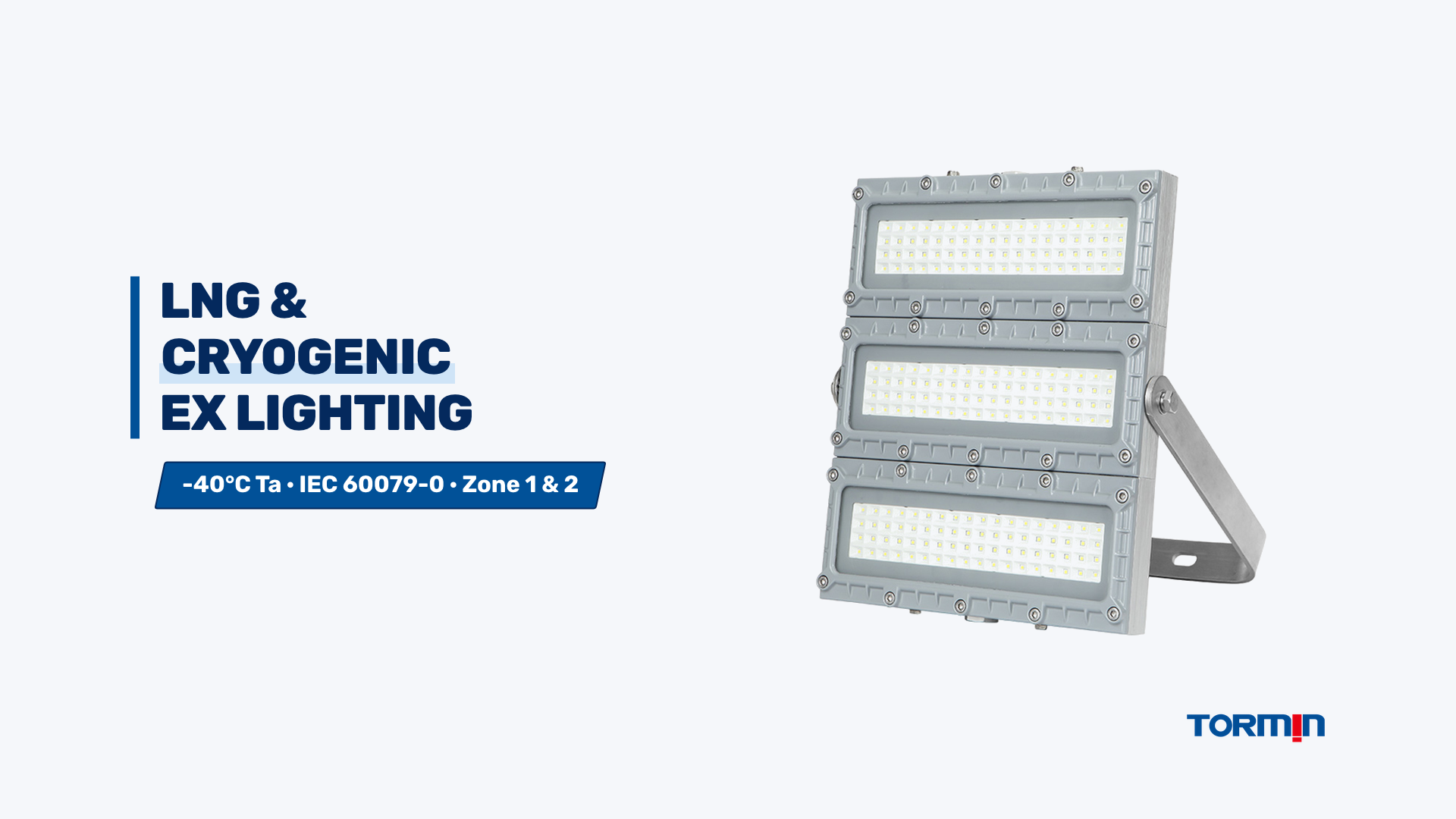
Standard ATEX and IECEx luminaires are certified by default only down to -20 °C under IEC 60079-0, making them non-compliant in sub-zero liquefied natural gas (LNG) liquefaction trains, Arctic terminals, and cryogenic vapor-plume zones. Specifying hazardous-area lighting for -40 °C LNG plants requires explicit low-ambient Ex certification, cold-rated silicone gaskets, low-ESR cold-start drivers, and strict siting outside -162 °C liquid-spill zones.
LNG and cryogenic facilities combine three harsh engineering constraints simultaneously: flammable hydrocarbon vapors (methane boil-off plus heavier refrigerant streams), extreme cold ambient or cold-plume temperatures down to -40 °C, and aggressive coastal salt spray at marine export or receiving jetties. Before shortlisting ATEX explosion-proof lighting, explosion-proof LED linear lights, or explosion-proof LED floodlights, project engineers should separate process-unit gas groups, -40 °C IEC 60079-0 physics, and sub-zero emergency power architecture using the boundaries below.
LNG Facility Process Zones, Gas Groups, and Cryogenic Spill Exclusion Boundaries
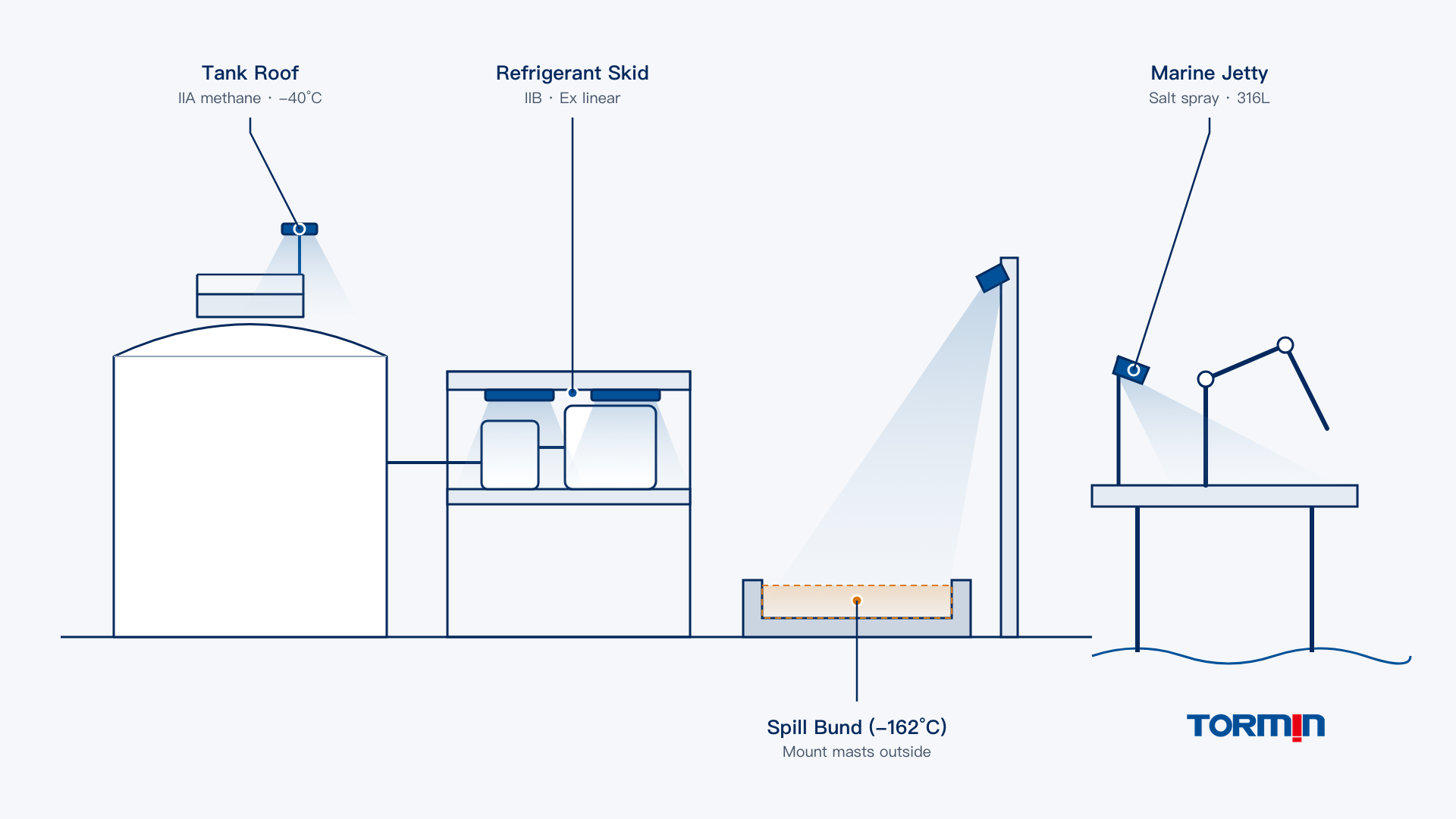
Although pure LNG boil-off gas is predominantly methane (Gas Group IIA, autoignition temperature above 530 °C, T1), LNG liquefaction and regasification plants frequently contain heavier hydrocarbon refrigerants such as propane, ethane, or ethylene that tighten equipment requirements to Gas Group IIB and T3 or T4. Mapping each facility zone by both gas composition and cold-exposure mechanism prevents dangerous under-specification.
| LNG / Cryogenic Plant Area | Dominant Flammable Medium | Typical Ex Zone & Gas Group | Cold & Environmental Exposure | Recommended Luminaire Strategy |
|---|---|---|---|---|
| Liquefaction & Mixed-Refrigerant Skid | Methane, propane, ethylene refrigerants | Zone 1 / Zone 2 (IIA to IIB, verify T3–T4) | Cold vapor plumes, heavy pipe-rack vibration | -40 °C rated Ex linear (e.g., BC5402A) mounted above drip lines |
| LNG Storage Tank Roof & Pump Column | Methane boil-off gas | Zone 1 near relief vents; Zone 2 general | High wind, -40 °C winter/plume cold, coastal salt | Low-wind-area Ex linear or stanchion-mounted floodlight |
| Cryogenic Spill Impoundment & Drip Pan | Liquid LNG at -162 °C during upset | Zone 1 / Zone 0 inside sump | Direct cryogenic thermal shock (-162 °C) | Exclusion zone: mount floodlights on perimeter masts outside bund |
| Regasification & Vaporizer Bay | Cold natural gas + seawater spray | Zone 2 (verify leak boundaries) | Freezing mist, heavy ice/salt accretion | IP66 -40 °C modular floodlight (e.g., BC9102S) with 316 hardware |
| Marine LNG Jetty & Loading Arm | Cargo vapor release + sea spray | Zone 1 around manifold; Zone 2 trestle | Direct salt spray, -40 °C cold, marine wind | Coastal C5/WF2 Ex linear and aimed jetty floodlights |
Never confuse a -40 °C ambient luminaire rating with cryogenic liquid immersion; no standard explosion-proof LED housing survives direct -162 °C LNG liquid contact without brittle metal fracture and glass shatter. Keep all luminaires outside cryogenic drip trays and impoundment trenches, illuminating spill basins remotely from elevated perimeter masts. For real-world waterside LNG access context, see our Xiaomendao LNG terminal photo archive (a June 2020 historical site-context archive only, not a current model certificate) and our oil and gas lighting solutions page.
Why Standard -20 °C Ex Luminaires Fail at -40 °C Under IEC 60079-0
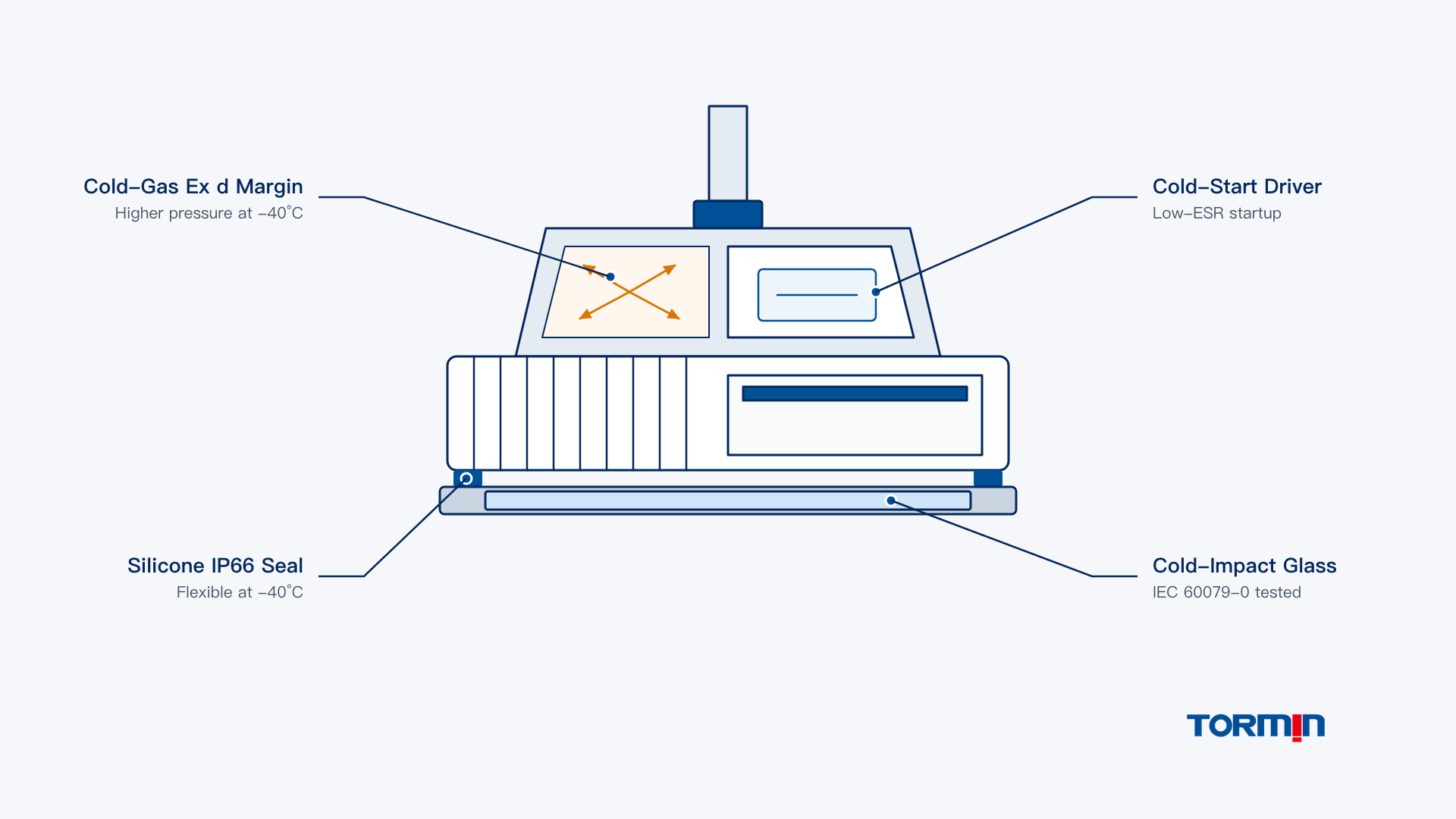
Under IEC 60079-0, any electrical equipment intended for ambient temperatures below -20 °C must carry an explicit extended ambient marking on its nameplate and certificate (for example, Ta = -40 °C to +55 °C). Operating a standard -20 °C luminaire in a -40 °C cryogenic plant violates both physical safety margins and hazardous-area compliance for four engineering reasons.
| Sub-Zero Failure Mechanism (-40 °C) | Physical Cause Below -20 °C | Governing Compliance Boundary | Mandatory Luminaire Design Feature |
|---|---|---|---|
| Higher Ex d Explosion Pressure | Denser cold gas increases peak internal explosion pressure during an arc fault | IEC 60079-0 low-temperature reference-pressure test | Reinforced flameproof enclosure tested for extended low Ta |
| Elastomer Gasket Embrittlement | Standard NBR or generic EPDM hardens near glass transition and cracks | IEC 60529 IP66 + IEC 60079-0 cold thermal conditioning | Molded cold-rated silicone or fluorosilicone perimeter seals |
| LED Driver Cold-Start Failure | Liquid electrolytic capacitor ESR spikes sharply below -30 °C | Manufacturer cold-start voltage and inrush rating | Industrial -40 °C rated constant-current driver topology |
| Polymer & Cable-Seal Cracking | Non-metallic lenses, O-rings, and cable sheaths lose impact strength | IEC 60079-0 cold-conditioned impact test | Cold-impact qualified tempered glass/optics and cold-rated Ex glands |
When selecting luminaires for cold-climate LNG sites, confirm the extended lower ambient limit directly in the product specification and certificate schedule rather than relying on generic brochure claims. For example, the TORMIN BC5402A explosion-proof linear luminaire (30 to 80 W, 3,300 to 8,400 lm, IP66) lists an ambient temperature range of -40 to +40 °C / +55 °C by configuration, and the modular BC9102S explosion-proof floodlight (60 to 300 W, 120 to 240 VAC, IP66) offers -40 °C ambient configurations in its catalogue scope. Always verify the exact Ex marking, gas group, T-class, and ambient range on the official certificate PDF in the TORMIN Standards and Certifications archive; never assume UL 844 or CSA North American listing unless explicitly documented for the ordered SKU.
Sub-Zero Emergency Lighting Battery Derating and Remote Power Architecture
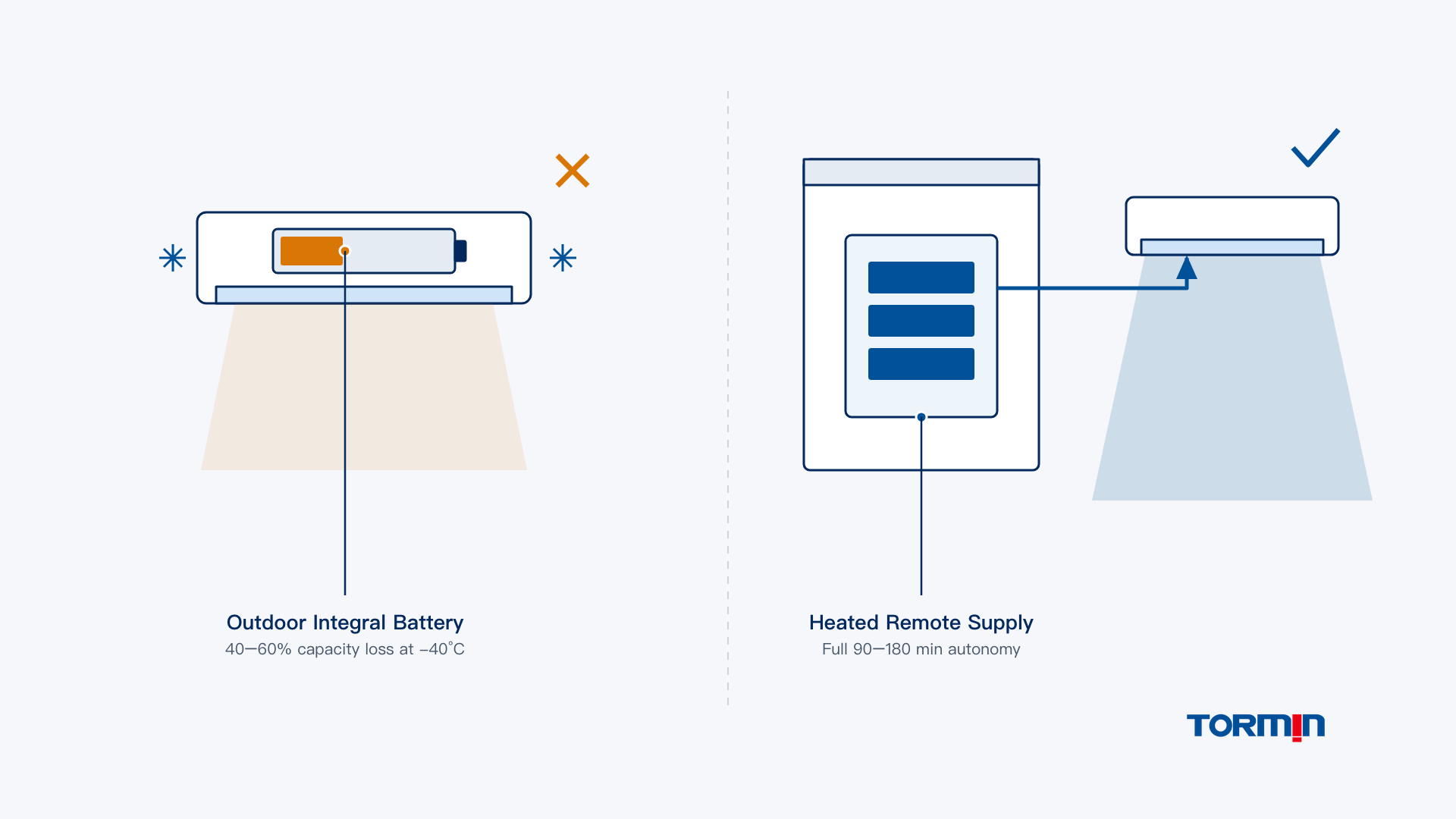
Self-contained explosion-proof emergency luminaires represent the highest hidden reliability failure point in -40 °C LNG plants. While LED chips actually increase luminous efficacy in cold air, electrochemical battery packs suffer severe internal resistance spikes below 0 °C, cutting usable discharge autonomy by 40 to 60 percent and making lithium-ion charging unsafe below freezing without active thermal management.
To guarantee 90-minute or 180-minute egress illumination during a winter plant blackout, engineering teams should choose between two proven cold-weather architectures:
- Centralized Remote Emergency Power Supply (Recommended for Extreme Cold): Place the battery bank, charger, and changeover inverter inside a heated, non-hazardous electrical substation or control building, and feed dedicated emergency-circuit Ex luminaires outdoors via fire-rated cabling. This eliminates sub-zero battery degradation and keeps routine battery testing out of classified zones. Review compatible emergency lighting power supplies and verify runtime margins with our Emergency Battery Runtime Checker.
- Cold-Rated Self-Contained Battery Units (Where Central Cabling Is Impractical): Specify wide-temperature nickel-cadmium (Ni-Cd) cells paired with a certified internal battery heater only where the complete heated assembly is explicitly approved for the site’s ambient Ta and T-class.
Coastal Salt Spray, Cold-Weather Cabling, and IEC 60079-14 Installation Checks
Most LNG liquefaction and receiving terminals sit directly on ocean coastlines, exposing -40 °C luminaires to simultaneous freeze-thaw cycling and chloride salt mist. Standard PVC-sheathed cables stiffen and crack when bent during winter installation, while dissimilar-metal gland threads corrode rapidly in coastal fog unless specified for marine environments.
Specify cold-bend rated armored cables, certified -40 °C Ex cable glands with cold-rated elastomer seals, and 316 or 316L stainless steel fasteners and brackets across jetty trestles and exposed tank decks. Keep upstream area-classification, gas-group, marine-corrosion, and gland-sealing procedures aligned with our canonical guides on Zone 0, Zone 1, and Zone 2 lighting, gas groups and temperature classes, marine and offshore explosion-proof lighting, and explosion-proof lighting installation. During IEC 60079-17 winter maintenance rounds, inspect silicone gaskets for ice-jacking damage and confirm that all unused cable entries remain sealed with certified Ex stopping plugs.
LNG and Cryogenic Lighting Specification Checklist Before Requesting a Quotation
Requesting a generic explosion-proof luminaire for an LNG plant without declaring the minimum ambient Ta, refrigerant gas group, and emergency battery architecture forces suppliers to quote standard -20 °C hardware that fails commissioning. Include the five controlled inputs below in your project enquiry:
- Extended Ambient & Thermal Envelope: Minimum design ambient temperature (for example, -40 °C), maximum summer ambient Ta (+40 °C or +55 °C), and confirmation that fixtures sit outside -162 °C cryogenic spill zones.
- Gas Group & T-Class Scope: Exact hazardous Zone (Zone 1 or Zone 2), gas group (IIA for pure methane vs. IIB where ethylene or mixed refrigerants exist), and required T-class (T3 to T6).
- Coastal & Mechanical Protection: Required IP66/IP67 rating, ISO 12944 C5 or WF2 marine coating, 316 stainless steel hardware option, and wind-load or vibration retention requirements.
- Emergency Lighting Architecture: Centralized remote emergency circuit vs. self-contained cold-rated battery pack, required autonomy duration (90 or 180 minutes), and supply voltage/frequency.
- Verification Package: Request -40 °C confirmed datasheets, IES or LDT photometric files for DIALux verification, and current model-specific ATEX or IECEx certificate schedules.
For model-specific -40 °C datasheets, IES photometric files, and certificate schedules across our BC5402A explosion-proof linear and BC9102S modular floodlight families, send your project schedule to [email protected] or via the TORMIN Contact page.
Sources
- IEC 60079-0:2017 — Explosive atmospheres: Equipment general requirements — supports extended low-ambient Ta marking below -20 °C, cold-gas reference explosion pressure, and cold-conditioned impact testing.
- IEC 60079-14:2024 — Explosive atmospheres: Electrical installations design, selection and erection — supports hazardous-area luminaire selection, cold-rated cable glands, and installation boundaries.
- IEC 60079-17:2023 — Explosive atmospheres: Electrical installations inspection and maintenance — supports cold-weather gasket, enclosure, and stopping-plug inspection intervals.
- IEC 60529 — Degrees of protection provided by enclosures (IP Code) — supports IP66 and IP67 sealing against freezing mist, wind-driven rain, and coastal salt spray.
- TORMIN Standards and Certifications Archive (first-party product documentation) — supports model-specific ATEX, IECEx, CE, and CNEX certificate verification.