
Short answer
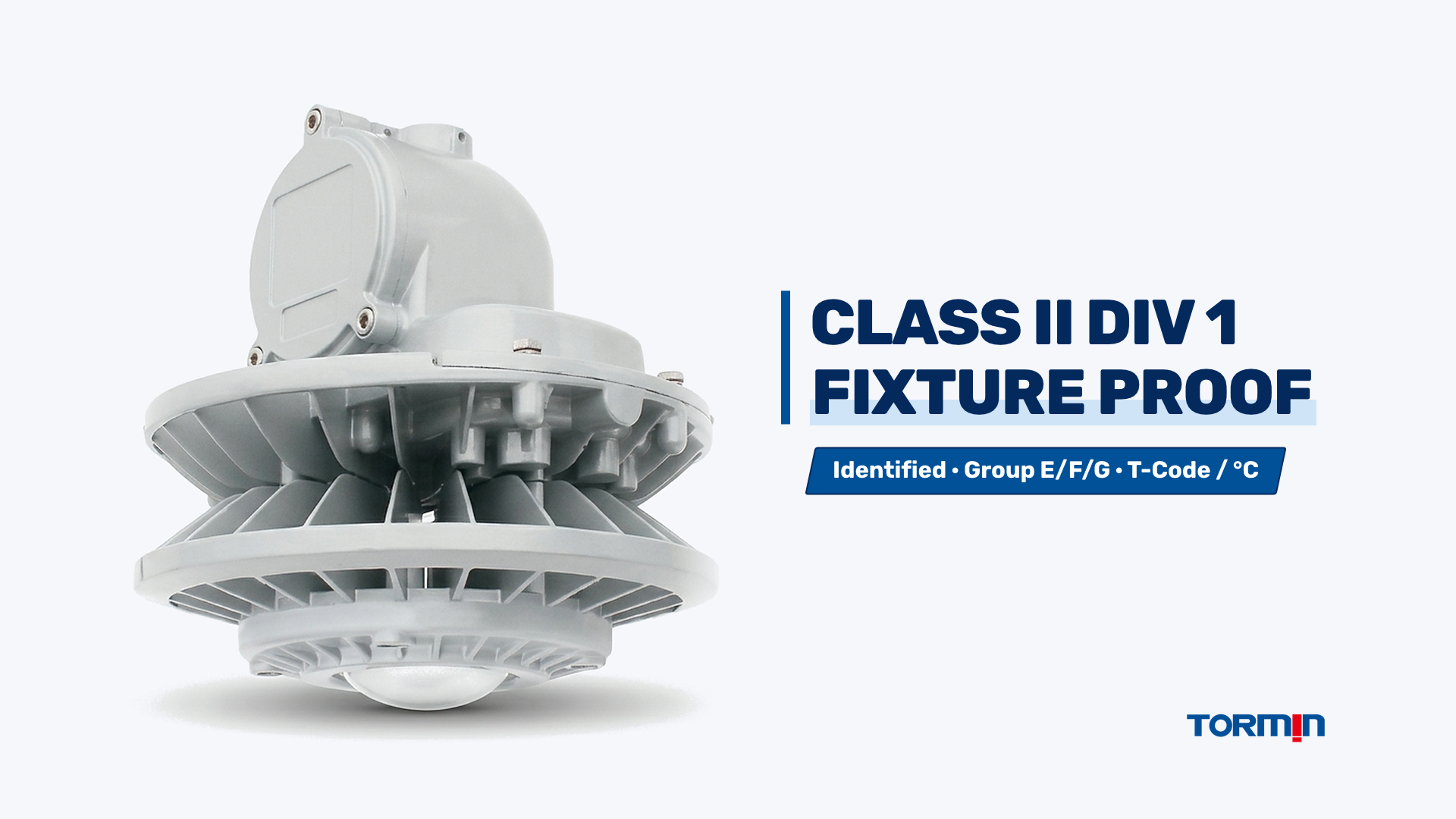
Before a luminaire enters a National Electrical Code (NEC) Class II, Division 1 combustible dust area, its permanent nameplate and approval record must match four site requirements: Class II, Division 1 location suitability (a dust-ignitionproof assembly), the specific combustible dust group (Group E, Group F, or Group G), a dust-blanketed surface temperature limit (a NEC T-code or °C value) valid for the site’s ambient range, and the evaluated lamp or integrated LED wattage configuration. Buyers often search for class 2 division 1 lighting as one product label, yet approval depends on matching all four fields to the area classification schedule and installation rules. (Code basis: NEC citations follow the NEC 2020 edition as adopted in the 2022 California Electrical Code; confirm the edition and local rules enforced by your authority having jurisdiction, or AHJ.)
| Nameplate Element | What It Proves | If Missing, Mismatched, or Misread |
|---|---|---|
| Class II, Division 1 suitability (dust-ignitionproof) | Assembly is recognized as suitable for Class II, Division 1—typically via listing to dust-ignitionproof standards—excluding dust and preventing internal ignition of clouds or tested layers. | Rejected in Class II, Division 1. Class I explosionproof (or IEC Ex d) fixtures are unacceptable unless also identified for Class II. |
| Dust group (Group E, F, or G) | Joint tolerances, shaft or lens seals, and dust-blanketed thermal dissipation were evaluated under product certification standards for that dust family. | Group approvals never transfer. Group G or F fixtures fail in Group E metal dust, where conductive particles bridge internal clearances. |
| Temperature marking (T-code or °C) and ambient (Ta / Tamb) | Maximum exterior surface temperature—as a NEC T-code or °C value at rated ambient—when tested under the maximum dust layer that accumulates on the housing. | If absent (with no exception), if a Class I gas T-code is read by mistake, or if site air exceeds Ta/Tamb, thermal margin is unverified. |
| Lamp type and max wattage (or LED configuration) | Light-source type, electrical input, and thermal load under which the enclosure passed its dust-blanketed temperature evaluation. | Relamping above max wattage or substituting an unapproved LED driver or array alters heat output and voids temperature suitability. |
Where Division 1 dust actually is
Under NEC 500.5(C)(1), a Class II, Division 1 location is an area where combustible dust is in the air under normal operating conditions in quantities sufficient to produce explosive or ignitible mixtures, where mechanical failure or abnormal machinery operation might produce such a mixture while simultaneously providing an ignition source through electrical failure or protection-device operation, or where Group E combustible metal dusts may be present in hazardous quantities. Typical examples include dust-collection points and baghouse hoppers, mixing, milling, and grinding equipment surroundings, and bucket elevator heads, boots, or transfer chutes. Under NEC 500.4, boundaries between Class II, Division 1, Class II, Division 2, and unclassified areas are set on formal area classification drawings rather than guessed from a plant’s industry type; see how to determine Class, Division, and Zone ratings for classification documentation, and explosion-proof lighting for combustible dust environments for broader dust-hazard mechanics and housekeeping regimes.
The three groups, and why E is different
Under NEC 500.8(B)(1) and 500.8(C)(3), material group marking is mandatory for Class II, Division 1 because different dust families stress joints, internal clearances, and external heat dissipation in distinct ways. NEC 500.6(B) divides Class II dusts into three groups:
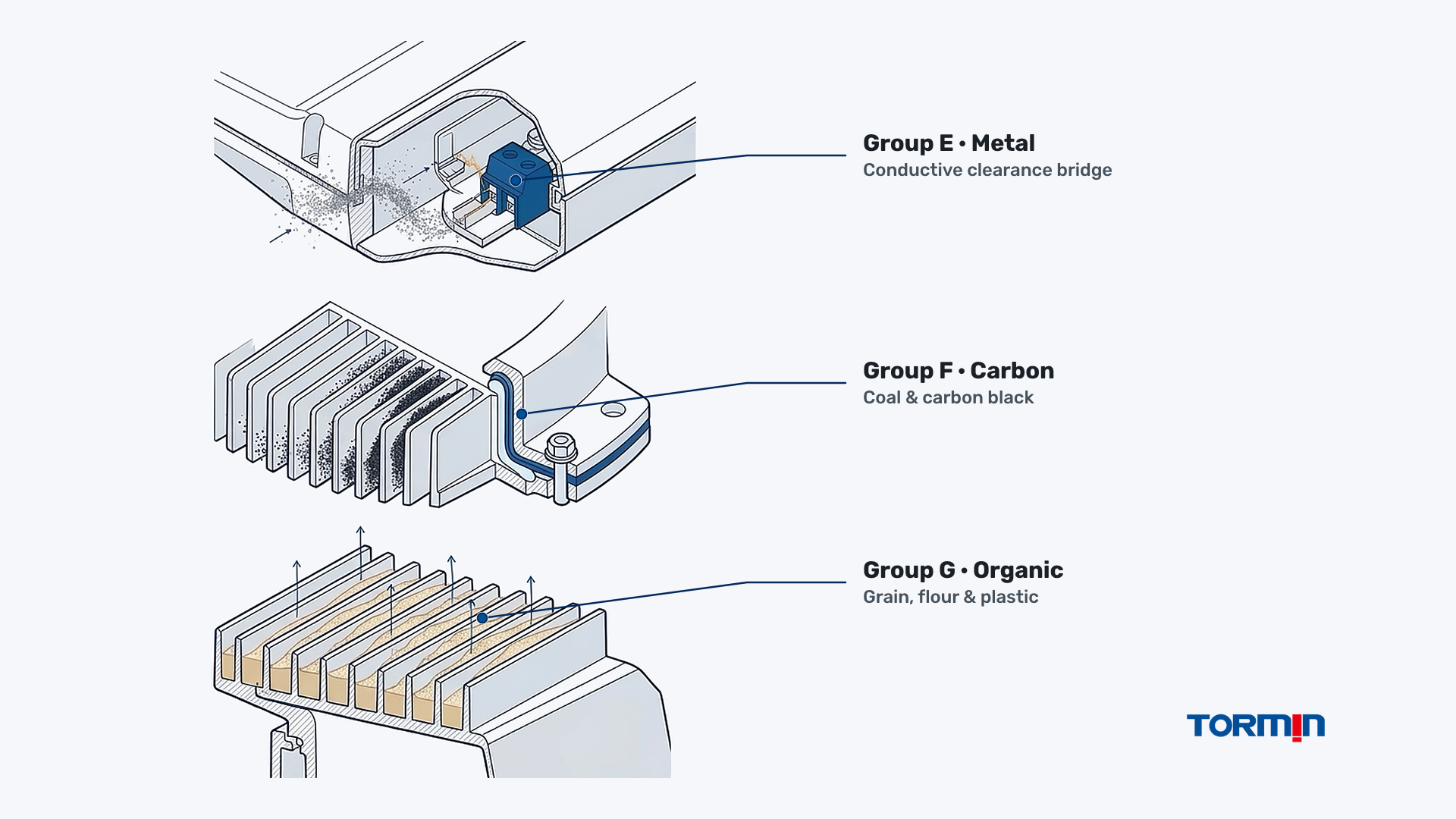
- Group E (combustible metal dusts): Combustible metal dusts—such as aluminum, magnesium, and their commercial alloys—or other dusts whose particle size, abrasiveness, and conductivity create similar hazards.
- Group F (combustible carbonaceous dusts): Carbonaceous dusts—such as coal, carbon black, charcoal, and petroleum coke—whose trapped volatiles or sensitization present an explosion hazard.
- Group G (other combustible dusts): Combustible dusts not in Group E or Group F, including flour, grain, wood, plastic, and chemical dusts; for how Group G agricultural spaces apply these ratings, see explosion-proof lighting for grain silos and feed mills.
While NEC 500.6(B) defines the groups and NEC 500.8(C)(3) requires group marking, physical testing for a group is performed under the product certification standard (such as ANSI/UL 1203, referenced in NEC Article 100 informational notes). Group evaluation addresses joint and shaft tightness against particle entry, thermal blanketing of dust layers, and dust ignition temperature (NEC 500.6(B) Informational Note 2).
Group E invalidates any claim that “all Class II fixtures are interchangeable.” With Group G grain, flour, or plastic dust, settled dust is non-conductive; the fixture excludes dust and sheds heat through an insulating layer under test conditions. Group E metal dust is both abrasive and electrically conductive. If fine metallic particles penetrate a flange or gasket during thermal breathing, they settle across internal terminals, driver spacings, or sockets and form a conductive bridge, triggering internal arcing while external metal dust surrounds the casting. Under NEC 500.5(C)(1), hazardous quantities of Group E dust also place a space directly into Class II, Division 1. A luminaire marked only for Groups F and G is prohibited in a Group E area, so the exact group letter (E, F, or G) must always be verified.
Identified and dust-ignitionproof: what the words commit to
Under NEC 502.130(A)(1), in Class II, Division 1 locations, each luminaire (fixed and portable) shall be identified for the location and clearly marked to indicate the type and maximum wattage of the lamp for which it is designed.
- “Identified for the location” (NEC Article 100 and 500.8(A)): “Identified” means recognizable as suitable for the specific purpose or environment. Under NEC 500.8(A), suitability is established via (1) equipment listing or labeling, (2) evaluation evidence from a qualified testing laboratory or inspection agency, or (3) evidence acceptable to the AHJ. In North American practice, third-party NRTL listing to dust-ignitionproof luminaire standards (such as UL 844 and ANSI/UL 1203) is the primary evidence used.
- “Dust-ignitionproof” (NEC 500.7(B) and Article 100): Article 100 defines dust-ignitionproof as enclosed to exclude dusts and not permit arcs, sparks, or heat generated inside the enclosure to ignite exterior accumulations or atmospheric suspensions of a specified dust. That certification test evaluates the fixture under standardized dust-chamber and dust-blanketing conditions for its approved mounting orientations and ambient range—it does not permit burying a fixture in bulk material or skipping housekeeping.
This also explains NEC 502.5: explosionproof equipment and wiring are not required and are not acceptable in Class II locations unless also identified for such locations. Neither a North American Class I explosionproof luminaire nor an IEC Ex d flameproof luminaire qualifies for NEC Class II, Division 1 by default. Gas flamepath gaps are not automatically dust-excluding, and compact gas-rated housings can overheat under settled dust.
Finally, NEC 502.130(A)(1) requires marking lamp type and maximum wattage. While that phrasing originated with replaceable-lamp fixtures, the same thermal rule governs fixed integrated LED luminaires, where the approval record binds the housing to a specific LED array, driver current, and input wattage. Relamping above marked wattage or swapping an unapproved LED driver or board alters heat generation and voids the temperature rating basis. See reading an explosion-proof lighting nameplate and certificate for verifying rating plate fields against certification files.
Dusttight is a Division 2 answer
In NEC Article 502, dust-ignitionproof and dusttight are distinct protection techniques assigned to different divisions under NEC 500.7(B), 500.7(C), and 502.130.
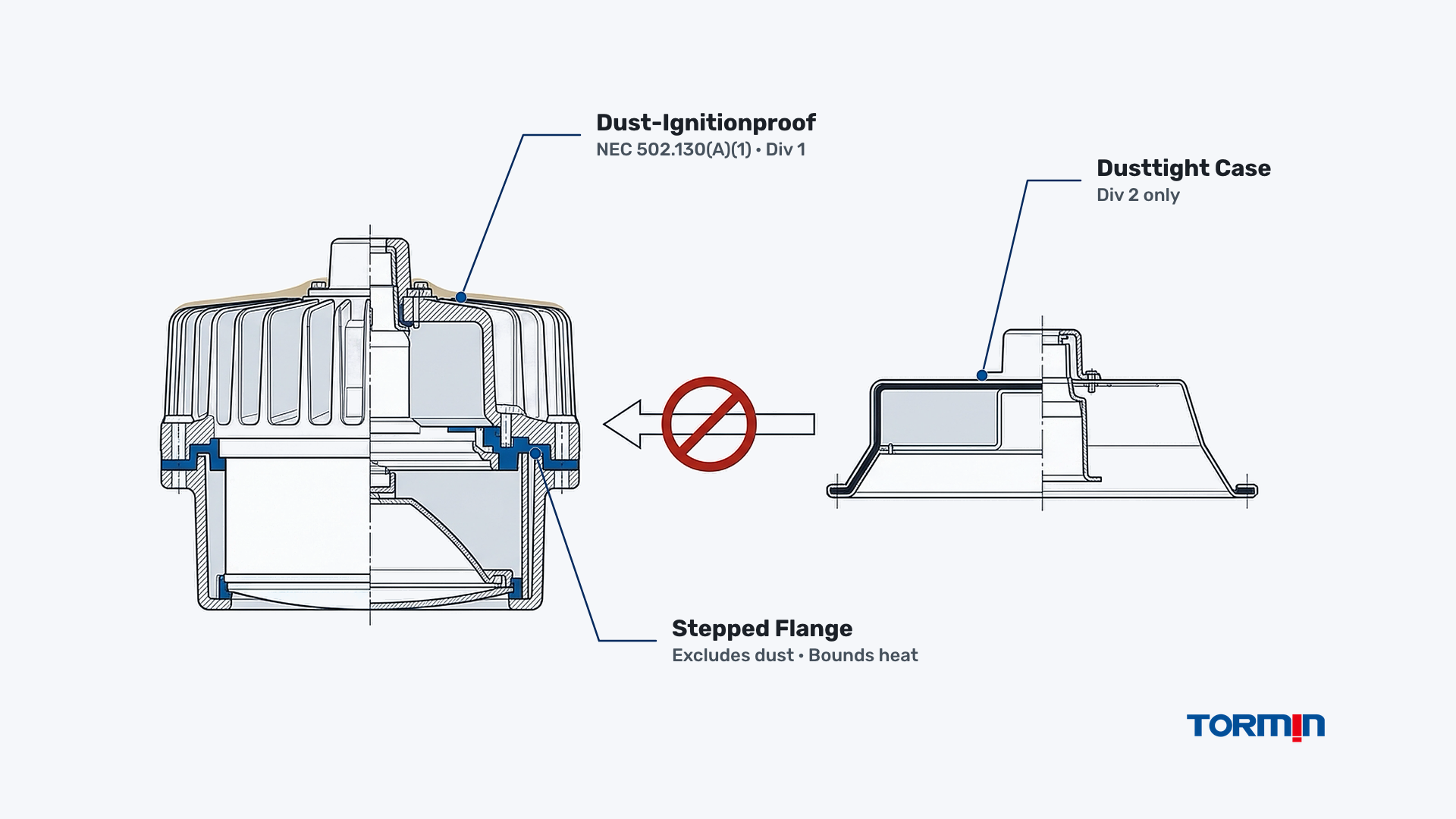
Under NEC 502.130(A)(1), a Class II, Division 1 luminaire must be identified for the location (dust-ignitionproof per 500.7(B)) and marked with lamp type and maximum wattage. Under NEC 502.130(B)(2), fixed lighting in Class II, Division 2 may use enclosures that are dusttight or otherwise identified for the location, marked with the maximum wattage permitted without exceeding the exposed surface temperature limit under normal use.
| Requirement | Class II, Division 1 (NEC 502.130(A)(1)) | Class II, Division 2 (NEC 502.130(B)(2)) |
|---|---|---|
| Identity | Identified for Class II, Division 1 (dust-ignitionproof per 500.7(B) and Article 100). | Dusttight enclosure (500.7(C), Article 100) or otherwise identified for the location. |
| Thermal Basis | Tested under maximum dust-blanketing accumulation (500.8(C)(4)) and dust-air exposure (500.8(B)(1)). | Evaluated for exposed surface temperature under normal Division 2 conditions of use. |
| Markings | Dust group (500.8(C)(3)) plus lamp type and max wattage (or LED configuration). | Max lamp wattage within temperature limit (group exception for certain Division 2 fixed luminaires per 500.8(C)(3) Exception). |
| Directionality | Suitable for Division 1 and Division 2 (within marked group and temperature limits). | Never permitted in Class II, Division 1. |
A Division 2 dusttight luminaire cannot be used in Class II, Division 1. For the separate rules governing what Division 2 and Zone 2 accept and when general-purpose fixtures are rejected there, see general-purpose lighting in Division 2 and Zone 2.
Reading the temperature marking: T-codes, °C values, and dust-blanketed limits
Under NEC 500.8(C)(4), the temperature marking for a Class II, Division 1 luminaire may be either a temperature class (T-code) from Table 500.8(C) or an operating temperature in degrees Celsius (°C), determined at rated ambient and based on operation when blanketed with the maximum amount of dust that can accumulate on the equipment under standard test conditions (subject only to the narrow 500.8(C)(4) Exception for non-heat-producing and qualifying low-temperature equipment). On the IEC side (IEC 60079-31 enclosure “t”), nameplates state maximum surface temperature only in °C. Never reject a NEC Class II, Division 1 luminaire merely because its nameplate uses a Table 500.8(C) T-code instead of a direct °C number.
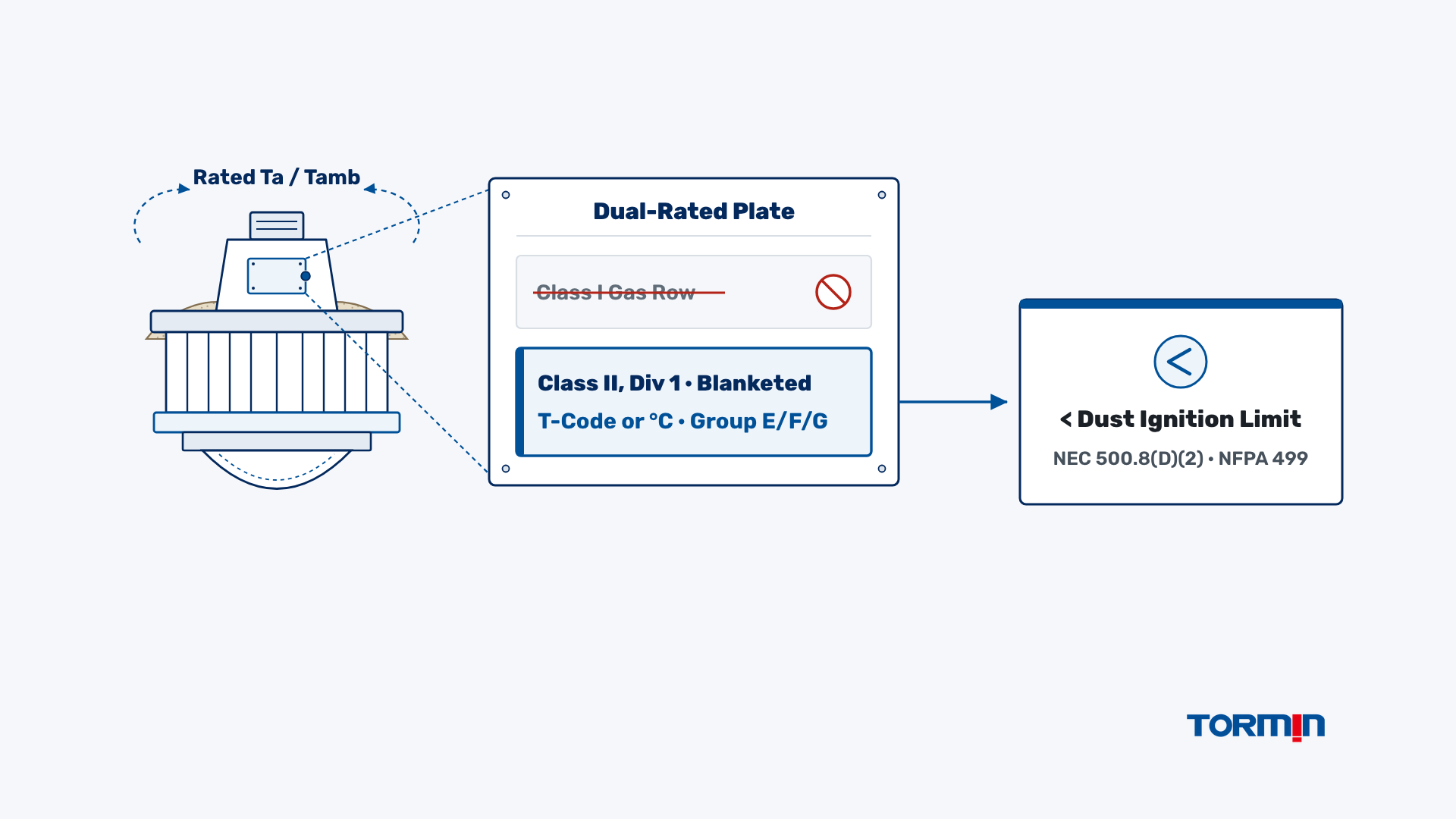
Instead, check four items on the rating plate:
- Class, Group, and operating condition: A nameplate may list separate ratings for Class I gases and Class II dusts, or a simultaneous-exposure rating (500.8(C)(4) Informational Note). Because a dust blanket traps heat, a dual-rated fixture often shows a cooler T-code for Class I gas and a more restrictive T-code or °C value for Class II, Division 1 dust. Read the marking assigned to Class II, Division 1 and the required dust group, never the Class I gas row.
- Maximum surface temperature: Whether printed as a Table 500.8(C) T-code or a direct °C value, verify the surface temperature ceiling it establishes.
- Ambient range (Ta or Tamb) under NEC 500.8(C)(5): For hot roof bays or process spaces above standard room conditions, the nameplate must carry a special ambient marking (Ta or Tamb in °C) covering that environment.
- Dust ignition limit under NEC 500.8(D)(2): The Class II temperature marking must be less than the ignition temperature of the specific dust per project test data, NFPA 499 references, and classification records.
Keep NEC and IEC systems distinct: NEC Groups E, F, and G do not map one-to-one onto IEC groups IIIA, IIIB, and IIIC. To see how the IEC framework calculates cloud-versus-layer surface temperature limits, check dust groups IIIA, IIIB, and IIIC and surface temperature limits and our dust surface temperature checker—noting that IEC tools illustrate IEC 60079-series rules and do not replace a NEC 500.8(D)(2) and NFPA 499 determination for a North American Division project.
Wiring pointers
A listed Class II, Division 1 luminaire loses its protection if its raceway, support hardware, or bonding path violates NEC Article 502. Verify four interface points under the locally adopted edition:
- Wiring methods and conditional cables (NEC 502.10(A)): Baseline raceways are threaded rigid metal conduit (RMC), threaded steel intermediate metal conduit (IMC), and Type MI cable with approved fittings. Listed cables (Type MC-HL, ITC-HL, TC-ER-HL, and Type P) in 502.10(A)(1) are not unconditional substitutes—each requires qualifying industrial establishments, maintenance supervision, specific armor/jacket constructions, and listed fittings. Boxes and fittings must be dusttight, have threaded bosses for taps, joints, or terminals, and be identified for Class II wherever taps, joints, or terminals exist or in Group E areas (502.10(A)(3)).
- Dust-exclusion sealing (NEC 502.15): Where a raceway connects a dust-ignitionproof enclosure with one that is not, provide permanent dust exclusion via a seal or code-specified horizontal or downward vertical run.
- Guards, stems, and Class II supports (NEC 502.130(A)(2)–(4)): Protect luminaires from physical damage (502.130(A)(2)), secure pendant stems with required bracing or flexible connectors (502.130(A)(3)), and use boxes or fittings identified for Class II to support luminaires (502.130(A)(4)).
- Bonding (NEC 502.30(A)): Do not rely on locknut-bushing or double-locknut contact; use bonding jumpers with proper fittings or other approved bonding means.
Mistakes
During submittal review and field inspection, check for four verification failures:
- Assuming a Class I explosionproof luminaire (or IEC Ex d flameproof fixture) fits NEC Class II, Division 1: Under NEC 502.5, explosionproof equipment is unacceptable in Class II unless also identified for the Class II location and dust group.
- Using a Division 2 dusttight luminaire in Class II, Division 1: A dusttight housing permitted in Division 2 (NEC 502.130(B)(2)) never satisfies the Class II, Division 1 requirement for an identified dust-ignitionproof assembly (502.130(A)(1)).
- Checking “Class II” while ignoring the dust group: Group G or F suitability never covers conductive Group E metal dust (NEC 500.6(B)(1), 500.8(C)(3)).
- Misreading the temperature or source rating: Reading a Class I gas T-code for a Class II dust area, ignoring ambient limits (Ta/Tamb), exceeding marked wattage, or modifying an integrated LED driver/array outside its approval record invalidates the rating basis.
To compare industrial and IEC hazardous-area luminaires across regional standards, browse our hazardous area lighting product category and confirm on the approval record that any fixture selected for a North American NEC Class II, Division 1 installation carries the exact suitability evidence, Group E/F/G marking, and dust temperature rating required by your classification schedule and AHJ.
FAQ
What does dust-ignitionproof mean for a light fixture?
Under NEC Article 100 and 500.7(B), dust-ignitionproof is the enclosure technique for Class II, Division 1 luminaires. The assembly is evaluated (commonly under ANSI/UL 1203 and UL 844) so dust cannot enter and internal arcs, sparks, or heat cannot ignite surrounding dust clouds or tested surface layers within its rated orientation and ambient range—stricter than a Division 2 dusttight enclosure (502.130(B)(2)).
Can I use a Class I Division 1 light in a Class II Division 1 area?
No, not by default. Under NEC 502.5, explosionproof equipment rated only for Class I gas (or IEC Ex d) is unacceptable in Class II unless also identified for Class II. It is acceptable only when the nameplate and approval record include Class II, Division 1 suitability, the required dust group (E, F, or G), and a Class II dust-blanketed temperature marking.
Does the dust group matter, or is “Class II” enough?
“Class II” alone is not enough. Under NEC 500.6(B) and 500.8(C)(3), the specific dust group (Group E, F, or G) is mandatory. Group E conductive metal dust is critical because metallic particles breaching an inadequate joint can bridge internal clearances and cause arcing.
How is the temperature marking shown on a NEC Class II Division 1 nameplate?
Under NEC 500.8(C)(4), a Class II, Division 1 nameplate may show either a Table 500.8(C) T-code or an operating temperature in °C, evaluated at rated ambient while blanketed with dust under standard test conditions (whereas IEC 60079-31 marks only °C). Verify that the marking applies to Class II, Division 1 and the dust group, check Ta/Tamb, and confirm under NEC 500.8(D)(2) that it sits below the dust’s ignition limit.
Can a dusttight fixture rated for Division 2 be used in Division 1?
No. Under NEC 500.7(C) and 502.130(B)(2), dusttight is a Class II, Division 2 solution. Class II, Division 1 requires an assembly identified for the location (dust-ignitionproof under 502.130(A)(1) and 500.7(B)) with the required dust group, dust-blanketed temperature marking (T-code or °C), and evaluated lamp or LED wattage configuration.
Sources
- NFPA 70 / 2022 California Electrical Code (NEC 2020 basis), Article 100, Article 500, and Article 502 — Definitions, Class II, Division 1 classification (
500.5(C)(1)), dust groups E/F/G (500.6(B)), suitability (500.8(A)), temperature markings (500.8(C)–(D)), explosionproof exclusion (502.5), wiring (502.10(A),502.15,502.30(A)), and luminaire rules (502.130(A)–(B)). - NFPA 499 — Recommended Practice for the Classification of Combustible Dusts and of Hazardous (Classified) Locations for Electrical Installations in Chemical Process Areas — Combustible dust ignition properties and Class II classification.
- USCG Outer Continental Shelf National Center of Expertise — Inspection Note DD-027: Hazardous Location Equipment Temperature Markings (NEC / IEC) — Reading NEC Table 500.8(C) T-codes, °C temperatures, and ambient markings.
- IEC 60079-31 — Explosive Atmospheres, Part 31: Equipment Dust Ignition Protection by Enclosure “t” — International dust protection by enclosure “t”.