
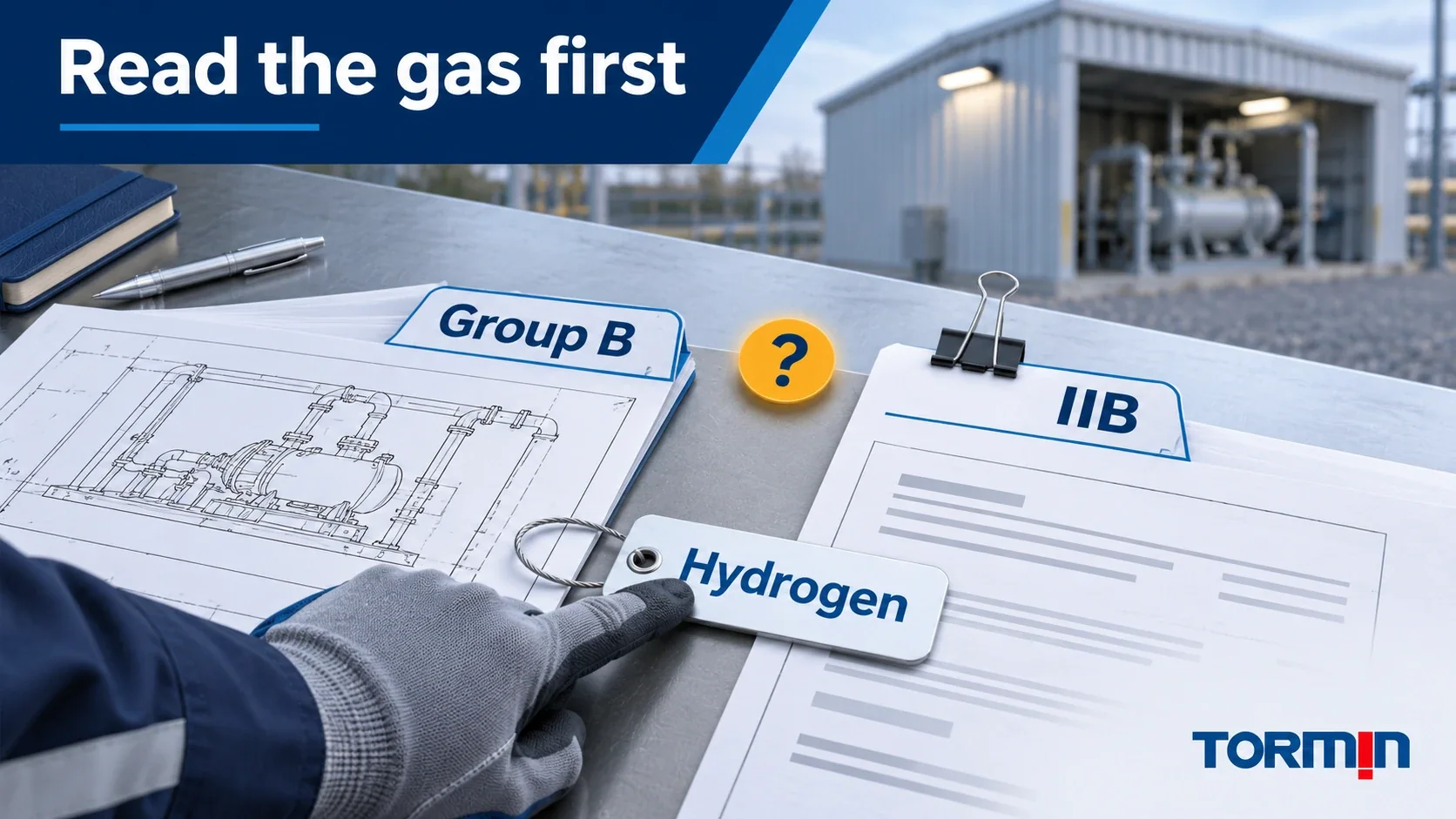
A North American drawing specifies Class I, Group B. An overseas lighting quotation says IIB. Both contain the letter B, so the offer looks plausible. If the atmosphere contains hydrogen, that reading fails: hydrogen is NEC Group B but IEC IIC. A plain IIB marking does not cover hydrogen on the IEC gas-group axis.
The useful comparison is substance first: identify hydrogen, look up its group in the system being reviewed, then check the equipment documents. Alphabet position cannot do that work. NEC A–D and IEC IIA–IIC organize their protection requirements in opposite directions, and their boundaries are different.
This guide to NEC gas groups vs IEC gas groups gives four substance anchors, explains why letter substitution fails, and walks through an IEC quotation for a hypothetical hydrogen project. It also keeps a separate question visible throughout: matching a gas group does not establish approval for a North American installation.
Two systems, two sets of group labels
For the NEC Class I A–D framework, the anchor substances are acetylene for Group A, hydrogen for Group B, ethylene for Group C, and propane for Group D. NFPA 497 material classifications and NEC Article 500 provide the relevant context. NFPA’s public committee record reproduces those group definitions and examples. Here, A is the most demanding end and D the least demanding end of the group-protection sequence. NFPA 497 extracts in the NFPA 505 committee record
For IEC industrial gas groups, the sequence runs from IIA through IIB to IIC. Propane anchors IIA, ethylene anchors IIB, and hydrogen and acetylene are IIC substances. IIA is the least demanding end; IIC is the most demanding. This describes group-related protection requirements, not a complete ranking of chemical or process danger. HSA ATEX Concepts
Two properties help explain the grouping. Maximum experimental safe gap, or MESG, concerns flame transmission through a specified test gap. Minimum igniting current ratio, or MIC ratio, compares ignition by an electrical test circuit with the reference gas under specified conditions. A smaller MESG means flame transmission must be arrested across a smaller test gap; a lower MIC ratio indicates ignition at less current relative to the reference in that test. These are test properties, not instructions for machining a luminaire joint or choosing an operating current. IEC 60079-20-1 describes the gas-classification methods and substance data. IEC data and methods, reproduced in the BIS identical adoption
This article compares the A–D and IIA–IIC group vocabularies. It does not imply that North America uses only Divisions; see our Class I Division 1 vs Division 2 lighting guide for the separate Division/Zone framework discussion.
Four anchor gases: compare substances, not positions
| Substance | NEC Class I group | IEC gas group | Why it sits there |
|---|---|---|---|
| Acetylene | A | IIC | Named NEC Group A substance; IEC MESG 0.37 mm / MIC ratio 0.28 accompanies its IIC classification. |
| Hydrogen | B | IIC | NEC Group B anchor; IEC MESG 0.29 mm / MIC ratio 0.25 accompanies its IIC classification. |
| Ethylene | C | IIB | NEC Group C anchor; IEC MESG 0.65 mm / MIC ratio 0.53 accompanies its IIB classification. |
| Propane | D | IIA | NEC Group D anchor; IEC MESG 0.92 mm / MIC ratio 0.82 accompanies its IIA classification. |
Table note: This is an anchor illustration, not a conversion table. NEC assignments are supported by the NFPA committee extracts, PDF page 8. All MESG/MIC numbers shown are IEC-side values from IEC 60079-20-1:2010 Annex B, PDF pages 30, 31 and 71 of the BIS adoption; they are not NEC threshold values.
Read the rows in NEC order: A, B, C, D moves toward less demanding group protection. Read the IEC sequence IIA, IIB, IIC: it moves toward more demanding group protection. Four groups also cannot form a one-to-one match with three. Acetylene and hydrogen occupy separate NEC groups while both appear in IEC IIC.
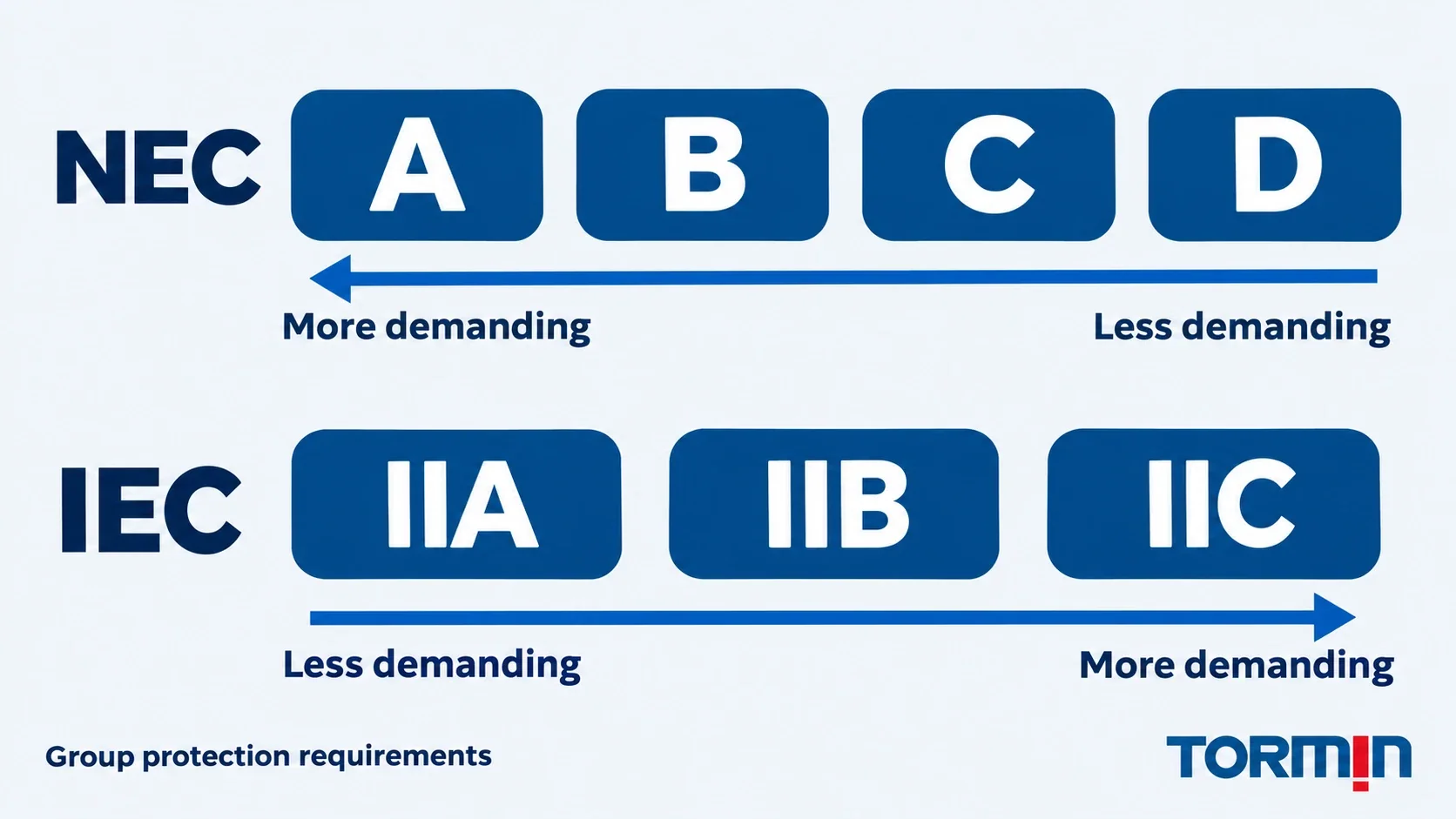
The direction diagram is a memory aid, not a permission to select a product from a single supposedly superior letter. In particular, check the actual groups covered by a North American listing rather than treating the A–D order as an automatic equipment-coverage ladder. A product record may identify a particular combination of approved groups. The relevant question is whether that record covers the atmosphere and installation specified for this project.
Why letter conversion fails
1. Group counts and classification boundaries differ
The extra NEC group is not a spare letter that can simply be dropped. Acetylene has its own named NEC category, while the IEC scheme places it in IIC alongside hydrogen. The grouping criteria also divide MESG and MIC properties differently. Similar test terminology therefore does not create identical classification bins.
Hydrogen makes the failure immediate. B is the second letter in the NEC sequence, but hydrogen belongs at the most demanding end of the IEC industrial gas-group sequence. Reading the second IEC subgroup, IIB, from the second NEC letter selects the wrong group. The substance assignment, rather than alphabet position, resolves the question.
A reference chart can legitimately place the two assignments beside the same substance. That is different from a universal rule that transforms one group label into another. Do not apply a row for one anchor gas to every substance sharing its NEC group. Use the material data and the target standard’s classification instead. The IEC classification clauses and Annex B provide the technical basis for that lookup.
2. A familiar name may hide a different material
A purchase request may identify a utility by a commercial name, while its SDS identifies a mixture or a particular composition. Translating the label before resolving the material identity carries the original uncertainty into the equipment selection. A matching-looking letter adds no missing chemical information.
Start with the process inventory and SDS, including the chemical name, CAS identification where applicable, and composition. Confirm that the lookup entry describes the substance actually present. For mixtures, request the project’s documented classification or competent assessment; do not assume that a trade name or the most abundant component settles the group. IEC 60079-20-1 treats mixtures separately from simple pure-substance lookup.
If the drawing, SDS and quotation describe different materials, resolve that discrepancy before accepting the offer. The question for the supplier is which atmosphere its proposed marking covers, with supporting documents. It is not whether a sales description sounds like the plant’s service name.
3. Group classification does not transfer approval
An IEC group describes one equipment-selection axis. ATEX conformity assessment, IECEx certification and North American listing are separate approval frameworks. An IIC marking does not, by itself, establish a Class I, Division 1, Group B listing. IECEx itself explains that national certification or approval processing may still be necessary in member countries. IECEx Certified Equipment Scheme FAQ
The same luminaire can have documentation for more than one market, but each claimed scope needs its own evidence. Similar test methods, a familiar enclosure, or an IEC certificate number cannot supply an absent North American listing. For luminaires, UL 844 is one relevant hazardous-location standard listed in OSHA’s recognized UL scope; mentioning the standard is not proof that a particular light is listed to it.
Ask for the exact product’s certification record, covered configuration and applicable marking. Group, Division or Zone, temperature limitations and installation conditions remain separate checks. OSHA’s rule requires approval for the specific atmosphere, not merely a generic hazardous-location description. OSHA 1910.307(c)(2)(i)
The substance-first method for reviewing a quotation
-
Identify the actual substance from the drawing and SDS. Record the chemical identity and reconcile inconsistent names. For a mixture or changing process stream, obtain the classification basis rather than treating a single constituent as the entire atmosphere. Keep the project’s required approval system alongside the material name so it survives the quotation review.
-
Look up that substance in the target system. When reading an IEC offer, use IEC 60079-20-1 data. For a practical entry point, open our IEC gas-group and auto-ignition-temperature table and find the Hydrogen row: its IEC gas group is IIC. That lookup resolves the group question without translating the NEC letter. For an NEC equipment specification, use the applicable NEC/NFPA material classification and project code edition instead.
-
Check the equipment’s group coverage within that system. On the IEC gas-group axis, IIC equipment covers IIB and IIA atmospheres as well, subject to its documented scope and conditions. Plain IIB does not cover IIC. Our IIB vs IIC lighting guide explains that coverage rule. It is an IEC subgroup rule, not permission to move equipment into another certification framework. IECEx-hosted selection training, slide 33 presents the permitted equipment groups separately from temperature selection.
-
Check temperature as an independent axis. A satisfactory group marking cannot compensate for an unsuitable temperature classification. Use the substance’s ignition data and the equipment’s certified temperature marking at the relevant ambient conditions. Our gas-group and temperature-class selection guide owns that two-axis method; no temperature-class conversion is inferred from the letters here.
-
Require the approval system specified for the installation. If the project calls for North American listed equipment, obtain the applicable listing and exact-model scope. If reviewing an IEC/ATEX specification, verify its corresponding documents. Use the group comparison to understand the other party’s paperwork, then assess approval independently. Keep the original project requirement in the purchase order rather than replacing it with a translated shorthand.
Keep the review traceable to one ordering code. A certificate for a related family, an optional configuration or a different market version may not describe the item on the quotation. Ask the supplier to connect the quoted code to the marking and certification scope in its submitted documents. Otherwise, an apparently corrected group entry can leave the original uncertainty about what will actually arrive on site.
For a supplier clarification, state the material, required approval framework and disputed marking together. For example: “The service is hydrogen. Please provide the exact model’s applicable listing and explain the offered IEC group marking.” This gives the reviewer a verifiable response to assess and prevents a revised group letter from quietly becoming a claim of complete compliance.
Worked example: hydrogen compressor shelter
The following is a hypothetical document-review example, not a TORMIN project or product offer. A North American buyer has a hydrogen compressor-shelter drawing marked Class I, Group B. An IEC quotation arrives with the illustrative marking Ex db eb IIB T4 Gb.
First identify the material: hydrogen. Its IEC group is IIC. The offered plain IIB marking therefore fails the IEC gas-group check. The shared B in the drawing and quotation has no corrective effect. Even if the temperature and every other operating condition were independently acceptable, the gas-group mismatch would remain.
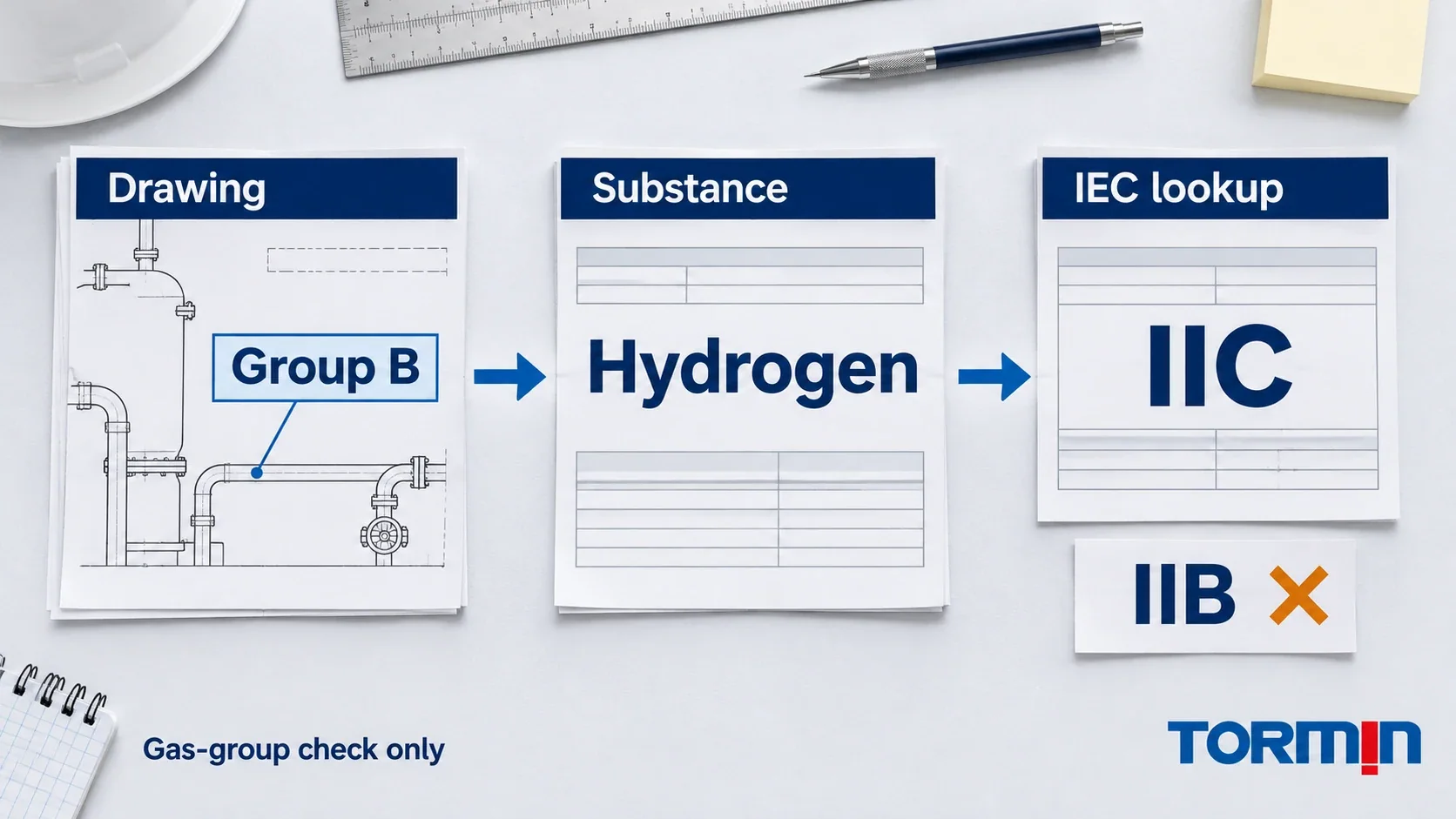
For a corrected IEC comparison, the equipment would need IIC group coverage. Merely editing the quotation is insufficient: the offered model and configuration must actually carry that scope, subject to the specific model’s nameplate and certificate. The example marking is not evidence that any real product has the stated protection types or ratings.
The North American procurement decision is still open after that correction. The buyer must obtain the listing required by the project, covering the exact equipment and classified-location requirement. An IIC IEC certificate alone does not close it. The completed review therefore produces two precise findings: reject the offered IIB scope for hydrogen, and request the required North American approval evidence separately.
Do not record the review simply as “change B to C.” Record the substance, the target-system group and the remaining approval requirement. That explanation lets another engineer reproduce the decision and prevents the correction from being mistaken for a universal conversion rule.
Keep the boundary at gas groups
This comparison covers gases and vapors. Class II Groups E/F/G and IEC dust Groups IIIA/IIIB/IIIC require their own treatment; see our dust-group and surface-temperature marking guide. Division/Zone classification is also outside this letter comparison and belongs in the Class article linked above. Neither question is resolved by finding the matching substance row.
FAQ
Is NEC Group B the same as IEC IIB?
No. Hydrogen is NEC Group B and IEC IIC. Matching the letter B would produce an incorrect IEC group selection for hydrogen. Check the actual substance in the target system, then verify the equipment’s documented coverage.
Which is more severe, NEC Group A or IEC IIC?
Each is the most demanding group-protection end of its own sequence. Acetylene is NEC Group A and IEC IIC. There is no cross-system severity conversion that establishes equivalent equipment approval or a complete ranking of gas hazards.
Can I convert a NEC gas group to an IEC group?
There is no universal official letter-to-letter substitution. Substance-based comparisons are useful, but you must look up the actual material’s classification in the target framework. Four NEC groups and three IEC groups cannot be paired one to one.
Does an IIC-certified light automatically meet a Class I, Division 1, Group B requirement?
No. IIC addresses the IEC gas-group axis. A North American project requiring a listing needs the applicable exact-product listing and scope; ATEX or IECEx evidence alone does not supply it. Check the Division, group, temperature and other project conditions in that approval record.
Where do I find the IEC gas group for a specific gas?
Use IEC 60079-20-1 substance data, supported by the actual material identity and project assessment. Our IEC substance table is a screening entry point; the Gas Group x Temperature Class Checker helps review the two IEC axes. Neither converts a North American listing.
Sources
- NFPA — NFPA 505 second-revision committee report, 2022 — PDF page 8 reproduces NFPA 497:2021 group definitions and anchor substances. This committee record does not establish the code edition adopted by a project.
- Health and Safety Authority — ATEX Delivery Guide: Concepts — IEC gas-group concepts and reference gases.
- BIS — IS/IEC 60079-20-1:2010, identical adoption of IEC 60079-20-1:2010 — classification methods and Annex B IEC substance properties; public reproduction of the national adoption.
- IECEx — FAQs: Certified Equipment Scheme — certification records and national approval processing.
- OSHA — UL LLC, NRTL scope of recognition — includes UL 844 for hazardous-location lighting fixtures; not a product certificate.
- Peter Thurnherr / IECEx Industry Symposium — Electrical installations design, selection and installation of equipment, including initial inspection, Edinburgh 2023 — slide 33 illustrates equipment-group coverage and separate temperature selection; training, not a product certificate or an adopted-code clause citation.
- OSHA — 29 CFR 1910.307, Hazardous (classified) locations — atmosphere-specific equipment approval and marking context.