
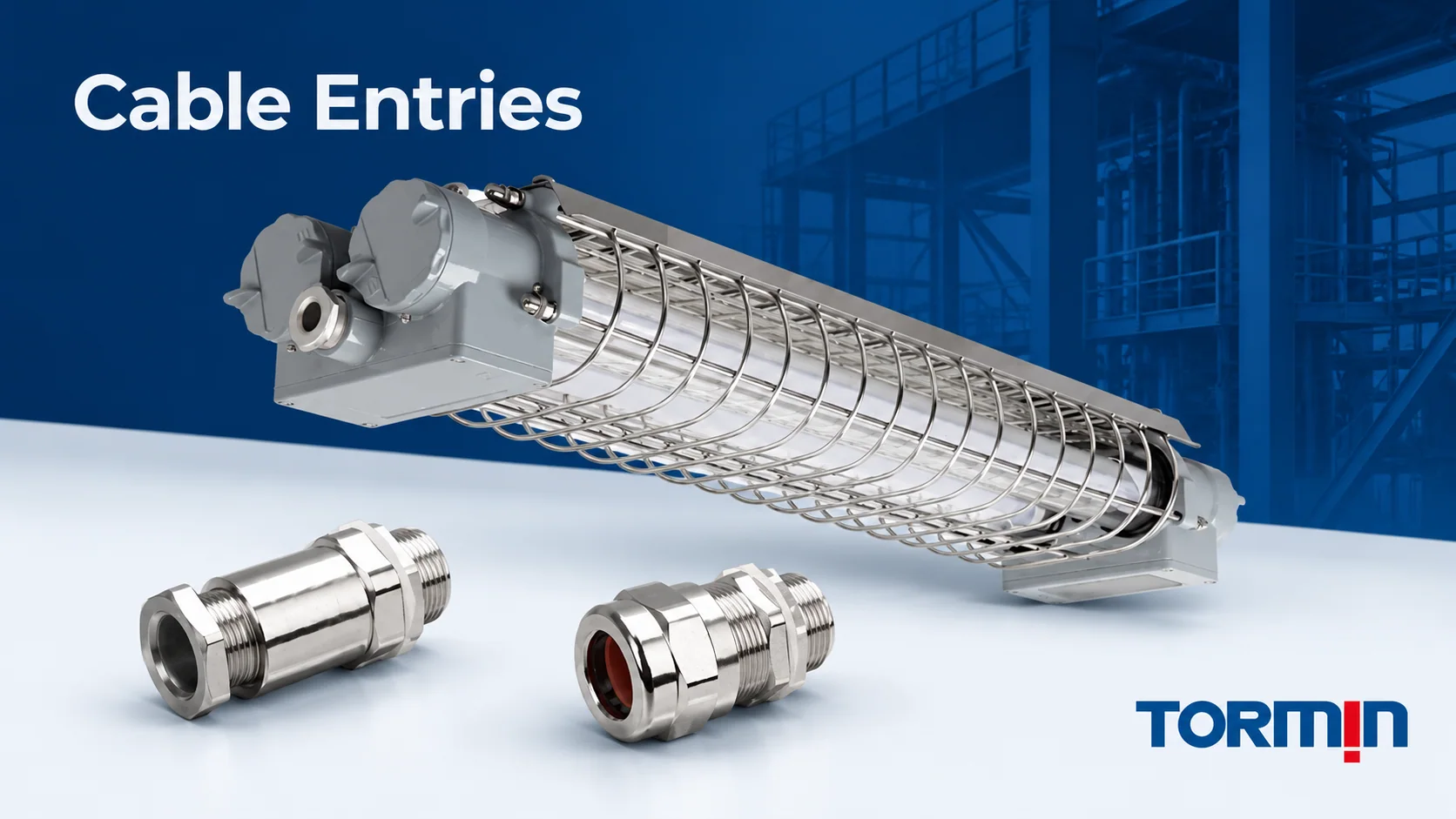
A cable gland admits and secures a cable at an enclosure entry. A stopping plug closes an unused entry. For hazardous-area lighting, each must preserve the protection required at that opening. A matching thread or an “Ex” description alone does not establish that the proposed arrangement is suitable. IEC’s cable-gland definition connects the gland to both the enclosure’s protection and cable strain relief; SGS Baseefa’s flameproof-equipment guidance explains the use of appropriate certified stopping plugs for unused flameproof entries.
The practical buying task is to account for every opening on the exact luminaire, including spare entries. Create an entry schedule connecting each opening to its duty, receiving compartment, proposed accessory and supporting documents.
This guide addresses IEC-based equipment review. Establish the project’s hazardous-area and jurisdictional requirements through the wider explosion-proof lighting selection process. The schedule below prepares a technical submittal for review; installation acceptance also requires the applicable rules and competent personnel, as the public scope of IEC 60079-14:2024 explains.
Cable glands and stopping plugs perform different duties
The comparison begins with whether a cable passes through the opening.
| Review point | Cable gland | Stopping plug / blanking element |
|---|---|---|
| Intended duty | Introduces a cable while maintaining the relevant protection and providing strain relief | Closes an entry that is unused in the proposed arrangement |
| Cable information | Requires the actual cable construction and the dimensions relevant to its sealing and retention arrangement | No operating cable passes through the closed opening |
| Enclosure interface | Match the documented entry and the applicable protection requirements | Match the documented unused-entry closure arrangement |
| Evidence to request | Exact gland identification, applicable certification basis and instructions, and cable compatibility | Exact closure identification, applicable certification basis and instructions, and enclosure compatibility |
| Procurement question | “What cable and entry does this gland cover?” | “What establishes this closure as suitable for this unused entry?” |
The functional distinction follows the IEC terminology and SGS guidance linked above. The evidence questions are a procurement worksheet, rather than a substitute for the equipment instructions.
Record the proposed closure for every spare opening. If a transport cover is supplied, request its identity and documented in-service purpose.
Also distinguish an enclosure stopping plug from any insert intended to blank an unused gland. Request the documented arrangement for the actual opening instead of accepting the word “plug” without a part reference.
Identify the compartment that receives the entry
Read the luminaire’s construction description before selecting accessories. A luminaire can combine protection techniques: TestSafe NSW describes other protection techniques being used together with increased-safety elements in luminaires and assemblies. A method identified elsewhere in the light does not establish the protection required at its field-cable termination.
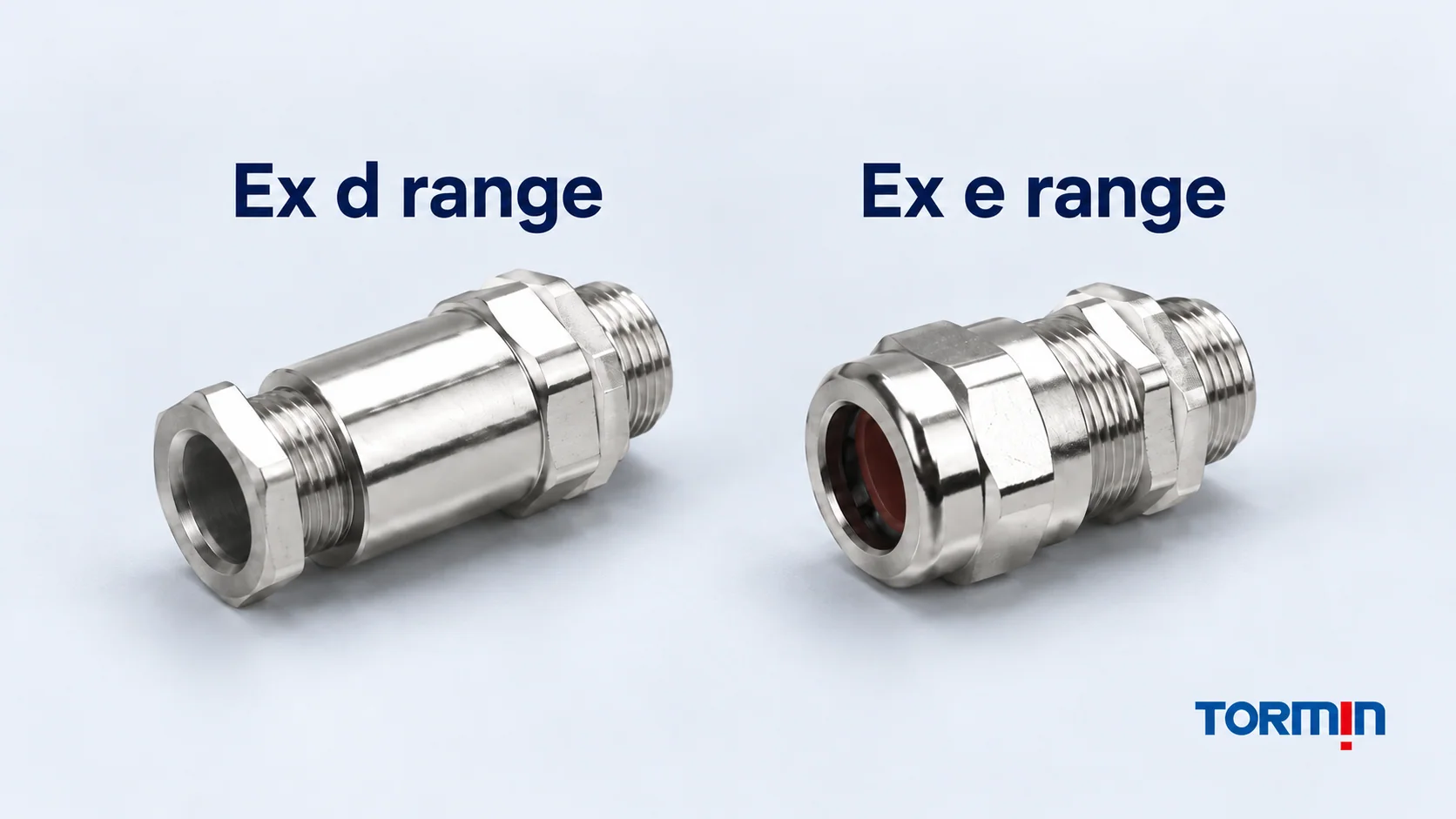
Ask the supplier to identify which compartment receives the cable and which documents govern that compartment’s entry. Retain the complete protection designation from those records. The existing Ex d vs Ex e lighting comparison explains the construction principles; this review applies them to a specific interface.
SGS’s flameproof guide distinguishes accessories included in the equipment assessment from selection left to the installer. Ask which applies, and obtain the equipment’s entry drawing or instructions alongside the accessory records.
Check cable fit and enclosure-entry fit separately
A gland has two interfaces to review: its relationship with the cable and its attachment to the enclosure. Resolving one leaves the other open.
Cable-side information
For the proposed cable, provide its manufacturer and designation, construction, outside diameter and relevant sheath details. Identify any armour, braid or screen and request the dimensions required by the proposed gland’s instructions. Ask the supplier to map that cable to the exact gland’s documented sealing and retention ranges.
This avoids an incomplete request such as “a gland for a four-core cable.” Conductor count alone does not describe the outer cable geometry or the arrangement at the gland. The intended outcome is a traceable cable-to-gland match, rather than a choice from appearance.
Enclosure-side information
Request the full entry designation, including thread form, nominal size and pitch where applicable. Record whether the entry is threaded or a clearance opening, and obtain the permitted mounting and accessory arrangement. “Metric” or “NPT” is an incomplete response without the actual specification.
In the flameproof context, SGS identifies thread form, engagement and adaptor arrangements as important. Require documentary confirmation of the proposed interface. Obtain tightening, engagement, sealing and locking details from the applicable instructions rather than applying a generic value from another gland or luminaire.
Barrier-gland questions need the project basis
If a barrier gland is proposed or omitted, request the technical basis for that choice. Record the cable construction, equipment arrangement, applicable installation-standard edition and any relevant certificate or instruction conditions.
The UK HSE’s 2016 barrier-gland safety notice discusses concerns about particular older editions and UK guidance. It demonstrates why the edition and jurisdiction matter; it is not a universal selection chart for every current project. Have the competent project reviewer resolve this question using the project’s adopted requirements.
Trace the accessory to the right documents
Collect the exact luminaire ordering code and entry arrangement, the gland or stopping-plug reference, applicable certificate records and schedules, and the relevant instructions. Ask the supplier to explain whether the accessory is covered within the equipment assessment or through a separate record and how the proposed combination meets the equipment requirements.
Within the IECEx scheme, an X suffix identifies Specific Conditions of Use. Read the conditions that apply to the actual equipment or accessory. A U suffix identifies component certification: review its Schedule of Limitations and how incorporation is addressed in the completed equipment assessment. IECEx explains these distinctions in OD 009 and OD 011-2.
A familiar mark or a certificate for a neighbouring model cannot complete this review. Use the existing nameplate and certificate guide for the full identity and marking check; keep this schedule focused on the entry arrangement.
Build one schedule row for every opening
Use the following fields alongside the supplier’s entry drawing. This is a suggested procurement record, with document references in place of unsupported assumptions.
| Schedule field | Cable-carrying entry | Unused entry |
|---|---|---|
| Opening identity | Entry reference and receiving compartment | Entry reference and receiving compartment |
| Intended duty | Supply, permitted loop connection or another documented duty | Unused in the proposed configuration |
| Cable | Exact cable designation and relevant dimensions | Not applicable |
| Mechanical interface | Full entry specification and proposed attachment arrangement | Full entry specification and proposed closure arrangement |
| Accessory | Exact gland reference and supplied configuration | Exact stopping-plug or blanking-element reference |
| Evidence | Equipment and accessory records, instructions and applicable conditions | Equipment and closure records, instructions and applicable conditions |
| Review outcome | Match or unresolved item; responsible reviewer and hold status | Match or unresolved item; responsible reviewer and hold status |
Worked procurement example: suppose a proposed luminaire arrangement has two documented openings. One will carry the incoming supply cable; the second will remain unused. This is an illustrative review scenario, not a statement about a TORMIN model’s construction.
The supplier offers a gland and a stopping plug with the same nominal thread size as the entries. That answers only part of the enquiry:
- Incoming entry: keep the match unresolved until the exact cable, gland range, receiving-section requirements and accessory documents have been reconciled.
- Unused entry: keep the closure unresolved until its identity and documentary basis establish that it is permitted in that opening.
If the project later proposes a loop-out cable through the spare opening, revise the schedule and obtain the equipment’s permitted connection arrangement. The earlier closure decision does not establish permission for the new cable duty.
Apply the request to TORMIN’s listed gland families
TORMIN’s Ex d Cable Gland and Ex e Cable Gland pages list families for unarmoured cable. These are first-party catalogue descriptions. Use them to identify the family for enquiry, then request the exact size, cable range, entry specification and applicable equipment/accessory documents.
Those family names do not establish that either gland fits a particular luminaire. A different cable construction also requires its own documented selection. For an unused opening, request the permitted closure reference and evidence separately.
The TORMIN cable-gland range provides the commercial starting point. A useful request to send through TORMIN’s contact page is:
Please review the attached luminaire ordering code and entry drawing. For each cable-carrying opening, identify the proposed gland against the cable designation, dimensions and entry requirements. For each unused opening, identify the permitted closure. Return the applicable document references, instructions, conditions and any unresolved items against the same entry schedule.
The comparison is complete when every opening has a defined duty and a documented proposed arrangement ready for the responsible technical review.
Sources
- IEC Electropedia — IEV 426-04-18, Cable Gland, published March 2020 — Ex cable-gland function and relationship to protection and strain relief.
- SGS Baseefa — Flameproof Equipment Design and Certification, BAS-PS-024, Issue 3, May 2025 — Flameproof entry principles and accessory interfaces.
- IEC — IEC 60079-14:2024, Explosive atmospheres — Part 14: Electrical installation design, selection and installation of equipment, including initial inspection — Public scope covering installation design, selection, documentation and competency; the full standard is not reproduced here.
- TestSafe NSW — Increased safety Ex e — Combined protection techniques in luminaires and assemblies.
- UK Health and Safety Executive — Use of Barrier Glands in Potentially Explosive Atmospheres to meet IEC 60079:14 2013 (Edition 5), HID 1-2016, 1 February 2016 — Historical edition and jurisdiction context for barrier-gland review.
- IECEx — OD 009, Edition 4.6, January 2026 — Specific Conditions of Use and component limitations.
- IECEx — OD 011-2, Edition 6.0, June 2024, redline version — Equipment/component certificate guidance, including X/U distinctions.
- TORMIN — Ex d Cable Gland product page — First-party catalogue evidence for the listed family and unarmoured-cable description; reviewed 23 October 2026.
- TORMIN — Ex e Cable Gland product page — First-party catalogue evidence for the listed family and unarmoured-cable description; reviewed 23 October 2026.