

An explosion proof LED retrofit should start with the installed asset, the proposed change and the interfaces that will remain. Establish whether the project replaces the complete luminaire or converts an existing assembly. Then collect the location, equipment, mounting, connection, lighting and access evidence needed to review that change.
A lower-wattage offer or an old Ex nameplate does not establish replacement compatibility. The useful survey output is an asset-by-asset record of existing conditions, proposed changes, retained parts and unresolved checks—not just a count of lamps to order.
Define what “retrofit” means for this project
Separate the two routes in the enquiry:
| Route | What the project changes | Evidence to request |
|---|---|---|
| Complete-luminaire replacement | Removes the old luminaire and proposes a new complete unit. Some external supports, wiring or connection infrastructure may remain. | Exact proposed-unit documents and an assessment of every retained interface. |
| Internal conversion | Retains a host luminaire while changing its light source, driver or other components. | Evidence covering the intended host/conversion combination, installation conditions and applicable acceptance route. |
For the U.S. UL route, UL Solutions describes certified kits used with identified host luminaires according to their instructions. Its FAQ also identifies hazardous-location conversion kits evaluated to UL 1598C and UL 844 under category IFUL. Conversion is therefore not universally prohibited, but a general LED kit is not evidence for a hazardous-location application. Do not transfer that UL route into an ATEX or IECEx project without the required scheme-specific assessment. UL Solutions: retrofit conversion-kit FAQ.
State which route is being priced. If a proposal changes from a complete replacement to a retained-housing conversion, reopen the scope review. A quotation should not conceal that change behind the same word, “retrofit.”
Establish the location and survey limits
Identify the mounting point on the current area-classification drawing and record the jurisdiction and acceptance requirements. Include the applicable classification, material group, temperature and ambient requirements from controlled documents. Do not treat the old installation as the classification document for the replacement.
The U.S. example is explicit: OSHA 29 CFR 1910.307 addresses location documentation and requires equipment appropriate to the classified location and relevant material hazards. This is a U.S. requirement, not a universal certification rule. OSHA: hazardous locations.
Arrange the survey under the site’s rules for access and equipment use. A walkdown does not authorize opening an enclosure, disconnecting a cable or probing a live circuit. UK HSE guidance emphasizes correct identification, all energy sources, stored energy, secure isolation and proving dead for electrical work. Those are matters for competent authorized personnel and the site’s work planning, not steps supplied by this checklist. HSE HSG85, paragraphs 47–55.
For an inaccessible or undocumented item, write not verified, identify what will resolve it and assign a follow-up owner. Do not obtain missing information by improvising intrusive work.
Use this seven-part site survey checklist
Start one record for each asset. Group assets only after confirming which conditions they actually share; a matching exterior does not establish identical entries, supplies or operating duties.
The following is a survey aid. It requests evidence for review; it does not supply acceptance criteria or approve reuse.
| Survey group | Capture the installed condition | Ask of the proposed change / retained interface |
|---|---|---|
| 1. Asset and approval identity | Asset ID, location, full model/variant, available marking, certificate reference and document revisions. | Which exact proposed configuration and documents meet the current location requirements? What remains unmatched? |
| 2. Mounting and structure | Mounting arrangement, orientation, accessible dimensions, support condition, obstructions and available drawings. | Which support or bracket remains? Who verifies compatibility, loads, fixing arrangement and service access? |
| 3. Cable and entry interface | Available cable/conduit records, entry identity, visible routing, connection location and any unverified details. | Which entries, glands, seals or adapters are retained or changed? Where is compatibility documented? |
| 4. Supply, controls and emergency duty | Electrical-team records for supply, circuit grouping, switching, controls, backup sources and operating modes. | Does the exact offered driver/control arrangement match? Which electrical checks and emergency evidence are still required? |
| 5. Environment and condition | Ambient/exposure information, nearby heat, dust, moisture, chemicals, vibration and visible deterioration. | Which exposure or condition changes the proposal? What construction evidence or further assessment is needed? |
| 6. Lighting task and geometry | Task surfaces, viewing directions, mounting positions, aiming, obstacles and reported lighting problems. | Which exact optical file and calculation will test the revised arrangement against project criteria? |
| 7. Work and handover constraints | Access route, shutdown window, isolation-planning responsibility, affected work areas and existing records. | Who plans the change, any temporary lighting, required inspections, document updates and return-to-service decision? |
Attach photographs or drawings to the relevant asset and field. Distinguish an observed detail from a drawing reference or an unresolved assumption. The nameplate and certificate guide covers document interpretation separately; this survey uses those records to track what changes.
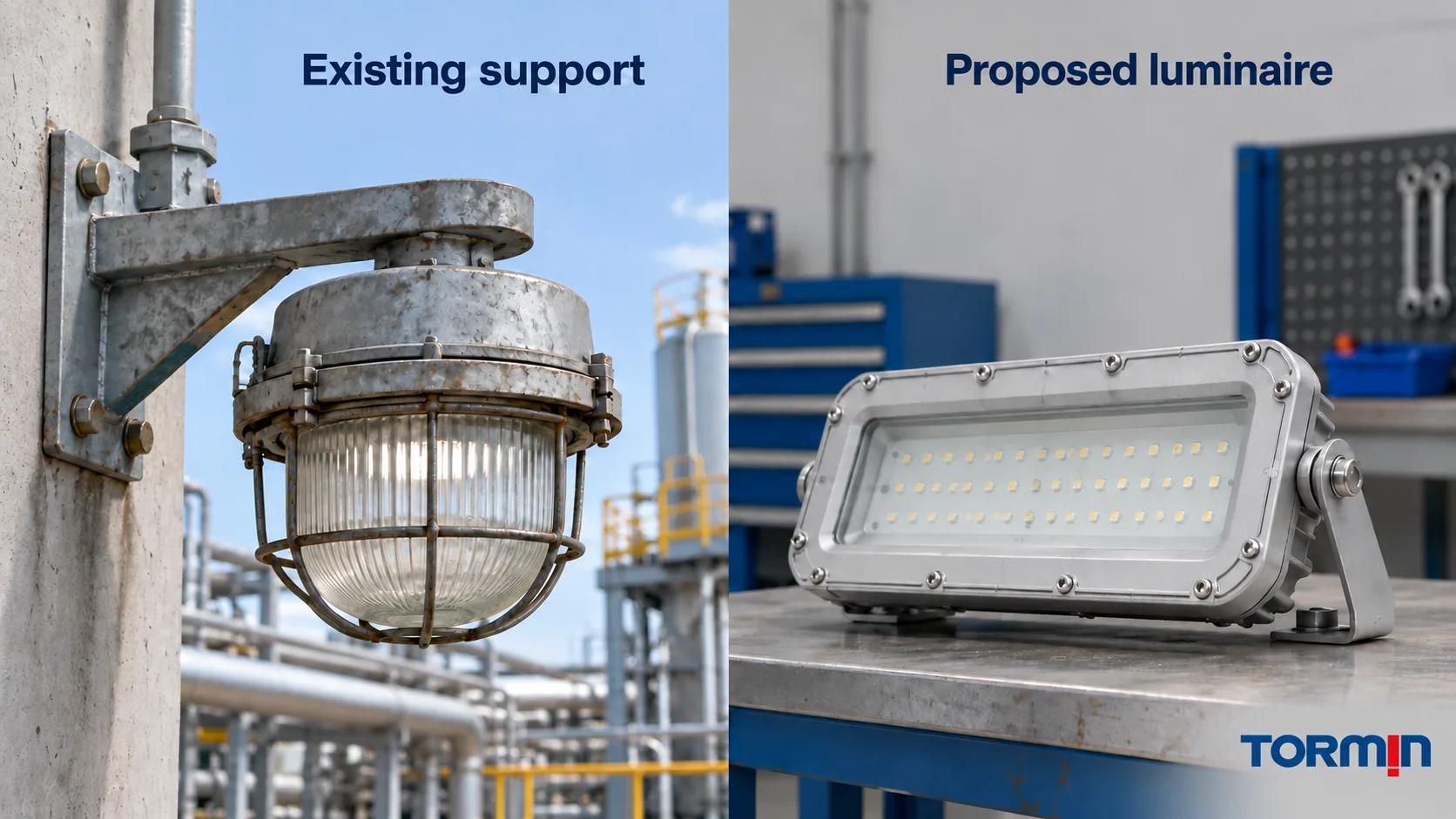
Make retained items explicit
“Replace complete luminaire” can leave substantial work outside the purchase. An existing support, connection point or cable route might remain even when the old housing is removed. List each retained item beside the evidence needed to assess it.
For example, “reuse existing bracket” is a proposed scope, not a compatibility result. Link it to the installed arrangement, the offered mounting drawing and the responsible assessment. If that evidence is unavailable, keep bracket reuse open rather than treating it as an included assumption.
Similarly, an entry visible in a photograph may still lack a confirmed identity. Record the observation without guessing its thread, sealing arrangement or suitability for the new assembly. This article provides no adapter selection, drilling, rewiring or conversion instructions.
Survey the lighting job, not only the fixture positions
A replacement project should record what the old arrangement fails to show well: a control-panel face, a bench, a walkway or a task hidden by pipework. Note changes in equipment, tasks or mounting constraints since the original installation.
IES identifies luminaire photometric data as input to lighting calculation software. Request the file for the exact offered optic and a calculation using the project’s geometry and criteria. A wattage comparison cannot supply that result. IES Computer Committee: data scope.
State the target surfaces, viewing directions and assessment conditions in the survey. If a candidate moves, changes aiming or uses another distribution, ask the designer to review that changed arrangement. The IES file-reading guide explains the data review; it does not replace the project calculation.
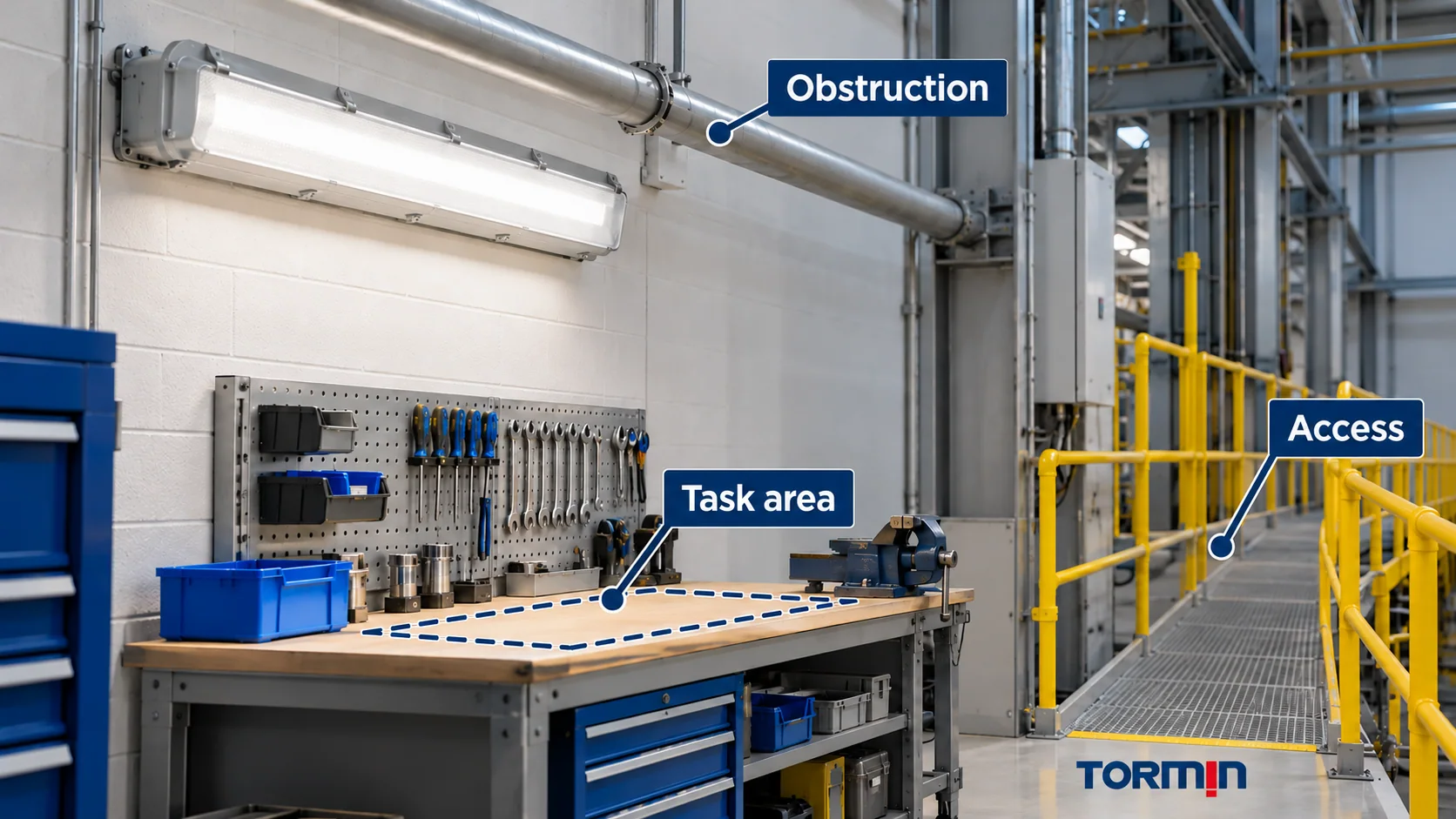
Preserve a baseline before removing the old equipment
Collect the evidence that will become harder to recover after removal: asset counts, operating schedules, documented total input power and the condition of the installation. Identify failed or disconnected units and changes planned to the control sequence. Record where values came from and which remain estimates; arrange any necessary measurement through the authorized team.
DOE’s energy-management eGuide recommends collecting a baseline before a change and comparing performance under consistent, representative conditions, including relevant operating variables. DOE: measure, monitor and analyze performance metrics.
Ask the project evaluator to separate the effect of equipment changes from changed hours, quantities or controls. Keep purchase price, access costs, downtime and maintenance assumptions visible in any business case. This survey does not promise a savings percentage, service life or payback period.
Example: keep an apparently simple substitution on hold
Consider an invented asset, L-024. The proposal replaces its complete luminaire, while the existing support and cable route are intended to remain. A photograph shows the exterior, but the entry identity and mounting compatibility have not been confirmed.
The survey record can say:
- Existing: L-024 at the marked location; photographs and available asset documents attached.
- Proposed: complete-unit LED replacement; exact offer and mounting drawing requested.
- Retained: existing support and cable route, subject to assessment.
- Open: entry identification, support compatibility and the revised optical calculation; named reviewers assigned.
This is enough to make the uncertainty actionable. It is not enough to approve substitution or continued operation. Hold final replacement approval until the responsible reviewers resolve the applicable evidence gaps. A lower-power offer does not close them.
Plan the handover while defining the change
Before procurement is finalized, agree who will confirm the installed configuration, inspect the completed work, update the asset record and authorize return to service under the applicable framework.
IEC 60079-17:2023 distinguishes initial inspection before service from ongoing inspection, and its introduction warns that functional operation alone does not establish preserved explosion-protection integrity. The public preview supports that boundary; it is not a complete replacement inspection schedule. IEC 60079-17:2023, authorized preview.
TORMIN’s inspection-grade guide explains visual, close and detailed inspection. Use the project’s specified inspection and commissioning requirements for the actual work. A completed pre-replacement survey does not sign off the installation.
Send the change record with the enquiry
Use the hazardous-area lighting category for candidate families, then send the asset record and open-item list through TORMIN’s contact page. Request the exact proposed-unit documents and a response identifying retained interfaces, exclusions and information still needed. The category does not establish conversion-kit availability or compatibility with a legacy host.
The general explosion proof lighting selection guide covers candidate assessment. Keep this survey attached to that process so the existing installation and proposed changes remain part of the decision.
Sources
- UL Solutions — FAQ: UL Certified LED Retrofit Luminaire Conversion Kits. Host/kit instructions and the hazardous-location conversion route; U.S. UL context.
- OSHA — 29 CFR 1910.307, Hazardous (classified) locations. U.S. location documentation and equipment requirements.
- UK HSE — Electricity at work: Safe working practices, HSG85, third edition, 2013. Identification and electrical safe-work planning.
- IES — Computer Committee. Luminaire photometric data as lighting-software input.
- U.S. DOE — AMO eGuide, Step 4.1: Measure, monitor and analyze performance metrics. Pre-change baseline and consistent comparison conditions.
- IEC — IEC 60079-17:2023, edition 6, authorized preview. Introduction and accessed initial-inspection definition; full inspection clauses not reproduced.