
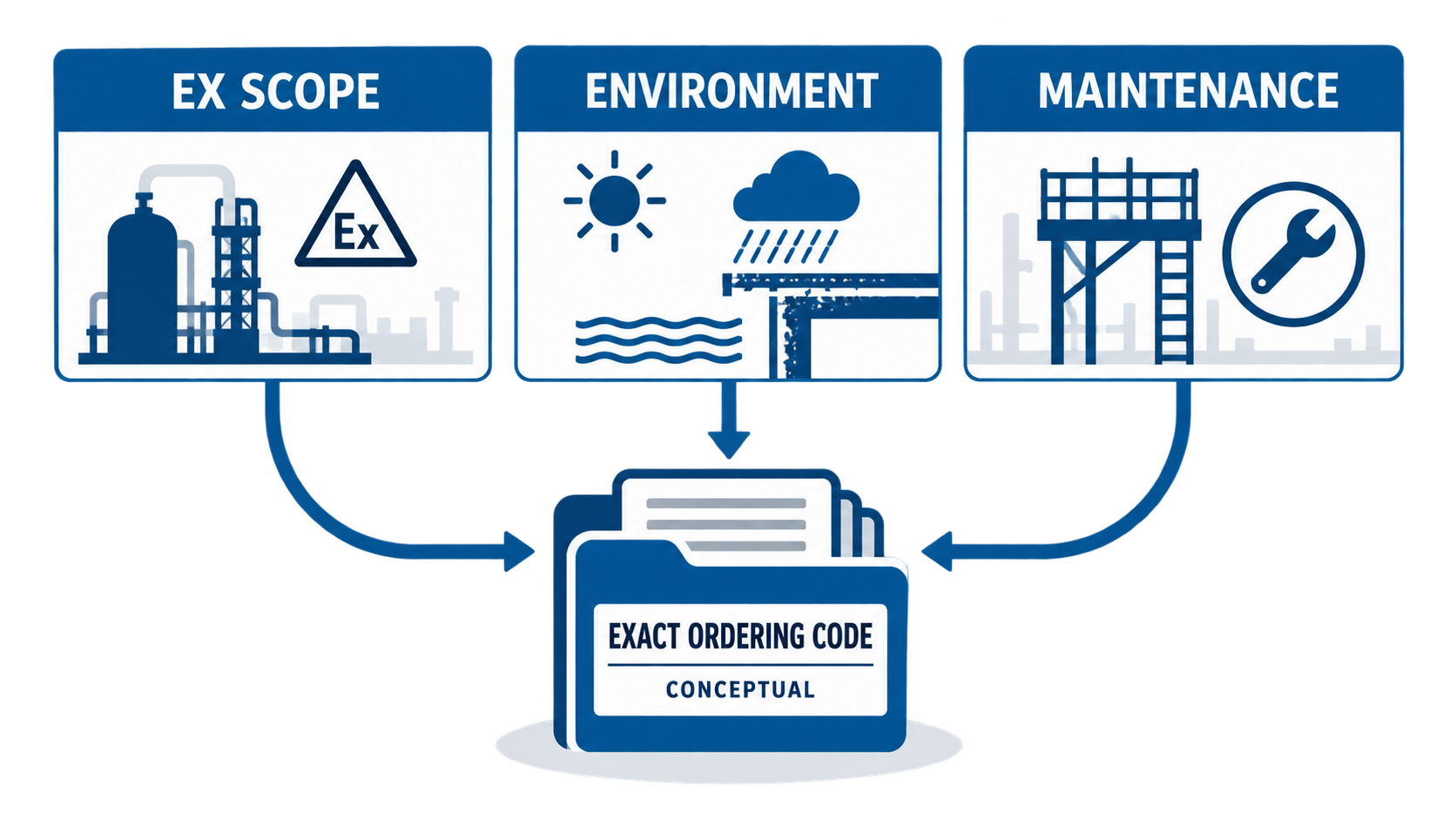
An explosion-protection certificate does not prove that a luminaire is suitable for an offshore location. Offshore acceptance requires three independent evidence tracks to align:
- the exact model and variant meet the project’s hazardous-area requirements;
- the materials, coating, seals, fasteners, entries and environmental limits suit the actual mounting exposure; and
- the luminaire can be installed, inspected, cleaned and replaced within the platform’s access and shutdown strategy.
Lighting performance is a fourth check: exact photometry must meet the real task geometry. “Marine-grade,” a high IP rating or an offshore image cannot replace any of these records.
Acceptance rule: verify explosion protection, environmental durability, maintainability and photometry separately; approve the ordering code only where all four intersect.
Offshore is not one environment
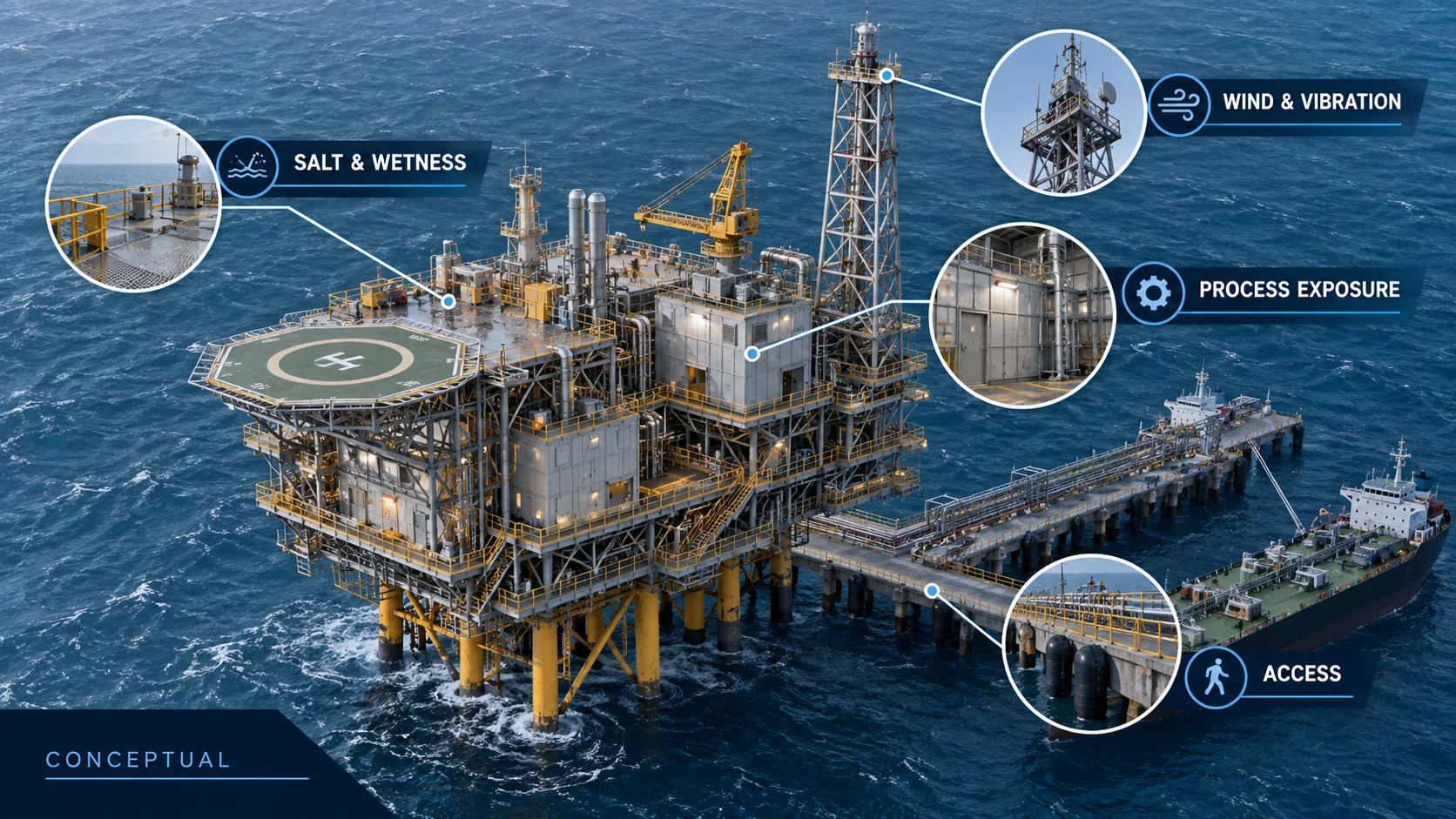
Salt is important, but it is not the only differentiator. Wetness, airborne salinity, UV, wind, vibration, process chemicals, hydrocarbons, washdown, temperature, impact, galvanic interfaces and difficult access vary by mounting point.
ISO 9223:2012 provides a system for classifying atmospheric corrosivity and identifies temperature/humidity, sulfur dioxide and airborne salinity as key factors in atmospheric corrosion. It does not characterize every chemical or metallurgical service atmosphere, so the project still needs local exposure data.
Start with a location schedule rather than a single “offshore” checkbox:
| Mounting location | Exposure questions | Ex and electrical questions | Maintenance questions |
|---|---|---|---|
| Open process deck | Direct salt spray, rain, UV, wind, hydrocarbons, washdown, vibration | Approved classification, gas/dust group, temperature and ambient limits | Safe isolation, access during operation, cleaning and dropped-object controls |
| Sheltered process module | Condensation, trapped salts, ventilation, process chemicals and heat | Boundary/ventilation basis, entries, glands, earthing and controls | Congested access, obstruction removal and inspection visibility |
| Jetty or loading arm area | Marine atmosphere, splash, vehicle/vessel interface and impact | Transfer release sources, classification extent and emergency interface | Tide/weather access, shutdown coordination and flexible operations |
| Crane, high mast or exposed perimeter | Wind, UV, salt, vibration and lightning environment | Classification boundary, supply, controls and mounting arrangement | Work-at-height plan, lifting access and replacement logistics |
| Stair, ladder and escape route | Wetness, glare, shadows, handrails and moving personnel | Emergency supply/function and classified boundary | Test access, cleaning and unobstructed egress |
| Workshop or control space | Indoor humidity, HVAC/pressurization basis and chemical carry-over | Whether the space is ordinary or controlled by another protection strategy | Routine access, spare strategy and interface with outdoor equipment |
Track 1: prove the hazardous-area scope
Use the approved area-classification drawing, equipment schedule, target-market scheme, owner requirements and adopted standard editions. Record the required zone or Class/Division, gas or dust group, EPL/category or equivalent, temperature class or maximum surface temperature, ambient range and special conditions.
For IEC-based projects, IEC 60079-0:2026 contains general construction, testing and marking requirements for Ex equipment. IEC 60079-14:2024 covers selection, installation and initial inspection, including documentation and personnel competency. These standards define requirements; they do not certify a specific TORMIN model.
For every offered ordering code, obtain:
- the current certificate and complete schedule or annex;
- the marking/nameplate record;
- the product and variant breakdown;
- all special conditions of use;
- the approved entry, mounting, driver, optic, control and emergency options;
- the installation and operating instructions.
Do not generalize a certificate across a visually similar housing, different wattage, optic, cable entry, driver or battery option. Do not infer dust suitability from a gas marking or vice versa.
Track 2: prove corrosion and environmental suitability
Explosion protection and ingress protection do not establish a corrosion life. The environmental review needs exact material and system evidence for the mounting location.
Define the exposure before naming a material
Record airborne salinity or project corrosivity category, wet/dry cycling, direct splash, immersion risk, temperature, UV, process chemicals, washdown chemistry, cleaning pressure, abrasion, vibration and impact. Identify dissimilar-metal interfaces, brackets, fasteners, cable glands, stopping plugs and earthing hardware—not only the main housing.
Ask for a complete construction statement
The supplier record should identify substrate materials, alloy/grade where claimed, pretreatment, coating system, thickness basis where controlled, seals/gaskets, lens, fasteners and entry accessories. It should also state the applicable test methods, acceptance criteria, sample construction and relationship to the offered product.
A phrase such as “marine aluminum,” “stainless steel” or “anti-corrosion coating” is incomplete without grade/system, exposure and evidence.
Keep paint-system standards in scope
ISO 12944-9:2018 specifies performance requirements and laboratory test methods for protective paint systems on offshore and related carbon-steel structures exposed to marine atmosphere or sea/brackish water. ISO confirmed the edition in 2025, but its own scope excludes several substrates and does not cover general maintenance.
Therefore, an ISO 12944-9 reference can support an applicable protective paint-system claim; it is not a universal luminaire approval and cannot automatically validate aluminum, stainless steel, glass, polymer, seal or mixed-material construction.
Evaluate the whole assembly
Corrosion-related failure can occur at fasteners, interfaces, brackets, glands, threads, seals or damaged coating even when the primary enclosure material is appropriate. Require evidence and compatibility for the delivered combination, including supplier-approved accessories.
Track 3: design for inspection and maintenance
IEC 60079-17:2023 covers factors directly related to inspection and maintenance of hazardous-area electrical installations. It does not cover equipment verification, Ex repair/overhaul or all general electrical maintenance. Those boundaries should stay visible in the maintenance plan.
Before purchase, define:
- how the luminaire will be safely isolated and proven de-energized;
- how personnel reach and position themselves at the equipment;
- what can be inspected externally without opening the enclosure;
- how salt, dust, oil or process residue will be removed without damaging seals, coating or optics;
- what damage, corrosion, looseness, moisture or marking loss triggers escalation;
- whether replacement can occur during normal operation or requires a shutdown;
- how spare units, glands, plugs, seals and mounting parts remain configuration-controlled;
- who is authorized and competent to inspect, maintain or arrange repair.
Do not select a fitting that can only be serviced by an access method the facility cannot safely provide. A lower-maintenance claim also needs a defined inspection/cleaning basis; offshore exposure does not disappear because the light source is LED.
Check installation interfaces before accepting the model
The installation review should close every interface rather than approve the luminaire in isolation:
| Interface | Required input | Evidence or decision |
|---|---|---|
| Structure and bracket | Orientation, loads, vibration, wind and material interfaces | Approved mounting drawing, fastener/bracket specification and project structural check |
| Cable entry | Cable/conduit type, diameter, thread and sealing philosophy | Certificate-compatible gland/plug/adapter and installation instructions |
| Earthing and bonding | Project system and fault-current path | Exact terminals/hardware and installation requirements |
| Power and controls | Voltage, tolerance, frequency, switching, dimming and emergency mode | Exact driver/control option and documented behavior |
| Environment | Ambient, salt, wetness, chemicals, UV, washdown and impact | Material/coating/seal evidence and limits for the full assembly |
| Optical result | Geometry, task planes, obstructions and maintenance factor | Exact photometric file and documented calculation |
| Maintenance | Isolation, access, cleaning, inspection and spares | Approved maintenance strategy and manufacturer instructions |
A compliant certificate cannot fix a mismatched gland thread, unsupported bracket, inaccessible isolation point or unsuitable cleaning method.
Control replacements and substitutions
Offshore replacement decisions often fail when a supplier offers an “equivalent” family name without matching the controlled configuration. Compare the replacement against the original and current project requirements across:
- certification scheme, marking and special conditions;
- exact dimensions, mounting centers, mass and orientation;
- entries, glands, plugs, wiring and earthing;
- materials, coating, seals, fasteners and environmental limits;
- supply, controls, emergency behavior and power quality;
- photometric distribution, output and maintained-lighting calculation;
- inspection, cleaning, spare and repair strategy.
Any unresolved change belongs in a deviation register. Do not approve the substitution from nominal watts or lumen output.
Copy-ready offshore acceptance block
Project / facility / asset:
Country, flag/class/authority and owner requirements:
Area-classification drawing and revision:
Required Zone/EPL/category or Class/Division approval:
Gas/dust group, temperature requirement and ambient range:

Mounting-location ID and exposure description:
Atmospheric corrosivity / salinity / wetness basis:
Process chemicals, washdown, UV, vibration, impact and wind inputs:
Required materials, coating, seals, fasteners and accessory evidence:

Supply, controls and emergency function:
Cable/conduit, entry thread, gland, plug and earthing requirements:
Mounting orientation, bracket/interface and structural loads:
Isolation, access, cleaning, inspection and replacement method:

Task planes, viewing directions and lighting criteria:
Exact photometric file and calculation required:

Exact ordering code:
Certificate, schedule, marking, datasheet, instructions and drawings required:
Environmental test records and limitations required:
Quantity, document language, destination and schedule:
Route the project without assuming offshore approval
Use the TORMIN Ports & Marine and Oil & Gas Lighting pages to identify the right application route, then review candidate form factors in the explosion-proof lighting category. These pages are navigation surfaces, not proof of offshore suitability.
Send the completed acceptance block and project records through the TORMIN contact page or sales@tormin-lighting.com. Request the exact document package before accepting a model, coating, mounting or maintenance claim.