
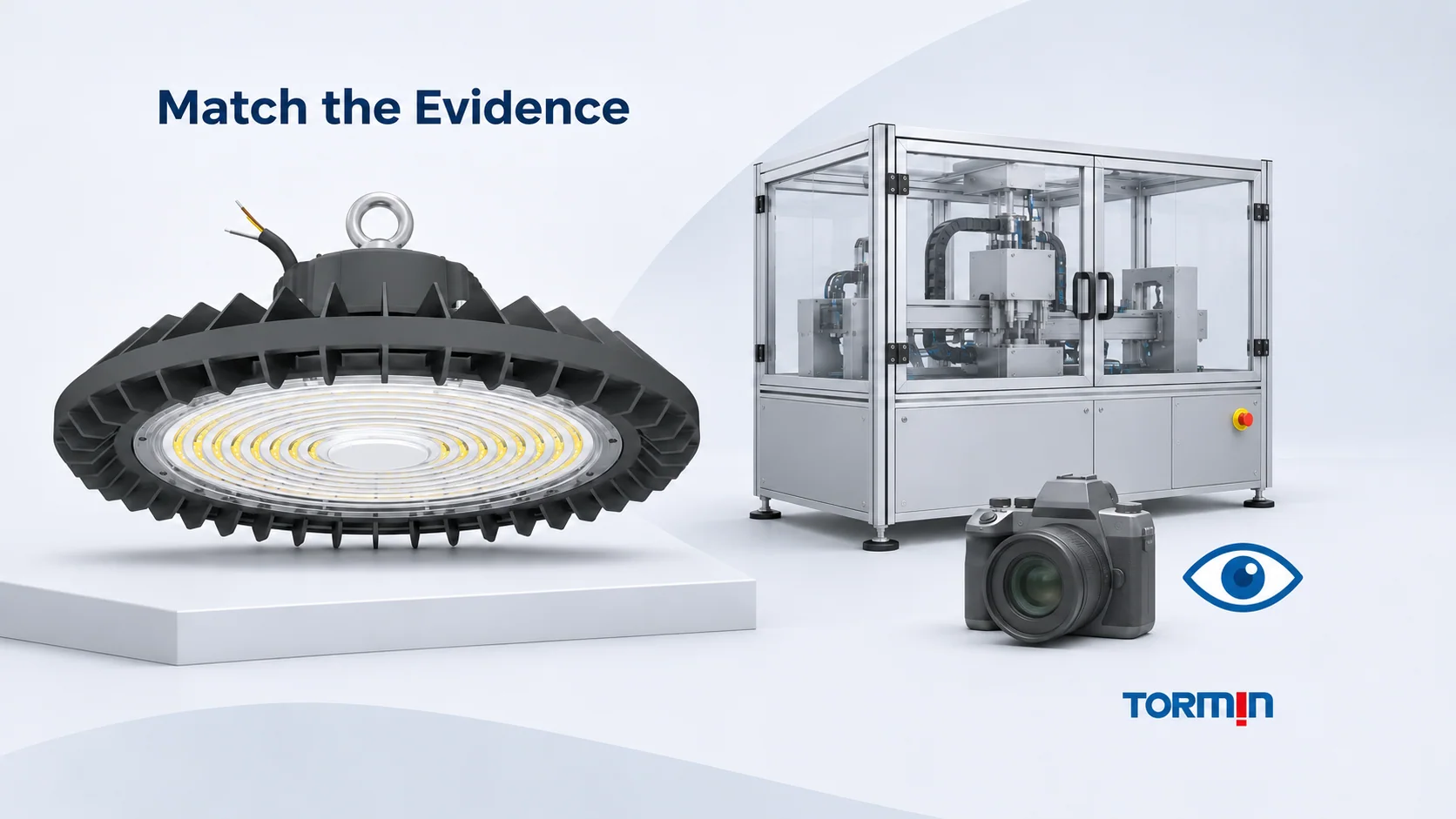
A moving part that looks unusual to a person and a band that appears in a camera image are different observations. Both may involve lighting that varies over time, but they do not establish the same effect, cause or risk. Start by separating the emitted-light stimulus, human perception and camera capture.
For industrial LED lighting, this distinction changes the evidence to request. An electrical-input report cannot describe every optical effect. A human-visibility metric cannot approve every machinery task or camera arrangement. And an apparently stationary part—seen directly or on a screen—is never evidence that machinery has stopped or been isolated.
Separate changing light from the response to it
Temporal light modulation (TLM) describes changing light; a temporal light artefact (TLA) describes a human perceptual response. CIE’s TN 006:2016 distinguishes these and excludes camera interactions from its human-perception scope.
When reviewing a statement such as “this light flickers,” retain the reported observation and its channel. A direct view, an image and an instrument record are different starting points for an investigation.
An ordinary specification such as wattage describes another property. The power-factor and THD guide concerns electrical-input measurements. Even a well-documented input report does not become an optical light-output-versus-time record merely because both concern the same luminaire.
Nor does the word LED settle temporal quality. DOE’s flicker research describes how light-output waveforms depend on driver operation, loading and dimming conditions. A conclusion needs the actual assembly and state to which its evidence applies.
Direct flicker and stroboscopic effects answer different questions
Using CIE’s terminology, compare what the observer perceives:
| Human effect | What changes in the perception? |
|---|---|
| Direct flicker | Visually unsteady light without requiring movement. |
| Stroboscopic effect | Motion appears different under temporally varying light. |
| Phantom array effect | Eye movement can produce repeated apparent positions or shapes, such as a trail of spots. |
Phantom arrays also belong to the human TLA family. Camera artefacts are a separate capture concern.
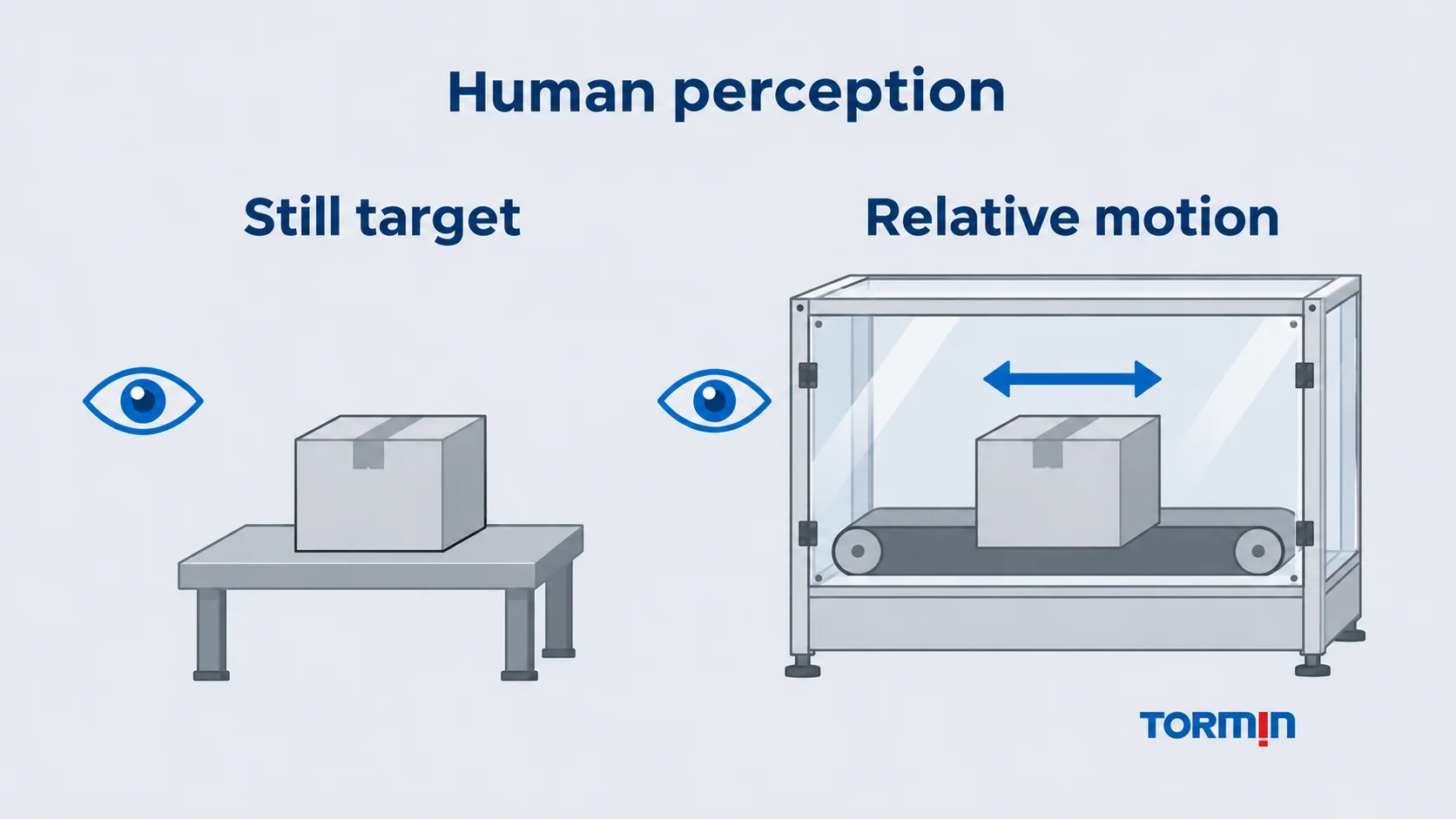
Varying light can make motion appear discontinuous; particular modulation/motion relationships can make rotation appear stationary. This changes perceived movement, not the machine’s physical motion.
HSE’s Lighting at work, HSG38, warns that this misperception can be dangerous. Its second edition dates from 1997; the relevant point here is the moving-machine hazard, not its older technology advice or frequency descriptions. Treat a concern through the site’s machinery-safety and reporting process. Do not reproduce the effect with a running machine or use visual appearance to determine a safe state.
A camera adds its own capture process
A recording is formed by a particular camera and its capture process. It is not a direct substitute for a person’s view. Dietz and Eberhart’s 2019 paper abstract on shutter artefacts identifies motion distortions from sequential sampling and banding that shutter mechanisms can produce with flickering light. This explains a possible interaction, not the cause of any particular industrial recording.
Consequently, “the video has bands” and “the operator sees flicker” should remain separate statements. If both are reported, retain both. If only one is reported, do not silently add the other. A camera artefact does not by itself quantify the optical waveform or demonstrate what a person experiences.
The converse also matters: a recording without obvious bands does not establish that every human visual effect or machinery interaction is acceptable. A video made under one capture condition does not represent every other camera mode.
For a real recorded-image requirement, the CCTV lighting acceptance guide explains how to define the operational image task. The present distinction comes first: identify whether the question is about the emitted light, direct perception or a captured image.
Match a metric to its scope before accepting the conclusion
A temporal-quality report needs more than a value labeled “flicker.” Identify the measured optical quantity, the method and version, the exact luminaire/driver/control arrangement, and the operating conditions. Then ask which response the reported result is intended to describe.
DOE explains that no single metric characterizes all applications. In particular, a stroboscopic-effect metric for human visibility does not predict video-camera response or the interaction of modulating light with moving machinery. This is why one favorable number cannot carry all three conclusions.
The public scope of IEC TR 63158:2018 describes a stroboscopic visibility measure (SVM) method for general indoor applications with moderate observer or handled-object movement. That scope is a reason to check applicability to the actual industrial task, rather than treating the metric name as machine-safety approval. Only the public scope is used here; this article does not reproduce the report’s calculation method or set an acceptance limit.
The following evidence map is an original interpretation aid, not a testing procedure or a standard’s pass/fail table:
| Evidence being reviewed | Question it can help address | Conclusion it does not establish by itself |
|---|---|---|
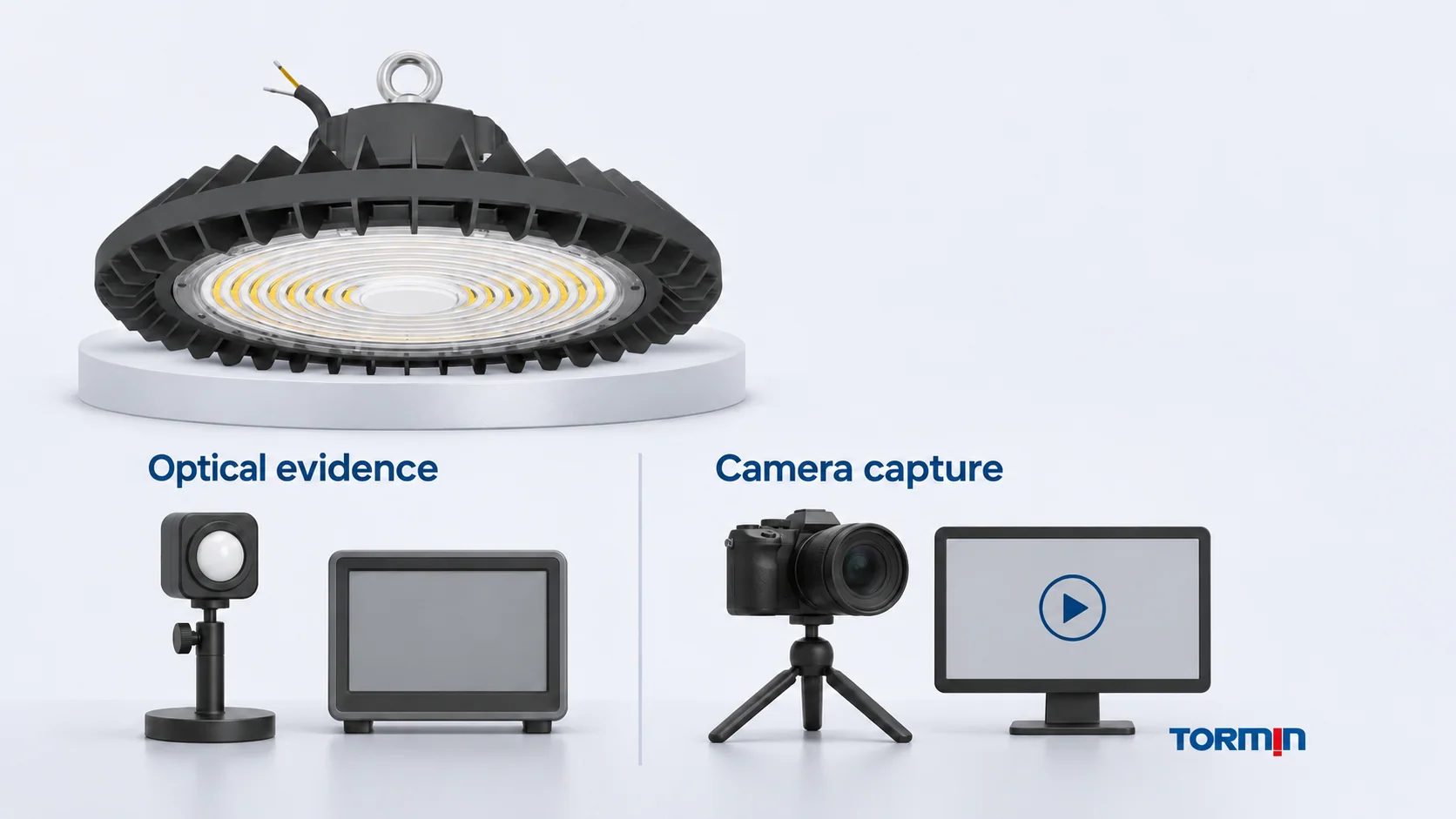
| Optical light-output-versus-time record, with method and conditions | What temporal stimulus was measured in that configuration? | Acceptance for every person, machine task or camera |
| Human-effect metric with a defined application scope | What aspect of human visibility does this method characterize? | Unrestricted machinery safety or camera compatibility |
| Camera recording with its capture/context information | What was captured in that particular image path? | A calibrated optical measurement or another person’s perception |
| PF/THD or other electrical-input record | What input characteristic was measured? | The temporal appearance of emitted light |
Keep a reported observation and the explanation proposed for it in separate fields. “Repeated-looking motion was reported” is an observation. “The driver caused it” is a causal claim requiring appropriate investigation. Likewise, calling a product “flicker-free” without an identified method, condition and scope leaves the engineering question unresolved.
Fictional comparison: one operating-state record cannot cover another automatically
Fictional document-review example—no actual tests or measurements have been performed. An imagined offer identifies assembly L-A and describes state N as normal output and state R as reduced output. These names specify no percentage, control protocol or permitted dimming arrangement.
An equally fictional document reference, D-N, concerns an optical test only in N. No numerical result is supplied. A reviewer asks whether that reference establishes the same temporal-quality conclusion for R, for a particular machine-viewing task and for a camera.
| Proposed inference | Review outcome from the stated information |
|---|---|
| D-N also represents R | Unresolved: condition-matched evidence and the exact implemented arrangement are missing. |
| D-N approves the machinery task | Unresolved: method applicability and the actual task/risk assessment are missing. |
| D-N proves the camera outcome | Unresolved: the relevant capture evidence is missing. |
The point is not that R must perform worse, or that L-A is unsuitable. Neither conclusion is supported. The reviewer should request the missing configuration and scoped evidence, while the responsible specialists determine the appropriate assessment. This example prescribes no operating state, test apparatus or machine demonstration.
Carry the distinction into an industrial lighting enquiry
The manufacturing lighting solution places temporal quality alongside task visibility and the operating environment. For product browsing, use the industrial high-bay range. The ZY8508B product page is the first-party identity source for this article’s exterior references; its photograph supplies no waveform or machinery-performance evidence.
In a technical enquiry, state which question needs answering and the actual proposed configuration. Request the corresponding optical report and its conditions. Keep human perception, machinery risk and camera capture conclusions within their own evidence scopes. That is more useful than accepting an unqualified label or trying to diagnose the luminaire from a video alone.
Sources
- CIE—TN 006:2016, Visual Aspects of Time-Modulated Lighting Systems: Definitions and Measurement Models—human-effect terminology and scope; no calculation method adopted.
- US Department of Energy—Flicker Research—operating-condition dependence and limits of human metrics.
- HSE—Lighting at work, HSG38, second edition (1997)—paragraph 28’s moving-machine misperception hazard.
- Dietz and Eberhart—Shuttering methods and the artifacts they produce (2019), IS&T—publisher abstract on capture artefacts; full paper not accessed.
- IEC—TR 63158:2018, Equipment for general lighting purposes: Objective test method for stroboscopic effects of lighting equipment—public scope only.
- TORMIN—ZY8508B LED High Bay Light—first-party product identity/exterior only.