
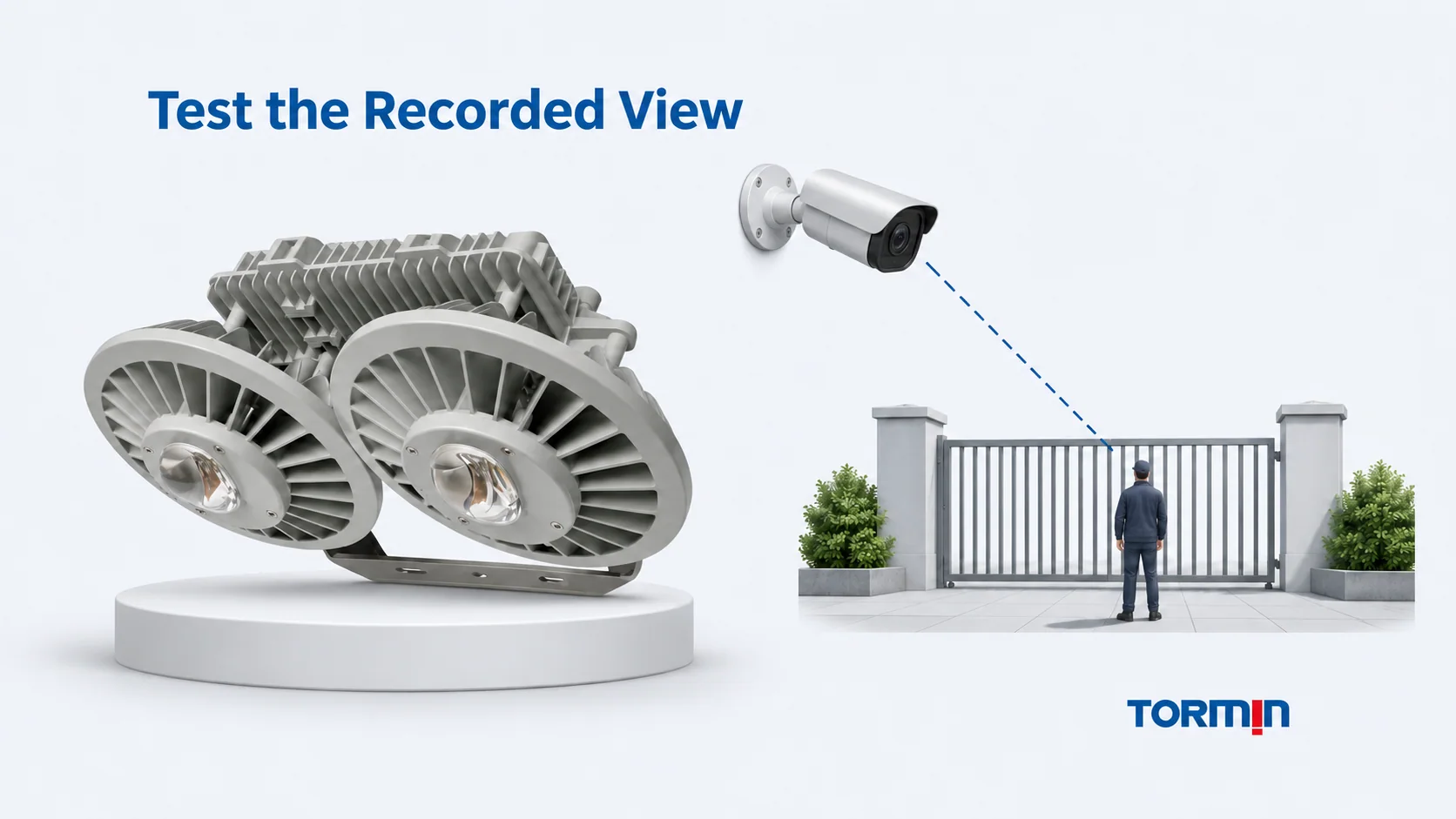
Industrial perimeter lighting for CCTV should be assessed against a defined recorded-image task. State what the reviewer must distinguish, where it must be visible, which operating conditions matter and which recording will demonstrate the outcome. A bright yard, a floor-lux average or an attractive live display does not complete that acceptance decision.
The useful deliverable is a joint test plan shared by the security owner, camera integrator and lighting designer. It connects each required observation to a location, a documented system state and reviewable evidence. This article develops that plan; it does not prescribe camera settings or a universal lighting level.
Start with the observation the camera must support
“Cover the fence” leaves the important question unanswered. Is the requirement to notice movement along a route, determine which side of an access line someone crossed, or distinguish a particular detail at a controlled entrance? These are different requests. Record the actual task without assuming that one successful view establishes the others.
The UK’s Dstl Police requirements for CCTV systems advises defining what must be seen and where, checking intended operating conditions, and assessing recorded video rather than relying on the live display. Its scope is video intended for police use; it is useful requirements guidance, not a universal industrial acceptance standard.
Write the proposed requirement as a sentence with an observable outcome:
At the agreed access line, the reviewer must be able to distinguish the two specified movement paths in the nominated recorded view under each listed operating condition.
This is a requirement-writing pattern, not an acceptance threshold. Replace its placeholders with agreed site details. If the owner actually needs a face, registration plate or object detail, specify that separate task and obtain the appropriate specialist criteria. Do not quietly substitute a simpler movement test.
Locate the target in the camera view
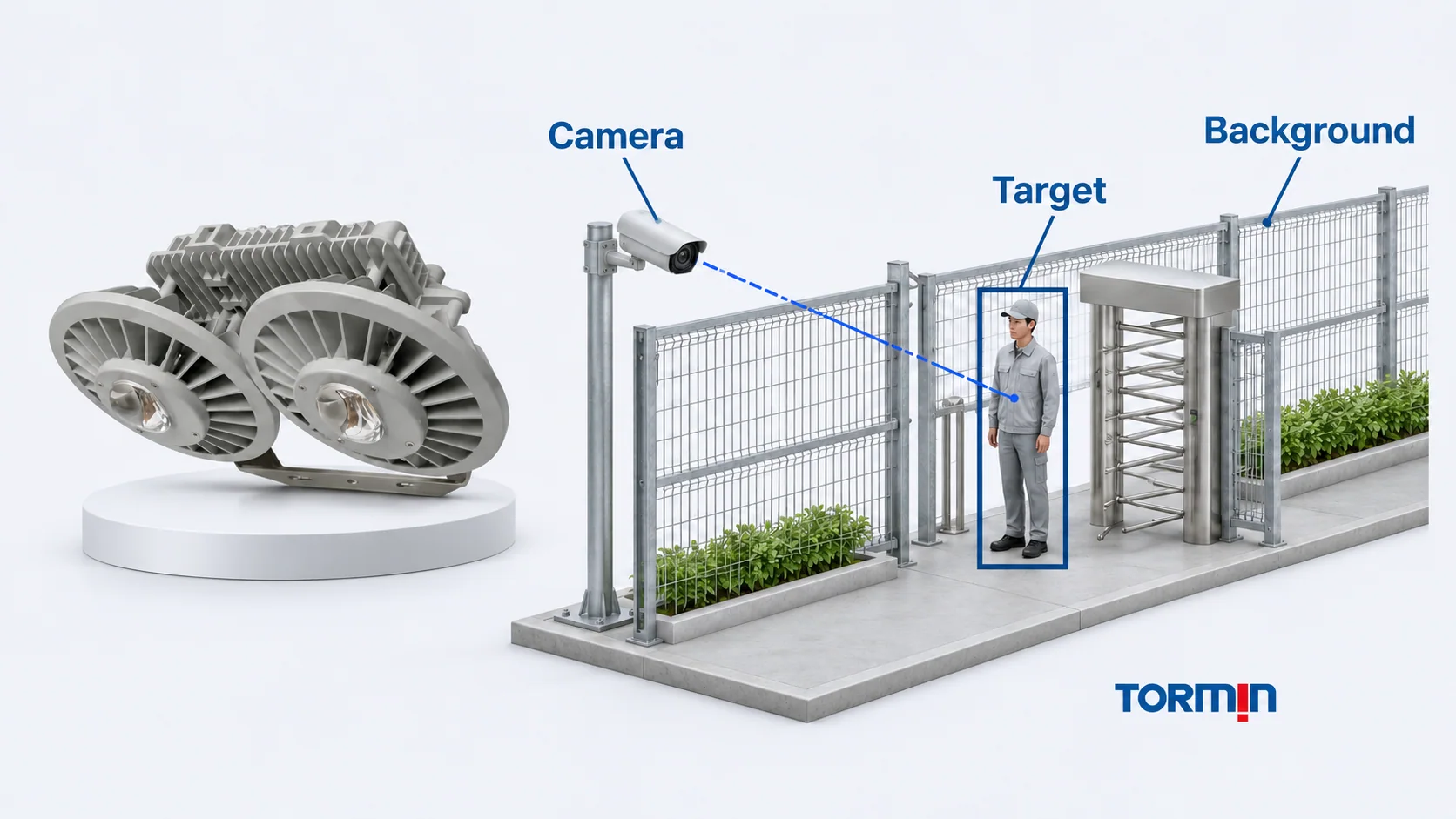
Mark the required observation on a plan and elevation: target location, relevant surface or movement segment, camera viewing direction and obstructions. Link the location to its camera/view identifier. A camera’s broad field of view is not a statement that every detail inside it meets the same requirement.
RCMP’s Security Lighting Considerations Guide, GCPSG-004 (2020) distinguishes lighting assessed toward an observer or camera from ground-plane measurements. The guide addresses Canadian government facilities; its numerical recommendations are not adopted here as general project limits.
For the joint review, ask which side of the target the camera sees and what can interrupt that view. An open gate leaf, a routinely parked vehicle or seasonal foliage may change the scene. Record the relevant configuration rather than treating an empty-yard view as the whole operating case.
The existing floodlight aiming guide addresses coverage, observer views and spill. Keep that lighting-design comparison alongside the camera task. Likewise, lighting uniformity explains a lighting report; it does not certify the information retained in a video recording.
Build a task-to-evidence matrix
The following is an original planning worksheet, not a standard’s prescribed checklist. Complete one record for each materially different observation and condition. Keep the criterion explicit enough that the owner and reviewer can agree what a successful observation would mean before testing.
| Record field | What to define | What an unresolved field prevents |
|---|---|---|
| Task and location | Required action/detail, named target segment and camera/view ID | Knowing what the evidence must demonstrate |
| Scene configuration | Target/view relationship and relevant gate, storage or vehicle positions | Relating a result to the intended scene |
| Operating condition | Agreed lighting state, camera mode and any transition being reviewed | Extending a result to another state |
| Recording identity | Configuration revision, recording segment and intended replay/export path | Retrieving the exact evidence assessed |
| Review criterion | Observable outcome, limitations and appointed decision-maker | Making a consistent acceptance decision |
| Result and action | Observation, disposition and any required re-evaluation | Separating a proposal from demonstrated performance |
Do not fill the result column with “compliant” merely because a product has been ordered or a design calculation is complete. A lighting calculation, equipment document and camera recording answer different questions. Retain each with its own identity and conclusion.
A useful record also says what was not assessed. A movement-direction task does not establish facial identification. One gate view does not establish the entire perimeter. A recording made in one operating state does not settle an untested state.
Preserve the recording and configuration being reviewed
Identify the camera, lens/view arrangement and relevant configuration version with the integrator. Identify the proposed luminaire variant, optic, position, orientation and operating-state record with the lighting designer. Keep a revision reference rather than an informal description such as “the brighter option.”
Dstl notes that live and recorded quality can differ. Review the intended recorded evidence path and identify the segment assessed. If an exported version will be used for the decision, name that version too; a screenshot of a live monitor leaves the recording question unresolved. Agree who retains the evidence and how the authorized reviewer retrieves it.
This is document traceability, not a camera-setup procedure. Changes to exposure, recording parameters or lighting settings belong to the responsible specialists and the site’s approved process. Record a change and its affected test records so that an earlier result is not silently attributed to a later configuration.
Fictional example: a gate-direction test plan
Fictional acceptance-test plan — no tests have been performed. Assume an ordinary industrial gate identified as G1, a proposed recorded view C1 and a marked access line L. The hypothetical owner requests one outcome: the reviewer can distinguish a volunteer crossing L toward the site from a volunteer moving parallel outside it.
No actual site dimensions, camera, settings, luminaire configuration or light level are supplied. The example does not require facial or plate identification and does not establish real security adequacy. Any eventual activities require the site’s approved plan, authorization and safe coordination with normal operations.
| Planned record | Scene or operating condition to define | Intended review | Current outcome |
|---|---|---|---|
| G1-A | Agreed after-hours scene, with the gate in its nominated reference position | Can C1’s recording distinguish the two agreed paths at L? | Not tested |
| G1-B | An agreed alternate gate position or routine obstruction state | Can the same distinction be made over the same nominated segment? | Not tested |
| G1-C | Change between two separately agreed lighting states | Does the recorded segment retain the required path distinction through the change? | Not tested |
These rows deliberately contain no assumed successful result. Before execution, the team must replace “agreed” with actual state/configuration references, define the target segment and decision criterion, and establish the evidence/reviewer arrangements. If an obstruction removes part of the required view, the team must resolve the requirement or proposal; it cannot mark the missing segment as passed.
G1-C tests an image requirement during a proposed change. It does not define a trigger, timeout, dimming level or controller program. Use the separate lighting-controls sequence guide to document the requested behavior, then identify which of its states need camera-image evidence.
Suppose only G1-A is eventually reviewed successfully. The defensible record would apply to G1-A’s task, configuration and conditions. G1-B and G1-C would remain open until their evidence is reviewed. This distinction prevents a single favorable demonstration from becoming an unsupported whole-system acceptance.

Investigate a missing observation without guessing its cause
When a reviewer cannot make the agreed distinction, record what is missing, where and in which segment/state. Ask the camera and lighting specialists to evaluate the combined evidence. A darker target, lost detail or visible banding is an observation, not proof that the floodlight alone caused the problem.
The US Department of Energy’s flicker research explains that a metric for human visual response does not predict video-camera response, and that driver loading and dimming conditions affect light-output waveforms. A “flicker-free” description or visual impression therefore cannot replace assessment of the intended camera/lighting arrangement. No ZY8606SH waveform or camera test is established here.
RCMP also distinguishes infrared imaging from visible-light colour information and discusses environmental and operating-state changes. If colour is part of the task, make the required mode explicit. If the operating environment changes, identify which evidence remains representative and which records require another review.
Request the lighting evidence without promising a camera outcome
DarkSky and IES’s Five Principles for Responsible Outdoor Lighting support purposeful light directed where needed. Increasing general output should not be the default substitute for resolving an unclear camera task. Keep worker visibility, off-site effects and the camera requirement in the same design review.
TORMIN’s industrial floodlight range is a product-comparison destination. The ZY8606SH page provides the first-party product identity used for this article’s exterior references. Its photograph establishes no camera compatibility, recognition distance or suitable installed configuration.
For a joint lighting enquiry, send the task-to-evidence matrix and the relevant site/view drawings. Ask for the exact offered luminaire documents and photometric identity, while the camera integrator supplies the corresponding recording/configuration evidence. Keep the acceptance decision attached to the defined task and demonstrated conditions.
Sources
- Dstl — Police requirements for CCTV systems (2022) — task definition and recorded-video assessment guidance for police-use recordings.
- RCMP — GCPSG-004 (2020) Security Lighting Considerations Guide — camera-oriented lighting and operating-condition considerations for Canadian government facilities.
- US Department of Energy — Flicker Research — limits of visual metrics for video-camera response.
- DarkSky International and IES — Five Principles for Responsible Outdoor Lighting — purposeful, targeted outdoor lighting.
- TORMIN — ZY8606SH product page — first-party product identity and exterior reference only.