
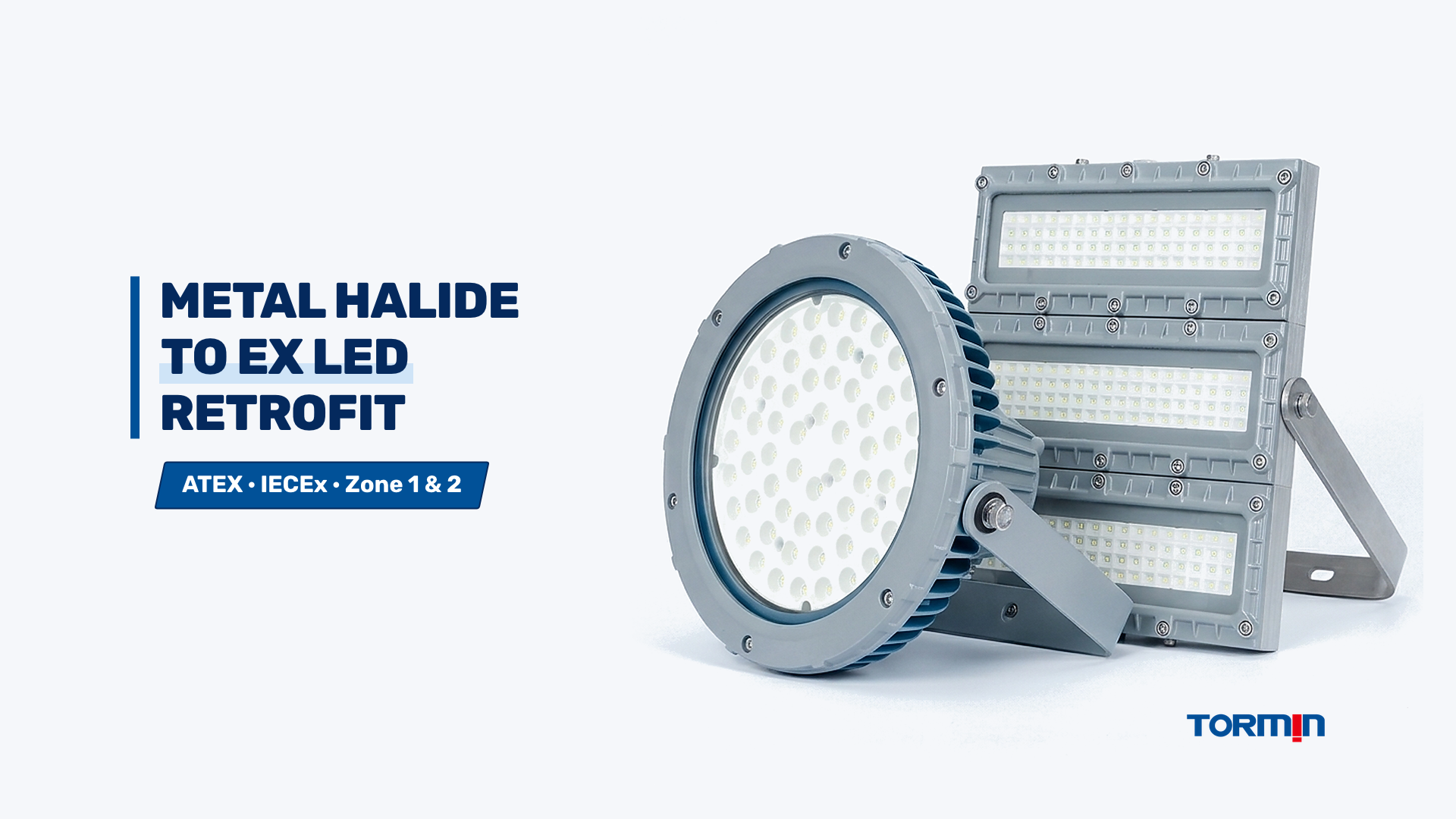
In ATEX and IECEx Zone 1 or Zone 2 hazardous areas, installing an uncertified LED corn bulb or generic retrofit kit inside an existing metal halide explosion-proof housing immediately voids the luminaire’s Ex certification under IEC 60079-14. Compliant retrofits require either a complete certified LED luminaire replacement or a rare manufacturer-certified kit explicitly listed on the original enclosure’s certificate schedule.
Across refineries, chemical plants, grain terminals, and offshore decks, legacy 250 W, 400 W, and 1,000 W metal halide fixtures remain one of the largest sources of wasted electricity and high-risk elevated maintenance. While most online retrofit guides focus exclusively on North American UL 844 rules, facilities operating under ATEX or IECEx face strict whole-luminaire certification, T-class, and single-adapter entry boundaries that govern every replacement decision.
Can You Put an LED Corn Bulb Inside an Explosion-Proof Metal Halide Fixture?
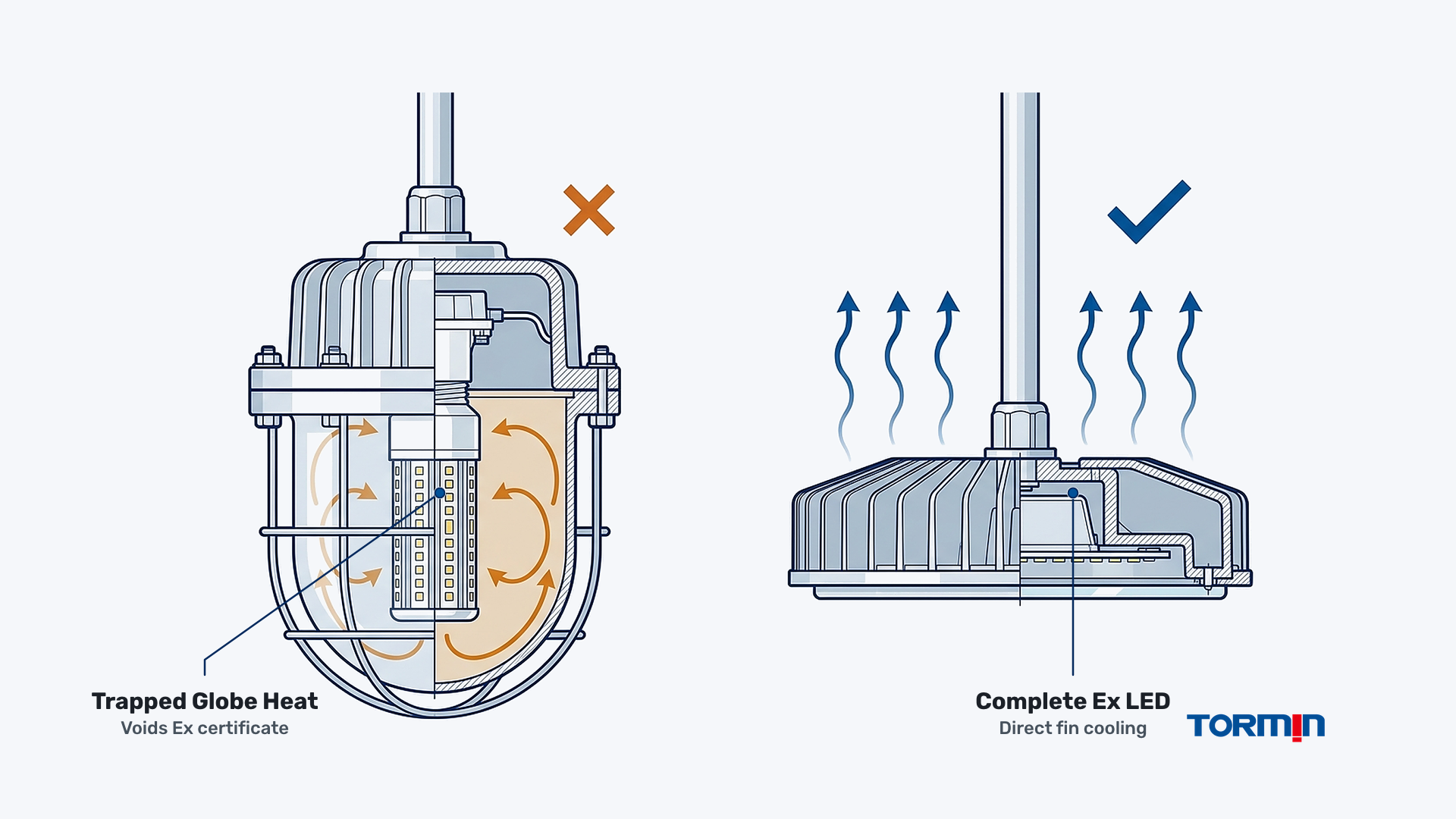
Installing a screw-in LED corn bulb inside an explosion-proof metal halide fixture is prohibited in ATEX and IECEx classified zones because the luminaire was tested and certified as a complete thermal and mechanical assembly. Substituting an uncertified lamp invalidates the EU-Type or IECEx certificate, alters internal temperature rise, and creates an immediate non-conformity during IEC 60079-17 inspections.
Even when an LED corn bulb consumes fewer watts than the original metal halide arc tube, its integrated electronic driver concentrates heat inside a sealed flameproof glass globe designed for high-temperature HID lamps rather than thermally sensitive electrolytic capacitors. In addition, bypassing the legacy magnetic ballast alters internal wiring clearance and fault-energy behavior that were never evaluated by the notified body.
| Retrofit Approach in Zone 1 / Zone 2 | ATEX / IECEx Compliance Status | Thermal & Photometric Impact | Practical Field Verdict |
|---|---|---|---|
| Screw-In LED Corn Bulb (Ballast Bypass) | Non-compliant (voids existing Ex certificate) | Traps driver heat inside sealed globe; severe glare and premature failure | Strictly prohibited in classified areas |
| OEM-Certified Retrofit Kit (Same Housing) | Compliant only if exact kit + host housing appear on certificate | Limited by legacy globe optics and aged enclosure gaskets | Rare; viable only if original housing and flamepaths are undamaged |
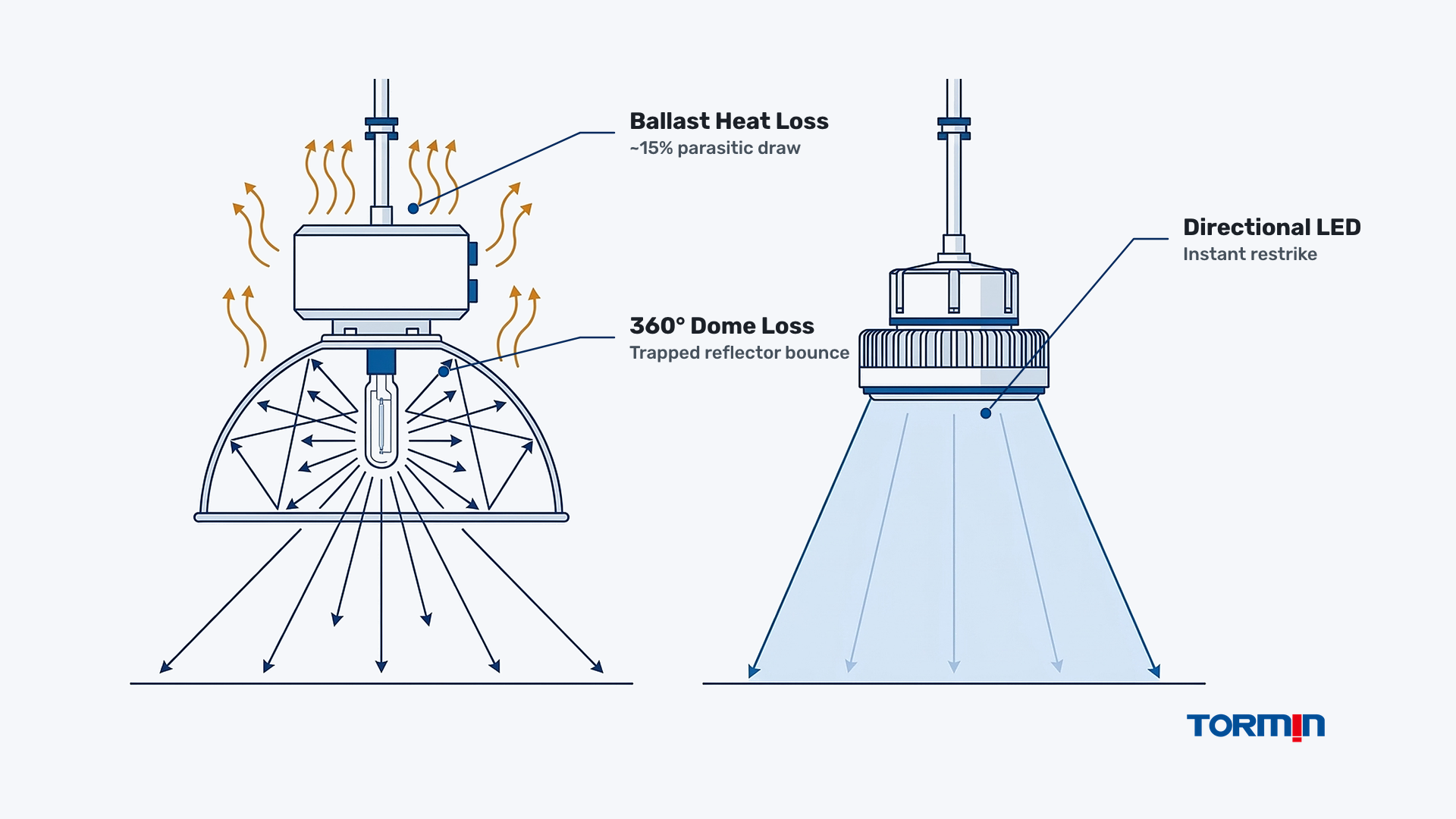
| Complete Certified Ex LED Luminaire Replacement | Fully compliant when matched to Zone, gas group, T-class, and Ta | Directional optics, lower T-class, fresh IP66 seals, instant restrike | Standard recommended engineering path |
Replace the entire legacy metal halide fixture with a factory-certified LED luminaire rather than attempting internal lamp-compartment modifications; this restores factory-tested IP66 seals, eliminates aged ballast enclosures, and provides a clean certificate trail for site auditors.
Metal Halide to Explosion-Proof LED Wattage and Lumen Equivalency Table
Converting metal halide fixtures to explosion-proof LEDs requires comparing delivered task-plane lumens and full system input wattage rather than nominal lamp wattage alone. Legacy magnetic metal halide ballasts add roughly 12 to 15 percent parasitic power draw, while 360-degree omnidirectional arc tubes lose substantial light inside reflectors and degrade rapidly over lamp life.
The table below provides preliminary replacement ranges for open industrial halls and process yards before running a formal photometric simulation. Exact fixture count, spacing, and glare compliance under ISO 8995-1 must always be verified in DIALux or AGI32 using manufacturer IES LM-63 or LDT photometric files rather than estimated from wattage alone.
| Legacy Metal Halide Lamp (W) | Typical System Draw with Ballast (W) | Preliminary Ex LED Replacement Band (W) | Indicative Delivered Flux Target (lm) | Typical TORMIN Reference Family |
|---|---|---|---|---|
| 175 W to 250 W MH | 205 W to 290 W | 60 W to 80 W | 6,500 to 9,500 lm | BC9304P (80 W config) or BC9102S (60 W config) |
| 400 W MH | 450 W to 460 W | 120 W to 150 W | 13,000 to 19,000 lm | BC9304P (120 / 150 W, up to 18,675 lm, IP66) |
| 1,000 W MH | 1,080 W to 1,120 W | 240 W to 300 W | 28,000 to 38,000 lm | BC9102S (modular 60–300 W, 120–240 VAC, IP66) |
For open overhead bays between 6 and 15 m, shortlist ATEX explosion-proof LED high bay lights such as the TORMIN BC9304P series (80 to 150 W, 8,873 to 18,675 lm, 100 to 277 VAC, IP66); for perimeter masts, loading racks, and 1,000 W area-lighting replacements, review hazardous-area LED floodlights such as the modular BC9102S series (60 to 300 W, IP66). For broader hazardous-area product lines including Zone 1 linear and emergency luminaires, consult the ATEX and IECEx hazardous-area lighting range.
ATEX and IECEx Compliance Upgrades When Switching from Metal Halide to LED
Replacing legacy metal halide luminaires with modern explosion-proof LED fixtures delivers two immediate safety upgrades beyond energy savings: lower maximum surface temperatures and elimination of hot-restrike blackouts. Both improvements directly reduce operational risk in Zone 1 and Zone 2 process units governed by IEC 60079-0 and IEC 60079-14.
- Temperature Class (T-Class) Margin Upgrade: High-wattage metal halide globes frequently operate at surface temperatures that limit the luminaire to T2 (300 °C) or T3 (200 °C). Purpose-built explosion-proof LED luminaires with passive die-cast heat sinks commonly achieve T5 (100 °C) or T6 (85 °C) at rated ambient temperatures, expanding safety margin around low-autoignition-temperature vapors in gas groups IIB and IIC. For detailed gas-group and ambient Ta rules, review our guide on gas groups and temperature classes.
- Instant Restrike After Voltage Dips: A metal halide arc tube extinguishes during a brief utility sag or generator transfer and requires 5 to 15 minutes to cool before reigniting. Explosion-proof LED drivers restore full illumination instantaneously, eliminating dark-zone hazards during process upsets or emergency evacuations.
- Model-Specific Verification Boundary: Never assume every LED configuration carries identical approvals. Confirm the exact model code, Ex marking, gas or dust group, T-class, ambient temperature range (Ta), and any X special conditions of use on the current certificate schedule in the TORMIN Standards and Certifications archive before ordering. Where a project falls under North American NEC Class/Division jurisdiction, confirm local AHJ and UL 844 or CSA requirements separately rather than assuming ATEX/IECEx equivalence.
Mounting and Conduit Interface Compatibility Under IEC 60079-14
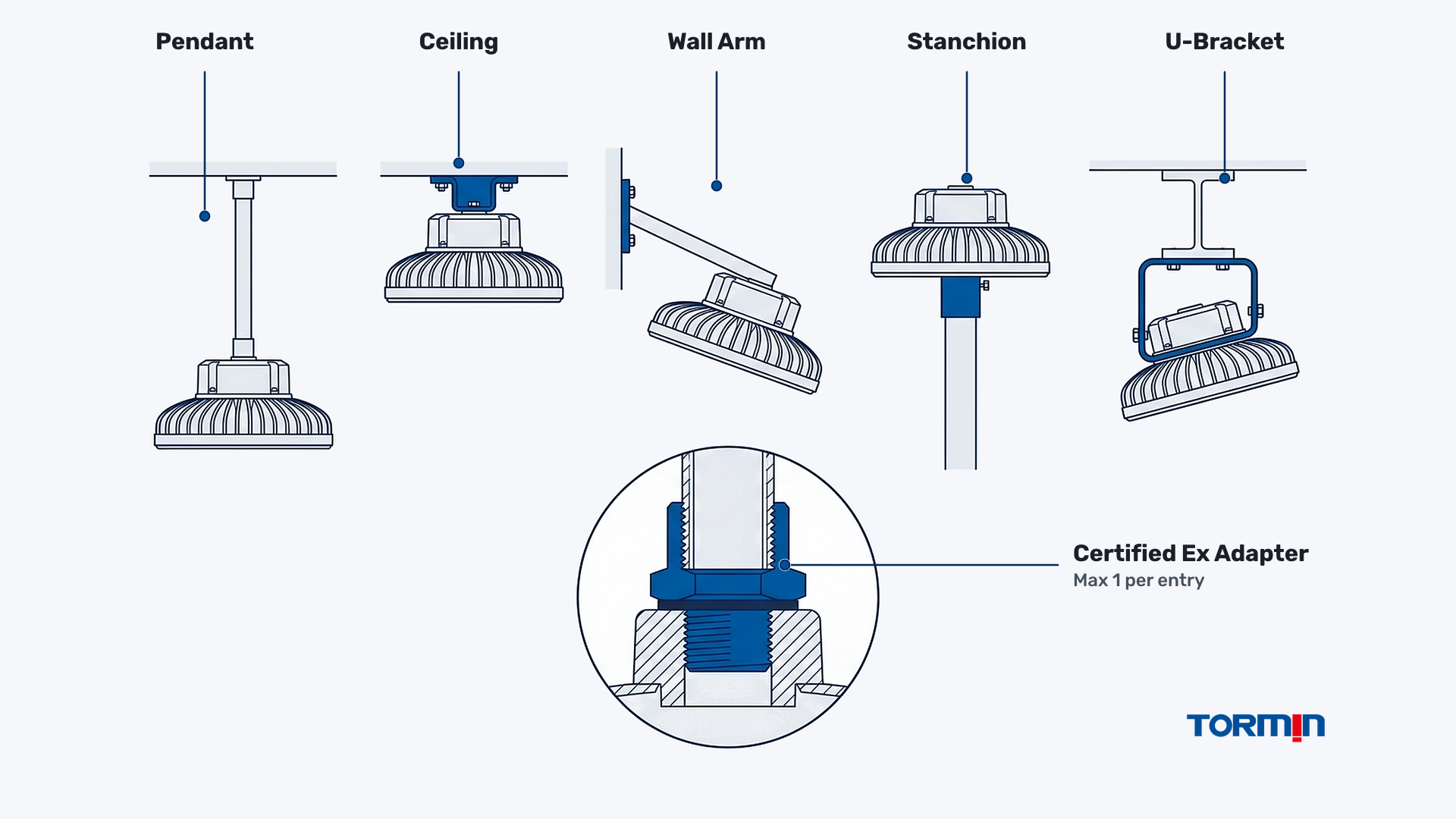
Re-piping rigid conduit or modifying welded steel supports is the single biggest cost multiplier during a plant-wide lighting retrofit. Matching the replacement LED luminaire’s bracket geometry and threaded cable entry to the existing mechanical mount allows crews to swap fixtures quickly without hot work or conduit reconstruction.
| Legacy MH Mounting Style | Typical Plant Location | Direct LED Replacement Interface | Key Mechanical & IEC 60079-14 Check |
|---|---|---|---|
| Rigid Pendant Drop | Open process halls and pump bays | Pendant cap with matched M20, M25, or NPT 3/4 in hub | Verify pendant stem load capacity and add vibration locking |
| Ceiling / Flush Box Mount | Low mezzanines and control corridors | Surface ceiling bracket or direct-mount adapter | Maintain upper heat-sink airflow clearance per manual |
| Wall Arm (25 or 90 deg) | Exterior walkways and door exits | Angled wall bracket with secondary safety tether | Check downward aiming to avoid walkway glare |
| Stanchion / Pole Mount | Pipe racks, platforms, and stairs | Slip-fitter or 25 deg stanchion clamp | Confirm pole outer diameter and wind-load rating |
| U-Bracket / Yoke | Masts, tank yards, and structural trusses | Adjustable stainless U-bracket with lock bolts | Stay within certified burning/tilt angle envelope |
When an existing hazardous-area cable entry thread (such as NPT 3/4 in) does not match the new luminaire’s metric entry (such as M20 or M25), IEC 60079-14 requires using a certified Ex thread adapter or reducer rated for the same protection concept (Ex d or Ex e) and IP level. Never stack multiple adapters in series (maximum one certified adapter per entry) and never install uncertified commercial plumbing reducers. For full thread-matching, cable-gland, and unused-entry stopping-plug rules, consult our guides on cable glands vs stopping plugs and explosion-proof lighting installation.
Total Cost and Payback Math: 400 W Metal Halide vs 150 W Explosion-Proof LED
Evaluating a hazardous-area lighting retrofit strictly on electricity savings understates its true financial return because elevated relamping in classified zones carries disproportionate labor, work-permit, and scaffolding costs. The worked hypothetical model below illustrates annual operating cost per fixture for continuous 24/7 operation (8,760 hours per year) at an example industrial tariff of $0.12 per kWh.
| Annual Cost Component (Illustrative 24/7 Model) | Legacy 400 W Metal Halide (455 W System Draw) | Replacement 150 W Ex LED (150 W System Draw) | Annual Difference per Fixture |
|---|---|---|---|
| Annual Energy Consumption (kWh/yr) | 3,985.8 kWh | 1,314.0 kWh | 2,671.8 kWh saved |
| Annual Electricity Cost at $0.12 / kWh | $478.30 | $157.68 | $320.62 saved |
| Estimated Relamping & Permit Labor (Annualized) | $140.00 to $250.00 (lamp/ballast + lift/permit) | $0.00 (during rated driver service window) | $140.00 to $250.00 saved |
| Combined Illustrative Annual Operating Savings | — | — | $460.62 to $570.62 / fixture / yr |
These figures are transparent teaching assumptions rather than a universal guarantee; actual payback depends on your site electricity rate, operating hours, local ambient temperature Ta, and scaffold or crane access costs. Plug your facility’s exact operating hours and utility rate into the TORMIN Energy Payback Calculator, and review our industrial LED retrofit measurement guide to establish an auditable before-and-after energy baseline.
Pre-Replacement Site Survey and Specification Handover
Accurate quotations and zero-rework installations start with capturing controlled field data before dismantling a single metal halide fixture. Before contacting suppliers, record four baseline datasets at each circuit: the existing Ex nameplate marking (Zone, gas group, T-class, and ambient Ta), actual supply voltage and frequency, exact mounting height and structural bracket interface, and cable outer diameter plus entry thread size.
To turn those field checks into a controlled change package without missing permit or photometric details, follow our dedicated seven-part explosion-proof LED retrofit site survey checklist. Once your survey sheet is complete, send the fixture schedule and target lux requirements to [email protected] or via the TORMIN Contact page to request matching IES/LDT photometric files and model-specific ATEX or IECEx certificate schedules.
Residual Engineering Questions for Metal Halide to LED Retrofits
Do You Have to Replace Existing Explosion-Proof Junction Boxes During an LED Retrofit?
Existing explosion-proof junction boxes do not automatically require replacement if an IEC 60079-17 detailed inspection confirms that their Ex certification, enclosure integrity, flamepaths, earthing, and terminal ratings remain compliant for the new LED circuit. Replace any box showing corroded threads, damaged gaskets, missing certification plates, or insufficient conductor space using compliant explosion-proof junction and terminal boxes.
Should Industrial Facilities Choose 4000 K or 5000 K CCT When Replacing Metal Halide?
Most industrial and hazardous-area facilities choose 5000 K neutral-cool white for outdoor yards, tank farms, and high-ceiling process bays to match the crisp visual contrast of legacy metal halide lamps, while 4000 K neutral white is often preferred in indoor control corridors and low-ceiling inspection areas to reduce perceived glare and eye fatigue during long shifts.
Sources
- IEC 60079-0:2017 — Explosive atmospheres: Equipment general requirements — supports whole-luminaire Ex certification, gas/dust groups, temperature class (T-class), and ambient Ta limits.
- IEC 60079-14:2024 — Explosive atmospheres: Electrical installations design, selection and erection — supports certified luminaire selection, Ex cable entries, and single certified thread-adapter rules.
- IEC 60079-17:2023 — Explosive atmospheres: Electrical installations inspection and maintenance — supports inspection of existing junction boxes, enclosures, and non-compliant field modifications.
- ISO 8995-1 / CIE S 008 — Lighting of work places, Part 1: Indoor — supports maintained task-plane illuminance and glare evaluation during lighting retrofits.
- IES LM-63 — Approved Method: IES Standard File Format for the Electronic Transfer of Photometric Data — supports DIALux and AGI32 photometric verification before finalizing fixture counts.
- TORMIN Standards and Certifications Archive (first-party product documentation) — supports model-specific ATEX, IECEx, CE, and CNEX certificate verification.