

A fair industrial LED retrofit comparison must keep the energy boundary and lighting service comparable, then account for changes in operating conditions. A lower post-retrofit kWh total may reflect lower lighting input power, fewer operating hours, or both. Subtracting two period totals does not separate those effects.
Preserve the original energy records. Make any adjusted comparison separately, naming the conditions held constant and the assumptions used. That lets the reader distinguish what happened during the two periods from what the calculation says about a specific change.
Why the raw electricity difference can be misleading
For a constant lighting load, the basic relationship is:
Energy (kWh) = total real input power (kW) × energized time (h)
Change either factor and the energy changes. If both change, the raw difference combines them. For variable power, a single full-output wattage multiplied by “hours on” may no longer represent the energy used.
The Uniform Methods Project’s commercial and industrial lighting protocol uses fixture power, quantities and hours of use, grouped by operating schedule. It distinguishes equipment measures from controls measures and makes the hours assumption explicit. A building’s opening schedule is not automatically the operating record for every lighting group.
TORMIN’s energy and payback calculator answers a simpler planning question: compare constant input powers using the same quantity and operating schedule. A real before-and-after review must first establish whether those conditions actually match.
Compare the same electrical boundary and lighting service
An electrical boundary identifies the loads included in the comparison. One luminaire’s input power, a lighting group’s electricity and a whole-building meter are different boundaries. A whole-building change can include production equipment and other loads that the lighting replacement did not change.
DOE FEMP’s final M&V Guidelines, version 5.0, explains why operating-condition changes can require adjustments and why the measurement boundary matters. Its guidance concerns performance-based energy projects; the worked calculation below illustrates the principle rather than implementing a complete federal-contract method.
Within the chosen boundary, use total real electrical input. Include the driver or ballast consumption represented by that boundary. Keep auxiliaries, standby and control-system loads consistently included or explicitly accounted for; a light-source wattage alone does not describe all of them.
Comparable service matters too. PNNL’s lighting-retrofit M&V framework assumes appropriate task lighting in both cases and comparable operating conditions for a technology comparison. A lower electricity total obtained by leaving a required task inadequately lit is not an equivalent-service comparison.
Define the task and assessment basis separately from the energy arithmetic. The uniformity guide explains one reason an average-lux number alone cannot establish that spatial result. Neither watts nor kWh proves acceptable illuminance, glare or visibility.

Worked example: separate the load change from changed hours
Fictional calculation—all inputs are assumed, not measured. Consider one hypothetical lighting group across two equal 30-day periods. Its electrical boundary remains the same. Assume:
| Input | Before period | After period |
|---|---|---|
| Constant total active real input power within the boundary | 12 kW | 8 kW |
| Energized hours | 300 h | 240 h |
| Off-state and standby energy | Assumed zero | Assumed zero |
| Required lighting service | Assumed maintained | Assumed maintained |
The input powers include the driver/ballast consumption inside the hypothetical boundary. There is no dimming. The facility operates fewer hours in the after period; no controls saving has been demonstrated. Equivalent lighting service is an assumption for this lesson, not a photometric result. None of these numbers describes a TORMIN product or project.
First calculate the two period totals
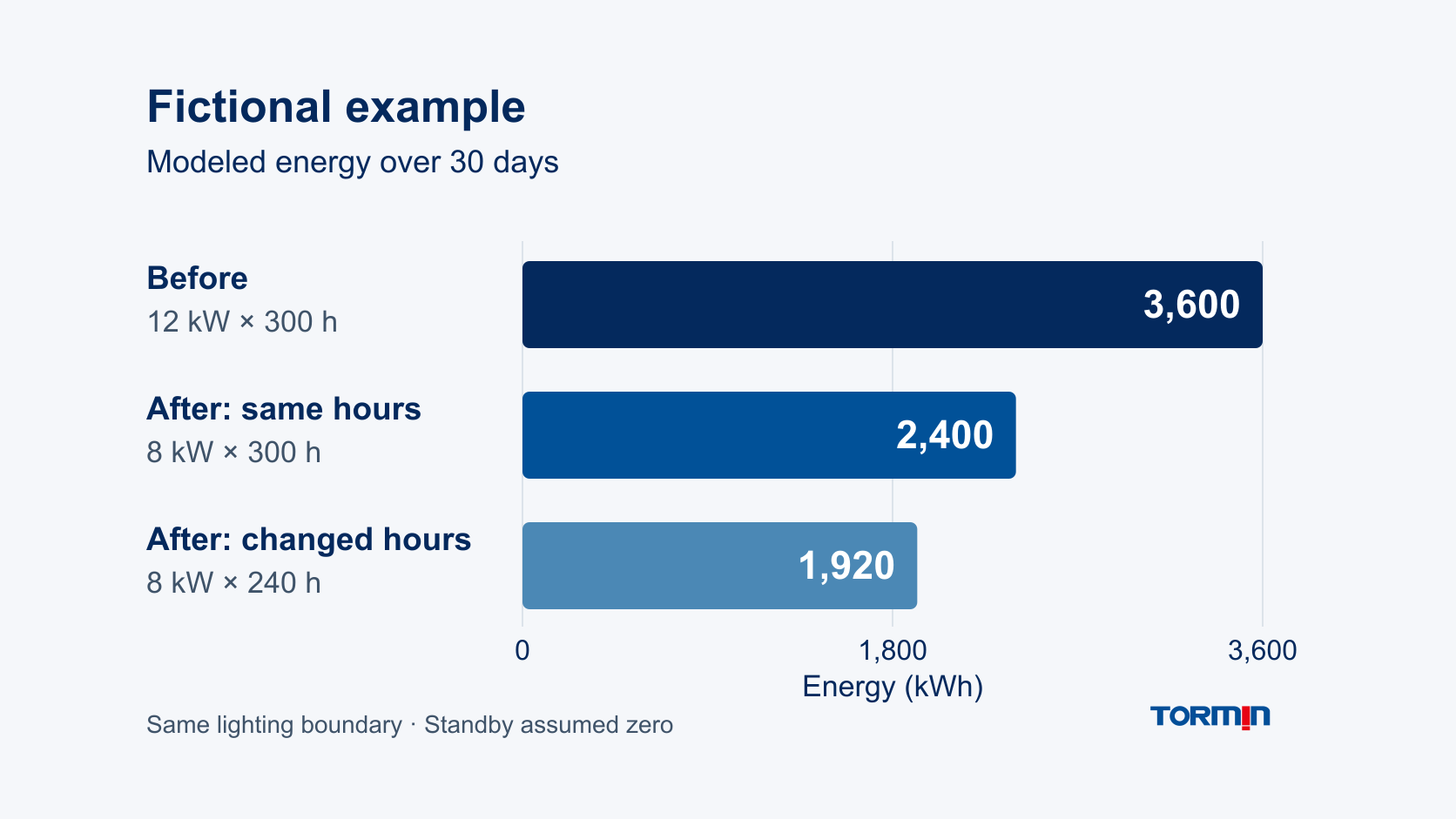
Before: 12 kW × 300 h = 3,600 kWh
After:   8 kW × 240 h = 1,920 kWh

Raw period difference = 3,600 − 1,920 = 1,680 kWh
Raw percentage change = 1,680 ÷ 3,600 × 100 = 46.7% less
There is 1,680 kWh less modeled electricity in the second period. That statement is correct for these assumptions. Calling the entire 46.7% difference the effect of replacing the luminaires would ignore the reduced runtime.
Then compare both loads at the same stated runtime
Choose the before-period 300 hours as the reference for this comparison. Keep the new 8 kW load but calculate its energy over those same hours:
After load at 300 h = 8 kW × 300 h = 2,400 kWh

Common-hours load difference = 3,600 − 2,400 = 1,200 kWh
Percentage at this reference  = 1,200 ÷ 3,600 × 100 = 33.3%
Under the declared constant-power and service assumptions, the lower group input requires 1,200 kWh less over 300 energized hours. This answers a different question from the raw period comparison. It holds runtime constant so that the load change can be seen.
Reconcile the remaining difference
At the after load of 8 kW, the 60-hour reduction contributes:
Hours component at after load = 8 kW × (300 − 240) h
                              = 480 kWh

1,200 kWh load component + 480 kWh hours component
                        = 1,680 kWh raw difference
The arithmetic now accounts for the entire modeled period change. It also shows why the 480 kWh must not automatically be called controls savings: the example attributes the reduced hours to changed facility operation, without supplying evidence of a controls measure.
State the reference because it changes the component comparison
The 300-hour reference is an analytical choice, not a replacement meter reading. At a 240-hour reference, the load comparison would instead be (12 − 8) × 240 = 960 kWh. The remaining hours component evaluated at the before load would be 12 × 60 = 720 kWh. Those also sum to 1,680 kWh.
This is not a contradiction. The combined change contains both a power and a time change, and the chosen decomposition assigns their interaction differently. Therefore, name the reference and calculation order rather than presenting one component as a uniquely measured causal saving. For an actual project, use the comparison basis and adjustments agreed in its M&V plan.
Keep measured totals, reconstructed energy and adjusted results distinct
An actual energy meter can provide a period total within its boundary. A reconstruction derives energy from powers and operating records. An adjusted comparison answers a stated counterfactual question, such as how the two loads compare at a common runtime. Label those outputs accurately; a calculated value does not become measured because one of its inputs was measured.
FEMP’s guidance allows for changes in operating conditions when comparing baseline and performance periods. Preserve the source data and show the adjustment separately. A new production shift, a changed area in use or an unrelated load added inside the boundary can change what the comparison means.
The fictional example used constant power and zero standby to make that distinction visible. For a dimmed or multi-state installation, represent the power and duration of the relevant states, or use suitable energy evidence for the defined period. Do not substitute a requested dimming percentage for the same percentage of input power. The controls-sequence guide defines requested behavior; it supplies no energy result by itself.
PNNL’s framework also separates equipment and controls effects. Its assumptions do not justify ignoring a real change in service or operation. If the old system contained failed units or the new layout serves a different task area, explain that difference and establish an appropriate comparison; do not quietly relabel an altered baseline as the original meter record.
Use the result for the decision it actually supports
The worked example establishes a useful bounded conclusion: a 46.7% raw period reduction and a 33.3% common-300-hour load reduction can both be correct, because they answer different questions. It establishes neither a real savings claim nor a recommended product substitution.
Energy comparison also does not authorize a hazardous-area replacement. The Ex retrofit survey guide owns the separate equipment, retained-interface and site-review task.
The ZY8605A product page supplies the first-party exterior identity used in this article’s illustrations. No fictional input power, replacement equivalence or percentage is assigned to that model.
For a project discussion, bring the defined lighting scope, actual input/energy records, operating context and required lighting service. Keep the raw result and any adjusted comparison visible side by side so the decision rests on the right question.
Sources
- Gowans and Telarico / NREL—Chapter 2: Commercial and Industrial Lighting Evaluation Protocol, NREL/SR-7A40-68558 (2017)—power, usage groups and operating-hours basis.
- DOE FEMP—M&V Guidelines: Measurement and Verification for Performance-Based Contracts, version 5.0 (September 2024)—comparison boundaries and operating-condition adjustments.
- E. E. Richman / PNNL—Standard Measurement and Verification Plan for Lighting Retrofit Projects for Buildings and Building Sites, PNNL-21983 (2012)—comparable lighting service and separation of equipment/controls effects.
- TORMIN—ZY8605A LED Area Light—first-party product identity and exterior only.