
Short answer
Explosion proof lighting for battery energy storage is required where the project’s accepted hazardous-area classification calls for it. A lithium-ion BESS container or room is normally not classified merely because it contains sealed cells operating as intended. That is neither a declaration that every BESS is unclassified nor permission to ignore fault releases. The decision belongs to the project’s hazard assessment and classification documents, followed by selection for the actual light position.
Keep the normal installation decision separate from a thermal-runaway event and from permission to enter afterward. A hazardous-area luminaire controls an equipment ignition source within its documented scope. It does not prevent a battery from releasing gas, replace the enclosure’s explosion-control strategy, or establish that an atmosphere is safe for personnel.
| Situation | Is it classified? | Lighting consequence |
|---|---|---|
| Sealed lithium-ion cells operating as intended, with no assessed release requiring classification | Not automatically classified by the presence of batteries; retain the project’s documented conclusion. | Select lighting for electrical, environmental and task conditions, plus applicable emergency-lighting requirements. |
| A project assessment identifies a classified extent around an assessed release source or at a defined equipment position | Follow the accepted classification drawing and schedule for that extent. | Select equipment for the specified framework, group, protection level, temperature and installation conditions. |
| Thermal runaway, a suspected gas release, or an unknown post-event atmosphere | An incident atmosphere requires emergency assessment; the normal drawing does not authorize entry. | Apply the emergency plan and atmospheric assessment before authorized work; a portable light is not an entry permit. |
The distinction follows the scope of IEC 60079-10-1: area classification addresses defined gas-release conditions, while catastrophic failures or rare malfunctions beyond its concept of normality are outside that standard’s scope. A competent assessment must decide which release scenarios apply; the word “fault” alone does not decide the classification.
Why a running BESS is not a gas area
A sealed lithium-ion cell operating within its intended conditions is not designed to discharge combustible gas into its surroundings as a routine charging function. The presence of racks, a charger or a metal container therefore does not by itself establish a persistent gas-release source. A room name on an architectural plan is not a hazardous-area classification.
The OPSS-commissioned technical review of battery storage describes lithium-ion batteries as sealed while recognizing venting and thermal-runaway hazards from faults. Its cell-construction distinction helps explain the issue; its domestic-system scope does not classify a commercial installation. For a BESS project, the engineering assessment must address the actual equipment and enclosure.
Do not turn “no routine release” into “no release worth assessing.” Expected abnormal conditions can matter to classification, and latent defects can produce serious events even when the operator has followed normal instructions. Release likelihood, containment and the adopted classification method determine how those scenarios are handled. They cannot be resolved by choosing an especially rugged lamp.
Lead-acid charging rooms involve a different gas-release question, addressed in the hydrogen-lighting guide, and those rules should not be transferred wholesale to sealed lithium-ion BESS.
For procurement, request a recorded classification conclusion for the proposed light positions, including an unclassified conclusion where justified. Missing drawings are an information gap, not proof that either ordinary equipment or hazardous-area equipment is the correct answer. The owner should resolve that gap with the competent design team and the authority having jurisdiction (AHJ) where review or acceptance is required.
A useful review distinguishes an accepted unclassified conclusion from an assessment that is still pending. The first is a design result with stated assumptions; the second is unfinished work. Ask which release conditions were considered, which controls the conclusion relies on and whether the light position is actually included. That makes a quotation review more useful than requesting an “explosion-proof option” without a defined requirement. Record who owns the conclusion so a supplier is not asked to invent the site’s classification.
The event the standards actually design for
Thermal runaway is an uncontrolled self-heating failure process. Cells can vent combustible and toxic gases, and release can spread beyond the initiating cell. Hydrogen, carbon monoxide and hydrocarbons are among the relevant gas components. Their presence and behavior depend on the cell chemistry, condition and test scenario; there is no universal BESS gas recipe that this article can assign.
The original UL 9540A AHJ checklist identifies hydrogen, carbon monoxide and hydrocarbon gas measurements as report-review items. That explains why the actual test report matters. A cover page stating that testing occurred does not provide the engineering inputs needed to assess the enclosure, release behavior or explosion-control design.
Inside an enclosure, released gas can accumulate and mix with air. The hazard can develop before there is an obvious external flame. Removing a possible lamp ignition source does not remove the combustible material, the battery’s own energy or other potential ignition mechanisms. An Ex fitting alone cannot make that enclosure safe.
NFPA 855 addresses the installation of stationary energy storage systems, including detection, ventilation and explosion-control considerations. The adopted edition, applicable exceptions, tested configuration and AHJ acceptance determine the project’s required approach. Do not assume that a comfort-cooling fan is an engineered gas-control system simply because it moves air.
Within that engineering framework, NFPA 69 addresses explosion-prevention systems, while NFPA 68 addresses protection by deflagration venting. Their functions and applicable design conditions differ. They are not interchangeable labels for any fan or pressure-relief panel, and a venting-only arrangement must not be assumed acceptable without checking the adopted requirements. This article supplies no control setpoints, ventilation design or vent-sizing instruction.
The lighting question remains narrower: does the accepted assessment require hazardous-area equipment at this position, and does the exact luminaire satisfy that requirement? Separately, the emergency strategy must address detection, equipment response, exclusion and authorized intervention. A luminaire certificate cannot answer those system questions.
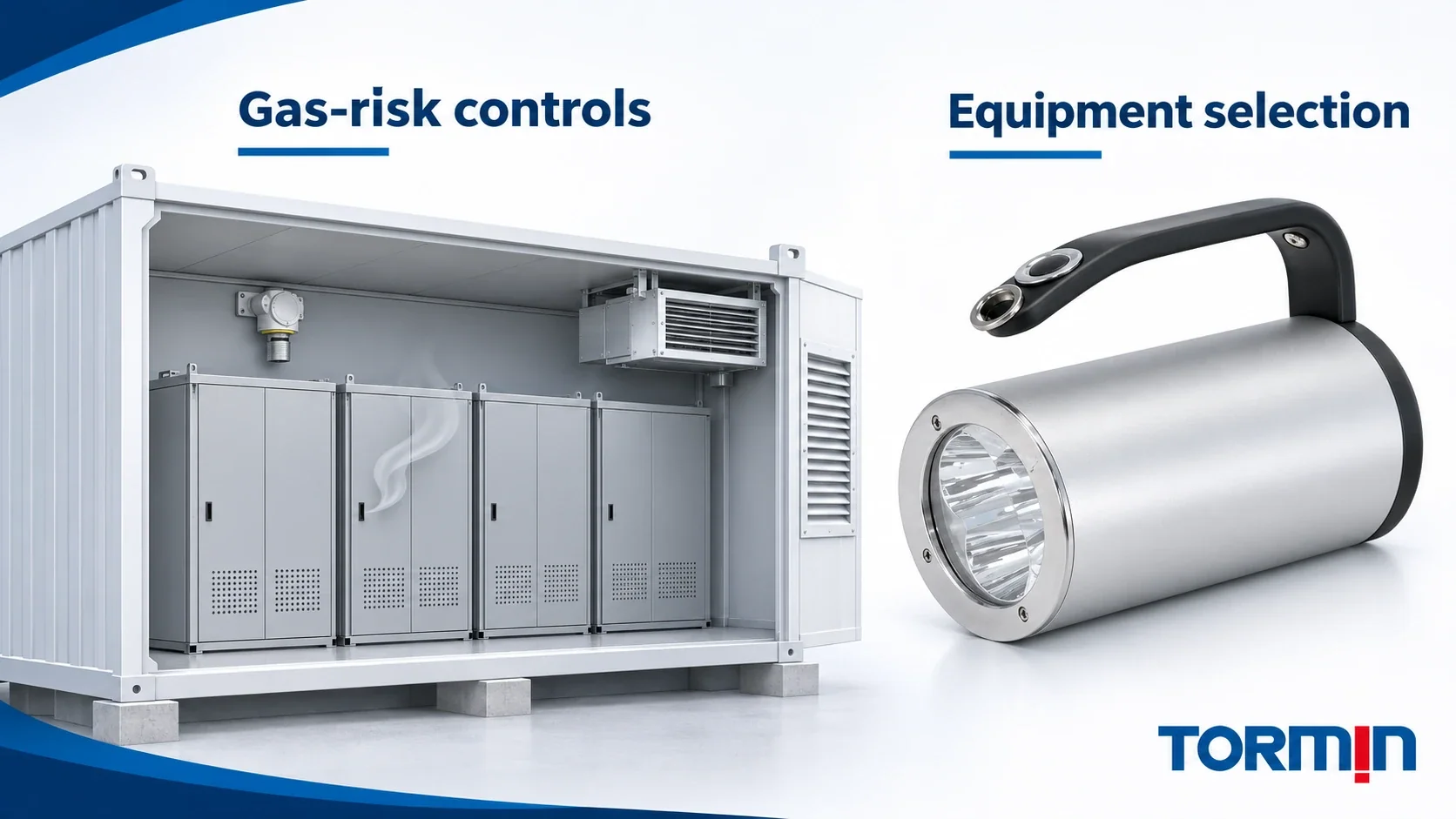
Keep ordinary cooling, emergency gas management and electrical isolation distinct in the design review. They may interact through approved controls, but their purposes and behavior are not established by seeing a fan on a container wall. The lighting designer needs the accepted consequences for equipment selection, rather than an improvised instruction to open a door or start ventilation after a suspected release. Changes to enclosure openings, detection or control arrangements belong with the responsible system engineers.
The three documents people mix up
An installation standard, a system product standard and a fire-test method answer different questions. Read the document’s title and scope before treating its number as a purchasing requirement for a light.
| Document | What it addresses | What it does not establish for a luminaire |
|---|---|---|
| NFPA 855 | Standard for the Installation of Stationary Energy Storage Systems: installation and associated protection requirements. | It is not an explosion-proof product certificate for the light. |
| UL 9540 | Standard for Energy Storage Systems and Equipment: the safety evaluation of the ESS product and equipment within its scope. | ESS product approval does not give an unrelated lamp a hazardous-location rating. |
| UL 9540A | Test Method for Evaluating Thermal Runaway Fire Propagation in Battery Energy Storage Systems: test evidence about thermal-runaway and fire behavior. | A report under this method is not an explosion-proof lighting certification. |
UL’s technical explanation of UL 9540, UL 9540A and NFPA 855 distinguishes the system product standard from the test method. UL 9540A results can inform an installation evaluation, but the report must represent the configuration being assessed. Test edition, test level, enclosure and system differences matter; changing a title on a supplier’s quotation does not resolve them.
A claim such as “UL 9540A-certified explosion-proof light” mixes those scopes. Ask instead for the light’s own hazardous-area evidence when the location requires it. For IEC equipment, that means the applicable IEC 60079 protection and exact-model certification documents; for a North American classified installation, use the applicable NEC requirements and accepted equipment approval. Neither route is replaced by a battery-system test report.
When a project does classify — and what follows
Classification should identify the assessed space, not just state that the project contains batteries. The engineering inputs should include:
- The cell chemistry and the actual system configuration represented by the evidence.
- Relevant UL 9540A gas and behavior data, with the report’s conditions and limitations.
- The release scenarios evaluated and why they fall within the chosen classification method.
- Ventilation, gas detection and control behavior, including the conditions the assessment assumes.
- The enclosure form: container, battery room, cabinet or open outdoor arrangement.
- The applicable NFPA 855 edition, electrical framework and AHJ requirements.
The hazard analysis and the classification record may be separate documents. The lighting schedule needs a controlled link between them so that an assumption about containment or ventilation is not lost between disciplines. If the accepted design changes, the responsible team must consider whether the classification and equipment requirements need review.
The classification-input guide explains the handoff to a competent classifier. Do not classify an entire container from a gas constituent mentioned in a test, or draw a boundary around a discharge point from a photograph. The study must establish the relevant release, extent and equipment position.
Where a classified extent is established, apply its group and temperature requirements independently. If the assessment requires hydrogen suitability, IEC IIC is the relevant general gas-group coverage; a NEC Division assessment may specify Class I, Group B. These are respective framework requirements, not mutually recognized certifications. Trace or detected hydrogen alone is not a substitute for the accepted mixture assessment.
The NEC-based adopted code text supplies the separate North American equipment framework. For an IEC project, take the Zone and required equipment protection level from the documents, using the Zone selection guide to read those inputs. For either framework, temperature suitability and permitted ambient conditions remain separate checks. This article assigns no temperature class to a BESS mixture.
Then use the nameplate and certificate guide to match the proposed ordering configuration to its approval and conditions. The same classification can affect other equipment at the location; replacing the light alone does not resolve a wider equipment-acceptance problem. Keep the selected mounting position and document revision with the lighting schedule.
That record should let a reviewer trace a proposed substitution back to the requirement it satisfies. If the lamp moves, the enclosure changes or its supply arrangement is revised, confirm the original conclusion still covers the new position and configuration. A previously accepted purchase description is not a permanent classification decision.
Lighting by location
Location still matters after the general assessment is understood. Enclosure form changes gas retention and access, while the exact task determines where useful illumination is needed. The following table organizes lighting decisions without assigning any location a fixed rating.
| Location | If documented as unclassified | If a classified extent includes the light |
|---|---|---|
| Inside a BESS container | Select suitable ordinary equipment for the enclosure, supply, environment and maintenance task; provide emergency lighting where required. | Use the classification’s exact equipment requirements and retain the enclosure’s separate event-control strategy. |
| Battery building or dedicated room | Coordinate ordinary task lighting with required escape lighting, power-loss behavior and access arrangements. | Identify the affected positions on the schedule and select approved equipment for them. |
| Outdoor yard and container surroundings | Address weather, mounting, visibility and applicable emergency arrangements. | Check the assessed release extent, including any relevant discharge location; being outdoors is not proof of exclusion. |
| Control and auxiliary rooms | Provide lighting for their actual tasks and environmental conditions; review shared openings and services. | Follow the documented boundary and equipment requirements rather than assuming separation from the batteries is sufficient. |
Emergency or escape lighting is an independent building and life-safety question. An unclassified battery room can still require it under the applicable rules. Conversely, not every unmanned outdoor enclosure has the same occupancy or escape-lighting requirements. Record what the adopted building and fire provisions require for the actual arrangement.
For a container supplied as a complete system, also check whether the proposed lamp or replacement changes the approved equipment configuration or conflicts with its instructions. An unclassified result does not authorize arbitrary alterations to a listed assembly. Access to the light, its supply and its controls should support the planned maintenance task without obstructing cabinet access or the escape route. Outside, aiming and mounting should serve the viewing task without creating glare for operators approaching the equipment. None of those checks is replaced by an Ex label.
A battery inside an emergency light does not confer explosion protection. If emergency equipment occupies a classified position, both its emergency function and its hazardous-area suitability need evidence. For a separate supply, the external emergency-power compatibility guide addresses the complete luminaire and power arrangement. The emergency battery-runtime checker can support duration screening after the project has established the requirement; it does not decide that requirement or certify the system.
Portable lights and the post-event rule
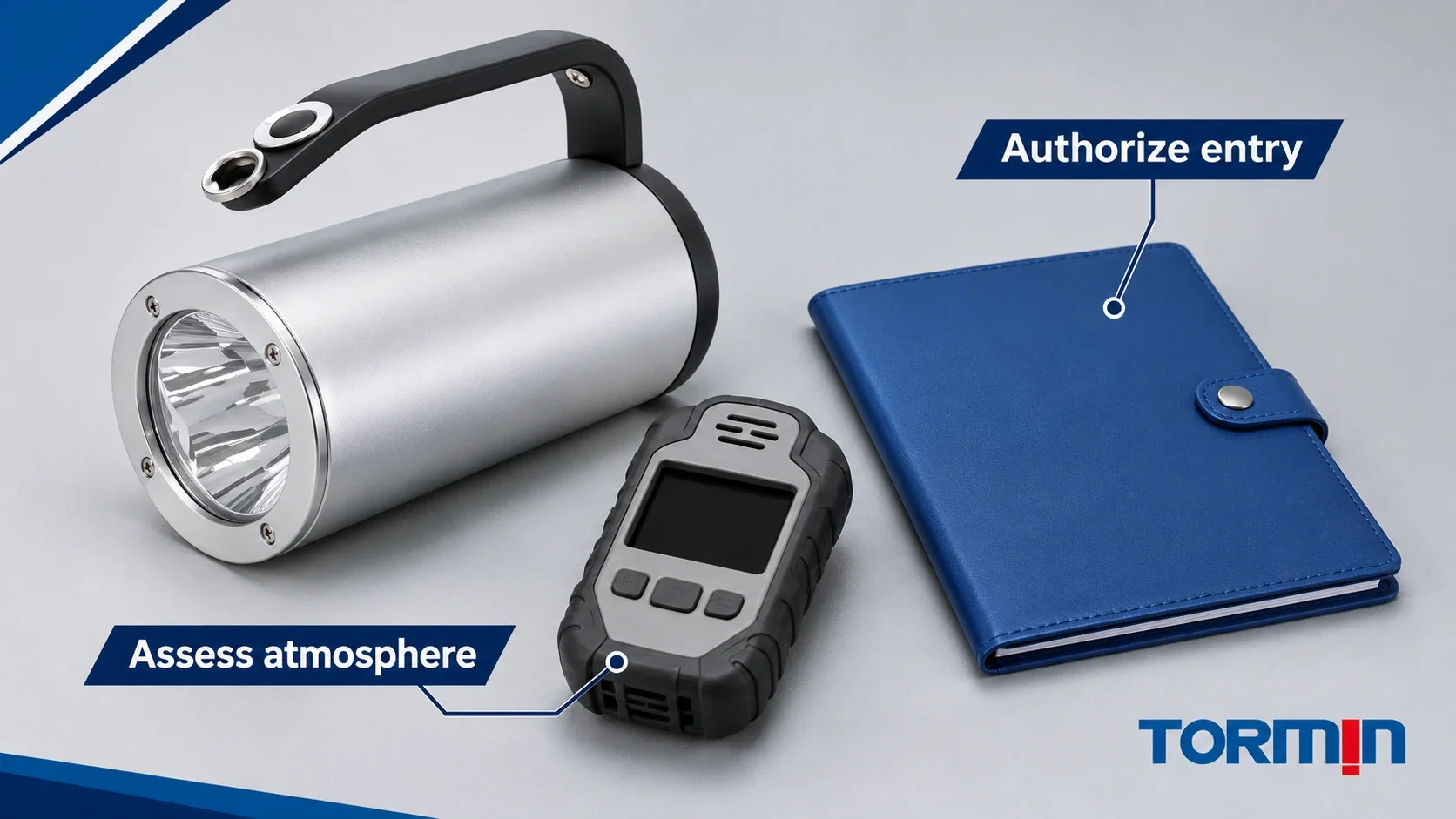
After a suspected thermal event, or whenever the atmosphere is unknown, do not enter merely to switch on a light or inspect the batteries. The immediate safety task is controlled assessment under the site’s emergency arrangements. Appropriate atmospheric testing must precede authorized entry, and a reading by itself does not provide permission to enter.
The responsible team must consider combustible gas, toxic exposure, oxygen conditions, continuing release, electrical energy and other event hazards. Testing requires suitable instruments and competent interpretation. Do not assume that a detector intended for another gas will answer every BESS atmosphere question. Assessment must continue as required during authorized work, because an initial reading does not establish that conditions will remain acceptable if gas release persists or a control fails. Where permit-space requirements apply, OSHA’s confined-space standard provides an entry-control framework; this is not a declaration that every BESS container is a permit space.
If authorized work requires a portable light in a potentially flammable atmosphere, its complete rating must cover the assessed conditions and the jurisdiction’s approval requirements. Where hydrogen suitability is required, select the corresponding approved group coverage, such as IEC IIC for that framework. The protection level, temperature suitability and permitted operating mode also matter. A handheld battery-powered light is not inherently safe merely because it has no trailing supply cable.
Place scene lighting outside the assessed gas cloud and, where the response plan permits, upwind. Maintain the prescribed exclusion area and consider discharge, fire and pressure hazards as well. Upwind positioning is not an independent guarantee of safety. Do not move ordinary electrical equipment into an uncertain atmosphere to improve visibility.
The hazardous-area lighting category is a starting point for requesting a portable candidate and its exact documents. It is not evidence that a listed product is suitable for this event. The cautious portable-light requirement must not be used to infer that every fixed light in normal BESS service needs an Ex rating.
Mistakes
- Selling the whole BESS as Zone 1 or Division 1. Neither label follows from the presence of lithium-ion cells. Obtain the assessed extent and requirements before specifying equipment.
- Treating UL 9540A as a light certificate. Battery fire-test evidence informs system evaluation; the luminaire needs its own applicable approval if its location is classified.
- Assuming unclassified means any light will do. Electrical, environmental, access and applicable emergency-lighting requirements remain, even without a hazardous-area equipment requirement.
- Importing another battery technology’s release rules. Check the actual cell design and assessed failure scenarios rather than transferring an unrelated charging-room conclusion.
The useful purchasing outcome is a lighting schedule linked to the accepted classification, normal task and emergency requirements, with a separate plan for uncertain post-event conditions. That preserves the distinction between choosing a fitting and deciding whether people can safely approach or enter.
FAQ
Is a battery energy storage container a hazardous (classified) area?
Not automatically. Sealed lithium-ion cells operating as intended do not by themselves establish a classified area. The project’s hazard assessment and accepted classification documents must address the actual configuration and release conditions, including relevant abnormal scenarios.
Do lights inside a BESS container need to be explosion proof?
They need the applicable hazardous-area rating where the accepted classification requires it at their position. Otherwise, select equipment for the ordinary electrical and environmental conditions. Applicable emergency-lighting requirements remain a separate obligation.
Is UL 9540A an explosion-proof certification for lighting?
No. It is a test-method standard for evaluating thermal-runaway fire propagation in BESS. It does not replace a luminaire’s applicable IEC 60079 evidence or North American hazardous-location approval under the project’s NEC requirements.
What gas group applies if part of a BESS installation is classified?
Use the group assigned by the classification assessment. Where hydrogen coverage is required, IEC IIC or NEC Division Group B may be specified in their respective frameworks. Do not assign either to every BESS merely because its test report identifies hydrogen.
Are lead-acid battery rooms the same question?
No: lead-acid charging can involve routine hydrogen generation, so use the separate hydrogen discussion referenced earlier rather than transferring that ventilation and classification logic to sealed lithium-ion BESS.
Sources
- IEC — IEC 60079-10-1, Classification of areas: Explosive gas atmospheres — public scope, classification purpose and limits; no project boundary derived here.
- Intertek for OPSS — Domestic Battery Energy Storage Systems: A review of safety risks — appendix Table A1 on sealed lithium-ion batteries and fault hazards; used for the construction distinction, not commercial-site classification.
- UL Solutions — UL 9540A Unit Level AHJ Checklist — relevant gas-measurement categories in a test-report review; historical checklist, not a current test-procedure substitute.
- NFPA — NFPA 855, Standard for the Installation of Stationary Energy Storage Systems — installation-standard identity and public scope; the project’s adopted edition governs.
- NFPA — NFPA 68, Standard on Explosion Protection by Deflagration Venting — scope of deflagration venting, not a complete vent design.
- NFPA — NFPA 69, Standard on Explosion Prevention Systems — scope of explosion-prevention systems, not a prescriptive BESS control design.
- UL Solutions — Understanding UL 9540A, NFPA 855 and Large-Scale Fire Testing — ESS product-standard and thermal-runaway test-method distinction.
- IEC 60079-20-1, public identical BIS adoption — hydrogen gas-group reference; no BESS mixture is assigned a group from this table.
- California Electrical Code, NEC-based adopted text — Articles 500, 501 and 505 as separate North American classification/equipment references; use the project’s adopted edition.
- OSHA — Permit-required confined spaces — atmospheric evaluation and authorized-entry controls where the standard applies.