
Compare emergency output, duration and changeover as separate fields for the exact configuration being offered. Then check its hazardous-area documents and the evidence for emergency operation. A normal-power datasheet, a battery label or a runtime headline leaves important parts of that comparison unanswered.
For a buyer, the useful question is: What will this particular arrangement do when normal supply fails, for how long, and which records demonstrate it? The following checks turn that question into a quotation review without substituting for the site’s emergency-lighting design.
Start with the emergency duty
State what the light must support: escape-route illumination, exit indication, or a specified task during an emergency. Give the supplier the project’s required duration, response criteria and lighting acceptance criteria, together with the mounting position and hazardous-area requirements. A sign and a luminaire illuminating a walking surface have different evidence needs.
Installed visibility remains a separate acceptance question. For example, U.S. OSHA 29 CFR 1910.37 addresses adequate exit-route lighting and working exit safeguards; a component’s battery-hour claim does not establish those installation outcomes. OSHA: exit-route requirements
Take the duration and response criteria from the applicable project basis. Do not automatically carry a three-hour figure from one catalogue into every purchase. For wider hazardous-area inputs, use TORMIN’s explosion-proof lighting selection guide, then add the emergency-specific fields below.
Separate normal output from emergency output
BS EN IEC 60598-2-22:2022 distinguishes maintained operation under normal and emergency conditions from non-maintained operation on normal-supply failure. BSI: emergency-luminaire standard
Request separate normal/emergency output and supporting duty-specific data: emergency photometry for illumination, or sign-performance evidence for indication.
The comparison should also identify the supply arrangement: an integral emergency supply or a separately documented power unit. Record the proposed luminaire, emergency option, power unit and controls together, rather than accepting a list of unrelated component names.
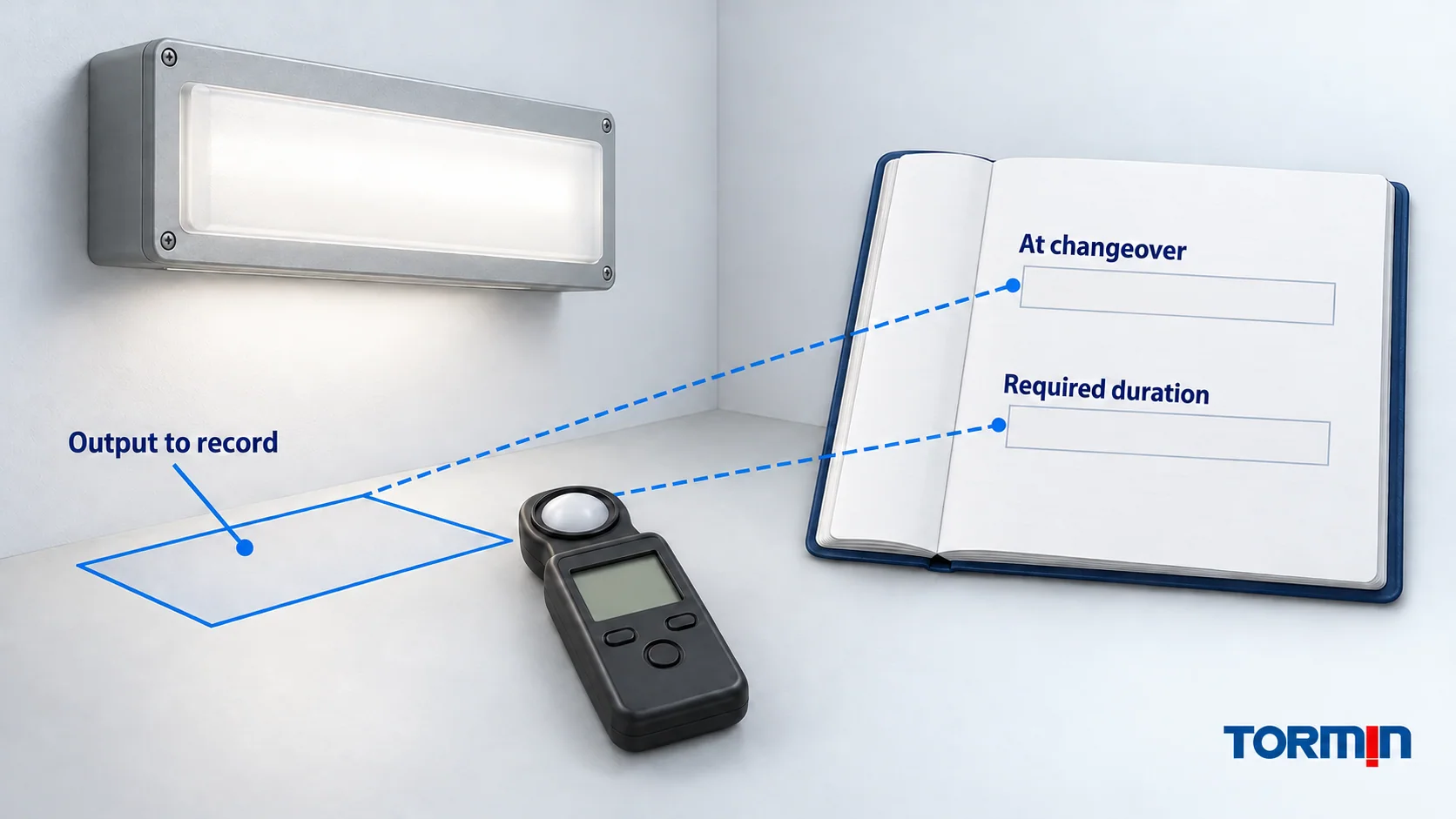
Specify runtime at the stated emergency output
BS EN IEC 60598-2-22 ties rated duration to rated emergency output and addresses photometric performance throughout it. BSI: rated duration and photometric performance
For duration evidence, request:
- The model, emergency option and document revision matching the offer.
- The emergency output being assessed and the acceptance criterion used.
- Battery and controlgear identification, preparation or charge conditions, and test environment.
- The observation or measurement method, elapsed-time record and result at the required endpoint.
If the record covers a different configuration or condition, keep the difference open for review. A battery capacity calculation can help explain a proposed design, but it does not replace measured evidence for the complete emergency arrangement.
Check changeover, restoration and readiness
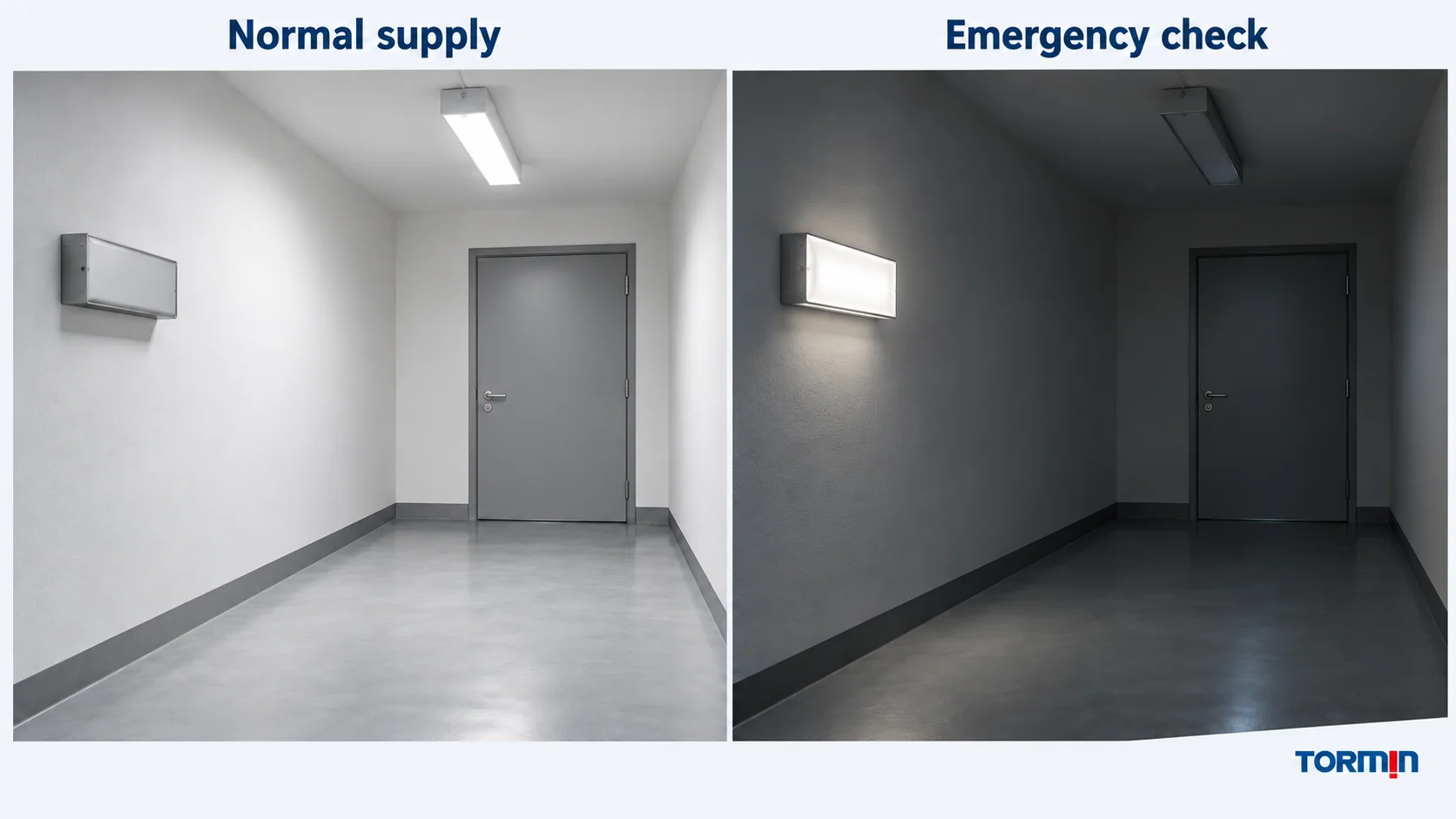
Duration tells you how long the emergency mode is intended to operate. Changeover tells you how the arrangement reaches that mode. Ask which loss-of-supply condition is sensed, what the lighting then does, and what evidence addresses the project’s response criterion. Clarify how a local lighting switch or normal dimming control interacts with that behavior.
UL’s 2018 technical discussion of emergency-luminaire controls explains why normal dim/off settings must not inhibit emergency operation in the systems it discusses. It separates sensing, control and emergency-power functions. This is a useful reason to request evidence for the complete control arrangement, rather than accept a relay’s transfer-time figure alone. UL: emergency-luminaire controls
Record what happens when normal supply returns: which operating state resumes, how charging is indicated, and when the specified emergency capability is restored. Ask for the applicable operating and charging limits. A quote saying “automatic emergency operation” should be expanded into the trigger, response, recovery and evidence fields.
Use a buyer evidence crosswalk
Keep this record beside each supplier’s quotation. Fill the proposed-configuration column with the actual offer, and give every document a title or identifier and revision. The last column is an open-question field, not an assumed pass.
| Requirement to resolve | Proposed configuration to record | Evidence to request | Gap that remains open |
|---|---|---|---|
| Emergency duty | Illumination or indication; project duration and response criteria | Project design basis and supplier’s response to it | Duty or acceptance criterion omitted |
| Exact identity | Full model and emergency option; integral or separate supply; associated controls | Configuration-specific datasheet and instructions | Evidence refers only to a family or another option |
| Hazardous-area scope | Offered equipment matched to the project’s Ex requirements | Applicable certificate, schedule, conditions and current record | Offered emergency arrangement cannot be traced |
| Output | Separate normal and emergency values and operating modes | Emergency-mode performance data appropriate to the duty | Only normal wattage or lumens supplied |
| Duration | Declared time paired with stated emergency output | Duration evidence identifying configuration, preparation, conditions and result | Time is given without output or test basis |
| Changeover | Sensed failure, control interaction and emergency response | Functional evidence for the proposed arrangement | “Automatic” or “fast” stated without a defined behavior |
| Recovery and environment | Restoration state, recharge/readiness indication and applicable limits | Operating, charging and recovery instructions | Readiness after an event or test is unclear |
| Verification in service | Test access, function/duration checks and result records | Maintenance instructions and the applicable site’s test plan | A brief lamp-on check is treated as duration proof |
Hazardous-area evidence and emergency-performance evidence answer different parts of this record. Read the listed standards and equipment scope before attributing a test to an Ex certificate. IECEx Guide 01D also explains that certificate copies are uncontrolled; current status should be checked against the official online record. IECEx: purchaser and user guidance
For the certificate-matching step, TORMIN’s nameplate and certificate guide covers the detailed reading process. Here, the additional task is tracing the emergency option and its performance documents to the offer.
If a separate unit is proposed from the emergency power supply collection, request documentation for the connected arrangement. An accessory certificate is not evidence that an arbitrary connected luminaire is approved or will achieve the required emergency behavior.
Distinguish a function check from duration evidence
A short check showing that the light enters emergency operation answers a different question from a duration check. HM Government’s 2006 factories and warehouses guide, for England and Wales, separates routine lamp-operation checks from full-discharge testing and calls for records. It also addresses recovery after discharge and alternative arrangements while capability is unavailable. HM Government: factories and warehouses, Section 5
Request the supplied test/maintenance instructions and record format. Check access to controls and indications at the mounting position. The responsible site team should define the applicable test plan and recovery arrangements.
If automatic testing is offered, request its defined scope, result history and fault reporting. Ask whether the available record addresses function, duration, or both, and how it relates to the lighting acceptance criteria. The presence of a status light alone leaves those questions unanswered.
Read a runtime headline as one field: BC5210
TORMIN’s BC5210 emergency-light catalogue lists an emergency time of 180 minutes. That is a manufacturer declaration for this model, not evidence that every TORMIN emergency light has the same duration.
The one-page catalogue does not supply emergency light-output data or a detailed changeover and duration test record. When reviewing an offer for BC5210, use the 180-minute entry as a starting point: confirm the exact configuration, then request the missing output, operating conditions and performance evidence. Keep any unresolved requirement visible in the crosswalk.
Close the quotation gaps before accepting the offer
Return the completed crosswalk with the enquiry. Include the supplied duty and project criteria, exact proposed configuration, emergency output and duration, changeover behavior, recovery requirements, and the documents still needed. Ask the supplier to respond against each open field so that offers can be compared on the same basis.
TORMIN’s industrial Emergency Lights collection is a separate product collection. For hazardous-area product discovery, use the explosion-proof emergency lights category. Category placement helps navigation; suitability depends on the exact equipment and its records.
Send the emergency-specific requirements and unresolved document questions through TORMIN’s enquiry page. A complete response should let the project reviewer connect the quoted configuration to both its hazardous-area scope and its required emergency performance.
Sources
- BSI — BS EN IEC 60598-2-22:2022: Luminaires for emergency lighting. Definitions and photometric provisions; licensed BSI document hosted by the Lighting Industry Association.
- UL — Code-Compliant Control of Emergency Luminaires, Lumen Insights, 2018 Issue 2, page 5. Technical discussion of emergency control functions.
- HM Government — Fire safety risk assessment: factories and warehouses, May 2006, Section 5. England and Wales guidance on emergency lighting and testing.
- IECEx — Guide 01D, edition 2.0: FAQs from Ex Equipment Manufacturers, Purchasers and Users. Certificate scope and controlled-record guidance.
- OSHA — 29 CFR 1910.37: Exit-route maintenance, safeguards and operational features. U.S. general-industry exit-route requirements.
- TORMIN — BC5210 emergency-light catalogue. First-party model declaration; not an independent emergency-performance test report.