
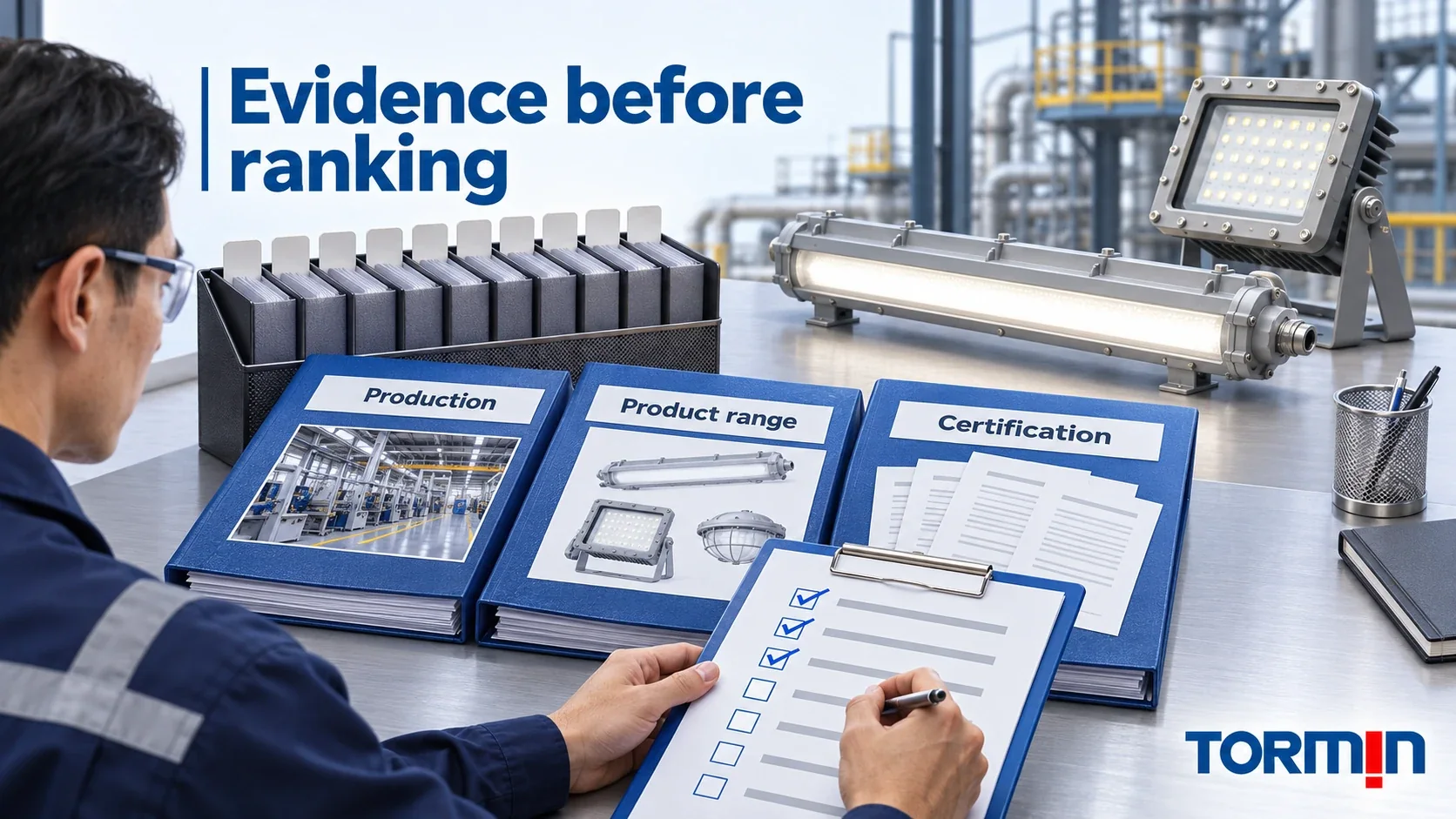
This shortlist is published by TORMIN, and TORMIN is one of the ten manufacturers included. Numbers are navigation aids, not quality rankings: we do not score companies or claim market share. The purpose is to help project buyers, EPC teams and distributors compare manufacturers using identifiable production operations, hazardous-area lighting ranges, public certification evidence and official English websites.
A search for top 10 explosion proof lighting manufacturers should produce a useful starting list, not a substitute for engineering review. Start with the comparison table, review the source references, and select suppliers whose documented product forms match your project. Final selection still requires checking the exact model’s certificate, schedule and nameplate against the installation requirements.
The eight global manufacturers appear first, followed by two China-based manufacturers. Each group is alphabetical. The grouping describes how this shortlist is organized; it does not guarantee worldwide supply, local approvals, price, delivery time or suitability for a particular hazardous area.
How this list was chosen
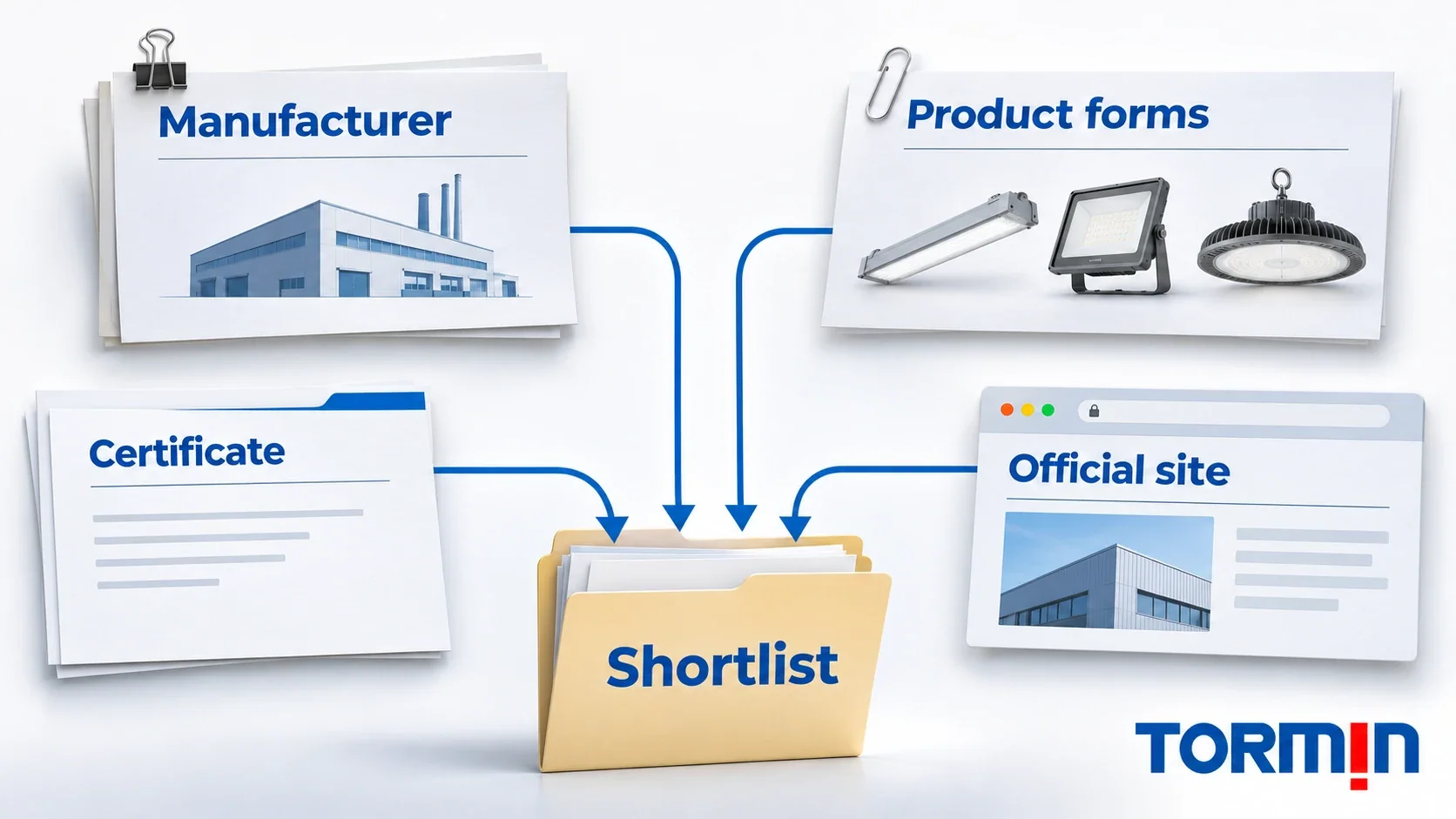
The same four inclusion tests apply to every company, including TORMIN:
- An identifiable manufacturer. There must be an identifiable production entity and product line. Trading companies, pure agents and businesses offering only private-label products are excluded from this shortlist.
- More than one relevant lighting form. The published range must cover at least two of linear, floodlight, high-bay or emergency explosion-protected luminaires. A general electrical catalogue without a lighting range is insufficient.
- Public certification evidence. At least one ATEX, IECEx or UL 844 lighting record must be accessible through an official certificate page, posted certificate or certification database. A logo on a homepage is insufficient.
- An official English website. Buyers must be able to check the manufacturer’s identity, products and supporting documents directly.
These tests establish inclusion, not comparative product quality. The evidence was reviewed on November 7, 2026. Certification examples below establish that public records exist for identified equipment; they do not certify every product sold under a company name. Posted copies can be older than the controlled record, so verify the applicable issue and status before procurement.
“Known for” identifies a documented product specialization. The table’s “Best fit for” column is an editorial guide to which purchasing task merits further investigation, not an endorsement or a measured result. No employee counts, revenues, production capacities or market-share estimates are used.
Manufacturer comparison at a glance
| Company | Headquarters | Founded | Product focus | Certification evidence | Best fit for |
|---|---|---|---|---|---|
| BARTEC | Bad Mergentheim, Germany | 1975 | Linear, floodlight and high-bay lighting | IECEx INE 13.0075X, EVAC lighting fixtures | Comparing several lighting forms within an explosion-protection product group |
| Cortem | Villesse, Italy | 1968 | Linear, high/low-bay, floodlight and emergency lighting | LFED: EPT 18 ATEX 2969X and IECEx SEV 18.0018X | Reviewing a lighting catalogue alongside product-specific certificate records |
| Dialight | United Kingdom; city not verified | 1938 | LED high-bay, linear, area and floodlighting | Official library: ATEX/IECEx and hazardous UL 844 records | Screening LED lighting families across different approval markets |
| Eaton (Crouse-Hinds) | Dublin, Ireland, parent company | 1911, Eaton | Linear, floodlight, high/mid-bay and emergency options | DEMKO 19 ATEX 2119X, VMVL models | Comparing named Crouse-Hinds lighting families and their documentation |
| Emerson (Appleton) | St. Louis, Missouri, USA, parent company | 1890, Emerson | Area, task, floodlight, emergency and portable lighting | IECEx LCIE 16.0038X, FELED luminaires | Reviewing Appleton lighting by application and approval framework |
| Hubbell (Chalmit) | Shelton, Connecticut, USA, parent company | 1888, Hubbell | Linear, floodlight, bulkhead and emergency lighting | IECEx CML 23.0027X, Protecta III LED | Screening Chalmit’s hazardous-area and marine lighting range |
| R. STAHL | Waldenburg, Germany | 1876 | Linear, pendant, floodlight and emergency lighting | EXLUX 6002: IBExU14ATEX1088 and IECEx IBE 14.0035 | Evaluating luminaires together with an emergency-lighting system brief |
| Raytec | Ashington, UK | 2005 | SPARTAN linear, floodlight, bulkhead and bay lighting | IECEx CML 14.0001, SPARTAN SPX luminaires | Comparing a specialist hazardous-area LED lighting family |
| TORMIN | Wenzhou, Zhejiang, China | 2003 | Linear, floodlight, high-bay, emergency and portable lighting | Public archive: BC5401 CNEX 23 ATEX 0008 X and IECEx CNEX 23.0005X; current status requires verification | Screening a China-based lighting manufacturer against a model-specific document request |
| Warom | Shanghai, China | 1987 | Linear, high/low-bay, floodlight and hand lamps | IECEx CQM 24.0001X, HRY97 lighting | Comparing a China-based manufacturer’s hazardous-area lighting forms |
For the TORMIN archive examples, open the standards and certification documents. For every supplier, verify the offered model rather than extending a certificate example to the entire range. Headquarters and founding years for Eaton, Emerson and Hubbell refer to the parent companies; their lighting brands are identified separately below.
Global manufacturers
1. BARTEC
Company and headquarters: BARTEC, Bad Mergentheim, Germany. Founded: 1975. Its About BARTEC page identifies the headquarters and production sites, providing a manufacturing basis beyond a sales office.
Product lines: Its posted equipment records include EVFG linear luminaires, SFD-series floodlights and EVAC lighting fixtures in the high-bay portfolio. These forms address different work areas; define the task before choosing a family.
Certification evidence: The official EVAC document names BARTEC F.N. S.R.L. as manufacturer under IECEx INE 13.0075X. This is identifiable equipment evidence, not an approval of the whole group catalogue.
Known for: Multiple hazardous-area lighting forms, including EVFG linear, SFD floodlight and EVAC fixture families.
Official website: BARTEC (bartec.com). For an enquiry, specify the required form factor and ask which group manufacturing entity, model and certificate apply. The German group headquarters and an Italian manufacturer named on a certificate are different pieces of information; retain both in the procurement record.
2. Cortem
Company and headquarters: Cortem S.p.A., Villesse, Italy. Founded: 1968, according to its company history, which also identifies the headquarters and factory address.
Product lines: The official catalogue lists LIFEX linear luminaires, FLOWEX high-bay lights, floodlights and LFED/LFEE emergency fixtures. These are separate product families rather than a single enclosure offered under multiple application labels.
Certification evidence: Cortem’s product-certificate library lists LFED records EPT 18 ATEX 2969X and IECEx SEV 18.0018X, with equipment descriptions and markings.
Known for: A catalogue of explosion-protected lighting forms with product-specific certificates, instructions and drawings available through its website.
Official website: Cortem (cortemgroup.com). A buyer can use the library to move from a lighting task to a candidate family, then request the exact ordering configuration. Compare the offered optical, mounting and emergency options against that family’s documents before treating it as a project candidate.
3. Dialight
Company and headquarters: Dialight; its official About page states a UK headquarters. A headquarters city is not verified here. Founded: 1938.
Product lines: Dialight publishes LED high-bay, linear, area, floodlight and emergency/exit lighting categories. Buyers must distinguish industrial products from the hazardous-location versions within those categories.
Certification evidence: Its certification library contains ATEX and IECEx lighting records and UL 844 authorization documents for identified hazardous-location families. The library separates these from ordinary-location approvals, which is useful when checking a quotation.
Known for: Industrial LED lighting families with a publicly organized certification-document library.
Official website: Dialight (dialight.com). Start an enquiry with the installation’s approval framework and required lighting task. Then compare the exact family and model against the relevant document, rather than assuming a familiar product name has identical certification in every market. This is especially useful when a project includes both ordinary and hazardous locations.
4. Eaton (Crouse-Hinds)
Company and headquarters: Eaton Corporation plc, Dublin, Ireland. Founded: 1911, referring to Eaton rather than the separate history of the Crouse-Hinds brand. Eaton’s heritage pages identify Crouse-Hinds as an Eaton portfolio.
Product lines: The Crouse-Hinds LED family guide includes linear fixtures, floodlights, high/mid-bay luminaires and emergency options. Its product families address different hazardous-area frameworks, so compare the specific catalogue entry.
Certification evidence: The posted VMVL certificate DEMKO 19 ATEX 2119X names Eaton’s Crouse-Hinds Business and defines particular LED luminaire models and variations.
Known for: Crouse-Hinds hazardous-area lighting families organized alongside a wider electrical product portfolio.
Official website: Eaton Crouse-Hinds (eaton.com). For procurement, preserve the full series and ordering code when requesting documents. An ATEX example demonstrates one available approval route; it does not establish that every Crouse-Hinds luminaire has that route or that it meets the project’s local acceptance requirements.
5. Emerson (Appleton)
Company and headquarters: Emerson, St. Louis, Missouri, USA. Founded: 1890, referring to Emerson. Its official company history and company profile support those corporate facts. Appleton is an Emerson brand, not a separate company ranked against its parent.
Product lines: Appleton’s hazardous and explosionproof lighting site separates area, task, flood, emergency and portable lighting. That task-based structure helps buyers begin with the work area rather than a wattage alone.
Certification evidence: The official FELED document identifies Appleton Group – ATX and IECEx LCIE 16.0038X, covering specified standard and emergency luminaire versions.
Known for: Appleton hazardous-location lighting organized across fixed, task and emergency applications.
Official website: Emerson Appleton (emerson.com). Confirm whether the proposed item is an IEC/ATEX or North American configuration and request its corresponding approval documents. The publicly posted FELED record is a traceable example, not proof that an unrelated Appleton model or a current offer is covered.
6. Hubbell (Chalmit)
Company and headquarters: Hubbell Incorporated, Shelton, Connecticut, USA. Founded: 1888, referring to Hubbell; Chalmit’s own history starts in 1910. The Hubbell company page and Chalmit history distinguish the parent and brand. Chalmit is a Hubbell lighting brand, rather than a company independent of its parent.
Product lines: Chalmit’s published range includes linear, floodlight, bulkhead and emergency lighting, with hazardous-area and marine applications.
Certification evidence: The posted issue 1 of IECEx CML 23.0027X identifies Hubbell Limited with Chalmit Lighting among its trading names for Protecta III LED equipment.
Known for: Hazardous-area and marine lighting through the Chalmit product range.
Official website: Hubbell Chalmit (hubbell.com). Compare the particular luminaire and emergency configuration, not the parent-company name alone. The trading names on a certificate can differ from the group name on a purchase order; documenting that relationship avoids confusing a brand, manufacturer and sales channel during approval review.
7. R. STAHL
Company and headquarters: R. STAHL, Waldenburg, Germany. Founded: 1876. Its official company profile and sites overview identify the corporate history, headquarters and lighting manufacturing operation in Weimar.
Product lines: The range includes linear luminaires, pendant fittings, floodlights and emergency lighting. Its published lighting systems also include emergency-lighting and central-battery solutions, which need a system brief as well as fixture selection.
Certification evidence: The EXLUX 6002 download page lists IBExU14ATEX1088 and IECEx IBE 14.0035 for identified variants.
Known for: Explosion-protected lighting supported by a dedicated lighting operation and system-oriented emergency-lighting offerings.
Official website: R. STAHL (r-stahl.com). This is a useful investigation path when the requirement includes several lighting roles or an emergency system. Keep the luminaire’s certificate scope separate from the design and acceptance of the complete installation, including power arrangements and any central emergency supply.
8. Raytec
Company and headquarters: Raytec Ltd, Ashington, UK. Founded: 2005. Its About page states that design and manufacture take place at its Ashington headquarters.
Product lines: The SPARTAN hazardous-area guide covers flood, linear, bulkhead and bay lighting, with other specialist forms. Those categories allow a buyer to compare fixed-lighting tasks within one published family structure.
Certification evidence: The official SPARTAN SPX document carries IECEx CML 14.0001 and identifies Raytec as manufacturer. Its annex defines the covered equipment rather than granting a brand-wide approval.
Known for: Specialist LED lighting, including the SPARTAN hazardous-area luminaire range.
Official website: Raytec (raytecled.com). Use the required location classification to select the appropriate catalogue section before comparing optics, emergency options and mounting. Ask for the document issue applying to the quoted configuration, especially when a project schedule or materials list refers to an earlier version of a product family.
China-based manufacturers
9. TORMIN
Company and headquarters: Zhejiang Tormin Electrical Co., Ltd., Wenzhou, Zhejiang, China. Founded: 2003, as stated on the company page.
Product lines: Public categories include explosion-proof linear, floodlight, high/low-bay, emergency and portable lighting. The broader company range also includes industrial lighting, which must be distinguished from the hazardous-area products.
Certification evidence: The public document archive includes ATEX and IECEx records, including BC5401 references CNEX 23 ATEX 0008 X and IECEx CNEX 23.0005X. The archive labels current status as unverified; obtain and check the applicable controlled record.
Known for: Fixed and portable industrial and explosion-proof lighting, supported by published workshop and laboratory views.
Official website: TORMIN. The factory tour shows assembly, machining, laboratory and aging-test areas. Use those public views to prepare manufacturing questions, then request the exact model’s certificate and document set. TORMIN is included under the same screening rules and receives no additional quality rating in this article.
10. Warom
Company and headquarters: Warom Technology Incorporated Company, Shanghai, China. Founded: 1987, according to its official company history, which identifies its headquarters and manufacturing operations.
Product lines: The English product catalogue includes linear, high/low-bay, floodlight and hand-lamp categories. The group also sells other explosion-protected equipment; only its lighting range is considered here.
Certification evidence: The official HRY97 certificate IECEx CQM 24.0001X names Warom Technology Incorporated Company and identifies the covered lighting equipment and manufacturing locations.
Known for: A range of hazardous-area lighting forms within a broader explosion-protected equipment manufacturing business.
Official website: Warom (waromgroup.com). Begin with the lighting task and the required certification framework, then ask which production entity and certificate cover the order. A broad catalogue can help consolidate enquiries, but it does not remove the need to check each proposed fixture, accessory and configuration against the project documents.
How to use this shortlist
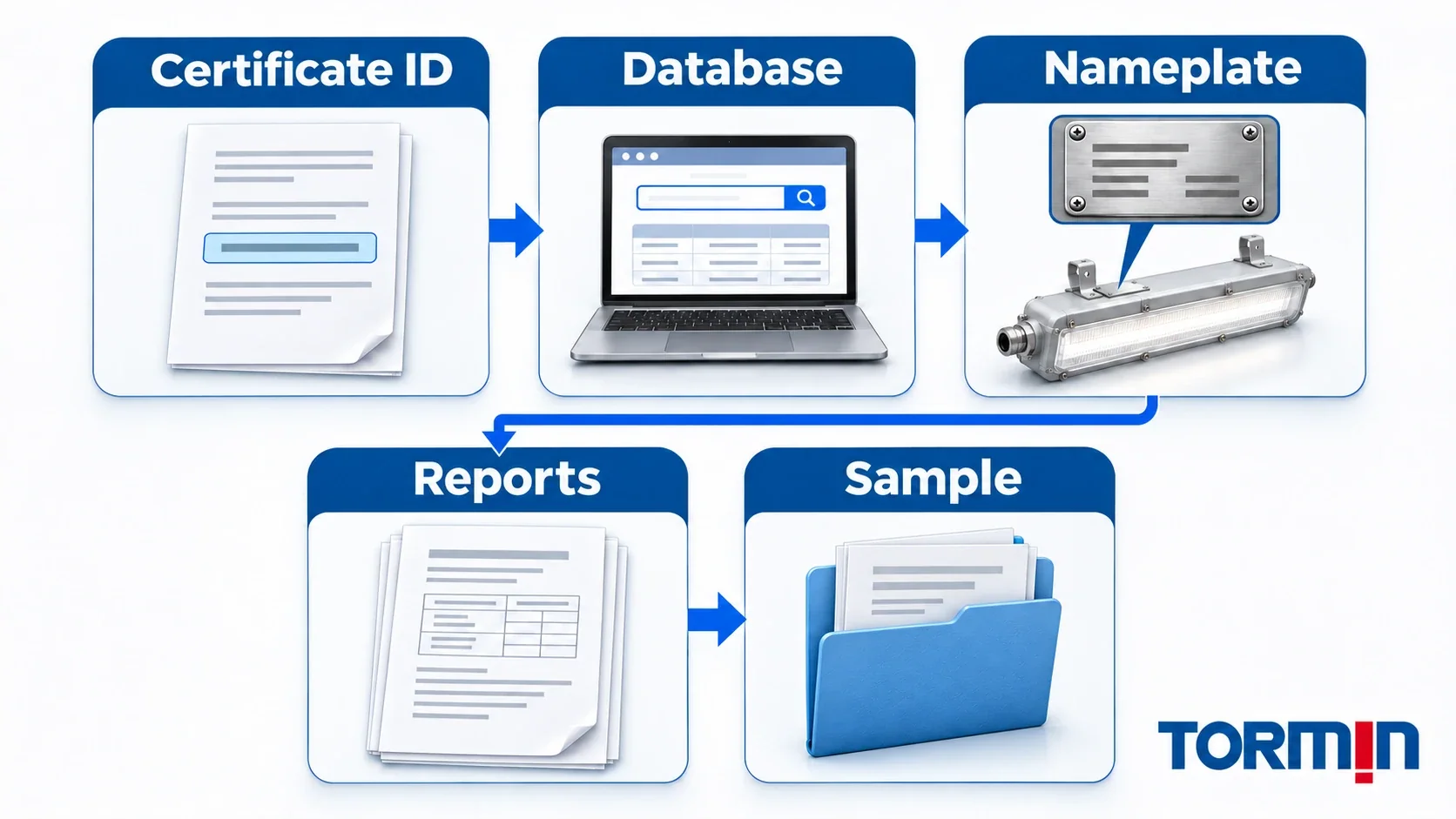
1. Match the certificate to the exact model
Request the certificate number, complete certificate, schedules or annexes, relevant issue and the quoted ordering code. Compare the manufacturer named in the record with the product and supplier documents. A family certificate or first page alone may leave configuration limits unresolved. TORMIN’s standards and certification archive illustrates the document identifiers to request; it is not an independent approval of other suppliers.
For IECEx, use the scheme’s controlled online record to check status. The IECEx equipment-scheme FAQ explains why an online master record matters. For another scheme, use the issuing organization’s appropriate verification route. Keep the result and review date in the project file.
2. Read the nameplate against the project requirements
Use the nameplate and certificate guide to check identity, protection type, gas or dust group, temperature marking, EPL and ambient range, Ta. Compare these fields with the site’s assessed requirements; do not infer them from a company’s reputation. The gas-group and temperature-class guide explains the separate substance and temperature checks.
A suitable group does not resolve temperature or ambient limits. Likewise, ATEX, IECEx and a North American listing are separate evidence routes. The required market approval must be addressed explicitly before a candidate becomes an accepted purchase.
3. Request the test reports and document package
Ask for the applicable datasheet, instructions, dimensional and mounting drawings, photometric files or reports, and agreed inspection or routine-test records. Identify which reports support which requirement. Certificate assessment reports may be confidential; request the evidence needed for the project without assuming unrestricted access to an entire certification file.
For emergency lighting, include the specified operating mode and corresponding documentation. For illumination design, request evidence for the proposed optic and configuration. A certificate establishes its stated protection scope; it does not prove the required illuminance at your working plane.
4. Distinguish the manufacturer from the seller
Confirm the legal manufacturing entity, production location and relationship to the quoted brand. An authorized distributor may be a valid purchasing route, but it should identify the actual manufacturer. This shortlist excludes pure trading and private-label businesses from its manufacturer entries; that is a scope choice, not a judgment on every distributor.
Use the factory-tour approach to frame questions about assembly, machining, testing and traceability. Photographs support a conversation about capabilities. They do not establish that every process occurs in-house or that a specific order has passed inspection.
5. Reconcile the sample with the project file
Before approving a sample, match its ordering code and nameplate with the submitted certificate scope, drawings and purchase specification. Record agreed accessories, entries, mounting, supply, controls and emergency options. Resolve discrepancies with the supplier and project reviewer before accepting substitutions.
Then check practical supply questions: local availability, agreed delivery, replacement parts and document language. These are enquiry items, not properties inferred from inclusion here. Use our complete explosion-proof lighting selection guide to turn the project conditions into a consistent specification for each shortlisted supplier.
Scope of this list
This shortlist compares explosion-protected luminaires, not complete portfolios of enclosures, cable glands or control panels. Several included manufacturers make those products, but their electrical-equipment breadth is not scored here. A regional manufacturer or OEM/private-label business omitted from this list is not automatically unsuitable; it has simply not been included in this particular manufacturer shortlist. Apply the same project and evidence checks to any additional candidate.
FAQ
Is this list a ranking?
No. The numbers provide navigation through two alphabetically arranged groups. The inclusion criteria are public, and no company receives a score or market-share claim. TORMIN publishes the article and is included, as disclosed in the first paragraph.
Is TORMIN on its own list?
Yes. TORMIN appears in the China-based group. The opening disclosure identifies TORMIN as both publisher and participant. Its entry uses public company, manufacturing and certificate information under the same screening rules as the other entries.
Which manufacturer is best for Zone 1 lighting?
That depends on the substance group, temperature requirement, Zone/EPL, required certification framework, operating conditions and agreed delivery. Use the checklist to screen candidates, then verify the exact model. This shortlist does not name a universal winner for Zone 1 projects.
Do all ten manufacturers sell worldwide?
Not necessarily in every market or through the same route. The global group has broadly international operations; the China-based group is relevant to export enquiries as well as domestic procurement. Confirm local certification acceptance, the sales channel and actual supply before purchase. Inclusion guarantees neither universal availability nor local approval.
How do I verify an explosion proof lighting certificate?
Match the certificate number, issuer’s controlled record and actual nameplate, including the exact model and configuration. Read the complete scope and any conditions. Use the certificate archive and nameplate guide to organize the request; confirm current status through the appropriate issuer or scheme database.
Sources
The company profiles and posted certificate documents below are first-party evidence, not independent endorsements. Certificate references are examples; the applicable current record remains part of purchase review.
- BARTEC — About BARTEC, EVFG linear IECEx record, SFD floodlight IECEx record, and EVAC IECEx certificate.
- Cortem — History, product catalogue, and product certificates.
- Dialight — About and certifications library.
- Eaton — Heritage, 2025 annual report, Crouse-Hinds portfolio identity, LED family guide, and VMVL ATEX certificate.
- Emerson — Company history, company profile, Appleton lighting range, and FELED IECEx certificate.
- Hubbell — About, 2024 annual report, At a Glance, Chalmit history, Chalmit lighting range, and Protecta III LED IECEx certificate.
- R. STAHL — About, sites and offices, lighting systems, and EXLUX 6002 documents.
- Raytec — About, hazardous-area product guide, and SPARTAN SPX IECEx certificate.
- TORMIN — Company — first-party company profile; manufacturing views and certificate archive are linked at their points of use above.
- Warom — Company, product catalogue, and HRY97 IECEx certificate.
- IECEx — FAQs: Certified Equipment Scheme — controlled certificate records and status verification.