

Auto-ignition temperature, or AIT, is the lowest temperature at which a substance ignites in air under specified test conditions without an external flame or spark. Use this table in order: find the substance, read its IEC gas group and AIT, take the minimum T-class, then check the proposed luminaire’s complete nameplate and certificate.
Start with the Gas Group × T-Class Checker to verify the result using your own accepted substance data. The table below contains 32 entries from one IEC data system. Substance names link to the actual source pages, so you can check an alias or qualification before using a row.
The gas group and temperature class pillar guide provides a selected table and the selection method; this page provides the expanded lookup. Neither replaces the site’s approved hazardous-area assessment or the exact equipment documents.
Derive the minimum T-class using a strict boundary
A temperature class limits the equipment’s maximum surface temperature. It does not describe the gas temperature in a pipe or the ambient air around the luminaire. Select the least restrictive class whose surface ceiling is strictly below the accepted AIT.
| Class | Maximum surface temperature | AIT required for this class |
|---|---|---|
| T1 | 450°C | AIT > 450°C |
| T2 | 300°C | AIT > 300°C |
| T3 | 200°C | AIT > 200°C |
| T4 | 135°C | AIT > 135°C |
| T5 | 100°C | AIT > 100°C |
| T6 | 85°C | AIT > 85°C |
The table follows IEC 60079-20-1:2010, Table 1. “Minimum” here means the minimum required temperature-class stringency. A higher class number imposes a lower surface-temperature ceiling: if T4 is required, T4, T5 or T6 can satisfy this temperature screen, while T1, T2 and T3 cannot.
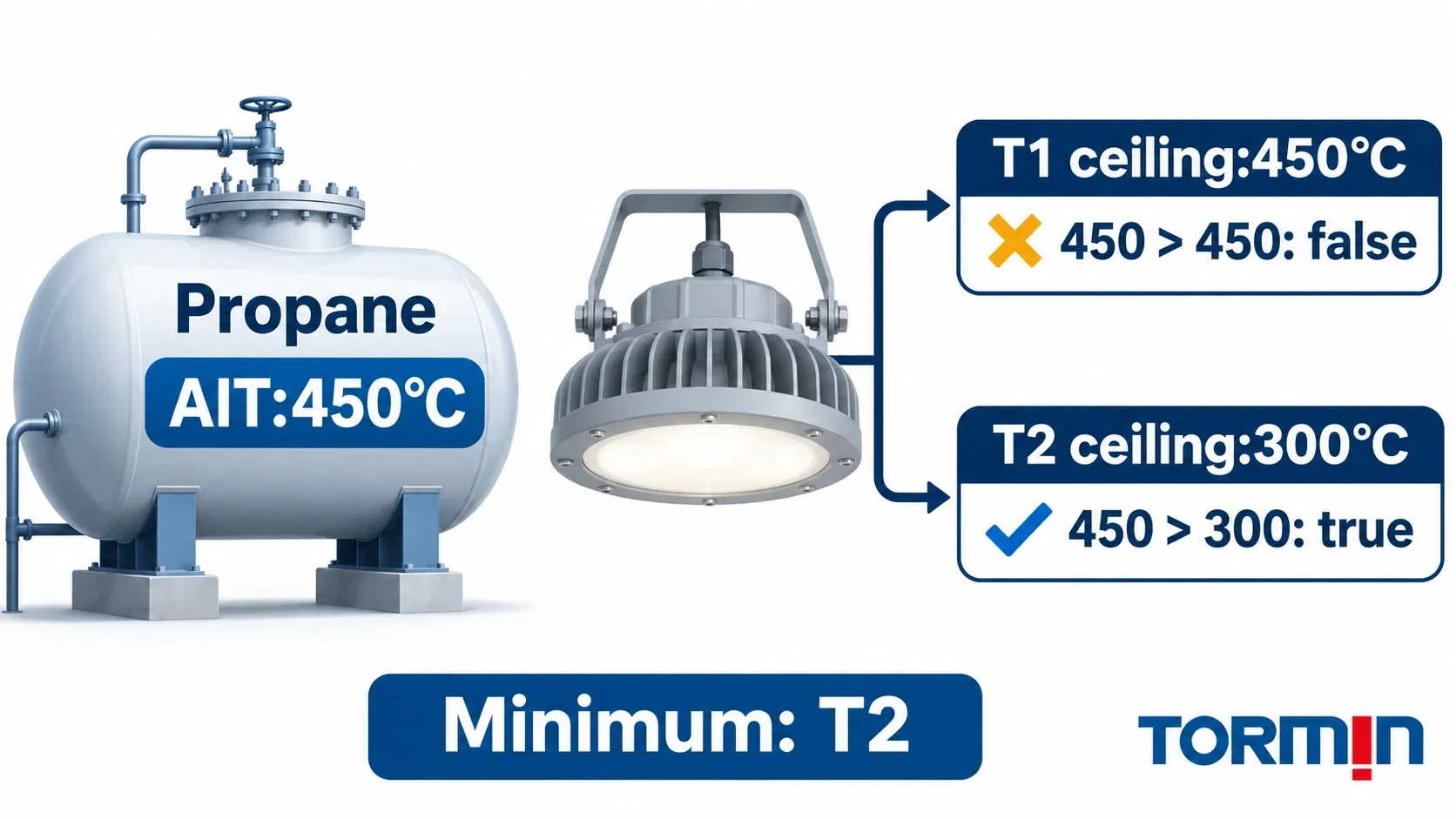
Propane: why 450°C means T2, not T1
The source gives propane an AIT of 450°C. T1 permits a surface ceiling of 450°C, but the qualifying condition is AIT > 450°C. Equality fails: 450 > 450 is false. T2 permits 300°C, and 450 > 300 is true, so propane’s minimum requirement is T2. The source propane row also states T2.
This is not rounding and not a reason to change propane’s AIT to a more convenient figure. Keep the published reference value and apply the boundary correctly. A supplier’s T1 marking does not pass this screen merely because it also contains the number 450. Nor does a report that the housing usually runs cooler establish the required certified class.
Auto-ignition temperature table
Data basis: all group, AIT and source-class entries come from Annex B of the public IS/IEC 60079-20-1:2010 identical adoption. Minimum classes were independently derived using the strict rule above and checked against the source class column. The IEC publication record identifies this edition as replaced by ISO/IEC 80079-20-1:2017; this is a traceable reference dataset, not a claim that the older edition governs every current project.
AIT is a reference value obtained under standard test conditions. Actual results vary with apparatus and test conditions; this table supports selection screening and does not replace the substance’s SDS or project assessment. Typical-use descriptions identify familiar industrial contexts, not a classification of every location where the material occurs.
| Substance | Gas group | Auto-ignition temperature (°C) | Minimum T-class | Where it typically appears |
|---|---|---|---|---|
| IIA | ||||
| Ammonia | IIA | 630°C | T1 | Refrigeration and fertiliser production |
| Methane | IIA | 600°C | T1 | Natural-gas processing and fuel systems |
| Acetone | IIA | 539°C | T1 | Solvent cleaning and coatings |
| Toluene | IIA | 530°C | T1 | Coatings, printing and solvent handling |
| Ethane | IIA | 515°C | T1 | Natural-gas processing and cracking feedstock |
| Acetic acid | IIA | 510°C | T1 | Chemical manufacture and solvent processes |
| Benzene | IIA | 498°C | T1 | Refining and petrochemical feedstock |
| Styrene | IIA | 490°C | T1 | Resin and polymer production |
| Ethyl acetate | IIA | 470°C | T1 | Coatings, printing and adhesives |
| Propylene | IIA | 455°C | T1 | Refining and polymer feedstock |
| Propane | IIA | 450°C | T2 | LPG storage and fuel handling |
| Methanol | IIA | 440°C | T2 | Chemical feedstock and solvent systems |
| Ethylbenzene | IIA | 431°C | T2 | Styrene manufacture and petrochemical processing |
| 2-Propanol (isopropanol) | IIA | 399°C | T2 | Cleaning solvents and process laboratories |
| n-Butane | IIA | 372°C | T2 | LPG and refinery gas systems |
| 1-Butanol | IIA | 343°C | T2 | Coatings and chemical intermediates |
| Cyclohexane | IIA | 244°C | T3 | Chemical intermediates and solvent systems |
| n-Pentane | IIA | 243°C | T3 | Blowing agents and solvent handling |
| n-Hexane | IIA | 225°C | T3 | Solvent extraction and cleaning |
| Kerosene | IIA | 210°C | T3 | Fuel storage and transfer |
| Acetaldehyde | IIA | 155°C | T4 | Chemical intermediates |
| IIB | ||||
| Carbon monoxide | IIB | 607°C | T1 | Synthesis gas and metallurgical processes |
| Ethylene | IIB | 440°C | T2 | Petrochemical feedstock and polymer production |
| Ethylene oxide | IIB | 429°C | T2 | Chemical manufacture and sterilisation systems |
| Butanone (MEK) | IIB | 404°C | T2 | Coatings, adhesives and solvent handling |
| Ethanol | IIB | 400°C | T2 | Solvent handling and fermentation |
| 1-Propanol | IIB | 385°C | T2 | Printing inks, coatings and solvents |
| Hydrogen sulfide | IIB | 260°C | T3 | Sour gas and wastewater |
| Diethyl ether | IIB | 175°C | T4 | Solvent handling and laboratories |
| IIC | ||||
| Hydrogen | IIC | 560°C | T1 | Electrolysis, refining and hydrogen systems |
| Acetylene | IIC | 305°C | T2 | Welding gas supply and chemical production |
| Carbon disulfide | IIC | 90°C | T6 | Viscose processing and chemical manufacture |
Source qualifications: methane uses the industrial IIA entry, not the separate firedamp Group I entry. The n-hexane row follows CAS 110-54-3 and its source values; the source also labels the entry “Hexane (mixed isomers)”, so confirm the actual material grade before applying it to a pure substance or commercial blend. Carbon monoxide’s source entry specifies water-saturated air at 18°C. Kerosene is a product mixture, and the reference row is not a universal value for every fuel formulation.
For a quick lookup, use your browser’s find function with the substance name or a listed alias such as MEK or isopropanol. The rows are grouped IIA, IIB and IIC, with descending AIT within each group. That order is for retrieval; it does not imply that adjacent substances are interchangeable or that the highest-AIT row has the least demanding group requirement.
When opening a linked page, match the substance name and CAS identity before reading across to AIT, source class and group. Some source names are systematic names rather than the familiar purchasing name: ethene is ethylene, ethine is acetylene, and 2-butanone is MEK. Similar names can refer to different compounds or isomers. Keep a copy of the relevant row and the SDS revision with the selection record, so a later reviewer can see which material and reference basis produced the requirement.
Three traps when reading the table
1. Equality belongs in the next stricter class
The propane example generalises to each class boundary. An AIT equal to a class ceiling does not meet the strict-greater-than requirement for that class. Use the next class with a lower ceiling, rather than treating “equal” as “below”. Do not soften the rule by rounding a source value upward or by copying a class from an unrelated safety-data table.
A missing value is different from a boundary value. If the accepted AIT is not available, this table cannot create it. If no listed T-class ceiling is strictly below the accepted AIT, stop the simple lookup and obtain the appropriate engineering assessment. Do not force the material into T6 just because T6 is the last row.
2. AIT is not the luminaire’s surface temperature
AIT describes the substance’s ignition behaviour in a defined test. The T-class describes a ceiling for equipment under its documented conditions. The selection step between them is essential: obtain the required class from AIT, then verify that the offered class meets or exceeds that requirement.
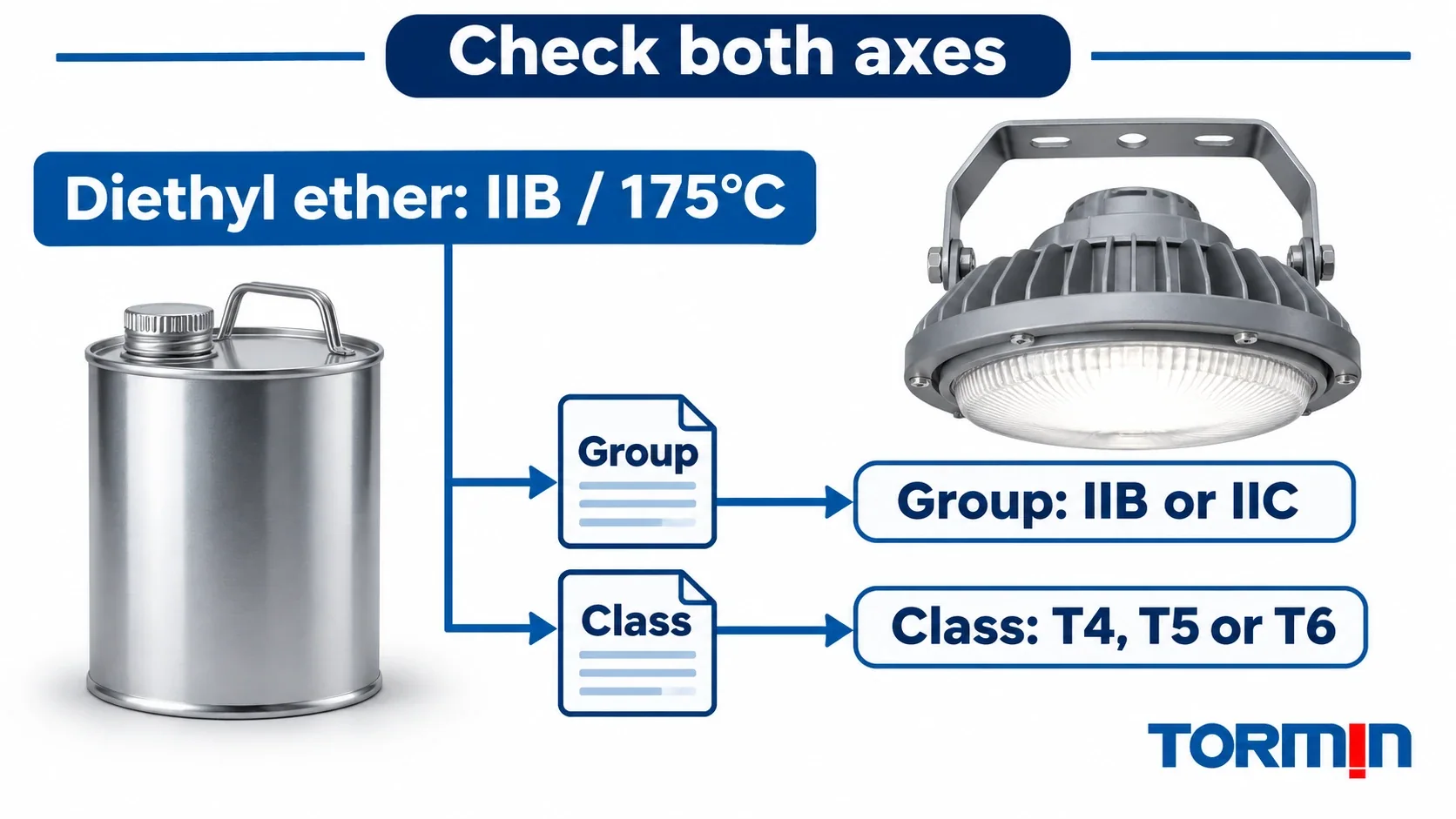
For example, the ether row does not instruct you to buy a light merely because someone measured its case below 175°C. It identifies the minimum T4 requirement under this rule. The certificate and nameplate must establish the applicable class for the chosen configuration; a field reading cannot substitute for that evidence.
Also distinguish the surface ceiling from Ta, the permitted ambient range. A satisfactory group and T-class combination remains conditional on operating within the documented ambient and other limits. Changing the power option, driver arrangement or emergency configuration can change the applicable rating. Keep those conditions attached to the ordering code instead of treating a family-level marking as a universal specification.
3. A mixture is not a new row invented from its name
If the actual mixture has accepted data, use that assessment and its documented composition and conditions. Where mixture data are absent, obtain the SDS and appropriate testing or competent review. For component-based initial screening, take the most demanding known group and the most demanding temperature requirement separately. They may come from different components.
This is the pillar guide’s dual-control principle, not permission to assume that the component with the lowest AIT also determines the gas group. Nor is taking component extremes proof that a mixture has been characterised: interactions, composition and operating conditions can require a more specific assessment. Unknown components cannot be screened by analogy to a familiar solvent.
UN guidance on preparing an SDS distinguishes available mixture AIT data from ingredient data. Retain that distinction in the project record. A supplier’s trade name, a room name or a statement such as “mostly ethanol” is not enough to assign a new group/AIT pair.
From the table to a luminaire: the diethyl ether example
Find diethyl ether and read the three linked results: IIB, 175°C, minimum T4. Those are substance-selection inputs. They do not identify a particular product, power or optical distribution.
On the gas-group axis, the offered luminaire must cover IIB or IIC for this requirement. An IIA-only light fails that axis. On the temperature axis, T4, T5 or T6 can satisfy the lower-temperature requirement; T3 and the less restrictive classes fail. Thus, an IIC/T3 offer still fails the temperature check, even though its group coverage is broad enough.
Next, match the complete offered ordering code to its actual marking and certificate schedule. Confirm the applicable zone/EPL, group, T-class, Ta and conditions of use, together with the installation requirements. A family catalogue that lists several temperature classes does not tell you which one applies to the configuration being purchased. Suitability remains subject to the specific model’s nameplate and certificate.
Use IIB vs IIC Explosion Proof Lighting: When IIB Stops Being Enough for the separate group-coverage decision and the limits of group terminology across regulatory contexts. This lookup does not turn an IEC gas group into a North American approval.
Now compare hydrogen: the source gives IIC / 560°C / T1. It needs the most demanding industrial gas subgroup but only T1 on this AIT-derived temperature axis. Ether needs IIB yet T4. That comparison shows why one axis cannot predict the other. The hydrogen lighting article develops that specific example without changing this table’s lookup task.
Keep the dataset inside its intended boundary
This is a gas and vapour table. It includes vapours of liquids that are handled as liquids at ordinary conditions; “gas table” does not imply every listed substance is supplied as a compressed gas. The relevant ignition and grouping information concerns the explosive atmosphere being assessed.
Combustible dust uses a different thermal selection method: dust-cloud and dust-layer ignition data are compared with a numeric equipment surface-temperature marking in °C. Do not transfer an AIT-derived gas class to dust service. See Dust Groups IIIA, IIIB and IIIC: Why Dust Markings Show °C, Not a T-Class.
NEC/NFPA reference values and classifications can differ from this IEC dataset. For a North American project, establish the required local approval and accepted substance data rather than transplanting these rows. No NEC/NFPA values have been used to fill gaps in this table, and there is no numerical crosswalk here.
FAQ
What is auto-ignition temperature?
AIT is the lowest temperature at which a substance ignites in air under specified test conditions without an external ignition source such as a flame or spark. It is a test-dependent reference property, not the luminaire’s operating temperature or the liquid’s flash point. Use accepted data for the actual material and conditions.
Why is propane T2 if its auto-ignition temperature is 450°C and T1 allows 450°C?
The class ceiling must be strictly below the AIT. Propane’s 450°C does not satisfy the T1 condition AIT > 450°C. It does satisfy AIT > 300°C, so the minimum class is T2. The IEC source row agrees; equality is the reason, not a different propane value.
Is a higher T-number better?
A higher number imposes a lower maximum surface temperature, so it is more restrictive on the temperature axis; T6 is the strictest of T1-T6. A class higher than the minimum can meet that thermal requirement, while a lower class cannot. It still has to match group, zone/EPL, Ta and the other documented conditions.
Can I use this table for combustible dusts?
No. Dust selection uses cloud and layer ignition temperatures and a numeric surface-temperature marking, including the relevant layer conditions. A gas T-class is not dust evidence. The dust group and surface-temperature guide explains the separate method and marking.
What if my gas or mixture is not in the table?
Obtain the SDS and accepted substance or mixture test data; do not estimate a value from a similar chemical name. For initial component screening, select group and temperature requirements independently using the most demanding known component on each axis. Missing composition or mixture behaviour still needs assessment, and component screening alone cannot supply that evidence.
Recheck the accepted group and AIT in the Gas Group × T-Class Checker before reviewing the exact model documents.
Sources
- Bureau of Indian Standards – IS/IEC 60079-20-1:2010, identical adoption of IEC 60079-20-1:2010, Table 1 and Annex B – Sole source for every numerical AIT, gas group and source T-class in the lookup; individual substance links identify PDF pages.
- IEC – IEC 60079-20-1:2010 publication record – Scope, edition and replacement by ISO/IEC 80079-20-1:2017; the record alone is not the source of the row values.
- United Nations – Guidance on the Preparation of Safety Data Sheets, GHS revision 7, Annex 4 – Distinguishes mixture AIT information from ingredient data; no numerical AIT or group values were imported from this document.