
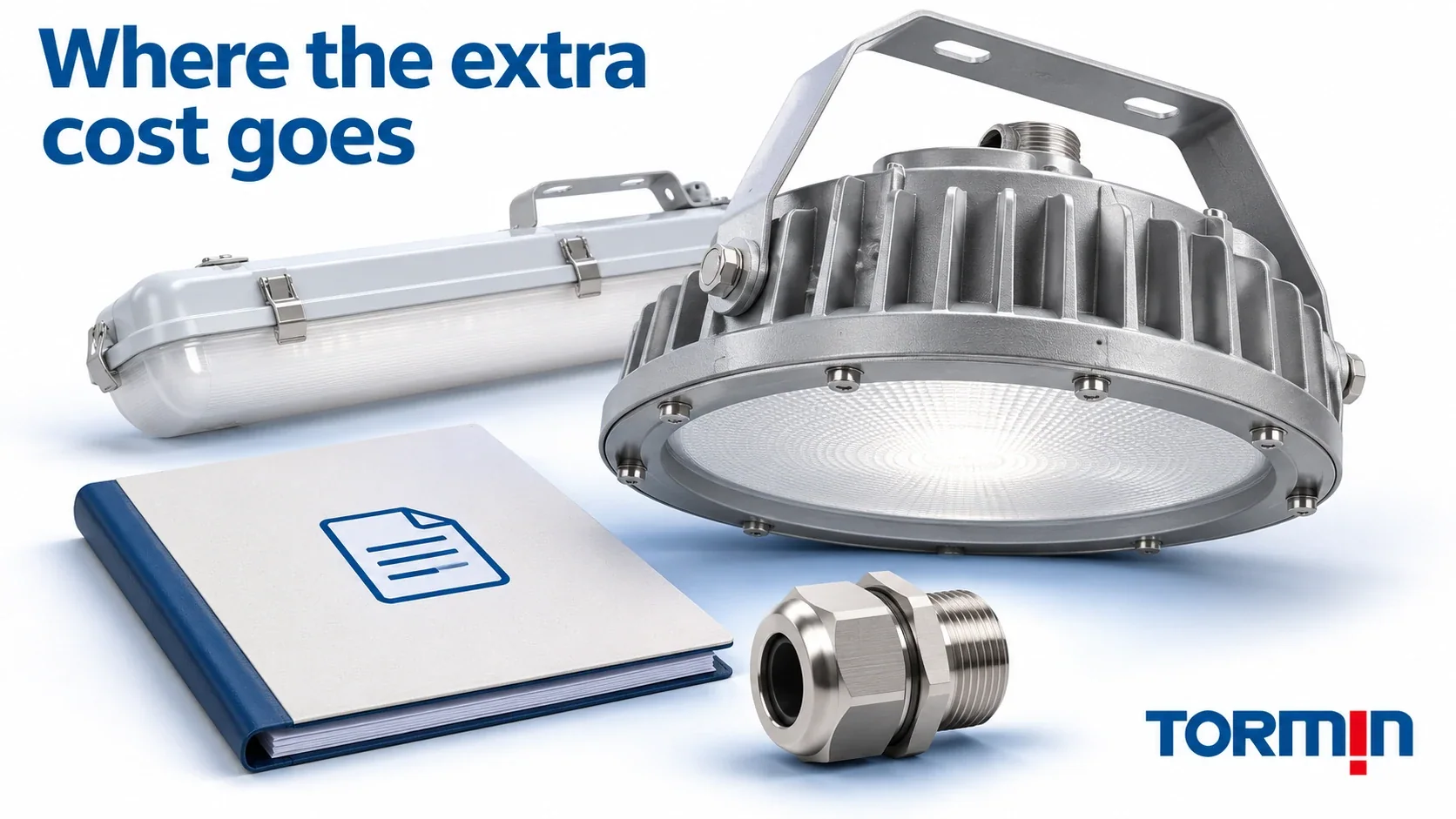
A Zone 1 lighting offer can cost more because the protection design, conformity assessment and installation scope require more work. The useful buying question is which of those costs your actual lighting positions require. There is no defensible universal Zone 1 price premium: compare complete, compliant configurations and ask suppliers to separate the luminaire, entries, documentation and installation scope.
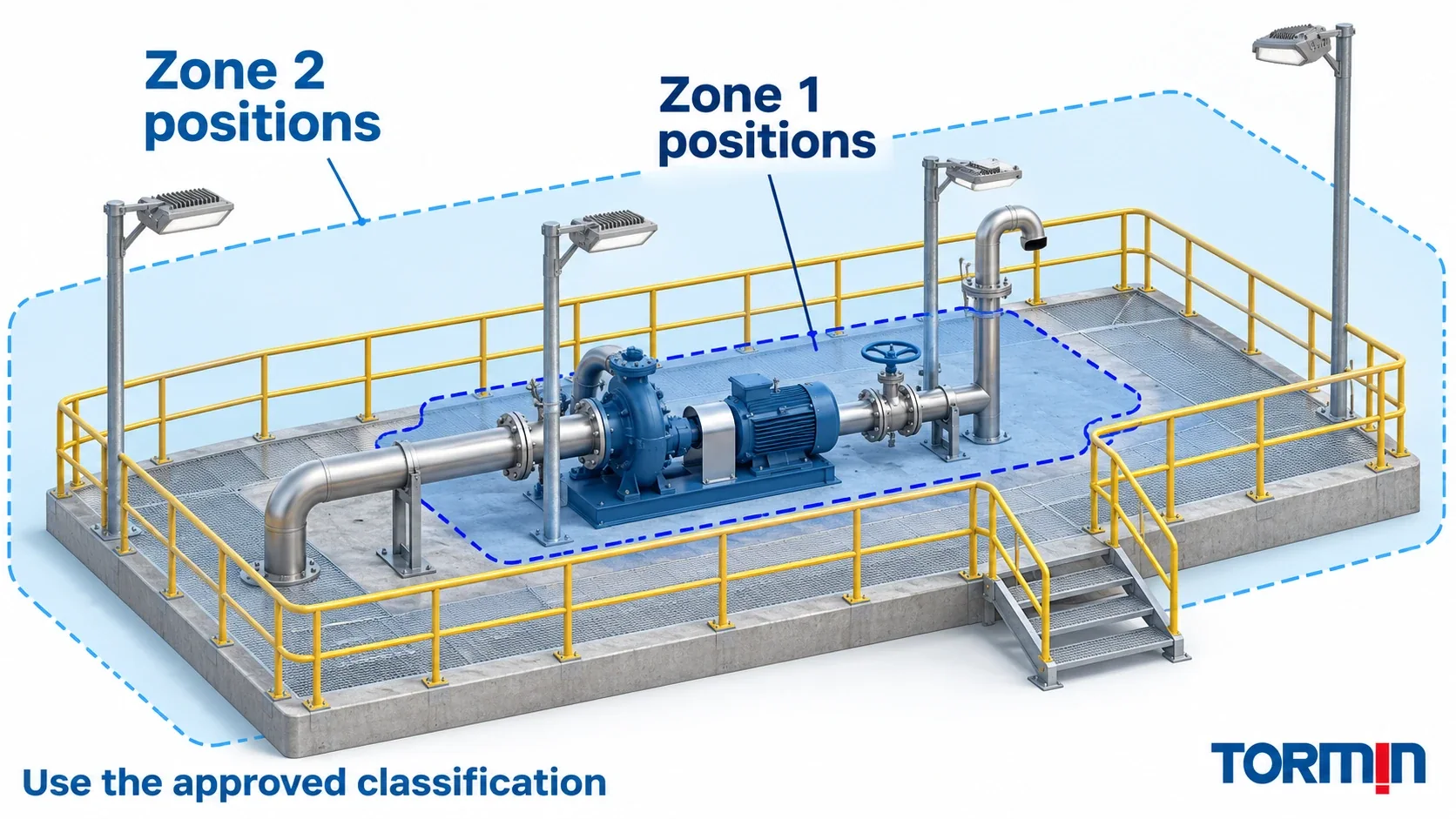
Zone 1 covers gas atmospheres that may occur occasionally in normal operation; Zone 2 covers those unlikely in normal operation and short-lived if they occur. The usual equipment selection is at least EPL Gb for Zone 1, while Gc can serve Zone 2; higher protection levels may also be suitable. Use the approved location classification, explained in Zone 0, 1 and 2, rather than assigning a zone from the plant name. The IECEx selection training provides the zone/EPL relationship.
Where the money goes: compare the work, not the label
The table describes mechanisms that can change a quotation. “Higher” and “lower” indicate potential work content under the stated design comparison, not measured market prices. A Zone 1-capable product can also be selected for Zone 2, in which case its construction costs do not disappear.
| Cost component | Zone 1 requirement or typical route | Zone 2 requirement or available route | What the buyer should compare |
|---|---|---|---|
| Protection design | Gb or higher; examples include Ex db, eb and ib, often combined with other techniques. | Gc is permissible where the assessment allows it; examples include Ex ec, ic and restricted-breathing nR. Gb equipment remains an option. | The complete equipment EPL and protection concept, not one symbol taken from a component. These are design alternatives, not interchangeable parts. |
| Enclosure manufacture | With Ex db, a pressure-resistant enclosure may require controlled casting quality, suitable walls and fasteners, and precision-machined flameproof joints. Other Gb designs can use different construction. | A suitable ec or nR design may avoid the pressure-containment enclosure and its flamepath machining. It still needs its own compliant construction. | Whether the quoted design actually contains a flameproof chamber. Do not pay or reject a premium based only on housing weight. |
| Type testing | Ex db adds explosion-pressure/overpressure and non-transmission-of-internal-ignition testing, alongside applicable general tests. | A non-flameproof Gc design avoids that particular test route but must satisfy the tests for its own protection concept. | The tested assembly and applicable standards. “Zone 2” does not mean untested. |
| ATEX conformity assessment for electrical luminaires | Category 2G normally involves notified-body EU-type examination plus the required conformity-to-type route. | Category 3G can use manufacturer internal production control and an EU declaration of conformity. | The specific legal route and supporting documents, explained below. |
| IECEx series certification | Gb equipment offered as IECEx certified needs the scheme’s certification evidence. | Gc equipment offered as IECEx certified also needs that evidence; the ATEX self-declaration distinction does not transfer. | Complete-equipment CoC scope, issue/status and manufacturer/site coverage. |
| Cable entries and glands | Direct entry into an Ex db chamber needs a compatible flameproof entry solution; a barrier gland may be required by the applicable selection conditions. Indirect entry can use an eb terminal chamber. | ec/nR entry arrangements must preserve their own protection, sealing and retention requirements. | Cable construction, entry method, gland certification, adapters, stopping plugs and included installation work. |
| Installation and initial inspection | Flameproof joints, fasteners and entry arrangements can add handling and verification work where fitted. | A simpler protection design may reduce some tasks, but hazardous-area installation and initial inspection still apply. | Actual assembly/access tasks, not a generic labour allowance per zone. |
| Subsequent inspection and maintenance | Ex db requires continued attention to joint and enclosure integrity; work depends on the installed protection. | Gc equipment still needs an inspection programme, including its relevant seals, entries and enclosure condition. | Protection-specific tasks, access, deterioration and inspection strategy; no automatic relaxed interval simply because it is Zone 2. |
Protection examples are covered by the IECEx training material, the IEC scopes for increased safety and type n protection, and the IEC intrinsic-safety preview. The table is not a menu from which a buyer can assemble a certified luminaire.
Flameproof hardware creates real cost, but not on every Zone 1 light
For a cast-metal Ex db design, the casting must support the specified enclosure strength and dimensional control. Machining and checking the flameproof joints adds manufacturing operations; damage or an out-of-tolerance joint is consequential to the protection. These are credible cost drivers compared with a suitable non-flameproof Gc construction, without assigning a monetary value to them.
NSW TestSafe’s flameproof guidance lists joint verification, explosion-pressure determination, overpressure and non-transmission tests. IEC 60079-1 governs flameproof construction and testing. Those obligations explain work content; they do not prove a particular supplier’s price is fair.
It would be inaccurate to call these costs exclusive to all Zone 1 lighting. A Gb luminaire using eb/mb can avoid an Ex db enclosure, and a Gb Ex db luminaire installed in Zone 2 retains its flameproof construction. Compare protection designs before attributing the entire difference to the zone.

ATEX and IECEx do not have the same cost distinction
Under Directive 2014/34/EU, Article 13, Category 2 electrical equipment normally follows EU-type examination, Annex III, plus either Annex VI internal production control with supervised product testing or Annex VII product quality assurance. Annex IX unit verification is an alternative. Thus, notified-body assessment and production conformity work can contribute to the supplier’s costs; “type examination plus production QA” is not the only permitted route.
Category 3 can use Annex VIII internal production control. Manufacturer declaration is a legitimate ATEX route, with technical documentation and conformity obligations; it is not permission to omit safety assessment.
Under the IECEx Certified Equipment Scheme, normal series certification uses type-test evidence, an ExTR, and factory assessment/surveillance, reported in a QAR, to support the CoC. This applies to IECEx-certified Gc as well as Gb equipment. A Category 3 ATEX declaration does not create IECEx certification.
Entries and inspection can change the installed cost
For an Ex db light, establish whether the field cable enters the flameproof chamber directly or an increased-safety terminal chamber through an approved indirect arrangement. Gland selection follows that interface, cable and certificate conditions. Barrier glands seal around individual conductors and may be required in particular circumstances; they are not mandatory merely because the location says Zone 1. The IECEx installation training, cable-entry section illustrates these distinctions. Apply the installation standard edition adopted by the project and the equipment instructions.
Ask whether glands, adapters, stopping plugs, cable preparation and sealing work are included. A low luminaire-only quote can become a higher installed-cost offer once required entries and labour are added.
IEC 60079-17:2023 addresses ongoing inspection and maintenance. Both zones need a suitable programme. Protection-specific checks follow the installed design; for example, the UK MOD petroleum-installation inspection guidance includes flamepath and enclosure checks. Zone 1 can add work where its selected construction requires it. Set the inspection strategy for the actual equipment and operating conditions; a plant-specific schedule is not a universal interval for either zone. Avoid a quotation that simply assumes Zone 2 needs little or no inspection.
The strongest saving lever: classify each lighting position correctly
Use IEC 60079-10-1 for the competent assessment of gas-area classification, then map the lighting positions onto its approved three-dimensional zones. The IEC standard’s scope establishes that classification supports equipment design and selection. Buying every light to Zone 1 specification can add unnecessary work content where Gc equipment genuinely satisfies the approved requirements.
Ventilation affects dilution, persistence and zone extent. Release characteristics, obstructions and the availability of ventilation matter together: adding a fan is not an automatic Zone 2 conversion. HSE’s classification guidance discusses these inputs. Any revised extent must be established and documented by the responsible assessor before procurement uses it.
The practical saving is to buy the required protection at each actual luminaire position. Do not move a symbol on a floor plan while ignoring mounting height, a roof pocket or a nearby release source. If the classification is unresolved, obtain that engineering input before seeking a “cheaper zone” offer.
Gas group and T-class are a separate price axis
Hold gas group, temperature class and ambient range constant when comparing zone-related costs. A difference in those requirements changes the design question independently of Gb versus Gc. Use How to Choose Explosion Proof Lighting by Gas Group and Temperature Class to establish that part of the specification; this article does not assign a surcharge to any group or T-class.
When buying Zone 1-capable lights throughout is reasonable
Standardising on a suitable Gb configuration can make procurement sense when the avoided stock and substitution complexity outweighs the extra acquisition or installation work. Evaluate these cases against actual offers:
- Shared spares: one approved ordering code may reduce spare holdings, training and the risk of a Gc-only replacement being fitted in a Zone 1 position.
- A credible future change: an identified process or ventilation change may lead to reclassification. Gb can preserve options, although a future change may also alter group, T-class, Ta or other requirements.
- A small remaining quantity: maintaining a second equipment type for a few Zone 2 positions may add more administration, stock and commissioning work than it avoids.
Compare the mixed-zone bill of materials with the standardised alternative, including entries, installation, inspection and spares. Standardisation is justified by that project comparison, not by a universal rule that Gb is always better value. Suitable Gb equipment can serve Zone 2, but every other condition must still match.
Worked example: one pump area, two procurement scopes
Assume an approved classification identifies lighting positions near specified pump seals and a vent outlet as Zone 1, with other general-area positions in Zone 2. These are hypothetical project inputs, not a rule that every seal or vent creates Zone 1. Hold required lighting performance, gas group, T-class, Ta, corrosion resistance, supply and emergency duties equal.
For this comparison only, consider an Ex db/eb Gb candidate at the Zone 1 positions and a suitable non-flameproof Gc candidate at the Zone 2 positions. No particular TORMIN model or available Gc counterpart is assumed.
| Cost check | Near seals/vent: assumed Zone 1 positions | General positions: assumed Zone 2 | Buying conclusion |
|---|---|---|---|
| Required protection | Gb or higher is the acceptance floor. | Gc can meet the assumed location requirement. | Retain Gb near the assessed releases; do not impose it elsewhere without a reason. |
| Manufacture | Selected db chamber adds pressure-containment and joint-machining work. | Selected non-db design avoids those particular operations. | Potentially higher hardware work at the Gb positions; obtain actual comparable offers. |
| Tests | Flameproof pressure and non-transmission test route applies to this candidate. | Tests follow the chosen Gc concept instead. | Compare applicable test scope, not an invented testing-price ratio. |
| ATEX route | Category 2 electrical route requires notified-body involvement. | Category 3 internal production control can reduce third-party assessment scope. | Compare route documents and inclusions; no fixed price gap follows. |
| IECEx, if specified | Require the appropriate CoC and scope. | Require the appropriate CoC and scope here too. | Do not credit the Gc offer with an assumed IECEx certification exemption. |
| Entries | Price the selected direct/indirect arrangement and any required barrier solution. | Price compatible entries for the actual Gc design. | Entry and preparation work may be lower for a simpler arrangement; verify it. |
| Installation/inspection | Budget protection-specific verification and later maintenance. | Keep required initial and subsequent inspection; omit only tasks irrelevant to this construction. | Compare work scope and access, not a blanket zone-based inspection discount. |
| Spares | Can supply a common Gb stock if otherwise compatible. | A dedicated Gc stock adds another controlled type. | Check whether standardising Gb reverses the acquisition saving at project level. |
The mixed-zone option avoids buying unneeded protection work at the general positions. The common-Gb option may still win the total procurement decision where spares and administration dominate. Neither outcome authorises Gc-only equipment in the Zone 1 positions.
False savings: reject incomplete or unsuitable offers
Installing Gc-only Zone 2 equipment in Zone 1 is a compliance and ignition-safety failure, not a saving. A seller’s “explosion proof” description cannot bridge a missing Gb capability. For an ATEX Zone 1 offer, require the applicable Category 2G or higher suitability evidence as well; Gb and Category 2G belong to different marking frameworks and should not be treated as synonyms.
A quotation that supplies only “explosion proof” without the complete marking and assessment/certificate scope is not a credible basis for a like-for-like price comparison. It may exclude the entry components, use a different approval route or describe another variant.
Have each supplier return the full ordering code, complete marking, applicable approval documents and schedules, conditions of use, matched cable-entry scope and exclusions against the same position schedule. Then compare compliant offers. Under IECEx, verify the controlled certificate status through the scheme’s certificate guidance; a component certificate alone does not approve the complete light.
TORMIN Zone 1 candidates: check the offered model
The following first-party listings were checked on November 6, 2026. They establish catalogue application and marking information, not prices or current approval of every ordering code.
| Individual product page | Listed gas application | Listed gas Ex marking |
|---|---|---|
| BC5402A Zone 1 linear light | Gas Zones 1 and 2 | Ex eb mb op is IIC T6/T5/T4 Gb |
| BC9306P series | Gas Zones 1 and 2 | Ex db eb IIC T6/T5/T4 Gb |
| BC9306S area/floodlight | Catalogue Zone 1 / 2 | Ex db eb IIC T6/T5/T4 Gb |
| BC9306S spotlight | Gas Zones 1 and 2 | Ex db eb IIC T6/T5/T4 Gb |
Application and the applicable temperature class are subject to the specific model’s nameplate, matching certificate schedule, ambient limits and installation conditions. The linear listing also demonstrates why “Zone 1” does not automatically mean an Ex db enclosure. The BC9306S area/floodlight page identifies family certificate copies as archived with current status unverified; obtain the applicable current documents before approval. No cheaper Zone 2-only version, model price or series-wide T6 rating is inferred here.
FAQ
Can a Zone 2 light be installed in Zone 1?
Gc-only equipment cannot satisfy a Gb requirement. If a light is described commercially as “for Zone 2” but its exact documents also establish the required higher protection, assess that documented configuration. The marketing phrase alone decides nothing. See the IECEx zone/EPL selection guidance.
Why do two quotations both saying “explosion proof” differ so much?
They may cover different protection designs, approval routes, variants, glands or installation scope. Require the complete marking and matching documents, then align lighting duty, ambient conditions and accessories. A price difference without that scope comparison cannot be attributed to the zone alone.
Is fitting Zone 1-capable lights throughout Zone 2 wasteful?
It can be unnecessary overspecification, but a suitable common Gb configuration can be reasonable where shared spares, planned changes or a small second-type quantity justify it. Compare the actual project scope and stock burden. Keep all other suitability conditions attached to the chosen model.
Where does the Category 2G versus 3G assessment difference affect cost?
For electrical equipment, Category 2 normally adds notified-body type assessment and conformity-to-type involvement; Category 3 can use manufacturer internal production control. This can change assessment work, not guarantee a price premium. IECEx has its own certification requirements for both Gb and Gc. The applicable ATEX routes are in Article 13.
How should a supplier prove a light is suitable for Zone 1?
Request the exact ordering code and nameplate, complete marking showing the required EPL, and the applicable full certificate/schedule and instructions. For ATEX, also verify the category and EU declaration against the conformity route; for IECEx, verify the complete-equipment CoC and current scope. Match group, T-class, Ta, entries and conditions to the project. A generic family certificate or Ex component approval alone is insufficient.
Sources
- IECEx – Electrical installations design, selection and installation of equipment, including initial inspection, Edinburgh Symposium 2023 – Zone/EPL selection and cable-entry relationships; training referencing draft clause numbering, not a claim of access to a current full installation standard.
- IEC – IEC 60079-7:2015 – Published scope for increased safety, including eb/ec.
- IEC – IEC 60079-15:2017 – Published scope for type n, including restricted breathing nR.
- IEC – IEC 60079-11:2011, public preview with interpretation sheets – Intrinsic-safety protection levels, including ic; historical explanatory reference, not a mandatory project-edition selection.
- NSW Government, TestSafe – Flameproof enclosure Ex d – Construction-related verification and pressure/non-transmission test types.
- IEC – IEC 60079-1:2014 RLV – Published scope of flameproof construction and testing.
- European Union – Directive 2014/34/EU, Article 13 and Annexes III, VI-IX – Electrical Category 2 and Category 3 conformity routes.
- IECEx – Certified Equipment Scheme overview – Series CoC, ExTR and QAR requirements.
- IEC – IEC 60079-17:2023 RLV, public preview – Inspection and maintenance framework, protection-specific checks and inspection strategy.
- UK Ministry of Defence – Inspection, Maintenance and Testing of Equipment Installed at Petroleum Installations on MOD Property, Petroleum 02, version 2.1 – Protection-specific inspection schedules; estate-specific practice, not universal statutory requirements.
- IEC – IEC 60079-10-1:2020 – Classification scope and three-dimensional areas.
- HSE – Hazardous Area Classification and Control of Ignition Sources – Release, ventilation and classification inputs.
- IECEx – Certified Equipment Scheme FAQs – Certificate status verification and equipment/component distinction.
TORMIN first-party product documents
- BC5402A linear product page – Catalogue gas Zones 1/2 and eb mb op is Gb marking.
- BC9306P product page – Catalogue gas Zones 1/2 and db eb Gb marking.
- BC9306S area/floodlight product page – Catalogue gas Zone 1/2, db eb Gb marking and archived-certificate status limitation.
- BC9306S spotlight product page – Catalogue gas Zones 1/2 and db eb Gb marking.