
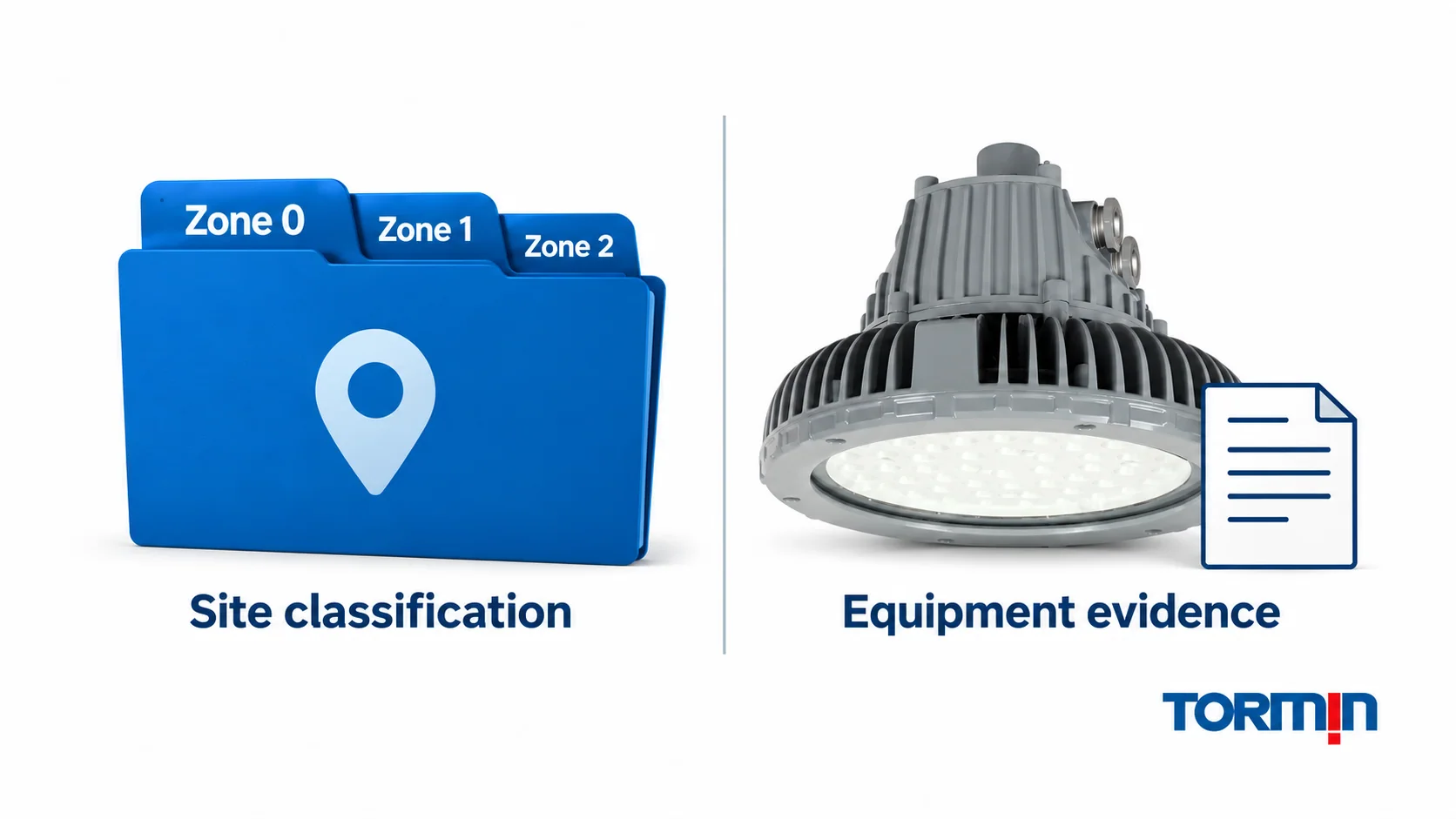
For Zone 0, Zone 1 and Zone 2 lighting, establish where the complete luminaire will be located within the project’s classified space before reviewing an equipment offer. A zone describes the occurrence of an explosive atmosphere at a place. The zone number does not identify a complete lighting specification.
Use the controlled area-classification drawing and schedule for the actual proposed position, including its elevation. A room name, a nearby process item or the work surface receiving the light cannot settle that position’s classification. When the location or boundary is unclear, obtain the project classifier’s answer before completing selection.
This article focuses on interpreting gas/vapour classification for lighting positions. It explains a procurement decision; it does not classify a plant or approve a luminaire.
What Zone 0, Zone 1 and Zone 2 describe
The distinctions concern how often an explosive atmosphere occurs and how long it persists. HSE’s definitions describe the gas/vapour/mist zones qualitatively:
| Classification | Meaning in the gas-zone definitions | What the lighting buyer should preserve |
|---|---|---|
| Zone 0 | Explosive atmosphere present continuously, for long periods or frequently. | The project’s exact classified location and required equipment protection basis. |
| Zone 1 | Explosive atmosphere expected occasionally during normal operation. | The assigned extent and the equipment requirements for the proposed position. |
| Zone 2 | Explosive atmosphere unlikely during normal operation; if it occurs, it persists only briefly. | The classification remains an equipment-selection input, even though the occurrence is less frequent. |
These numbers are not concentrations, distances from a source or a ranking of explosion consequences. Do not assign a zone from the number of hours a lamp operates. HSE’s hazardous-area classification guidance discusses release and ventilation information and notes that proposed annual-hour boundaries have not been officially adopted.
The HSE definitions include mist, but the technical scope needs its own check. IEC 60079-10-1:2020 addresses gas/vapour classification and identifies limits for mist situations; IEC 60079-14:2024 excludes installations where the hazard is due to flammable mist. Do not extend this gas/vapour explanation to a mist application without specialist assessment.
Combustible-dust classifications use Zones 20, 21 and 22. A gas-zone entry does not establish the dust assessment or a product’s dust protection. HSE lists these separately in its definitions.
Locate the luminaire in three dimensions
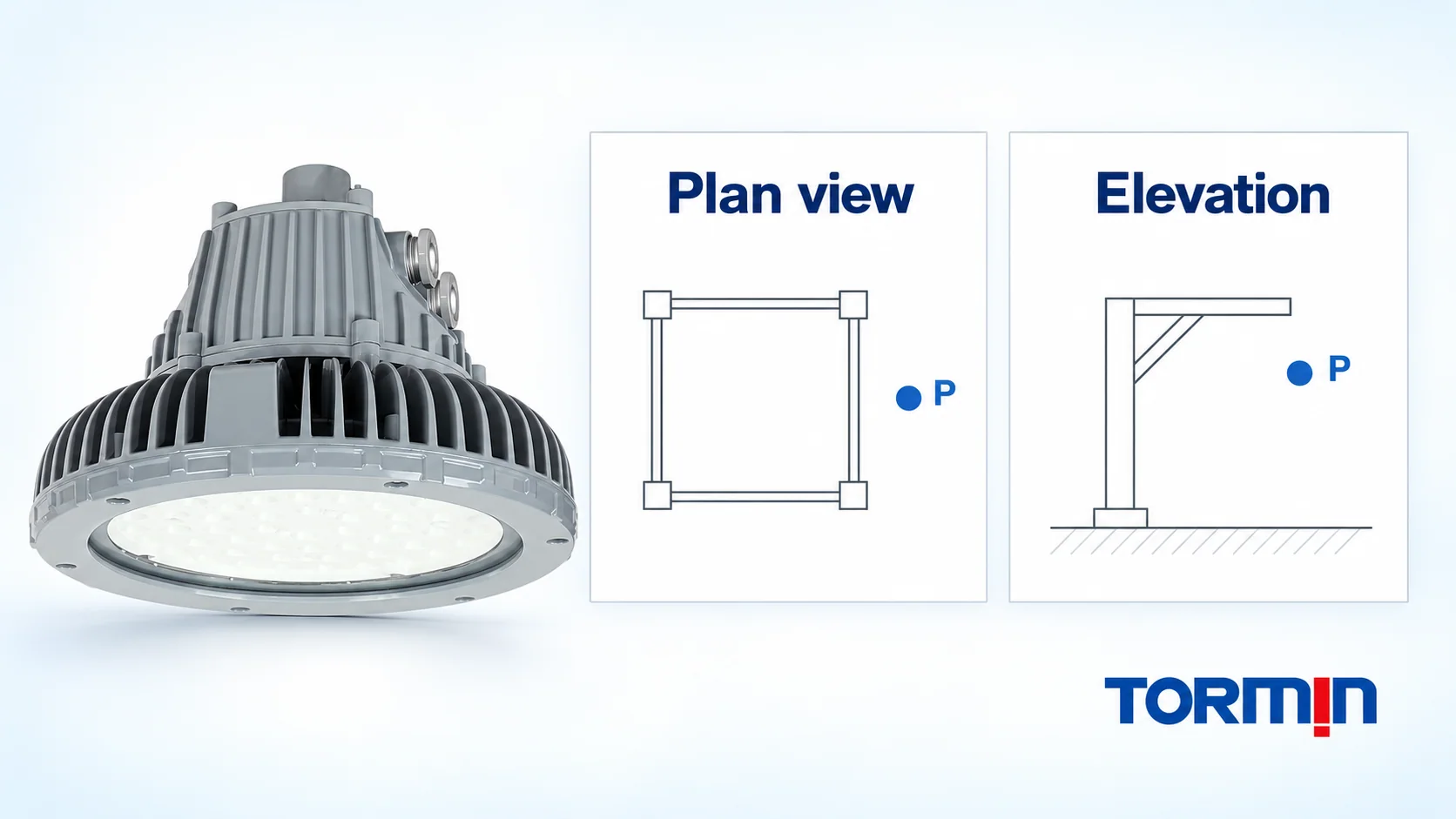
The IEC 60079-10-1 public scope describes an area as a three-dimensional region or space. That matters when interpreting a lighting layout: a mark on a floor plan may not resolve the height or complete position of the proposed equipment.
Read the plan together with the relevant elevations, sections, notes and location schedule. Establish which documents control the selection and whether their revisions agree. If the drawing gives a boundary but the mounting position is only approximate, do not silently choose the more convenient interpretation.
Distinguish the luminaire’s location from the surface it illuminates. Light reaching a classified task surface does not, by itself, place the fixture in the same zone. Conversely, placing a fixture above a walkway does not prove that it is outside a classified extent. The project must resolve the actual three-dimensional positions. This is a spatial review question, not an invitation to move equipment to avoid requirements.
Where a proposed arrangement crosses a boundary, identify which parts and associated equipment require review. A luminaire, a separate supply accessory and their locations need the relevant documented assessment. A lighting-plan symbol alone should not hide that question.
Worked example: three positions on one lighting layout
The following is a fictional document-review example, not a real site, classified distance or TORMIN installation. No zoning calculation is performed.
Assume the responsible project team has issued classification drawing R2. Its plan and section identify a Zone 1 volume around one process location and a separate Zone 2 extent. A lighting designer proposes three fixture positions on a lighting layout.
| Proposed position | What the documents show | Selection decision |
|---|---|---|
| A | The fixture’s complete proposed position is identified within the R2 Zone 1 volume. | Carry the established Zone 1 requirement into equipment review, together with the project’s other requirements. The position is defined; no product has yet been accepted. |
| B | The fixture appears outside the Zone 1 outline on plan, but its elevation and relationship to the three-dimensional extent are missing. | Hold the location decision. Ask the classifier to resolve the proposed position using the relevant section or additional information. Do not assume Zone 2 or non-hazardous from the plan alone. |
| C | The fixture is identified within the R2 Zone 2 extent, but the designer later changes its proposed location. | Review the new position against the controlling classification. The earlier location assessment cannot automatically be transferred. |
The useful outcome is three different records: A has a defined location, B needs boundary information, and C needs review after a position change. A defined location starts equipment assessment; it does not complete it.
Now suppose the classification team issues R3, changing an extent after a process review. Link each affected fixture position to R3 and record which previous decisions require reconsideration. Record the effect on the associated equipment review and update the quotation’s location basis where needed.
Do not let the supplier resolve a conflict between R2 and R3 by choosing the document that matches an available light. Return the conflict to the responsible project team and record the controlling revision. The supplier can then review a defined requirement against the exact equipment documents.
Carry the location decision into equipment selection
A gas zone, an equipment protection level (EPL) and an equipment category describe different parts of the assessment. Preserve the requirement stated by the project under its adopted framework. Do not substitute one label for another, or convert a Zone requirement into a Class/Division requirement informally. The existing Class I Division 1 versus Division 2 guide covers those framework boundaries and category relationships.
For each defined position, the project reviewer must still establish the relevant material group, temperature requirement, ambient conditions and acceptance basis, then compare those requirements with the offered equipment’s complete scope. A catalogue statement such as “Zone 1/2” cannot resolve missing location information or an unverified variant.
IEC 60079-14:2024’s public description identifies design, selection, installation, documentation and personnel competence within its scope. It does not turn a general article or a product photograph into installation approval. Use the rules and editions adopted for the project and the appropriate competent reviewers.
Once the position is defined, use the nameplate and certificate guide to check the offered unit’s identity, full marking, certificate scope and conditions. For the document routes themselves, see the separate ATEX versus IECEx article.
Keep a location-specific decision record
Attach the established classification to each proposed lighting position. A short record is more useful than a purchase line that only says “explosion-proof light”:
Lighting position/asset reference:
Proposed location and elevation; arrangement drawing reference:
Controlling classification drawing, section, schedule and revision:
Assigned gas/vapour zone and applicable project equipment requirements:
Boundary, associated equipment or revision questions still open:
Exact offered luminaire configuration and document reference:
Decision: location defined / clarification needed / change review needed
Responsible project reviewer and decision date:
Keep the open question visible until the responsible team answers it. A missing elevation is not proof of a particular zone; a clear zone assignment is not proof that the offered luminaire fits it. Preserving those two decisions prevents uncertainty in the layout from becoming an unsupported equipment claim.
For a complete lighting specification, continue with the hazardous-area lighting selection guide. The BC9304P product page identifies the official exterior used in these illustrations; its appearance is not evidence of Zone 0, 1 or 2 suitability. Contact TORMIN with the established location requirements and exact proposed configuration to request the relevant current documents.
Sources
- HSE — Definitions: explosive atmospheres and hazardous areas, updated 17 April 2025 — qualitative Zone 0/1/2 definitions and the separate dust-zone series; GB regulatory context.
- HSE — Hazardous Area Classification and Control of Ignition Sources — release/ventilation context and limits of annual-hour interpretations. Historical references and old protection tables are not used as current selection rules.
- IEC — IEC 60079-10-1:2020, Explosive atmospheres — Part 10-1: Classification of areas — Explosive gas atmospheres — public scope, three-dimensional areas and gas/vapour/mist boundaries; licensed full text was not consulted.
- IEC — IEC 60079-14:2024, Explosive atmospheres — Part 14: Electrical installation design, selection and installation of equipment, including initial inspection — public scope, documentation/competence and flammable-mist exclusion; licensed full text was not consulted.
- TORMIN — BC9304P product page — first-party product identity and exterior image reference only; no exact-model certificate or zone suitability was assessed for this article.