
For a hazardous-area lighting project, start with the destination market, the applicable requirements and the exact luminaire configuration. Then ask for the documents that demonstrate the route required by that project. An ATEX document and an IECEx certificate serve different purposes; neither is a universal substitute for the other.
For an EU supply within the scope of the ATEX product rules, request the applicable EU Declaration of Conformity, instructions and conformity-assessment evidence. Where the applicable assessment route requires an EU-type examination certificate, request that certificate and its scope. For a project specifying IECEx, request the relevant IECEx equipment Certificate of Conformity and check its controlled online record. A project may also require additional national or customer acceptance evidence.
The European Commission describes ATEX Directive 2014/34/EU as EU product legislation. IECEx describes its Certified Equipment Scheme as a separate international certification system. The project reviewer must determine what applies to the particular transaction and installation.
ATEX and IECEx: compare the document’s job
| Review question | ATEX product route | IECEx Certified Equipment Scheme |
|---|---|---|
| What is it? | EU legislation for equipment and protective systems within the Directive’s scope, implemented through national measures. | An international conformity-assessment scheme using accepted certification bodies and relevant standards. |
| What is the principal product document? | The manufacturer’s EU Declaration of Conformity for the applicable product, supported by the conformity-assessment route and relevant evidence. | The IECEx Certificate of Conformity for the complete equipment, where that is the certification claimed. |
| Who makes the declaration or issues the certificate? | The manufacturer issues the declaration. A notified body participates where the applicable conformity-assessment route calls for it. | An accepted IECEx certification body (ExCB) issues the equipment certificate under the scheme. |
| Where should the reviewer look next? | The declaration, applicable assessment evidence, instructions and exact type/variant mapping; verify the project’s applicable requirements. | The current online certificate, scope, conditions and exact equipment/variant mapping; check national and project acceptance. |
| What does it not establish alone? | Suitability of an installed system or automatic acceptance under another jurisdiction’s rules. | Automatic satisfaction of all local market or installation requirements. |
This comparison follows the Commission’s ATEX explanation and the IECEx Certified Equipment Scheme overview. It is a document-planning aid, not a decision that an offered fixture is suitable.
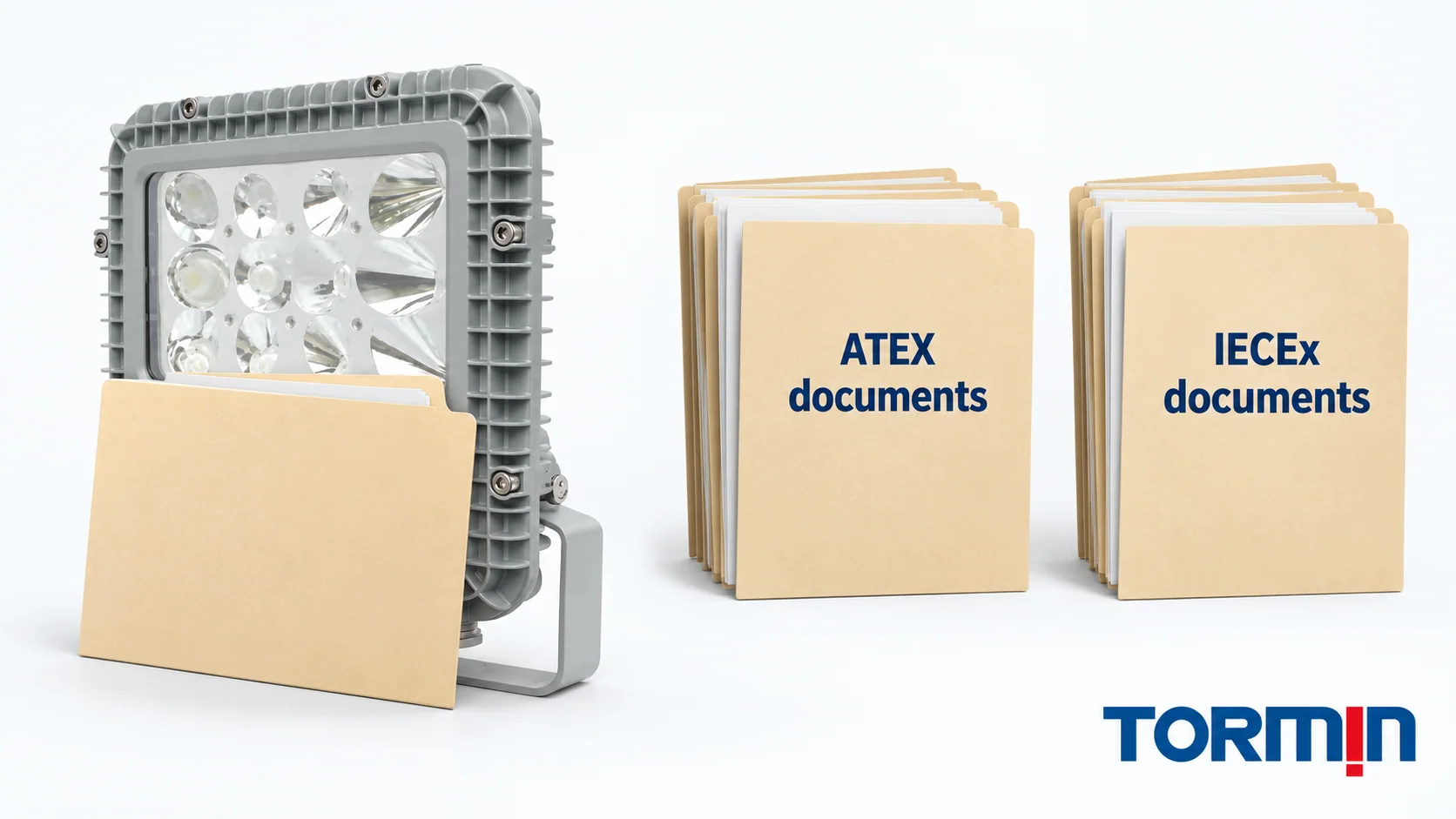
For an EU ATEX supply, identify the applicable evidence
The Commission states that the product Directive sets essential health and safety requirements and conformity-assessment procedures before products within scope are placed on the EU market. National implementing measures apply, so confirm the transaction, product scope and responsible parties with the project’s compliance reviewer. The product Directive and workplace requirements have different roles. See the Commission’s ATEX overview.
Ask for these documents for the offered configuration:
- EU Declaration of Conformity: check the manufacturer, identified product, relevant legislation and supporting references. The European Commission’s 2026 ATEX guidelines reproduce the declaration model in Annex X of Directive 2014/34/EU. The manufacturer issues the declaration; a third-party type examination certificate has a different function.
- Conformity-assessment evidence applicable to that product: identify the equipment category and assessment route with the manufacturer. Request the EU-type examination certificate and complete scope when that route requires one, together with other evidence required by the route. Do not assume every ATEX luminaire follows the same notified-body procedure.
- Instructions and identification: request instructions applicable to the actual equipment and the manufacturer’s mapping from full ordering code to the documented type and configuration.
- Project review inputs: establish the required hazardous-area classification and conditions from the responsible project team, and identify any additional contract or local requirements.
The Commission notes that national authorities implement and enforce the Directive. A CE mark or an attractive catalogue image alone does not resolve the explosion-protection scope or project acceptance. Other EU legislation may also apply to a product; the ATEX assessment is not a substitute for those separate obligations.
For IECEx, verify the correct equipment record
Request the IECEx equipment Certificate of Conformity for the complete offered luminaire when that certificate is required or claimed. The IECEx scheme overview distinguishes a complete-equipment CoC from a component certificate and from unit verification. A component certificate concerns an element of equipment; its existence alone does not establish certification of the finished luminaire.
The normal type-certified equipment route uses a test report (ExTR) and a quality assessment report (QAR) as part of certification. They are related evidence with different functions, not interchangeable document names. Whether a buyer receives a particular supporting report depends on the applicable process and arrangements; ask the manufacturer or issuing ExCB what can be supplied for the review. The IECEx FAQ explains these scheme documents and identifies the manufacturer as the first contact for an equipment question.
Use the IECEx online certificate system to locate the controlled record. Record the reference, issue, status and date checked, then read its complete scope and any applicable conditions. The scheme FAQ identifies the online version as the controlled master; a downloaded PDF can become superseded.
Do not confuse an IECEx Certificate of Acceptance for a testing laboratory with an equipment Certificate of Conformity. They identify different things, as explained in the IECEx FAQ.
Acceptance depends on the project destination
An IECEx certificate can be useful evidence in international projects, but do not treat it as automatic authorization in every market. IECEx explains that some countries retain national approval or processing requirements even where scheme assessment data can be recognized. Confirm the local route and the owner’s specification before treating a document set as complete. IECEx FAQ: acceptance.
Likewise, an ATEX document alone does not establish that another country or a particular customer will accept the equipment. When both routes are specified, request and review each required document set and resolve discrepancies. Common standards or shared test information do not, by themselves, convert one certificate into another.
An equipment certificate does not approve the whole installation. The site’s classification, installation design, accessories and operational controls require their own review under the applicable rules. For the detailed task of matching a unit’s marking to its documents, use the nameplate and certificate guide.
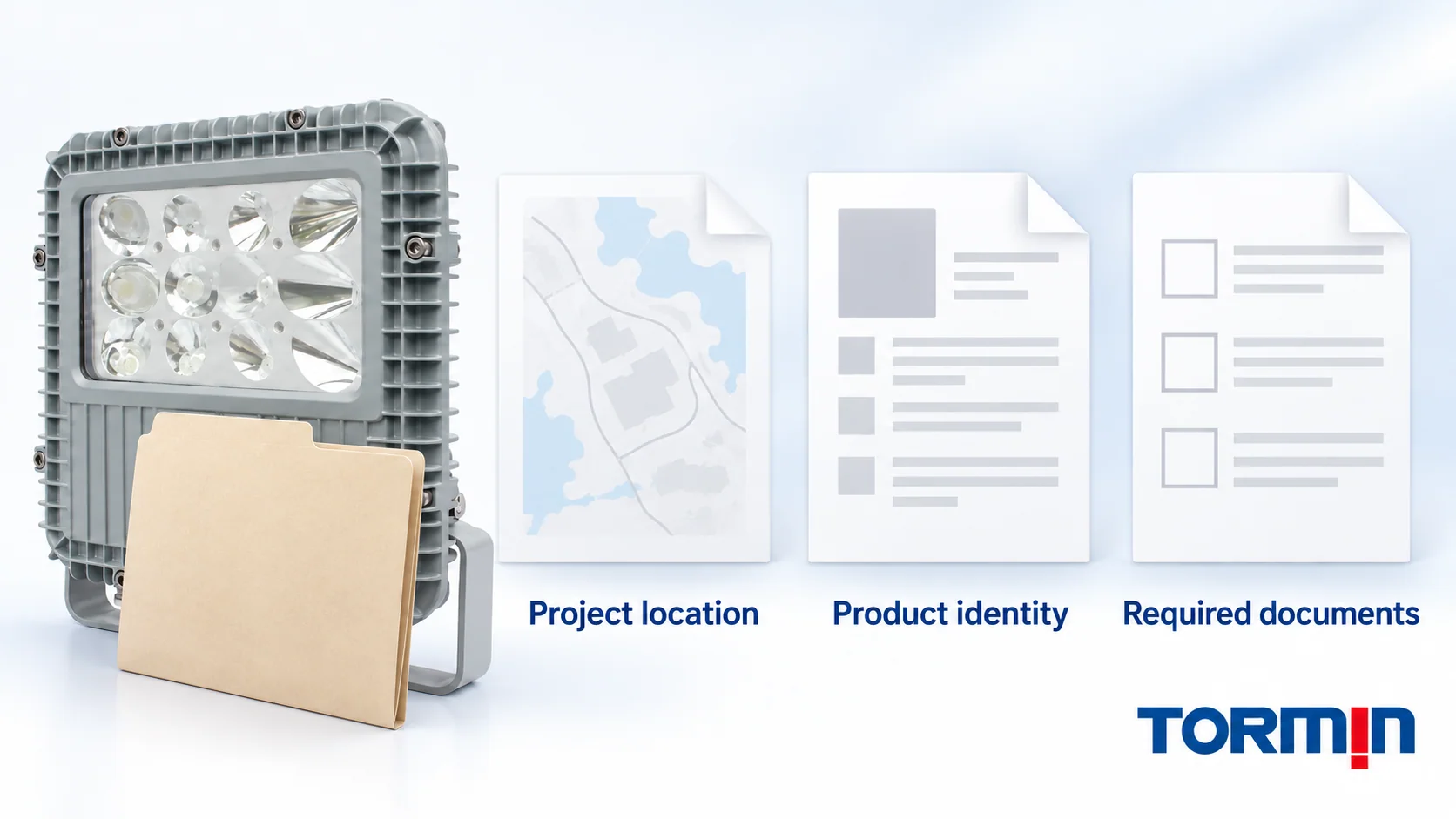
Two fictional project requests
These examples describe invented projects and document gaps, not a TORMIN order, certificate or legal determination.
| Review point | Project A: EU supply | Project B: non-EU project specifies IECEx |
|---|---|---|
| Known requirement | The buyer identifies an EU destination and requests the applicable ATEX product documentation. | The client specification calls for an IECEx equipment CoC; the local acceptance route is not yet confirmed. |
| Supplier initially sends | A product brochure with an Ex symbol; no declaration or route-specific evidence. | A copy of an IECEx component certificate for one part; no complete-equipment record. |
| Next request | Ask for the declaration, instructions, exact variant mapping and conformity-assessment evidence appropriate to the equipment and route. | Ask for the complete offered luminaire’s IECEx equipment certificate, current online record and variant mapping; confirm local and client acceptance. |
| Decision at this stage | Incomplete: a brochure alone does not identify the required evidence. | Incomplete: the component record does not establish the claimed certification of the complete luminaire. |
Neither example decides the site’s classification or accepts the product. The reviewer should document the answer and the source of each requirement before releasing the submittal.
Send a project-specific document request
Provide the supplier with the location and the exact configuration under review. Keep unanswered fields open:
Destination market and project/site:
Applicable regulatory route and client specification:
Full luminaire ordering code and configuration:
Project classification and required equipment characteristics:
ATEX declaration, instructions and applicable assessment evidence:
IECEx complete-equipment CoC, issue, status and online record:
Exact variant-to-document mapping and applicable conditions:
Any additional local approval or project acceptance requirements:
Outstanding question, responsible reviewer and decision date:
Use the explosion-proof lighting selection guide for the broader technical inputs. When reviewing a potential TORMIN product, the BC9101 product page identifies the exterior illustrated here; the image is not evidence of a certification. Browse the ATEX lighting range and contact TORMIN with the complete project and ordering details to request the relevant current documents.
Sources
- European Commission — Equipment for potentially explosive atmospheres (ATEX) — EU Directive scope, national implementation and product/workplace distinction.
- European Commission — ATEX Directive 2014/34/EU Guidelines, sixth edition, January 2026 — sections 89, 93 and 227 on assessment routes and declaration structure. This is guidance; check the applicable consolidated law and national implementation for the project.
- IECEx — Certified Equipment Scheme overview — equipment, component and unit-verification certificate distinctions and ExTR/QAR roles.
- IECEx — Frequently asked questions about IECEx — scheme comparison, acceptance, certificate types and manufacturer/ExCB contact.
- IECEx — Certified Equipment Scheme FAQs — controlled online master and status checks.
- TORMIN — BC9101 Series Explosion-Proof LED Square Light — first-party identification and exterior image reference only; no model-specific certificate was assessed for this article.