
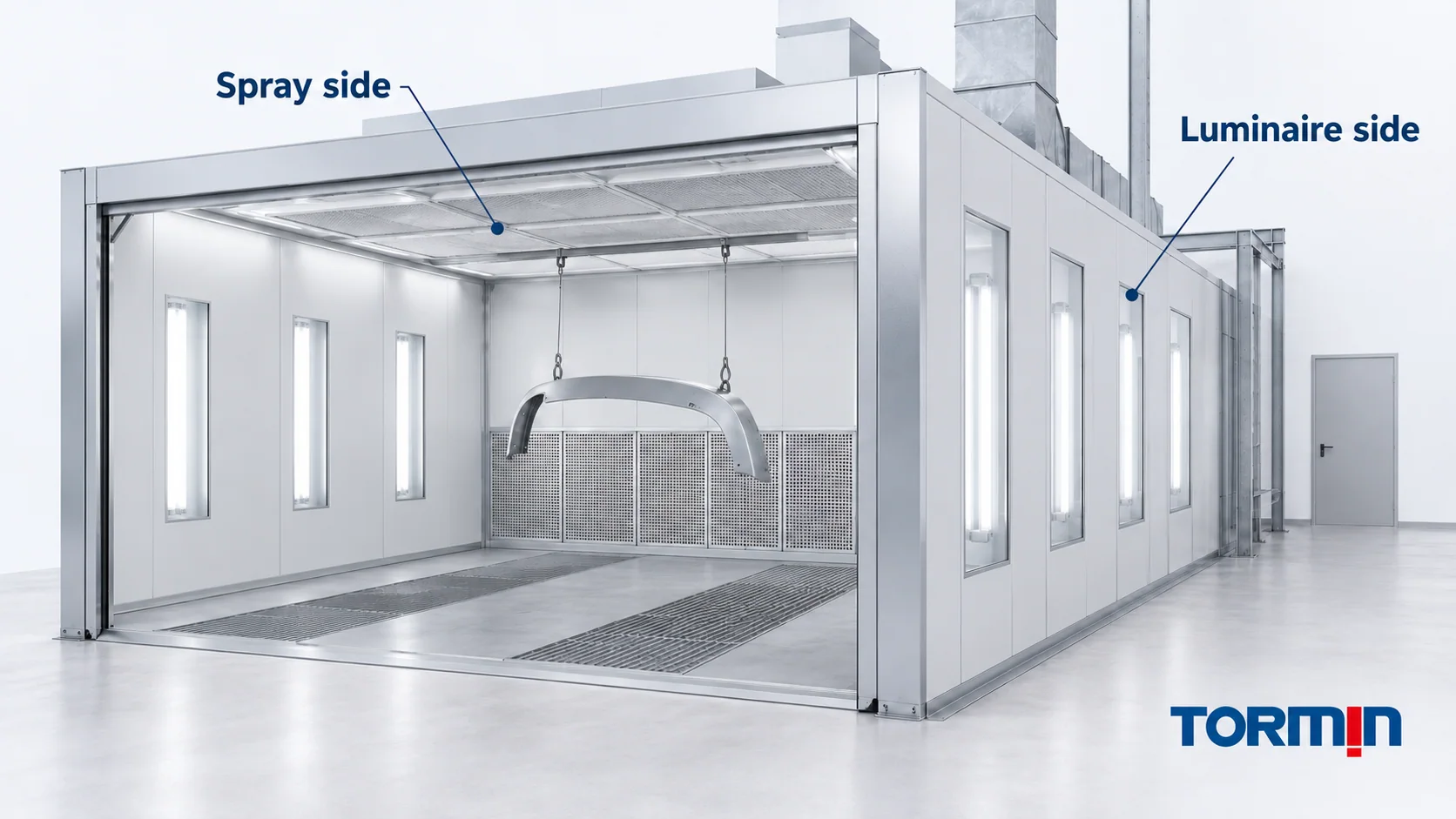
Explosion-proof lighting for a paint booth starts with the documented process hazards and the actual location of the luminaire. A light exposed to the spraying area, a fixed light behind an isolating window, and a light near an open booth entrance are different arrangements to evaluate. LED technology, a waterproof housing or the words “paint booth light” do not settle that evaluation.
Before comparing fixtures, identify the spraying side, the luminaire side, the separating construction and the workpiece surfaces that need illumination. Then ask for evidence tied to the proposed assembly and operating conditions.
This guide helps booth builders, engineers and technical buyers prepare that specification for a new installation or replacement. U.S. OSHA provisions below are scoped examples, not a classification for your booth or a substitute for the applicable project rules and qualified design review. The images show generic spatial relationships, not actual TORMIN installations or approved layouts.
Map the fixture location before specifying its rating
Start with a drawing of the booth and surrounding space. Mark each proposed light, transparent panel, opening and service-access point. Obtain the applicable area-classification record rather than assigning a rating from a product photograph.
OSHA 1910.307 treats classification as a room-, section- or area-specific question. Equipment acceptance must account for the actual substance hazard, not only a familiar class designation. Temperature and operating conditions also matter.
Use the following table to organize the review. It is a specification worksheet, not a map of approved locations.
| Proposed arrangement | Record on the booth drawing | Question the proposal must resolve |
|---|---|---|
| Luminaire on the spraying side | Exact fixture position, process exposure and service access | What documented location and exposure requirements apply to this exact configuration? |
| Fixed luminaire illuminating through a panel | Spraying side, panel assembly, luminaire side and all relevant openings | What evidence establishes the separation and the requirement at the luminaire’s own location? |
| Luminaire near an entrance or other opening | Opening geometry, partitions and position relative to the spraying area | Does the project classification or applicable spray-finishing provision extend to this position? |
| Replacement in an existing lighting recess | Existing assembly identity, retained parts and proposed changes | Does the replacement preserve the reviewed assembly, or require a new assessment? |
For the broader classification question, use the Class I Division 1 versus Division 2 guide. Apply that documented requirement to the actual booth arrangement.
Check the spray-finishing provisions that affect lighting
For covered U.S. operations, OSHA 1910.107 distinguishes:
- Through-panel lighting: (b)(10) requires fixed lights, effective isolation, noncombustible panels constructed or protected so breakage is unlikely, and prevention of dangerous residue heating.
- Equipment in spraying areas: residue-exposed luminaires need specific approval for readily ignitable deposits and explosive vapors under (c)(5). For covered equipment without those deposits, (c)(6) specifies approved Class I, Group D explosion-proof equipment and Division 1 provisions.
- Nearby, unpartitioned locations: (c)(6)–(7) address equipment and lamps within 20 feet, including Division 2 requirements and enclosed, mechanically protected lamps.
- Portable lamps: (c)(8) prohibits their use in spraying areas during spraying. Cleaning/repair lamps must be of a type approved for hazardous Class I locations.
- Different processes: powder coating and drying/curing have separate provisions; do not reuse one liquid-spray specification for all operating modes.
These are not universal booth classification boundaries. A light behind glass is not automatically an ordinary-location light. Evaluate the separation and luminaire location under the project’s complete applicable requirements.
Review the window and fixture as an installed arrangement
When light reaches the workpiece through a panel, compare proposals for the complete arrangement—not just the LED module or enclosure.
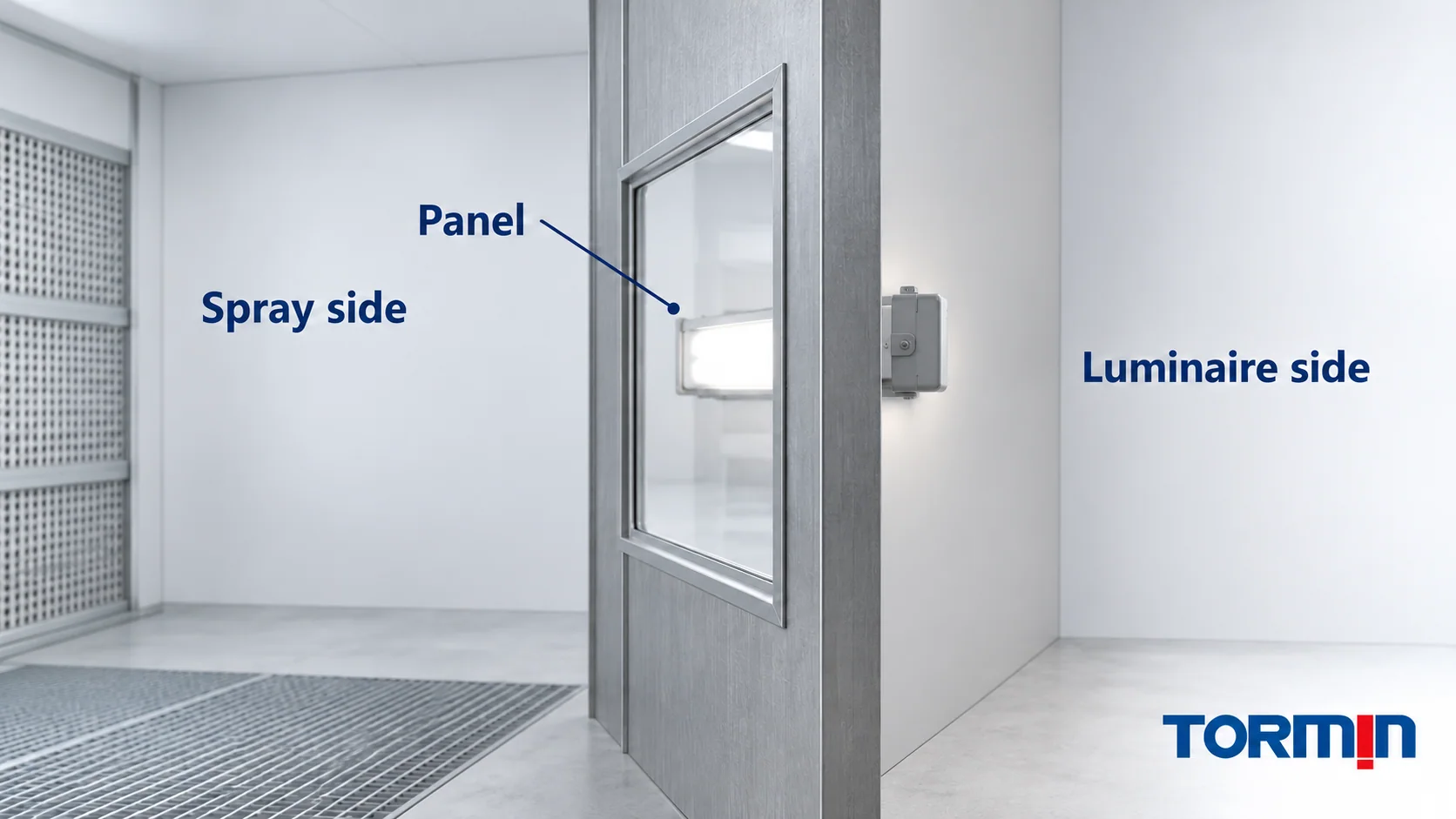
Ask the booth supplier and lighting supplier to identify:
- the panel, frame, seals and documented assembly configuration;
- the allowed luminaire position, orientation and surrounding space;
- which side provides access for maintenance and cleaning;
- the expected coatings, residues and cleaning-agent exposure on each side;
- the applicable instructions and any restrictions on substitutions.
Record unanswered interface questions separately from the fixture’s electrical rating. An enclosure may have documents for a particular hazardous location while the proposed booth recess or window arrangement remains unresolved.
For an exposed fixture, ask specifically what supports the intended spray-process and residue exposure. Do not accept a generic “explosion-proof” description as the complete application evidence.
Keep detailed marking and certificate decoding in the nameplate and certificate guide. For this application, the important deliverable is a documented connection between the exact fixture, the exact arrangement and the location requirement.
Specify visibility at the workpiece, not only floor illumination
A paint-booth lighting proposal should describe what the operator must see. Spray application, surface-defect inspection and colour evaluation may involve different workpiece faces and viewing directions. Write those tasks into the brief instead of specifying only total watts or room brightness.
The CIE summary of ISO/CIE 8995-1:2025 explains that workplace lighting quality includes light delivery, glare and colour characteristics, alongside illuminance. Select the applicable task criteria; the publication’s scope is not a single paint-booth target.
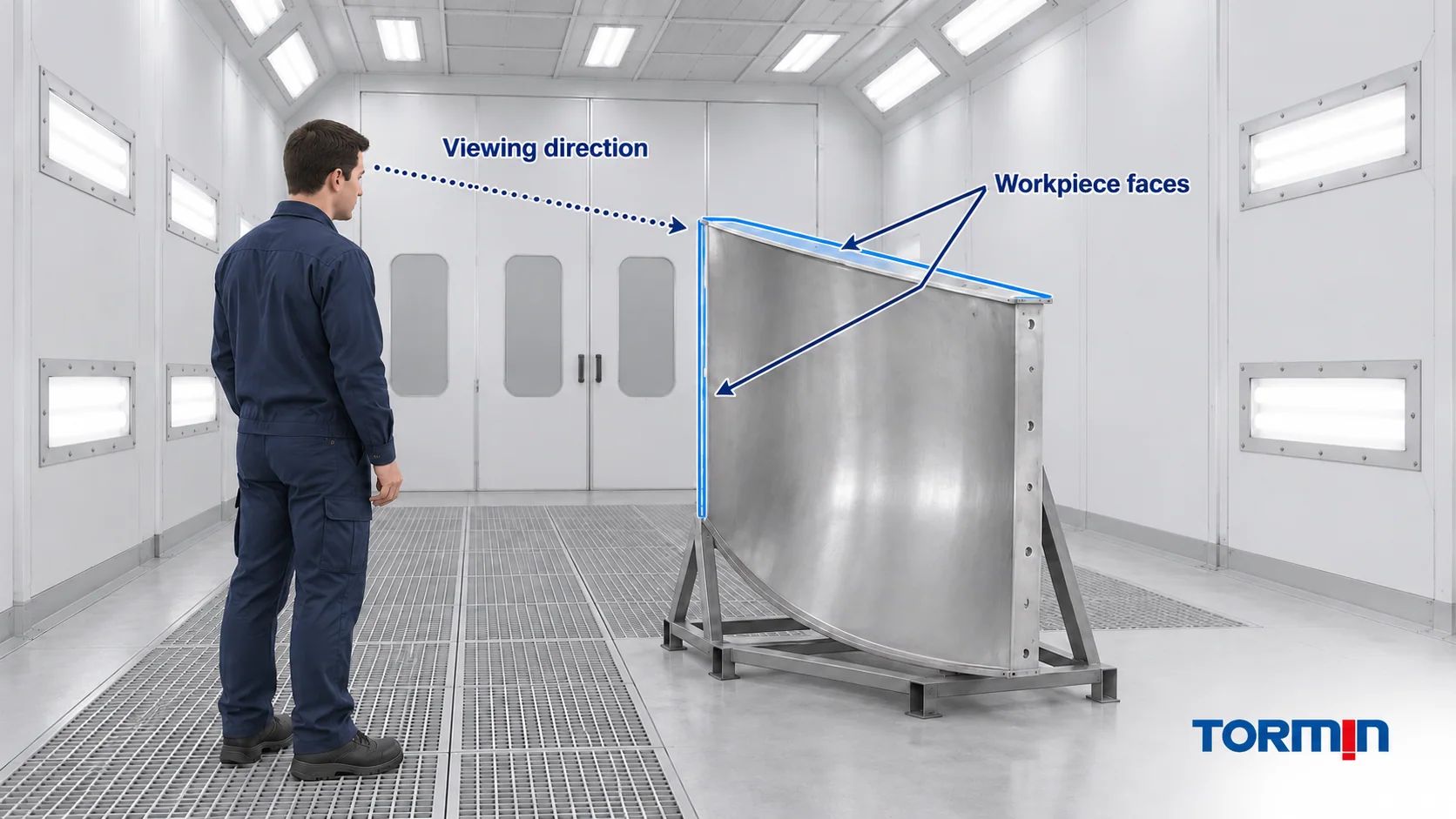
Give the lighting reviewer the actual workpiece envelope, operator positions, obstructions and proposed mounting locations. Ask the proposal to address:
- the vertical and inclined surfaces used for application or inspection;
- views where the workpiece, operator or equipment may interrupt the light;
- glare or reflections from the operator’s relevant viewing directions;
- the installed panel and the stated cleaning/maintenance assumptions;
- the project’s measurement and acceptance method.
Request the photometric file for the exact optical version being proposed. IES explains that these files describe light distribution and support simulation together with the modeled space and surface properties.
For a window-lit proposal, ask how the assessment represents the installed panel. A calculation for a bare fixture does not, by itself, establish the result at the workpiece through that assembly. Keep any unverified panel or maintenance assumption visible for review. Do not turn a quoted lumen output, beam angle or high CRI claim into a guarantee of finish inspection or colour matching.
Separate a fixture replacement from a booth-lighting redesign
Replacing a light with an LED version can involve more than matching its length and electrical input. First identify what stays and what changes.
For a retained booth recess, record the existing fixture and assembly identity. Ask the responsible equipment reviewer to assess proposed changes to the fixture, driver location, optical components, panel, frame, sealing arrangement, mounting or access method against the relevant documents.
Compare both proposals on the same drawing and task criteria. For example, one proposal might retain a reviewed through-panel arrangement while another places a different fixture on the spraying side. They are not like-for-like offers merely because their nominal lumen outputs match. This is a proposal-review example, not an approved design for either arrangement.
Obtain the applicable installation and replacement instructions. Do not improvise changes to a window, enclosure, cable entry or control interface to make a new product fit. The project’s qualified personnel and the relevant equipment suppliers must resolve those interfaces.
The general explosion-proof lighting selection guide covers the broader equipment-selection process. Use it alongside the booth-specific arrangement review, rather than assuming the old installation proves the replacement is suitable.
Prepare one arrangement record for each lighting position
Use this record to make supplier offers comparable. Attach the drawing and refer to the exact proposed assembly. Where several positions genuinely share the same requirements, identify the group explicitly.
| Record field | Information to supply or obtain |
|---|---|
| Process and operating modes | Coating/cleaning materials, spray process and any separate drying, curing or inspection mode |
| Location requirement | Jurisdiction, classification document/revision and the requirement at the actual luminaire position |
| Booth boundary | Spray side, luminaire side, isolating panel, openings and service-access location |
| Exact assembly | Luminaire ordering code, optical/electrical options, panel/frame arrangement and document references |
| Exposure and access | Residue, cleaning contact, temperatures and the documented maintenance method |
| Visual task | Workpiece faces, operator views, applicable criteria and assessment/measurement method |
| New or replacement scope | Parts retained, parts changed and the required compatibility review |
| Unresolved items | Missing information, deviations and the person responsible for each decision |
Missing classification, unresolved separation, unclear assembly compatibility or unsupported workpiece-lighting performance means the proposal still needs review. Completing this worksheet does not approve the installation.
To explore candidate forms, start with TORMIN’s explosion-proof lighting range. Send the arrangement record and booth drawing through the TORMIN contact page and request documents for the exact proposed configuration, with deviations identified. Product-family names are a starting point for the enquiry—not proof that a particular luminaire is accepted for your paint booth.
Sources
- OSHA 29 CFR 1910.107 — Spray finishing using flammable and combustible materials: scoped U.S. spray-finishing provisions, including lighting arrangements and portable lamps.
- OSHA 29 CFR 1910.307 — Hazardous (classified) locations: location-specific classification and suitable equipment.
- CIE — ISO/CIE 8995-1:2025 public summary: workplace-lighting quantity and quality; no numerical paint-booth criterion is inferred here.
- IES — Learn About IES Files: light-distribution data and simulation inputs.