
Choose tri-proof LED lights for a washdown area by matching the cleaning conditions at the luminaire to the exact product’s documented limits. Record the water application, temperature, nozzle arrangement, cleaning mixture and contact time, then check the exposed construction and assembled interfaces. An IP number is one part of that review.
The useful question is specific: “Does this ordering code, in this installed arrangement, have evidence covering our cleaning procedure?” A product described as suitable for damp industrial spaces may still need further assessment before selection for direct cleaning exposure.
This guide helps a plant engineer or buyer prepare that assessment. It produces a cleaning-exposure record and an evidence decision, rather than a generic list of tri-proof lighting benefits.
Start with exposure at the proposed mounting point
Describe what reaches the light during normal production and cleaning. The room name alone leaves too much unresolved. Two luminaires in the same processing room can occupy different positions relative to a hose, rinse station or cleaning access route.
Separate the intended cleaning procedure from foreseeable exposure around it. Ask the facility team whether the luminaire receives direct spray, splash from another surface, applied cleaning solution, or moisture without intentional spraying. Record any uncertainty about the actual nozzle path.
| Location observation | What the selection record should establish |
|---|---|
| The nozzle can be directed at the luminaire | The documented cleaning method and the manufacturer’s limits for the exact assembled light |
| Nearby machinery is washed and the light receives splash | The direction, extent and chemistry of the exposure at the mounting point |
| The light is outside the intended spray path | Whether the proposed arrangement and work procedure actually keep it outside that path |
| Moisture occurs without direct washing | The relevant humidity or condensation conditions, reviewed separately from a hose-cleaning claim |
These are descriptions for an enquiry, not standardized exposure classes. Mark the position on a drawing or photograph and have the responsible site team confirm the cleaning procedure. The broader manufacturing lighting page covers task and facility inputs; this article concentrates on the cleaning exposure of the proposed light.
Read the IP claim within its actual scope
An IP code classifies enclosure protection against access to hazardous parts and the ingress of solids and water under specified tests. INTECO’s public scope for its adoption of IEC 60529 also distinguishes external influences such as corrosion, corrosive solvents and condensation, which require consideration through the relevant product provisions. An ingress claim is therefore not a complete material-compatibility statement.
High-pressure cleaning also needs its own evidence. DKE’s summary of DIN EN 60529 Berichtigung 2:2019-06 explains that IPX9 added a high-pressure-cleaner test while the earlier protection grades retained their existing requirements. A catalogue IP66 claim cannot, by itself, establish suitability for every pressure-cleaning method. Conversely, a high-pressure water test does not settle compatibility with the site’s cleaning mixture.
Request the applicable test standard and edition, report scope, exact tested construction and manufacturer instructions. Compare them with the actual exposure rather than selecting the highest-looking number. For the separate hazardous-area question, use Does an IP Rating Mean a Light Is Explosion-Proof?. This guide does not treat a tri-proof product name as hazardous-area evidence.
Build a cleaning envelope before comparing products
A cleaning envelope is a project record of the conditions the proposed light may encounter. The table below is an editorial selection worksheet, not a test specification or permission to use the listed methods.
| Input to obtain from the site | Detail to preserve | Product evidence to request |
|---|---|---|
| Water application | Hose, pressure equipment, foam application, wiping or another defined method; nozzle type and operating mode | Instructions and test information relevant to that method |
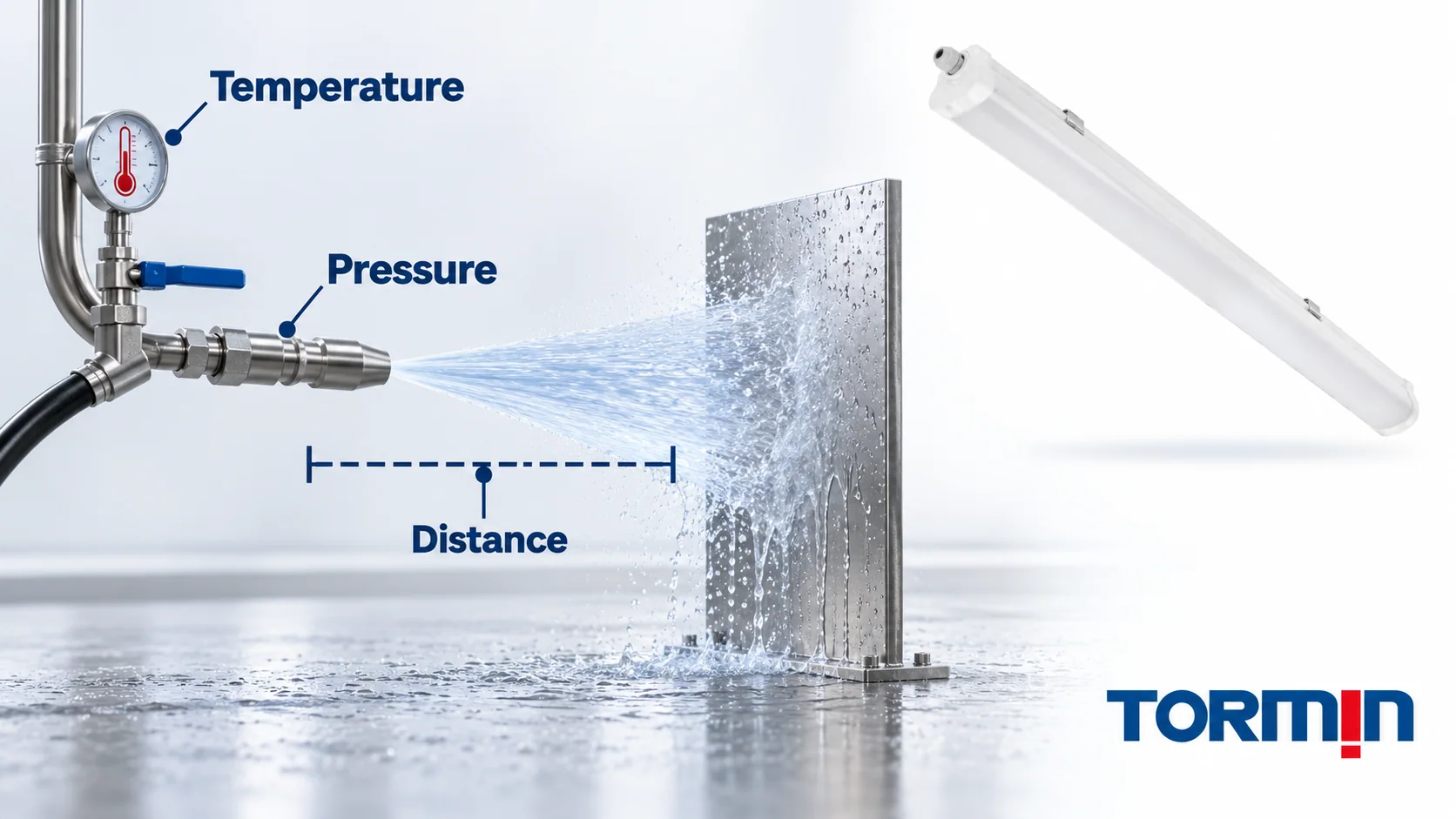
| Pressure and spray geometry | Declared pressure and where it applies; nozzle-to-light distance, direction and which surfaces may be reached | Supported limits and the configuration/conditions to which they apply |
| Temperature | Water or solution temperature through the cleaning sequence, plus the normal environment | Cleaning-exposure limits, distinguished from ordinary operating ambient ratings |
| Chemical mixture | Product name, supplier, use dilution or concentration, relevant product information and rinse sequence | Compatibility evidence for the specified mixture and exposed materials |
| Contact and repetition | Wet-contact duration, frequency, sequence and whether residue can remain | Evidence or a manufacturer assessment addressing the proposed exposure pattern |
| Installed arrangement | Exact ordering code, orientation, closures, cable-entry arrangement and supplied accessories | Documents that cover the offered assembly and its installation conditions |
| Separate project requirements | Applicable jurisdiction and any hazardous-area, hygiene or other site requirements | The corresponding documents, assessed separately from the IP claim |
For chemical identification, supply the actual cleaner’s technical information and safety data sheet where available. If the facility uses several products in sequence, preserve the sequence instead of reducing it to “detergent cleaning.” A broad description such as “alkaline” does not identify the complete commercial mixture.
Keep stated values tied to their source. A cleaning machine’s maximum advertised pressure and a site procedure’s specified operating setting are different records. If the conditions reaching the light have not been established, retain that gap; do not invent a conversion or assume a nozzle distance makes the exposure acceptable.
Review materials and assembled interfaces separately
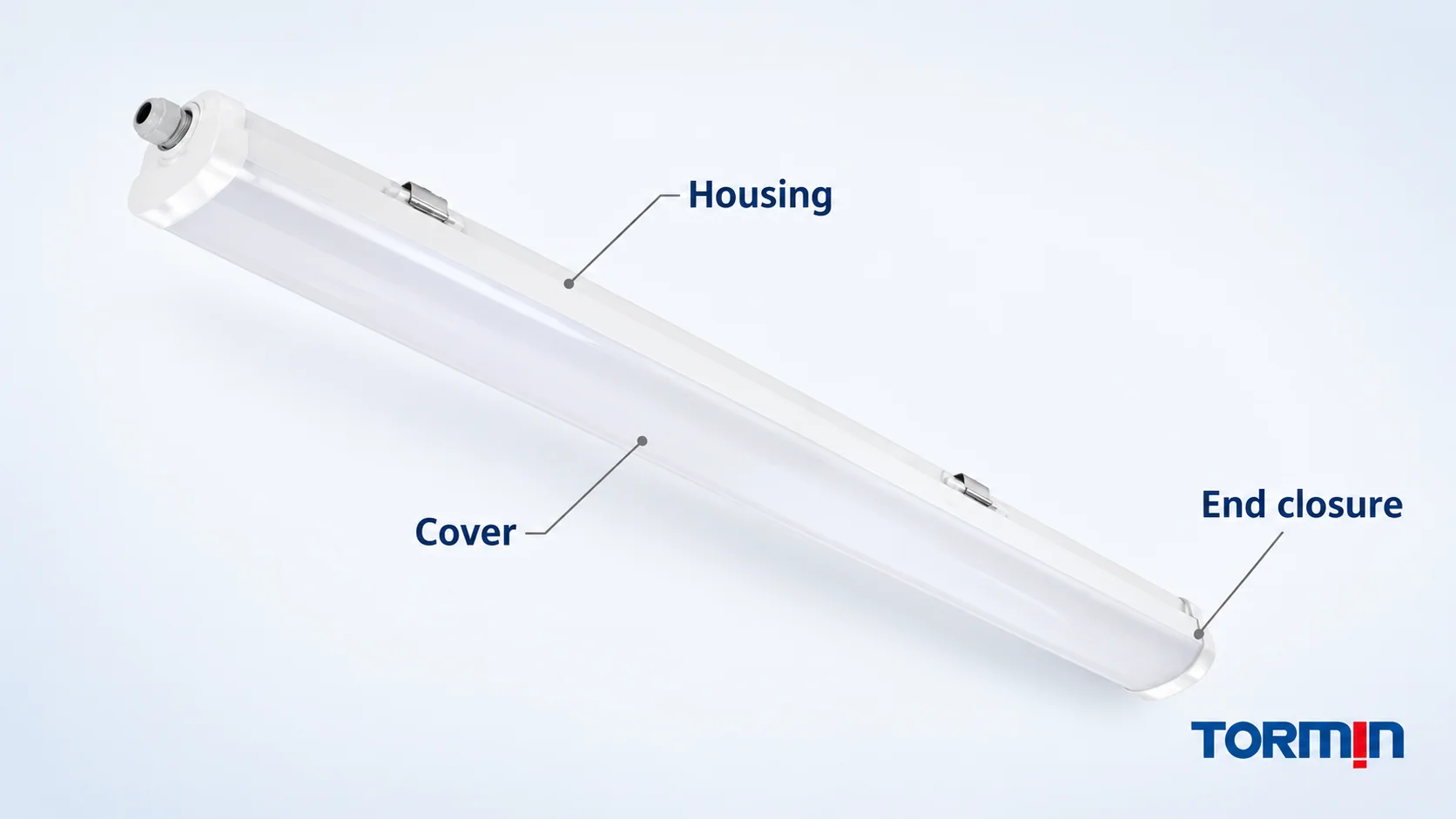
The exposed construction deserves more than a single material name. Ask which documents apply to the housing, optical cover, closures, sealing components and entry arrangement of the offered unit. Do not infer hidden parts from an exterior photograph.
Housing and cover
Identify the actual material specification and any relevant finish or coating. If a supplier cites a general compatibility chart, ask how it applies to the finished part and the proposed cleaning conditions.
Covestro’s Makrolon chemical-resistance guidance, edition 2016-12, identifies the medium, temperature, exposure duration and stress in the moulded part as influencing parameters. It also warns that laboratory guidance may differ from finished-part behavior. This explains why a polymer family name alone is insufficient. It does not establish that a TORMIN light uses a particular Makrolon grade or inherits that grade’s test results.
Sealing components
Request the sealing-component specification and the manufacturer’s evidence for the cleaning medium and temperature. A statement about the main housing material does not answer the seal question.
The Parker O-Ring Handbook, in its cleaning-agent compatibility notice and base-rubber selection discussion, emphasizes the actual medium, temperature and compound, with suitability assessed under application conditions. It supplies a useful evidence principle, not a seal recommendation for ZY5321. No Parker component or particular gasket construction is assumed here.
Closures and cable interfaces
Ask whether the evidence covers the exact closure and entry arrangement being offered. Record any permitted accessory or installation conditions and have the responsible designer resolve differences between the tested configuration and the proposal. Avoid substituting a housing-material statement for evidence about the complete assembly.
PNNL’s Operations & Maintenance Best Practices Guide, Release 2.0, section 9.11.5.3, makes the underlying maintenance point: cleaning compounds and methods should suit the luminaire surface to avoid damage. Its 2004 guidance is used here for that principle; its generic cleaning recipes are not instructions for a modern TORMIN product.
Use ZY5321 as a documented starting point
TORMIN’s ZY5321 LED Tri-Proof Light page identifies a linear product with a polycarbonate housing and a catalogue IP66 claim. The linked ZY5321 first-party datasheet also states those features. These are manufacturer statements for the product review, not independent verification of a particular washdown installation.
The documents reviewed for this article do not specify a complete cleaning envelope: a named cleaning mixture, permitted concentration, cleaning temperature, pressure/nozzle arrangement and repeated-exposure conditions. That leaves the washdown match unresolved. It does not demonstrate either compatibility or incompatibility with a proposed procedure.
A useful request is: “Please assess the offered ZY5321 ordering code and entry arrangement against the attached cleaning procedure, and identify the supporting documents, limits and any conditions outside the documented scope.” The industrial linear and tri-proof lighting range is a browsing destination for candidate products; it cannot replace that assessment.
Example: one room, two different evidence gaps
Consider a fictional proposal review, not a TORMIN installation or test. A facility proposes the same linear luminaire at two positions in a room cleaned under an existing site procedure.
| Position | Site information | Supplier response | Review outcome |
|---|---|---|---|
| A, beside the wash station | Direct spray is foreseeable; the cleaning procedure identifies the mixture and operating conditions | A product sheet states IP66 and the housing material, with no assessment of that procedure | Unresolved: request the missing cleaning and assembly evidence |
| B, beyond the intended cleaning reach | The proposal relies on a restricted nozzle path, but the drawing and site procedure do not yet confirm it | The same product sheet is supplied | Unresolved: confirm the location’s actual exposure before evaluating the product match |
The missing evidence differs. Position A needs the documented cleaning exposure matched to the proposed assembly. Position B first needs a reliable exposure description. Neither is settled by copying the same IP number into both rows.
Close the review with a traceable decision
Use three explicit outcomes in the proposal record:
- Matched: the responsible project reviewer can connect the actual exposure, exact offered configuration and applicable requirements to supporting documents, with any conditions carried into the project specification.
- Unresolved: a site input or supporting product document is missing. Name the gap and the person responsible for answering it.
- Outside documented conditions: the proposed use conflicts with an identified limit. Refer it for a different documented product or a project-approved change; do not waive the limit through a generic “tri-proof” description.
Send TORMIN the marked mounting position, cleaning procedure and mixture information, full ordering code, proposed interfaces and the unresolved question through Contact TORMIN. Keep evidence references and conditions with the proposal so a later change in cleaner, method or product configuration triggers a review of the match.
The selection is complete when the project has a supported exposure-to-product match and carries its conditions into the final specification.
Sources
- INTECO — INTE/IEC 60529:2018, public scope — Enclosure-protection classification and the distinction from other external influences. Public scope only; the licensed standard’s full test clauses were not used.
- DKE — DIN EN 60529 Berichtigung 2 (VDE 0470-1 Berichtigung 2):2019-06, public summary — IPX9 high-pressure-cleaner testing and the unchanged earlier protection grades; no test settings are reproduced.
- Covestro — Makrolon: The chemical resistance, edition 2016-12 — Pages 1–2: exposure parameters and finished-part assessment limits. Material-supplier guidance, not evidence of the resin grade in a TORMIN luminaire.
- Parker Prädifa — O-Ring Handbook, PTD5705-EN — Printed pages 4 and 74: cleaning-agent compatibility and base-rubber selection. Seal-manufacturer guidance, not a TORMIN component identification.
- PNNL — Operations & Maintenance Best Practices: A Guide to Achieving Operational Efficiency, Release 2.0, PNNL-14788, 2004 — Section 9.11.5.3: cleaning methods and compounds appropriate to surfaces; used only for that general principle.
- TORMIN — ZY5321 LED Tri-Proof Light — First-party identity, exterior, polycarbonate-housing statement and catalogue IP66 claim; reviewed 25 October 2026.
- TORMIN — ZY5321 Series LED Tri-proof Light datasheet — First-party model-family document linked from the product page, reviewed 25 October 2026. Its general environmental statements do not establish a washdown match for the reader’s site.