
Pharmaceutical cleanrooms that handle volatile organic solvents or combustible active pharmaceutical ingredient (API) powders require luminaires engineered for two simultaneous regulatory regimes. Every ceiling fixture must satisfy both cleanroom contamination control (ISO 14644 airborne particle limits, flush wipe-down surfaces, and room pressure-cascade sealing) and hazardous-area ignition protection (ATEX or IECEx Zone 1, Zone 2, Zone 21, or Zone 22 under IEC 60079).
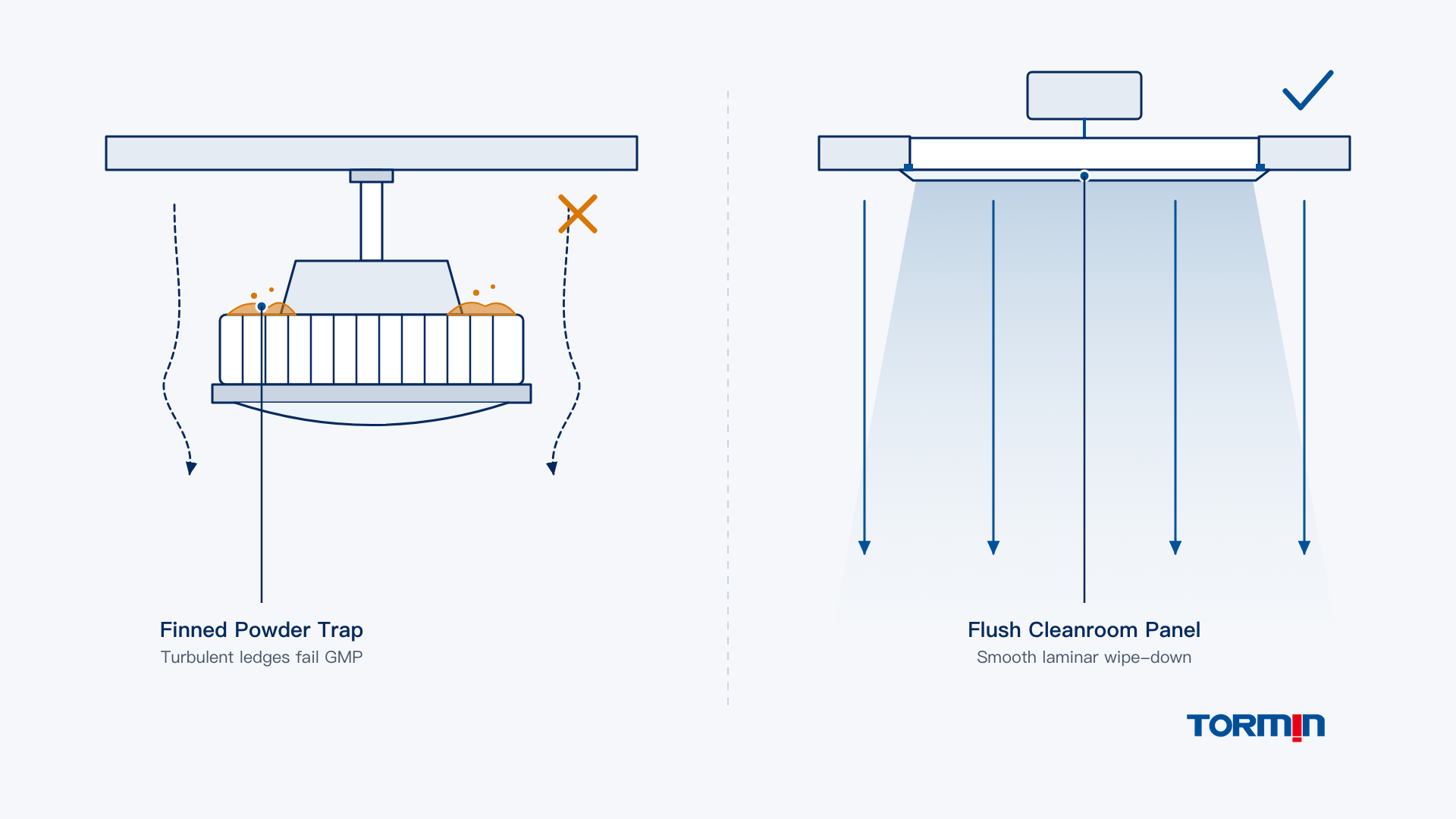
Installing a conventional industrial explosion-proof fixture inside a GMP cleanroom triggers immediate quality-assurance rejection because exposed cooling fins and cast brackets trap powder, disrupt laminar airflow, and corrode under repeated sanitization. Conversely, a standard commercial cleanroom panel cannot prevent ignition when ethanol, isopropanol, acetone, or fine excipient dust reaches explosive concentrations. Before specifying explosion-proof panel and cleanroom lights or broader ATEX explosion-proof lighting, facility engineers should align room cleanliness, hazardous-area classification, ceiling sealing, and chemical durability using the engineering boundaries below.
Dual-Classification Matrix: ISO 14644 Cleanliness vs. ATEX and IECEx Zones in Pharma Plants
Pharmaceutical manufacturing rooms rarely share a single hazard profile across the entire facility; solvent-extraction suites, wet-granulation bays, and dry-powder dispensing booths combine different ISO 14644 air-cleanliness classes with distinct gas or dust explosion zones. Mapping both classifications together prevents under-protecting solvent rooms and over-specifying non-hazardous packaging corridors.
| Pharmaceutical Process Room | Typical Cleanliness Class | Dominant Explosive Hazard | Typical Ex Classification | Required Luminaire Architecture |
|---|---|---|---|---|
| API Solvent Synthesis & Extraction | ISO 7 to ISO 8 (GMP C/D) | Ethanol, IPA, methanol, acetone vapors (IIA / IIB) | Zone 1 or Zone 2 (verify site drawing) | Flush sealed Ex cleanroom panel (e.g., BC5405) or flush Ex linear |
| Fluid-Bed Granulation & Solvent Coating | ISO 7 to ISO 8 (GMP C/D) | Hybrid flammable solvent vapor + combustible dust | Zone 1 / 2 and Zone 21 / 22 | Dual gas- and dust-certified flush Ex panel with tight T-class margin |
| Dry-Powder Milling, Weighing & Blending | ISO 7 to ISO 8 (GMP C/D) | Combustible API or excipient dust (IIIB / IIIC) | Zone 21 or Zone 22 | Smooth, ledge-free Ex dust-tight flush panel (IP66, low max surface temp) |
| Aseptic Filling & Isolator Support Room | ISO 5 to ISO 7 (GMP A/B/C) | Disinfectant vapor during VHP / IPA wipe-down | Often Non-Hazardous (verify solvent volume) | Sealed indoor cleanroom LED light unless classified Zone 2 |
| Solvent Tank Wash & Drum Dispensing Bay | Controlled CNC / ISO 8 | High-concentration solvent spill vapor | Zone 1 (IIA / IIB) | IP66 washdown-rated Ex cleanroom panel or Ex linear luminaire |
Separate classified solvent and powder suites from non-hazardous sterile corridors on the master luminaire schedule before requesting quotations; forcing explosion-proof fixtures into unclassified ISO 7 packaging halls inflates capital cost unnecessarily, while placing general cleanroom panels inside Zone 2 solvent rooms violates IEC 60079-14. For upstream gas-zone and combustible-dust fundamentals, consult our dedicated guides on Zone 0, Zone 1, and Zone 2 lighting and combustible dust hazardous-area lighting.
Flush Cleanroom Panel and Remote Ex Driver Box Architecture vs. Industrial Finned Fixtures
Standard industrial explosion-proof high bays and floodlights rely on deep external aluminum cooling fins and protruding mounting brackets that create dead-air turbulence and harbor pharmaceutical powder. Cleanroom-specific explosion-proof LED panels solve this conflict by separating the smooth, flush room-side emitting surface from an isolated, certified explosion-proof driver and wiring enclosure mounted above the ceiling grid.
For example, the TORMIN BC5405 explosion-proof cleanroom panel light (12 to 48 W, 90 to 264 VAC, Ra 80, IP66, 6000 K standard with 3000 K, 4000 K, and 5000 K options) pairs a slim flush-mount diffuser frame with a separate remote explosion-proof driver box. Keeping the sealed driver chamber inside the technical ceiling plenum eliminates exposed heat-sink ledges inside the cleanroom while maintaining controlled thermal margins. Always verify the exact Ex marking, gas or dust group, T-class, and ambient Ta range on the current SKU certificate schedule in the TORMIN Standards and Certifications archive; never assume UL 844 or CSA North American listing unless explicitly documented for the ordered configuration.
Where a pharmaceutical production hall uses exposed structural beams and overhead process piping rather than a walkable modular cleanroom ceiling—such as the historical layout documented in our Shandong pharmaceutical plant photo archive (a mechanical-context reference only, not a current model certificate)—smooth-profile explosion-proof LED linear lights offer easier wipe-down access than finned round high bays.
Ceiling-Plenum Pressure Cascades and Hazardous-Boundary Sealing Under ISO 14644-4 and IEC 60079-14
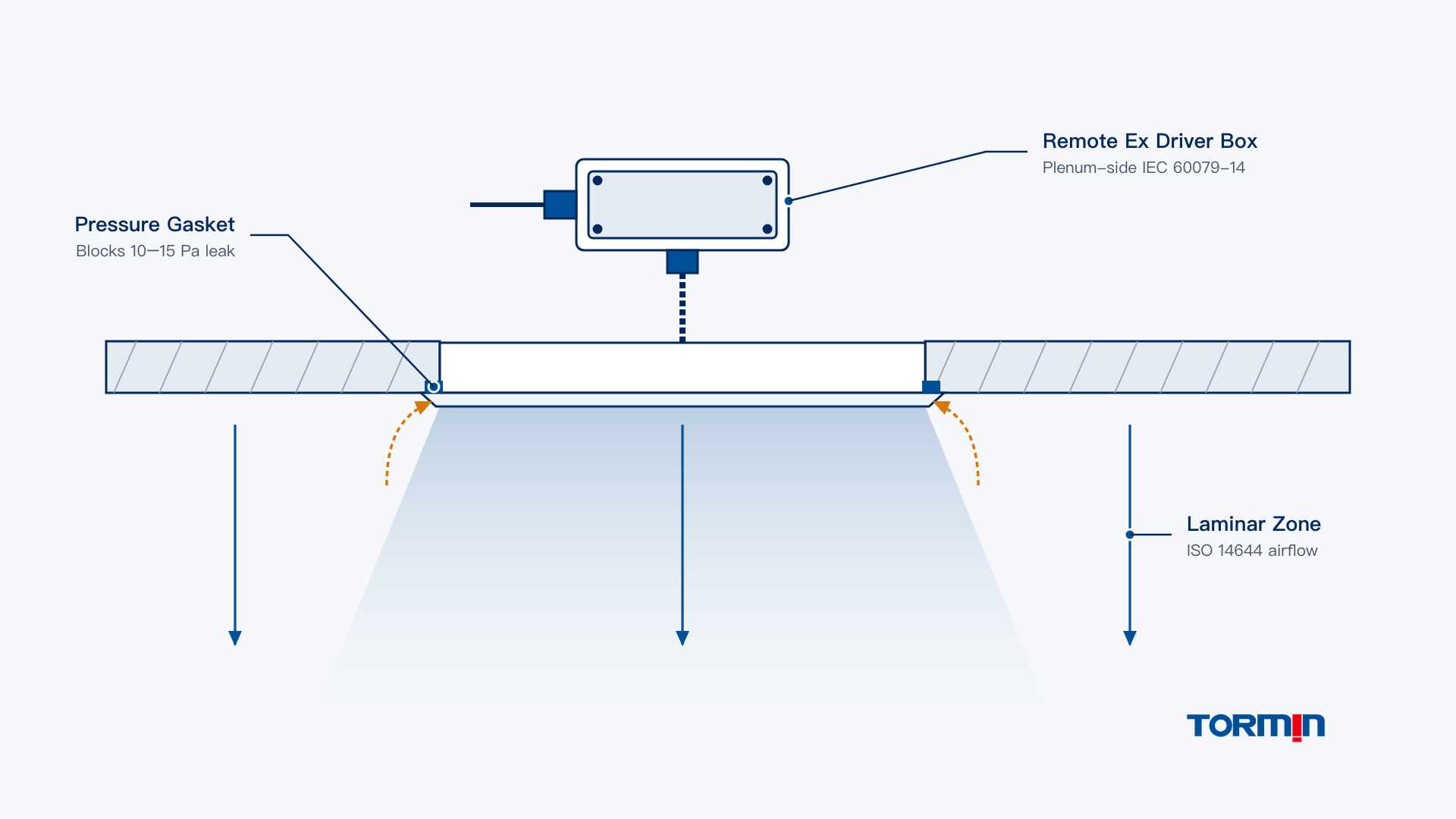
Recessed cleanroom luminaires penetrate the room’s pressure-control envelope, which means an unsealed fixture frame can cause two simultaneous failures: loss of cleanroom differential pressure (typically 10 to 15 Pa between adjacent GMP grades) and migration of flammable solvent vapors from a classified production room into an unclassified technical plenum above.
- Continuous Closed-Cell Perimeter Gasketing: Every flush or recessed cleanroom Ex panel must compress a continuous silicone or closed-cell gasket tightly against the walk-on sandwich panel or T-bar ceiling grid so air neither leaks upward from positive-pressure sterile rooms nor bypasses downward from the mechanical plenum.
- Plenum Classification & Remote Driver Box Compliance: If the technical ceiling void above a Zone 1 or Zone 2 cleanroom is not verified as continuously ventilated non-hazardous space, the remote Ex driver box, interconnecting flexible armored conduit, and cable entries must carry full hazardous-area certification matching the room classification under IEC 60079-14.
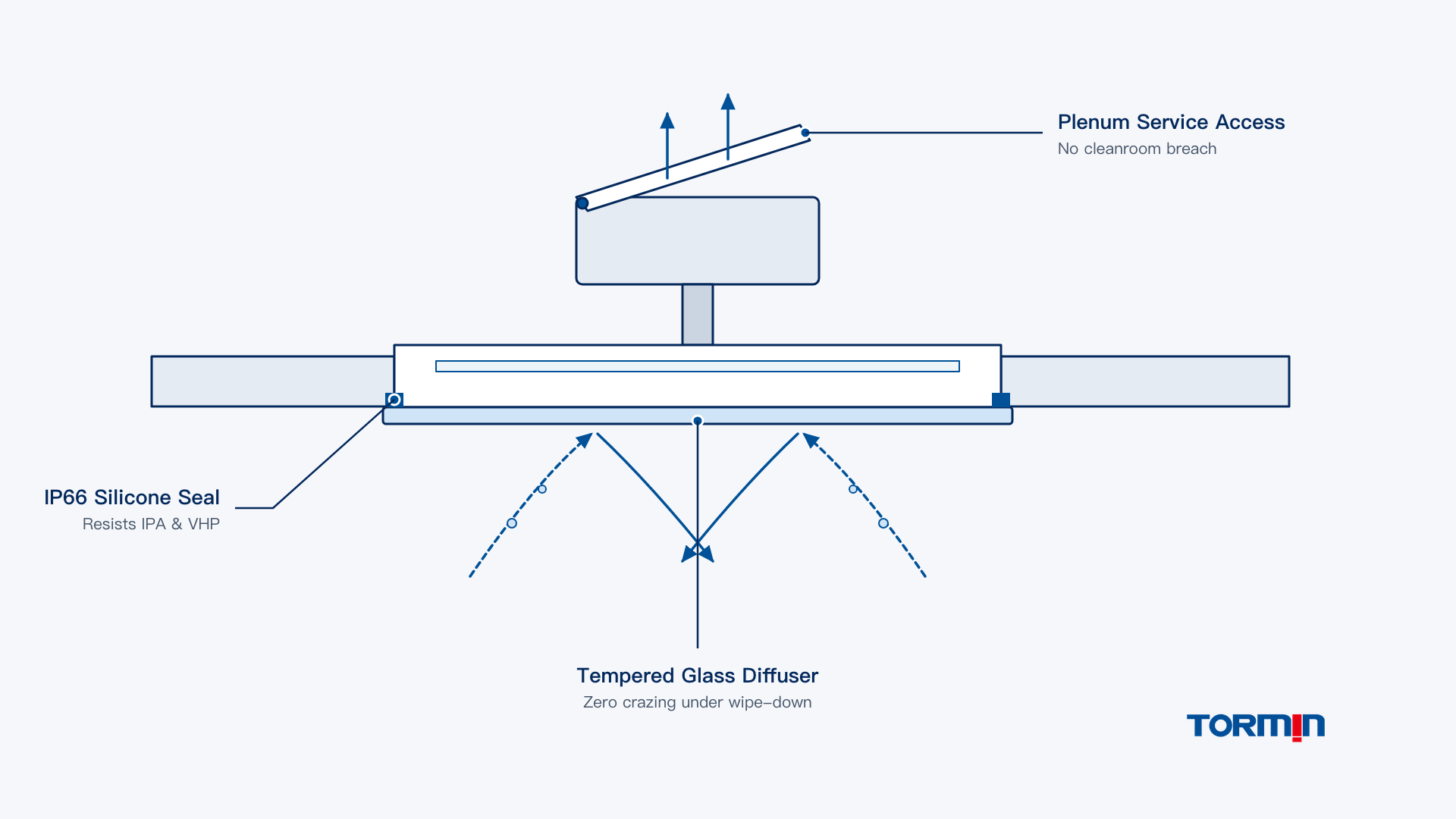
- Top-Access vs. Room-Side Service Planning: Walkable pharmaceutical ceilings favor top-access driver and wiring maintenance from the technical plenum so electricians never breach sterile room cleanliness or require full room requalification after servicing a driver box. Confirm gasket compression and certified cable-entry sealing during commissioning per our explosion-proof lighting installation guide.
Chemical Sanitization Durability, Diffuser Materials, and Visual Inspection Optics
Pharmaceutical cleanrooms undergo daily manual wipe-downs with 70 percent isopropyl alcohol (IPA), rotating sporicidal disinfectants, and periodic vaporized hydrogen peroxide (VHP) bio-decontamination cycles. Over 12 to 24 months, aggressive cleaning chemistry attacks incompatible plastics and elastomers, causing diffuser crazing, yellowing, and brittle gasket cracking that compromises IP66 ingress protection.
| Component or Optical Spec | High-Risk Material / Spec in Pharma | Recommended Pharma Cleanroom Spec | Engineering Failure Prevented |
|---|---|---|---|
| Room-Side Diffuser / Lens | Untreated polycarbonate exposed to strong ketones/esters | Tempered safety glass or chemically verified diffuser rated for site agents | Stress crazing, haze, and yellowing under IPA, acetone, and VHP |
| Perimeter & Lens Gaskets | Generic open-cell foam or standard EPDM | Molded silicone or fluorosilicone closed-cell gasket (IP66 sealed) | Chemical swelling, particle shedding, and washdown moisture ingress |
| Frame Finish & Fasteners | Exposed carbon-steel screws or rough powder coat | Smooth anti-corrosive powder coat or stainless trim with concealed fasteners | Rust staining, crevice bioburden traps, and disinfectant flaking |
| Color Rendering & CCT | Low-CRI (Ra 70) industrial LEDs | Ra 80 or higher; 4000 K to 5000 K (or 6000 K where specified) | Accurate visual inspection of vial clarity, tablet color, and powder residue |
| Optical Glare & Flicker | Unshielded bare LED points; high-ripple drivers | Uniform opal/micro-prismatic diffuser with low-ripple constant-current driver | Prevents visual fatigue and stroboscopic hazard near rotating tablet presses |
Verify your exact cleaning-agent list (including concentration, contact time, and VHP cycle temperature) against the luminaire manufacturer’s lens and gasket material datasheet before finalizing procurement. For rooms with combustible dust layers or elevated disinfection temperatures, also verify maximum surface temperature limits using our gas group and temperature class guide and Dust Surface Temperature Checker.
Pharmaceutical Cleanroom Lighting Specification Checklist Before Enquiry
Submitting an incomplete enquiry—such as requesting an IP66 explosion-proof panel without specifying the ceiling cut-out system, plenum service access, or sanitization chemicals—causes bid mismatches and costly ceiling-grid rework on site. Include the five engineering inputs below when requesting datasheets, IES or LDT photometric files, and model-specific certificates:
- Dual Classification Inputs: Exact ISO 14644 / EU GMP room grade alongside hazardous-area Zone (Zone 1, Zone 2, Zone 21, Zone 22), gas or dust group (IIA/IIB/IIC or IIIB/IIIC), required T-class, and ambient Ta range (°C).
- Ceiling & Pressure-Cascade Architecture: Ceiling construction (walkable sandwich panel, clip-in metal tile, or cleanroom T-bar), exact panel module size (mm), pressure differential (Pa), and whether maintenance occurs from the plenum above or room side.
- Sanitization & Chemical Regime: Routine disinfectants (70 percent IPA, quaternary ammonium, peracetic acid, VHP fogging) and required washdown IP rating (IP66 minimum on room face).
- Photometric & Visual-Task Targets: Mounting height (m), target maintained illuminance (lx), uniformity ratio, required CRI (Ra 80+), CCT (4000 K, 5000 K, or 6000 K), and emergency egress runtime requirements.
- Electrical & Documentation Deliverables: Supply voltage (VAC) and frequency (Hz), preferred cable entry thread on the remote Ex driver box (M20, M25, NPT), IES/LDT simulation files, and current ATEX or IECEx certificate schedules.
When your room schedule and cleaning-regime inputs are ready, contact [email protected] or submit your project brief on the TORMIN Contact page to request BC5405 cleanroom panel datasheets, IES photometric files, and model-specific certificate PDFs across our explosion-proof panel and cleanroom lights range.
Sources
- IEC 60079-0:2017 — Explosive atmospheres: Equipment general requirements — supports gas/dust group, temperature class (T-class), and maximum surface temperature boundaries.
- IEC 60079-14:2024 — Explosive atmospheres: Electrical installations design, selection and erection — supports hazardous-area luminaire selection, remote driver box compliance, and cable-entry sealing.
- IEC 60079-17:2023 — Explosive atmospheres: Electrical installations inspection and maintenance — supports ongoing gasket, enclosure, and hazardous-area maintenance inspection boundaries.
- IEC 60529 — Degrees of protection provided by enclosures (IP Code) — supports IP66 room-side dust-tight and washdown sealing specifications.
- ISO 14644-1:2015 — Cleanrooms and associated controlled environments, Part 1: Classification of air cleanliness by particle concentration — supports ISO 5 to ISO 8 pharmaceutical cleanroom airborne particle classes.
- ISO 14644-4:2022 — Cleanrooms and associated controlled environments, Part 4: Design, construction and start-up — supports ceiling-envelope sealing, pressure cascades, and cleanability design principles.
- TORMIN Standards and Certifications Archive (first-party product documentation) — supports model-specific ATEX, IECEx, CE, and CNEX certificate verification.