
An industrial LED lighting lifetime claim becomes useful when it identifies what was assessed, the end-of-life criterion, the operating conditions and the supporting method. Keep those four items beside the hour figure when comparing quotations.
L70 describes light-output maintenance. It does not establish driver survival, a maintenance-free period or a warranty for the complete luminaire. The IES position on LED product lifetime prediction explicitly warns against using LED-component projections alone to claim whole-luminaire lifetime. Drivers, optics and other parts introduce additional failure mechanisms.
The practical outcome is a comparison record: which claims can be compared, which need clarification, and which have not been shown to apply to your proposed operating conditions.
Read L70 as a defined light-output criterion
L70 means a luminous-flux maintenance threshold of 70% of initial output. The accompanying operating hours describe the time associated with reaching that threshold under the declaration’s stated conditions. L80 and L90 use different output thresholds, so retain the full notation rather than comparing hour counts alone.
For a simple arithmetic illustration, 70% of an initial 1,000 lm is 700 lm. These are invented teaching values, not TORMIN performance data. They say nothing about the time taken to reach that output or how many units remain operational.
The IES public description of TM-21-21 defines flux-maintenance life in terms of a percentage of initial output and identifies temperature, drive current and source construction as relevant variables. A projection is conditional on its inputs.
Where a declaration includes B10 or B50, retain that population qualification. In the IEC-based useful-life terminology explained by LightingEurope’s January 2025 guide, section 3.2, the population includes operating products; non-operating products are excluded. A B10 value is therefore not a statement that 10% of drivers have failed.
Check whether the report assesses a source or a luminaire
An LED package report and a complete-luminaire report have different assessment boundaries. Record the object named in the report before accepting it as evidence for the quoted product.
| Document or method | Object and purpose identified by the IES public scope | What to retain in your comparison |
|---|---|---|
| ANSI/IES LM-80-21 | Measurement of light-output and color maintenance for LED packages, arrays and modules. | Source identity, test conditions, duration and report reference. |
| ANSI/IES TM-21-21 | Projection of LED-source flux maintenance using LM-80 data. | Input data, applicable temperature/current conditions and reported projection limits. |
| ANSI/IES LM-84-20+E1 | Measurement of optical-radiation maintenance over time for lamps, light engines and luminaires within its scope. | Tested assembly, operating conditions and recorded results. |
| ANSI/IES TM-28-20 | Long-term luminous-flux maintenance projection for LED lamps and luminaires. | Assembly identity, method, input reports and stated limitations. |
These are scope summaries from the public IES descriptions, not a reproduction of the licensed procedures. A method number on a quotation does not establish that a matching report exists. Ask how the submitted report connects to the exact ordering code.
Even a luminaire-level light-output projection answers a narrower question than every possible cause of loss of service. Keep the IES whole-product reliability distinction visible when interpreting the evidence.
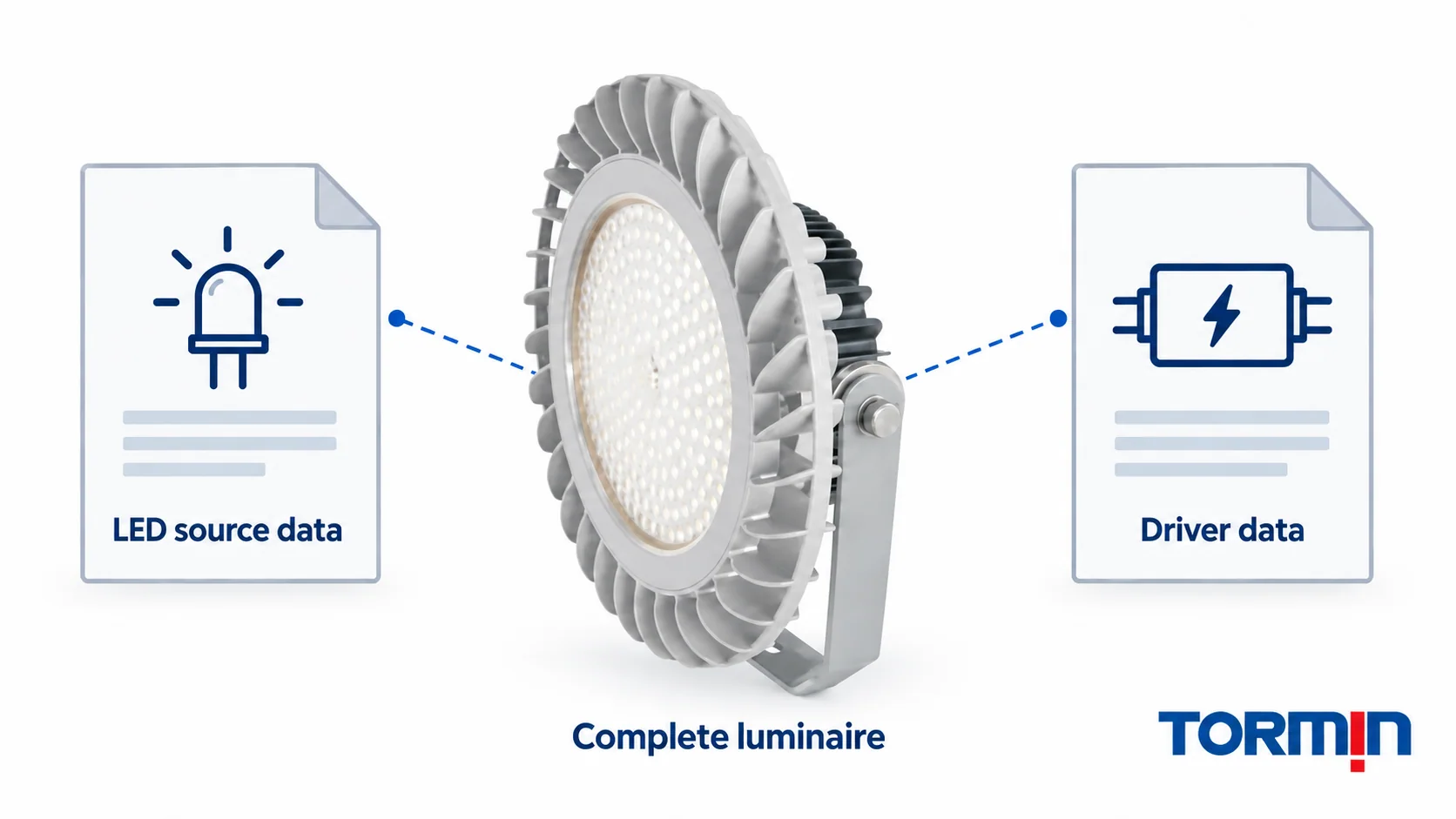
Evaluate driver life separately
The driver supplies and controls power to the LEDs. The LSRC lifetime guide, third edition, section 3.2 treats power-supply electronics and their temperature conditions as a separate system-reliability concern.
Request the driver identity or controlled specification, the meaning of its life claim, the applicable load and temperature conditions, and the supporting reliability information. If an expected failure percentage is supplied, keep its operating-hour basis beside it. An LED-source L70 report cannot fill an empty driver-evidence field.
No universal first-failing component follows from these records. Confirm the manufacturer’s service arrangements; replaceability alone does not establish a replacement interval or interchangeability.
Keep warranty on a separate line. The same LSRC guide, section 4, distinguishes performance evidence from warranty risk and coverage. Ask what constitutes a covered failure and whether parts, labor and access costs are included. Use the agreed terms; a catalogue hour figure does not create them.
Match the temperature basis to the proposed location
Keep three temperature questions separate:
- Permitted operating conditions: what ambient range and restrictions does the manufacturer declare for the exact assembly?
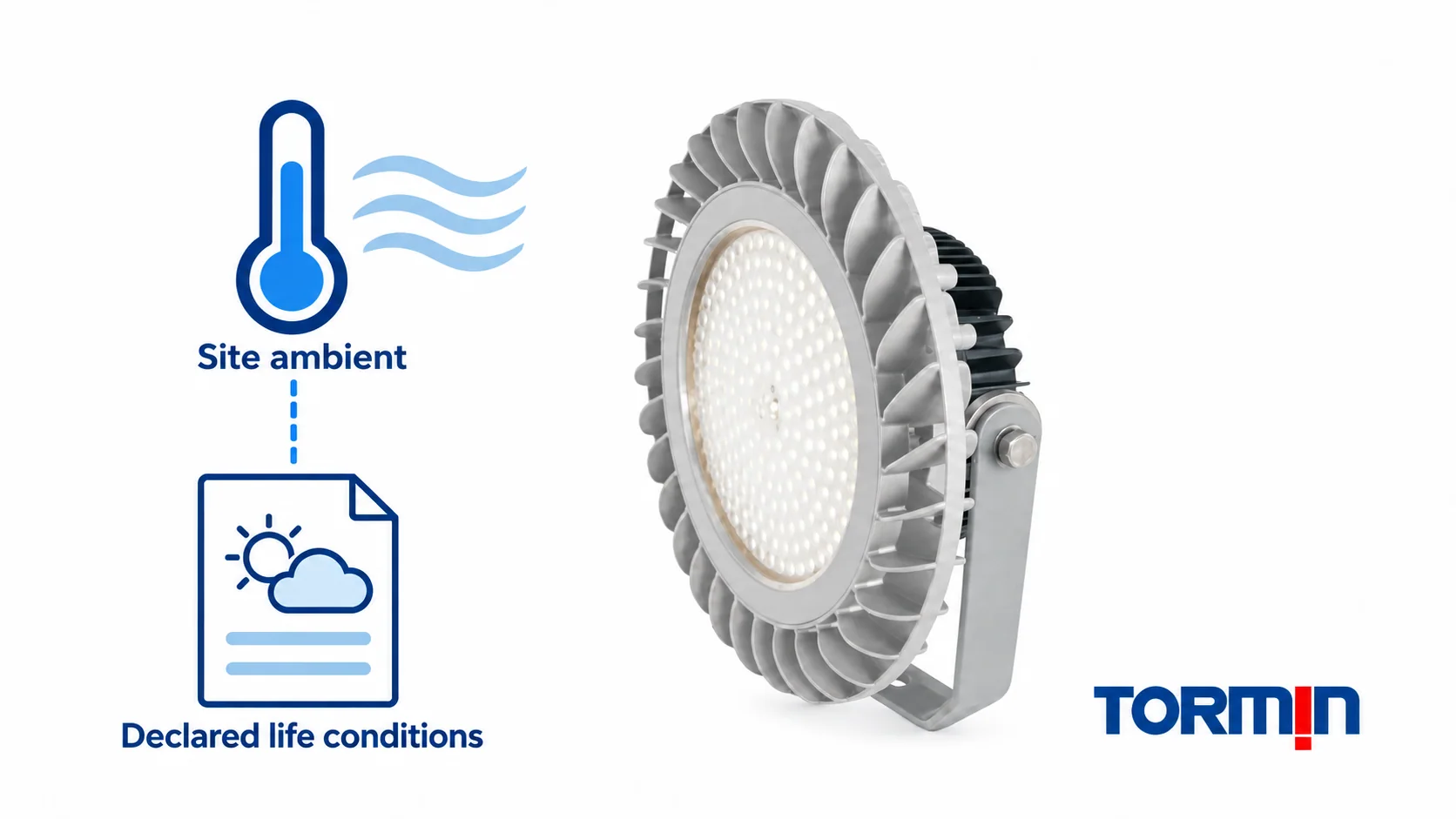
- Declared lifetime conditions: at what ambient performance temperature and operating basis is the life value stated?
- Component evidence: what temperatures and electrical conditions were used for the LED-source and driver assessments?
LightingEurope’s 2025 guide, sections 2.1 and 3.1, associates performance and lifetime declarations with a stated ambient temperature and operating conditions. The TM-21 public scope separately identifies source temperature and drive current as projection variables. An LED test temperature and the air surrounding a luminaire are different inputs.
For an industrial high bay, describe the proposed conditions at the luminaire location. A temperature record from another position is not automatically representative. Identify the record’s location, period and operating context, including relevant process heat or exposure, and ask the responsible engineer what further assessment is needed.
Being inside an advertised operating range does not, by itself, establish that one life figure applies across that entire range. Request the declaration applicable to your conditions. Avoid adjusting hours with a universal temperature rule or estimating internal temperatures from the shape of the cooling fins.
Example: read the ZY8605A catalogue entry without adding a criterion
The TORMIN ZY8605A product page lists 50,000 h for life and −40 to +45 °C for ambient temperature in separate specification entries, checked on 27 October 2026. This is first-party catalogue information.
Those entries do not identify an L70 criterion or a driver failure percentage alongside the hour value. Read them as the starting point for an exact-configuration document request. Do not relabel the figure “L70 at +45 °C,” turn it into a warranty, or infer a component temperature from the pictured exterior.
For other catalogue parameters, use the separate industrial lighting specifications reference. This article addresses the meaning and support of the lifetime declaration.
Worked comparison: two quotations with the same hours
The following records are fictional. Neither describes a TORMIN quotation or test. Assume the project engineer’s brief calls for assessment at 40 °C local ambient during the relevant operating period.
| Comparison field | Fictional quotation A | Fictional quotation B |
|---|---|---|
| Stated hours | 50,000 h | 50,000 h |
| Object and criterion | “Lifetime”; assessment boundary and threshold missing. | LED-source L70 projection; explicitly a component claim. |
| Temperature information | No life-related conditions supplied. | Accompanying luminaire performance declaration covers 25 °C ambient only; no linkage to the project’s 40 °C condition supplied. |
| Driver evidence | Not supplied. | Not supplied. |
| Review decision | Clarification needed: establish the claim’s meaning and conditions. | Clarification needed: establish applicability at 40 °C and obtain driver/system evidence. |
Quotation B provides a clearer component statement, but the project comparison remains incomplete. The missing evidence is different for each quotation. Equal hours do not resolve those gaps, and a more transparent record does not establish suitability for the proposed location.
Use this compact record for the actual offers:
Exact luminaire ordering code and document revision:
Quoted hours, criterion and assessed object:
Population qualification or failure definition, where declared:
Measurement/projection method, report ID and duration:
LED-source data and documented link to this configuration:
Driver identity, reliability basis and applicable conditions:
Declared lifetime ambient and operating basis:
Proposed site conditions and evidence of applicability:
Serviceability and agreed warranty coverage, recorded separately:
Decision: comparable / clarification needed / not shown applicable
Open question and responsible respondent:
Mark a claim comparable only within its documented scope after aligning the relevant criteria and conditions. If a link is missing, retain the open question instead of filling the field with an assumption.
For a TORMIN project, start with the exact model in the industrial high-bay range and request its lifetime evidence with your proposed operating conditions. Use the support FAQ for order and warranty enquiries. The goal is a traceable declaration that can be assessed for your project.
Sources
- IES — PS-10-18: IES Position on LED Product Lifetime Prediction, 2018 — LED-component projections and the limits of whole-luminaire claims.
- IES — ANSI/IES TM-21-21: Projecting Long-Term Luminous, Photon, and Radiant Flux Maintenance of LED Light Sources, 2021 — public description and contents; projection scope and variables. Licensed full text was not consulted.
- LightingEurope — Guiding Paper: Evaluating Performance of LED Based Luminaires, updated January 2025 — operating-population qualification and declared ambient/lifetime conditions; industry-association guidance.
- IES — ANSI/IES LM-80-21: Measuring Maintenance of Light Output Characteristics of Solid-State Light Sources, 2021 — public description of source-level maintenance measurement. Licensed full text was not consulted.
- IES — ANSI/IES LM-84-20+E1: Measuring Optical Radiation Maintenance of LED Lamps, Light Engines, and Luminaires — public measurement scope. Licensed full text was not consulted.
- IES — ANSI/IES TM-28-20: Projecting Long-Term Luminous Flux Maintenance of LED Lamps and Luminaires, 2020 — public projection scope. Licensed full text was not consulted.
- LED Systems Reliability Consortium / Next Generation Lighting Industry Alliance — LED Luminaire Lifetime: Recommendations for Testing and Reporting, third edition, September 2014, hosted by DOE — sections 3.2 and 4 on electronics, conditions, serviceability and warranty; historical guidance, not current TORMIN test evidence.
- TORMIN — ZY8605A LED Area Light — first-party catalogue entries and exterior reference, verified 27 October 2026; no exact-model life report was assessed.