
To compare power factor (PF) and total harmonic distortion (THD) data for industrial LED lighting, first align the tested product, electrical supply, operating mode and measurement definitions. A figure without those conditions may be useful as a question for the supplier, but it is not yet a like-for-like comparison.
PF describes the relationship between active and apparent power. THD describes waveform distortion and can refer to current or voltage. They answer different questions. Neither value alone establishes driver efficiency, light quality or compliance with every project requirement.
What does power factor tell you?
For an AC load, true power factor is active power divided by apparent power. For a single-phase measurement using RMS voltage and current:
True PF = active power (W) ÷ [RMS voltage (V) × RMS current (A)]
The US Department of Energy’s CALiPER study distinguishes true PF from displacement PF. True PF reflects the power relationship with waveform distortion as well as displacement; a value based only on the fundamental phase relationship is a different reported quantity. Ask which one the report states.
PF is not driver efficiency. Driver efficiency concerns power delivered at the driver output relative to its input; PF concerns the AC input power relationship. Luminaire efficacy is another measure again: light output relative to input power. The DOE LED Basics overview distinguishes light-source performance from the performance of the assembled luminaire. For other lighting parameters, use the industrial lighting specifications reference.
A bounded current example
Assume a fictional single-phase luminaire draws 100 W at 230 V RMS with a measured true PF of 0.90 in steady operation:
RMS current = 100 W / (230 V × 0.90) ≈ 0.483 A
This is arithmetic using the assumed values, not a TORMIN measurement. It does not calculate starting current, breaker selection, conductor sizing or a three-phase installation. The result also does not tell you the driver’s efficiency or THD.
THD-I and THD-V are separate measurements
THD-I refers to distortion in current; THD-V refers to distortion in voltage. A report must identify the quantity before its percentage can be interpreted. The DOE CALiPER report explains that different THD calculation conventions can produce different numbers.
For a useful comparison, record the report’s denominator, included harmonic range, measurement method and test supply. Do not silently treat two percentages as equivalent when the report does not give their calculation basis. Do not treat THD as a flicker measurement: current waveform distortion and temporal variation in light output are different observations.
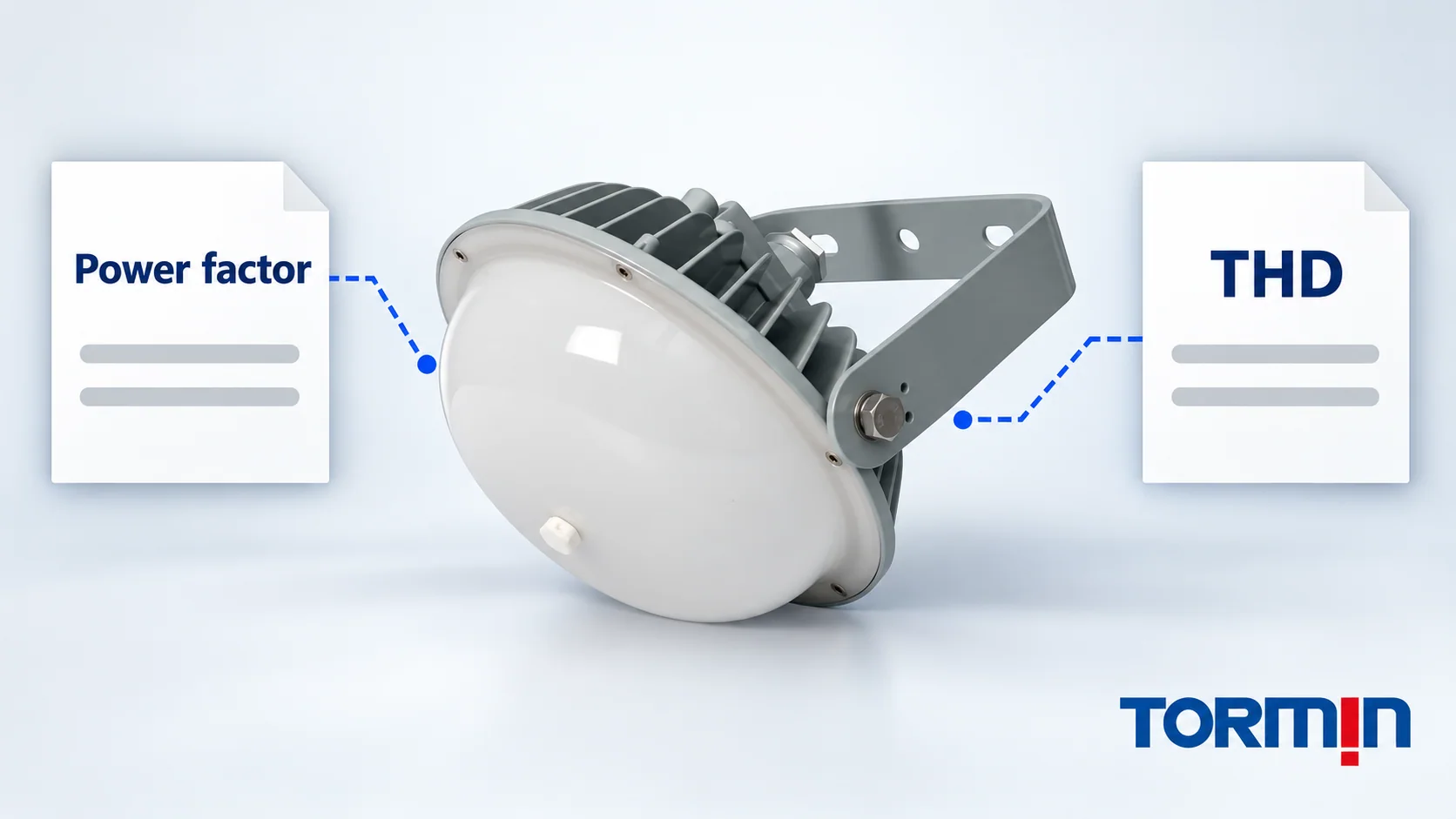
Align the test conditions before comparing values
Ask for the following alongside each result:
| Comparison field | What to establish |
|---|---|
| Tested object | Complete luminaire, separate driver or another assembly; exact model, configuration and report revision. |
| Supply | RMS voltage, frequency and stated supply waveform or source conditions. |
| Operating point | Full output or a specified dimming/control setting, where supported; connected load and operating state. |
| PF | True or displacement PF, with active power and RMS voltage/current where available. |
| THD | Current or voltage; denominator, harmonic range, measurement method and applicable conditions. |
| Report basis | Test method, date, instrument bandwidth where relevant, uncertainty if provided, and any deviations. |
An offered luminaire may use a different driver or configuration from the one in an underlying component report. Ask the supplier to connect the evidence to the exact ordering code. A bare catalogue figure does not reveal all those conditions.
NIST’s 2013 power-measurement study found that source impedance and measurement bandwidth can affect active-power measurements for the lamp studied. Its experimental results are not correction factors for another product. They show why the test setup belongs in the comparison record.
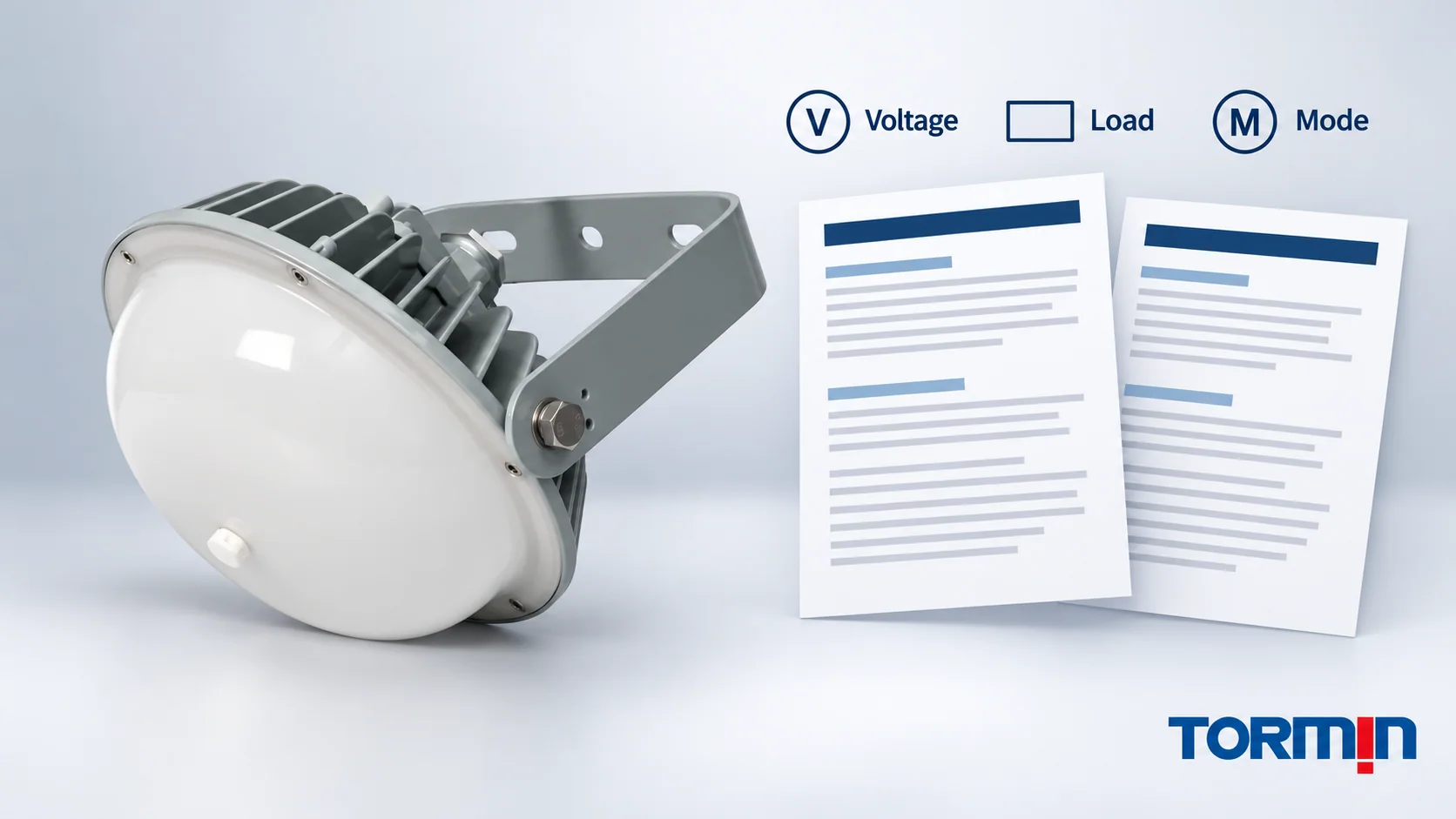
Worked example: two figures that are not yet comparable
The following quotations are fictional teaching examples, not TORMIN products, offers or test results. Assume the project requires evidence for a single-phase 230 V supply and a specified operating mode.
| Field | Fictional report A | Fictional report B |
|---|---|---|
| Tested object | Complete luminaire A, identified configuration | Driver B; link to offered luminaire not supplied |
| Test supply | 230 V, 50 Hz | 120 V, 60 Hz |
| Operating mode | Full output | Not stated |
| Power factor | True PF 0.90 | PF 0.95; type not stated |
| Harmonic result | THD-I 15%; calculation basis identified in its report | THD 10%; quantity and calculation basis not stated |
| Decision | Request the individual harmonic data and other project-required evidence. | Request a matching luminaire/driver link, supply and operating conditions, PF type and THD basis. |
The larger PF and smaller THD figures in B are not enough to rank the offers: the tested objects, supply, operating mode and definitions differ. Even A’s aligned supply does not establish project acceptance. Each figure needs the relevant evidence and criteria.
When dimming is part of the project, request data at the actual supported operating points and identify the control arrangement. The DOE 2014 study tested a particular set of retail LED A lamps with phase-control dimmers and observed that performance could vary with operating conditions. Those findings do not establish the behavior or dimming capability of an industrial fixture.
Does a low THD number establish compliance?
A THD percentage on its own does not establish compliance with every harmonic-current requirement. Applicable requirements depend on the equipment, jurisdiction, connection and assessment basis. The IEC public description of IEC 61000-3-2 describes limits on individual input-current harmonic components under specified conditions, for equipment within its stated scope. A total distortion percentage is not a substitute for the required component data and assessment.
Ask the responsible electrical engineer to identify the applicable requirements and review the appropriate report. A higher PF or lower THD does not by itself establish that a complete site installation meets its requirements. Do not infer site harmonic behavior by adding individual THD percentages.
A practical request for comparable data
Send the supplier the intended supply, operating mode and exact proposed ordering code. Then record:
Model, configuration and tested object:
Test report, revision, method and date:
Supply voltage, frequency and waveform conditions:
Connected load and full or dimmed operating point:
Active input power, RMS voltage and RMS current:
True PF or displacement PF:
THD-I or THD-V; denominator and harmonic range:
Individual harmonic data and project-specific assessment, if required:
Instrument bandwidth, uncertainty and report deviations, where available:
Comparison decision: comparable / clarification needed / different scope
Open question and responsible reviewer:
Keep unreported fields open. For example, an absent dimming result is not proof of either acceptable or unacceptable performance at a dimmed setting.
If you are reviewing TORMIN industrial lighting, identify the exact configuration on the ZY8601S product page or browse the industrial LED floodlight range, then contact TORMIN for the data relevant to your proposed conditions. This article does not assign a PF, THD or control option to that model. For a separate interpretation of life claims, see industrial LED lighting lifetime.
Sources
- US Department of Energy — CALiPER Retail Lamps Study 3.1: Dimming, Flicker, and Power Quality Characteristics of LED A Lamps, December 2014 — PF and THD definitions and the conditions of the specific lamp/dimmer study.
- US Department of Energy — LED Basics — source and luminaire performance distinctions.
- NIST — Influence of Current and Voltage Harmonic Distortion on the Power Measurement of LED Lamps and Luminaires, 2013 — public research abstract on bandwidth and source impedance in a specific measurement study.
- IEC — IEC 61000-3-2:2018+AMD1:2020+AMD2:2024, consolidated version — public catalogue description of the standard’s scope; the licensed full text was not consulted.
- TORMIN — ZY8601S LED Area Light — first-party product identity and exterior reference for the illustrations; no electrical test data is inferred.